Support WBUR
Unemployment In New England Highest Among Latinos
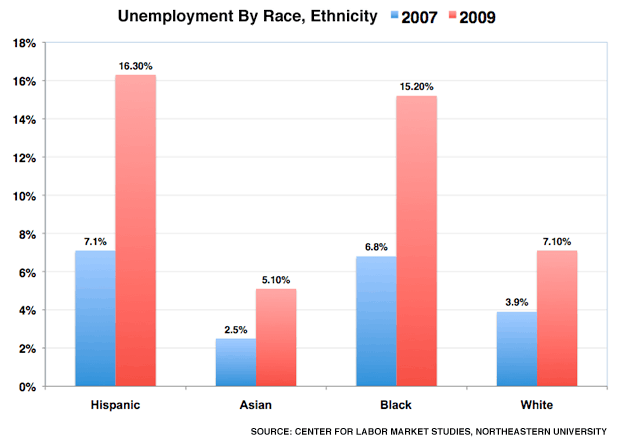
Latino unemployment in New England has surpassed joblessness among all other ethnic groups, surprising some labor market analysts. Unemployment among Latino men has tripled since 2007.
Mauricio Restepo has a masters degree in Engineering from his native Colombia. But he doesn't speak English well, so he's been working for temp agencies since a year and a half ago when he moved to Lowell.
He's packed razors and manufactured medical equipment, pretty much full time. But now he's lucky to work one out of ten days.
"It's hard to live like this," he says in Spanish. "And even harder when you don't speak English. You don't have many opportunities."
Companies that use temporary workers have been drastically scaling back in this economy. And they tend to employ Latino immigrants like Restepo.
During the boom time, Latinos in New England had fairly high employment rates. But when the recession hit, they were saturated in all the vulnerable industries.
Andrew Sum, from the Center for Labor Market Studies at Northeastern University, says the Latinos in the region have been over represented in construction, manufacturing, trucking and labor-leasing temporary help.
Sum has analyzed unemployment both here and in the rest of the country. He finds a surprising difference in New England. In other regions, blacks have the highest jobless rates. But in Massachusetts and surrounding states, more Latinos are losing jobs. Latino men are worse off with 18 percent unemployment. Black men are at 15 percent, and white men have 8 percent unemployment. What really worries Professor Andrews Sum is the sharp increase since 2007.
"That tripling you haven't seen," he says. "It's gone up a lot in the country, but you don't see anything of that magnitude. So, for Hispanic males to have these increases, is just absolutely extraordinary."
Females aren't far behind with 14 percent unemployment.
This doesn't surprise Ramon Borges-Mendez, a professor at Clark University who studies Latinos in the Massachusetts labor market. He says low education levels for many Latinos have made them vulnerable, along with immigration status. Then there's geography.
"Springfield, Holyoke, Lawrence, Lowell," Borges-Mendes says. "Those are cities in which the recession is felt much stronger, because to begin with, they have a very weak economic base. Just add the volatility of the recession, and unemployment explodes. And that's where Latinos have been concentrated."
Borges-Mendes says many of these jobs aren't coming back, especially in manufacturing. He says the state should target its job-training programs to help these workers develop marketable skills and improve their English.
That's what Mauricio Restepo plans to do. He's applied to go back to school this fall.
"I don't know if I can study this year," he says. "It all depends on finances. But if I can't, I'm hoping they can save my place for next year."
Restepo wants to break into the high-tech industry and learn English along the way. That way, he says, he won't be quite so susceptible to lay-offs in the future.
This program aired on August 17, 2009.