Listen LIVE button

WBURGov. Patrick Threatens To Boycott Hyatt

Published September 23, 2009  Updated September 25

BOSTON — Gov. Deval Patrick is threatening to stop using Hyatt hotels for state employee travel, unless the chain reinstates nearly 100 housekeepers it laid off from its three Boston-area hotels.

Some of the housekeepers had worked for Hyatt for as long as 25 years and made up to $15 an hour. The hotel company discharged the housekeepers at the end of August and replaced them with workers from a Georgia-based staffing firm who get far fewer benefits and earn less – $8 an hour.
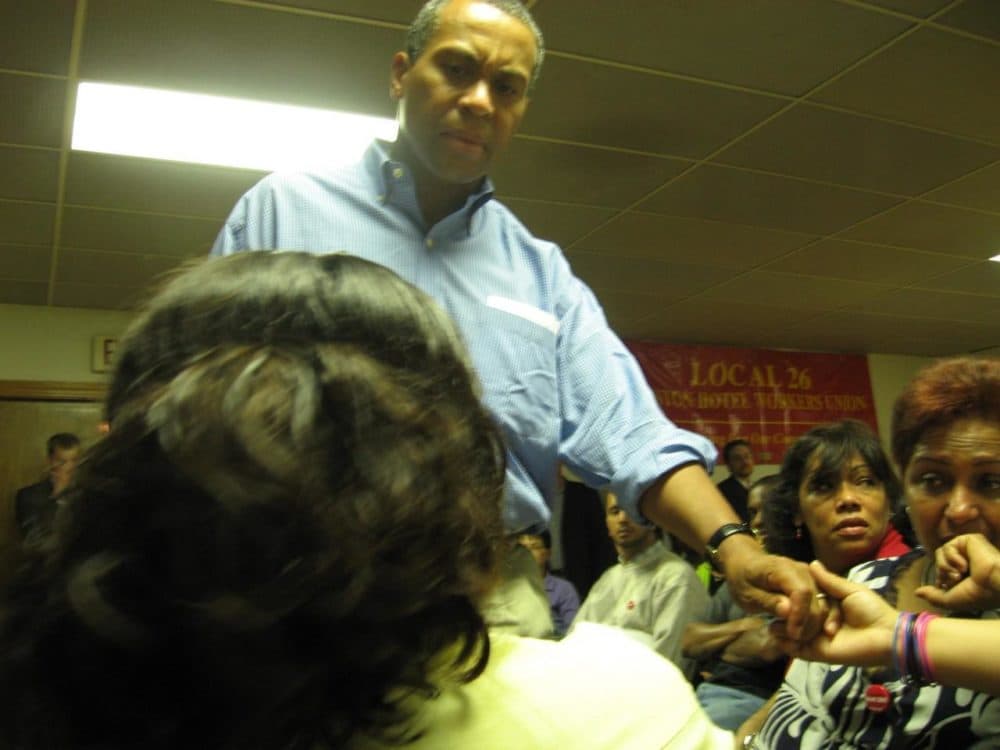
Governor Deval Patrick listens to the stories of housekeepers laid off from work at Hyatt's three Boston-area locations.  The governor is threating a state goverment boycott of Hyatt unless the housekeepers are reinstated.  (Curt Nickisch/WBUR)

Gov. Deval Patrick listens Wednesday night to the stories of housekeepers laid off from work at Hyatt's three Boston-area locations. (Curt Nickisch/WBUR)

In a letter to the Hyatt CEO, Patrick accused the hotel chain of unceremoniously tossing out the workers to fend for themselves, and of paying barely livable wages to the new workers.

On Wednesday night, some of the discharged housekeepers met with Gov. Patrick. They told him that despite Hyatt’s denials, they had been forced to train their replacements.

Patrick said he understands that businesses have to make tough decisions in this economy, but that Hyatt’s move was unconscionable.

“If they must take this path, there’s a right way and a wrong way to do it,” Patrick said. “They’ve done it in an exceedingly wrong way. And it seems to me the only way to make it right is to offer these folks their jobs back.”

If not, Patrick said state employees will no longer stay in Hyatt Hotels when it comes to state employee travel. That’s a threat that has more symbolic than financial impact. Hyatt is still paying health benefits for the laid-off workers, but has said the challenging economy forced the staff changes.

The company said it regrets having to make the personnel change (PDF), but that the hotel industry is facing the worst economic climate in decades. Business and personal travel is way down. Maryann VaRence, the company’s human resources director in Boston, said the governor is playing politics, with a price.

“There are 600 associates who work in Hyatt properties in Massachusetts,” VaRence said. “The governor’s boycott would be a direct threat to those jobs.”

State business with the hotel chain is relatively small, in the tens of thousands of dollars a year. But the governor’s threat has turned what touched a public nerve into a symbolic standoff.

WBUR Topics: Boston   Economy   Politics  
Your Comments
Comments RSS
  • [...] Gov. Patrick Threatens To Boycott Hyatt [...]

    Posted by wbur.org » News » Hyatt Promises Jobs To Fired Boston Employees on September 25, 2009, at 6:22 PM
  • Claudia, my previous comment was intended in large part for you. We can argue back and forth about which would be worse for the economy: disabling the consumers’ spending power by making their wages unsustainably low, or preventing a business from laying off *any* employees at all. The answer is in the balance: macroscopically (ie looking at the US’s entire labor force) some layoffs – *not* firings – are necessary, but some retention of the workforce (incl. long-term, higher-paid employees) is also crucial. The key is in the balance. Considering that Hyatt fired 100 housekeepers across 3 hotels – a *very* significant portion of the housekeeping staff of hotels of that size – if the rest of the businesses across the country followed suit, we’d surely be hit with another depression. Layoffs need to be administered in careful, measured ways, so that they do not upset the balance of the economy.

    Posted by Nela Suka on September 25, 2009, at 12:21 PM
  • Although it may seem to make *mathematical* sense to fire long-term (and full-time) workers and hire new, cheaper labor/contractors (possibly on a part-time basis), it doesn’t actually make much economical sense in the grander scheme of things. If you’re thinking about the numbers only short-sightedly, theoretically, it may seem like it would make sense. But what is to stop any employer – especially a large enough number of employers – in any industry from doing this? Doing so would do two things:

    1) Since most people would be out of a full-time/benefits-eligible job, they would be forced to take anything they can get, including part-time, contract, and low-salary jobs. This would in turn create the sort of working conditions we saw at the beginning of the 20th century: no benefits and unsustainably low wages. The people and the government have worked for the past 100 years to change this. (And let’s not even get into what that would do to consumer spending – the #1 driver of economic activity in the US).

    2) This would create what I call ‘the Wal-Mart Effect:’ fire your full-timers, fire your long-term employees, save some money, and put a financial strain/burden on the state/federal government by overusing welfare and public health programs. Now, that doesn’t sound very capitalistic or small-government, does it? (For a review of studies on the effect of Wal-Mart on public health programs across the country, see “The Wal-Mart Tax: A Review of Studies Examining Employers’ Health Care Cost-Shifting.” (AFL-CIO) http://www.aflcio.org/corporatewatch/walmart/upload/walmart_tax_memo.pdf )

    Posted by Nela Suka on September 25, 2009, at 12:10 PM
  • Claudi’s argument is BS and a red herring! The real issue is the attack on the American worker by Corporations. Outsourcing jobs to cheaper sub contractors is only one technique. The reason these subcontractors can pay 1/2 is because they typically don’t offer health insurance or other benefits. If Claudia is so concerned about the Corporate bottom line why doesn’t she also complain about obscene Executive pay. I’m guessing that she is also the first to complain about Govt spending when that same $8/hr worker goes to the Emergency room for treatment and can’t pay or when that same person gets unemployment or when that person’s kid needs extra help in overcrowded schools. Grow up Claudia.

    Posted by Jacksd3 on September 25, 2009, at 7:12 AM
  • What an idiot. The pot calling the kettle black. I’m a state worker, and they are doing that exact same thing where I work. They’re pushing out the union mechanics to replace them with contract mechanics. They did it already at one of our sites and are in the middle of doing it to 13 people at this site. I don’t see this in the news. I don’t think the government should be stepping into the affairs of businesses. They’ll just wreck what remains of the struggling businesses and leave more people unemployed.

    Posted by Landry T on September 24, 2009, at 3:14 PM
  • Did they try to see if they would work for less pay or less hours. What they did was treat them as 2nd CLASS citizens. And, only a 2nd class hotel chain would do that!To compare laying off housekeepers to laying off teachers is a bit of a stretch. Apples and oranges would be a lot closer economically.

    Posted by Otis Armstrong on September 24, 2009, at 1:29 PM
  • The problem is that Hyatt did not lay off the workers. Hyatt fired them and hired replacements at a lower cost. Lay off means that the workers are no longer needed. In this case, they were no longer wanted. I wonder what the CEO of Hyatt gets. Wouldn’t it be interesting to see the senior executives make a decision to take a small paycut in order to cut costs rather than fire low-end workers. The move by the governor simply says that the state, which does very little business with Hyatt, will do no business with Hyatt. The response that 600 people work at Hyatt is irrelevant. What about the 100 MA citizens who were fired?

    Posted by Marc Respass on September 24, 2009, at 11:10 AM
  • Gov. Patrick’s move is anti-capitalistic, hypocritical and is going down a dangerous path. Laying off housekeepers is not any different than laying off teachers, which he claimed was necessary. And although it is regrettable that this too was necessary, we can not fault a business for trying to cut costs so that it can survive in this harsh climate. If we do go down this path, where do we stop? Can we blame a business for freezing salaries or finding cheaper vendors? If we do go there, we will be handcuffing businesses from taking mitigation measures in a recession and will inevitable lead to more bankruptcy, which is is no one’s best interest. Not even the housekeepers.

    Posted by Claudia on September 24, 2009, at 7:29 AM
Have something to say?
Please stay on topic, be civil, and be brief. These comments are moderated by WBUR, but you are solely responsible for the content of your comments. By commenting, you agree to our Community Discussion Rules.

WBUR Topics
Most Popular
This site is best viewed with: Firefox 3.5 | Explorer 8 | Chrome 2 | Safari 4 | Weather provided by Yahoo!