Support WBUR
Softening A Flood's Blow Along New England's Largest River
At the Union Village Dam gatehouse in Thetford, Vt., hydraulic engineer Greg Hanlon of the U.S. Army Corps of Engineers points to two hulks of metal.
"These two here, they operate 8-foot-by-12-foot steel gates that can close off or open the conduit to varying degrees," Hanlon explains.
This fall day, the flood gates are open. The water that flows in from a tributary of the Connecticut River flows out just like an undammed river. When there is a threat of flooding, the gates are lowered.
"During the spring when we have downstream concerns or high rain events we would operate these fairly frequently," Hanlon says.
The Connecticut River has had its share of floods. After the devastating flood of 1936, the federal government decided to put flood control dams on the river. Besides dams, floodplains form a natural buffer.
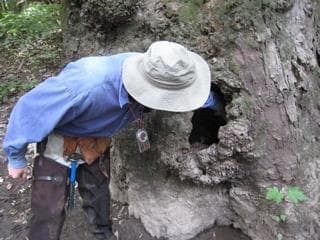
"So this a nice one. This is 612 centimeters (20 feet) circumference," says forest ecologist Christian Marx of the Nature Conservancy, pulling a measuring tape around a stout silver maple on a wide floodplain in East Hartford, Conn. "That could be the biggest one we've found yet."
As part of a study conducted by the Nature Conservancy and the U.S. Army Corps of Engineers, Marx is trying to find out where the healthy floodplains are on the Connecticut River and how much water they need. He says when the river floods, it carries sediment and nutrients which feed the lush floodplain forests.
"All the resources that a tree needs to grow are really abundant here," Marx says. "And so you get these really luxurious forests, kind of like a tropical rain forest, big trees, the herbs in the understory can be as tall as a man."
We walked through six- and seven-foot high nettles, which usually grow much smaller, and large trees with vines snaking over them. This kind of a no-man's land is good for wildlife. Wood ducks and mergansers nest in tree cavities. Muskrats burrow on the rivers edge.
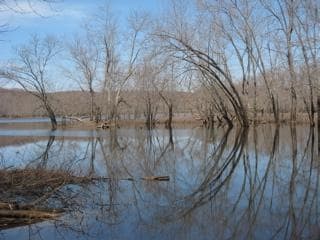
Upstream on a bridge over the river in Massachusetts, Kim Lutz of the Nature Conservancy says floodplains also benefit humans.
"They are the first buffer when a flood is coming down the river that provides that water storage," Lutz says. "It slows down the river and protects human development along river systems."
Much of the floodplains were lost long ago when the major cities on the Connecticut River were built and farm fields were ploughed. Roughly half of the floodplain acreage in the river basin has been lost to development and farms fields, Lutz says.
"There are forests that have changed because the flow has changed," Lutz says. "Whereas there might be a forest that's high and dry, it used to be a wet forest due to dam management."
Researchers from the Nature Conservancy and the Army Corps are building a computer model that simulates how all the dams on the river operate now and looks at whether it is possible to provide more environmental benefits without infringing on human uses like hydropower, recreation and flood control.
The Army Corps has already altered the flow of water to benefit the environment, Hanlon says.
"There's a fine line between flooding a field and flooding a house next to the field. It's a very tight balancing act," Hanlon says. "We may be getting to the point that we've done all that we can do without sacrificing our main mission of flood control. Maybe not. And maybe these models will help us push the gray areas a little more to the environmental side — or maybe not."
Ultimately, Hanlon says it is the Corps that has to answer to the public in the wake of a flood. But the Nature Conservancy says the ecosystems also deserve an answer.
This report is part of a collaboration with Northeast public radio stations on environmental issues.
This program aired on October 13, 2009.