Support WBUR
Mass. 'On-Call' Judges Handle Off-Hour Emergencies
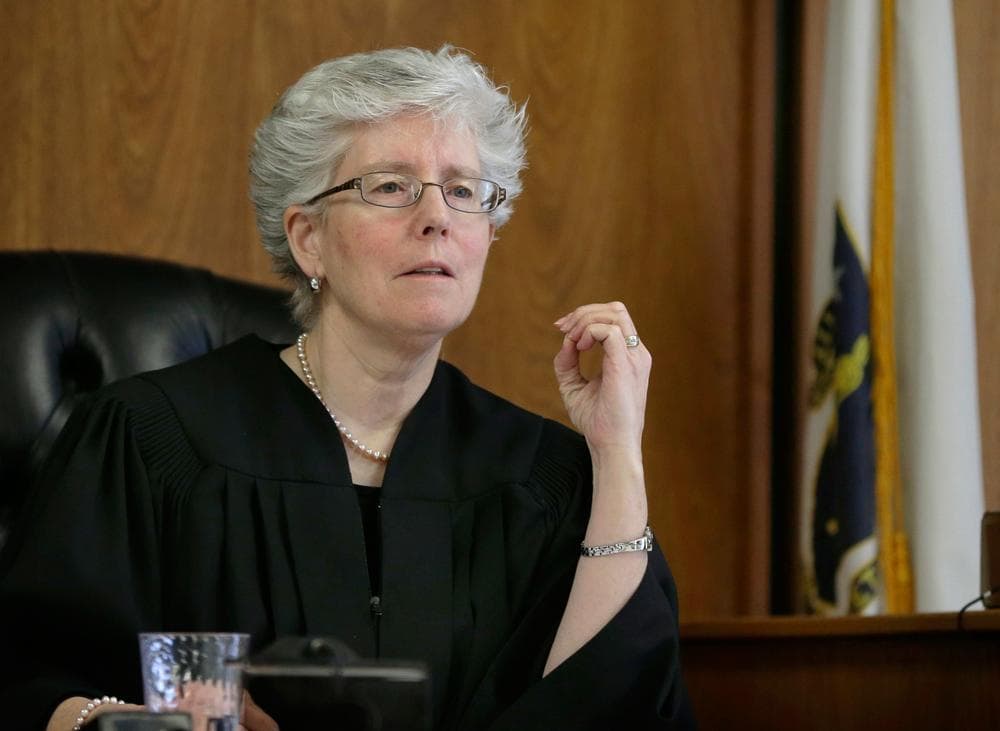
One judge had to decide whether to keep a 21-year-old woman locked up all weekend because she was wanted for urinating in public.
The same judge was also asked to order a blood transfusion for someone whose religion taught that such procedures were contrary to God's will.
Another judge was asked to issue a restraining order after a husband's refusal to take his wife out to dinner escalated into a fight.
For Massachusetts judges, being on call for after-hours emergencies is part of the job. Every judge in the state is required to spend one week every nine months handling calls at night and on weekends. Most of the calls involve requests for emergency restraining orders or search warrants, although sometimes judges are asked to issue orders in medical emergencies or to commit someone to a psychiatric ward.
The state's Judicial Response System began in 1984, and judges have handled more than 220,000 emergency requests since then.
"It really grew out of the recognition of the potential for violence against women and the inability to receive protection," said Judge Robert Mulligan, chief justice of the Trial Court. "We wanted to provide around-the-clock access, knowing that often the violence and the intimidation takes place after court hours."
"I've had cases where I've thought that an individual was clearly at dire risk, and I've tried as much as I can, with the collaboration of the police officer, to develop some safety plan."
Superior Court Judge Robert Kane
More than 300 judges from seven different court departments participate in the program, being on call from the time courts close at 4:30 p.m. through the night on weekdays and all weekend. At any given time, eight judges are on call, one in each of the different geographic areas of the state. During their on-call weeks, the judges are required to maintain their regular court schedules during the day.
Typically, judges will get calls from a police officer requesting a restraining order after being sent to a home on a domestic violence call. The judge gets a rundown of the situation from the officer, then usually interviews the person requesting the restraining order over the phone. If the judge issues the restraining order, it is only temporary, until the court opens the next business day.
Judge Paula Carey, chief justice of the Probate and Family Court, said an officer once called her to say he had taken a young woman into custody because she was wanted on an out-of-state warrant for urinating in public. The officer said he was required to hold the woman over a long holiday weekend until the courts reopened. Carey said the woman was released after being told she would have to report to court Tuesday to take care of the warrant.
Carey also handled a request to order a blood transfusion for a member of the Jehovah's Witnesses. The parents of the adult child who needed the transfusion protested, citing religious objections. Carey held a hearing in the person's hospital room. Ultimately, she did not have to make a decision because doctors were able to use a non-blood alternative.
"I think the (on-call) system is a very valuable service to the citizens of the Commonwealth. It ensures that people at least have an opportunity in an emergency for a hearing of sorts," she said.
Judges are often asked to deal with violent domestic abuse.
"I've had cases where I've thought that an individual was clearly at dire risk, and I've tried as much as I can, with the collaboration of the police officer, to develop some safety plan," Superior Court Judge Robert Kane said.
"That's what makes it a very engrossing experience," he said. "You're living with that case. You can't go back to bed, you can't rest. That has life to it that extends beyond the call."
Mulligan, who has been on the bench for 33 years, said the types of restraining order requests handled by on-call judges has changed over the years and are no longer limited to spouses.
"Now, more often, you see family situations where you have parents seeking restraining orders against children, usually involving mental health and addiction issues," he said.
"As difficult as the domestic violence calls are, something about a mother having to call about a son or a daughter is more heart-breaking," he said.
Although some large cities have night courts, most states instead have some kind of rotating on-call system for judges, said Judge Bill Dressel, a retired judge from Colorado who is now president of The National Judicial College, a Reno, Nev., nonprofit that runs educational programs for judges.
"Usually, most states leave it up to the individual circuit or district to come up with a plan because of the differences that exist around a state," Dressel said.
In Massachusetts, each on-call judge usually ends up handling about 30 calls per week.
Sleep, family time and dinners are often interrupted. Once, Carey was at a Bruins game when she got a call. Another time, she had to pull over on Interstate 495 after receiving a call.
The judges are given a daylong training every year covering restraining orders, harassment orders, search warrants and other things they may be asked to deal with while they are on call.
District Court Judge Marianne Hinkle, one of the judges who teaches the training workshop, said most judges take their on-call duties in stride.
"It's a responsibility that is just part of our job," she said.
This article was originally published on March 03, 2013.
This program aired on March 3, 2013. The audio for this program is not available.