Support WBUR
How New Mexico's governor got big things done
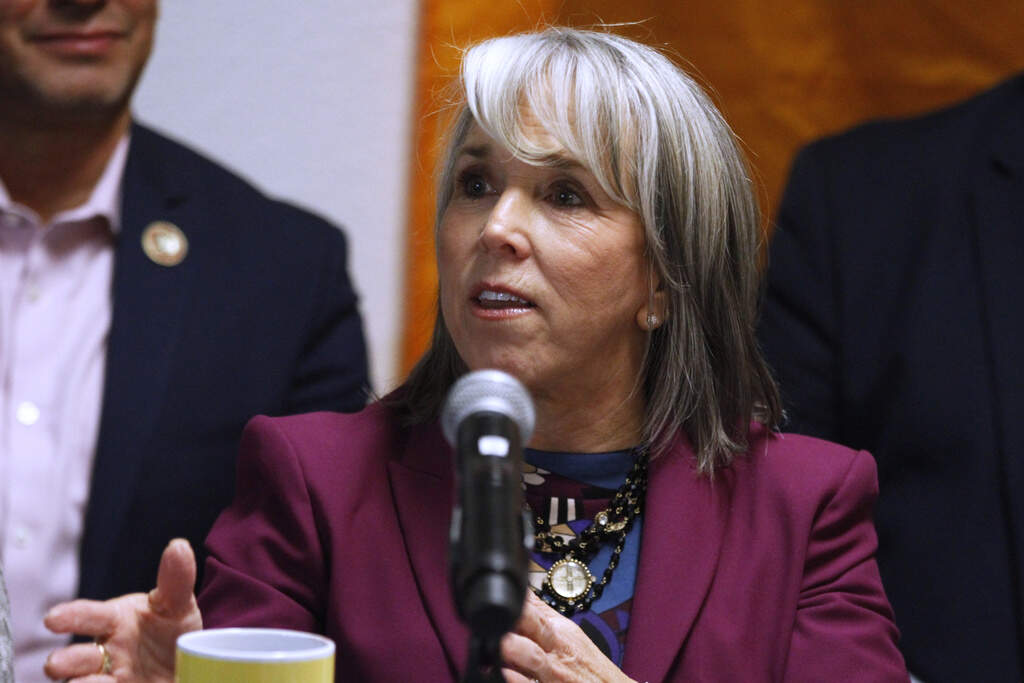
New Mexico’s Democratic governor Michelle Lujan Grisham has a robust list of progressive achievements – including making her state the first in the U.S. to offer free universal childcare. The outgoing governor shares what her party can learn about how she got it done.
Guests
Michelle Lujan Grisham, governor of New Mexico.
Transcript of Full Broadcast
Part I
MEGHNA CHAKRABARTI: Michelle Lujan Grisham is a governor of superlatives. She's a 12th-generation New Mexican. In 2019, she became the state's 32nd governor and the first Democratic Hispanic woman elected governor in U.S. history. Prior to that, she served in Congress for New Mexico's 1st Congressional District from 2013 to 2019.
And back in November of 2025, she made headlines when New Mexico became the first state in the country to offer free universal childcare. New Mexico has one of the highest poverty rates in the country. The childhood poverty rate is 22%, according to a recent state report. But the universal childcare program is exactly that.
It is universal. It doesn't only apply to low-income families. Anyone can access it. So how did the governor pay for it? In part, by dipping into the state's robust oil and gas revenues. New Mexico is the third-largest energy-producing state in the country, and with that in mind, Lujan Grisham might be one of the Democratic Party's most effective leaders.
She got universal childcare passed in her state after all, and Americans are hungering for concrete improvements to their lives right now. A recent Ipsos poll finds that 75% of respondents say they're only making just enough money to maintain their standard of living, or they're financially falling behind.
Of course, Lujan Grisham isn't without her critics, and not all of her strategies have come to fruition, but still, she's gotten things done. New Mexico's governors are term limited, so this year marks Lujan Grisham's final year in office, and she joins us today for a look back at her time leading her state and a look forward at the future of her party.
And she joins us from Santa Fe.
CHAKRABARTI: Governor Lujan Grisham, welcome to On Point.
MICHELLE LUJAN GRISHAM: Thank you for having me, Meghna. I'm delighted to be with you.
CHAKRABARTI: It's great, actually, to have you back. We first talked to you about the universal childcare program a little while ago, so I want to just stick with that for a moment as one of your signature accomplishments.
You not all that long ago gave your final State of the State address at the beginning of the year. Time seems to fly for me, Governor.
LUJAN GRISHAM: It does. I don't know where it goes, but it's gone.
CHAKRABARTI: I was like, "Not that long ago. Oh, January. It was six months ago." But anyway-
LUJAN GRISHAM: I know. It flies.
CHAKRABARTI: You gave your State of the State address, and you talked about the universal childcare program.
Here's a clip of it where you stress that it's not a benefit, it's something else entirely.
LUJAN GRISHAM [Tape]: New Mexico, in fact, is the first state in America to make childcare a right, not an aspiration, not a goal, a right. A right enshrined in our constitution, permanent and protected, approved by this legislature, and affirmed by the people of the great state of New Mexico.
CHAKRABARTI: So Governor, why was it important for you to make that distinction, that it's a right now?
LUJAN GRISHAM: For a couple of reasons. We have a tendency to politicize in an extreme fashion, not only in the country, it happens right here in New Mexico, these issues. It should only be for some. Childcare isn't a benefit that ought to be included.
It's just a social program. It's an economic program. It's a huge opportunity and benefit for workforce development. It's gender equality. And so you keep debating it. What is it? It is all of those things all at once, which is why once you enshrine it in the Constitution, you make it clear, like the pursuit of liberty and happiness, that this is what citizens can expect in the state of New Mexico.
Like the pursuit of liberty and happiness ... [universal childcare] is what citizens can expect in the state of New Mexico.
That changes the trajectory and the debate for politicians then forever.
CHAKRABARTI: So you're hinting to the long debates over things like Social Security, Medicare --
LUJAN GRISHAM: Absolutely.
CHAKRABARTI: Things like that, yeah.
LUJAN GRISHAM: Absolutely. And we are going to want that to stay the course, and I'm feeling bullish, I always do, that this is gonna stay the course. And of course, we got it funded at the last legislative session for multiple years so that you take that debate about what a new governor may want to do with money and what a legislature may want to do with money. We took it off the table, so that it's just there, stability for parents and providers.
CHAKRABARTI: So I just want to make it clear for people who didn't hear our last show about this specific childcare program in New Mexico. Obviously, you are and were governor when it finally was enshrined into law and passed, but a lot of people had been working on this as well for quite some time.
Because when I say you got it passed, I don't want people to think that it didn't come without a lot of hard work.
LUJAN GRISHAM: This is true. It's a collective. But I'll take a little more credit here ... because you're not a good governor unless you can do that. What New Mexico was debating, all valuable, important, with incredible diverse leaders really making it their signature and top priority issue, and in fact also bipartisan work, was full-day kindergarten, which occurred in the Richardson-Denish administration.
Denish was the lieutenant governor, her signature issue. And then the debate about constitutional reforms and funding from oil and gas was about pre-K. Childcare wasn't contemplated as part of this continuum. So childcare cradle to college. That effort was something I campaigned on in '18, because you opened the show with that.
While we've seen stunning decreases in childhood poverty from 50th to 22nd, we're expecting another drop in the data this year, we are still living among those states where hundreds of years of deep-rooted poverty still traps families in any number of hardships. So this was the way that I firmly believed created wealth, equity, and opportunity, and by wealth, that you can make choices.
That you have the choices that belong to so many other people that never belonged to you or your family for decades or hundreds of years. So I'm all about the whole thing.
CHAKRABARTI: Okay. Well credit where credit is due. Let's talk about how you did it, though, then, because externally, I guess also internally to New Mexico, the question people first always ask is how are you going to pay for it? And New Mexico had some particular resources to hand, but you had to convince basically the energy industry to somehow get on board, is that right?
LUJAN GRISHAM: The energy industry can certainly defeat where money is going from their oil and gas revenues.
I would actually say it's harder for them to defeat that and easier for them to defeat reforms that might limit oil and gas production or create accountability. But I'm going to give them, which most Democrats don't do, a shout-out. They have been more in line with accountability and funding our regulators than some of our Democratic lawmakers have been.
Now if we have regulators, they can get more leases, so I want to be balanced here about what can occur. But in fact, they agreed to our methane reforms, our ozone precursor requirements, the 98% recapturing of methane so you can't flare. So I do want the people who are listening, that you can create partnerships that benefit everyone.
Now fast-forward to the question that you asked me, which is --
CHAKRABARTI: Hang on for just a second. Hang on. I just want everyone to know that since you were talking about accountability, we're going to get to your sort of your climate goals a little bit later in the show. So we will come back to that issue.
But yeah, but go ahead in terms of the paying for the universal childcare.
LUJAN GRISHAM: But legislators long before my time, and leaders, governors long before me, were smart enough to take excess oil and gas revenues and stick them into these permanent endowment funds for education. It was a brilliant move decades long ago, and when I became governor, those funds were right about 22, 23 billion, and today they're just under 70 billion, and we've changed the way in which we invest those funds.
We also have about 100 it's now about 200 million that go directly to New Mexico businesses and venture capital that promotes the expansion of New Mexico businesses, including renewable energy. But with this stunning growth in that fund, we're in a opportunity that other states have to create for themselves with their highest paying revenue and economic sources to dedicate an additional percentage of that revenue towards childcare and pre-K.
And then we have safeguards so that if oil and gas goes below $60 a barrel, which it isn't now, which is how our state budget is directed, right? We count on at least. Then we know we've got excess money. In addition, we created a childcare trust fund with yet another set of oil and gas revenues that goes into that, and that started with $300 million, and now it's at $11 billion.
CHAKRABARTI: Okay. Governor, you like horses, right?
LUJAN GRISHAM: I like everything, but yes, I like horses.
CHAKRABARTI: Okay. I'm just going to use them as analogy because let's go, let's move a little faster. All right?
LUJAN GRISHAM: Okay. Yes, ma'am. Yes, ma'am.
CHAKRABARTI: Okay. You said earlier something which I think is very true, that ... you gave a shout-out to the oil and gas industry, and then you said, "Not something many of my fellow Democrats do."
Let me ask you about that. You basically were talking about Democrats seem to have certain purity tests, and one of them is, do you dump on the oil and gas industry or not? And I'm just wondering what you think about the power or maybe the danger of these kinds of political purity tests in the party.
LUJAN GRISHAM: I think they're dangerous. I think that real life is complicated, and I think many of these issues are incredibly complicated. It's not all of one or the other. If I had a magic wand, nowhere in the world would we be using or burning fossil fuels. Evidence is very clear. That is the core reason that we are addressing this climate crisis, and it has incredible negative aspects for the future of the planet and for everybody's daily public health.
If I had a magic wand, nowhere in the world would we be using or burning fossil fuels.
Fact. But also fact, we don't have transmission to move green electrons. We don't have enough renewable energy. We can't move it fast enough or far enough. There is a transition. So as long as that's the fact, then why don't I clean up oil and gas, hold them accountable, use those revenues to fix and address health care issues, health care access, childcare, pre-K, college, better education, so that you're creating these balances.
I think this is where Democrats can lead by example by making a difference in everyday people's lives while owning there are real challenges, and let's be truthful about them.
Democrats can lead by example by making a difference in everyday people's lives while owning there are real challenges.
Part II
CHAKRABARTI: Governor Lujan Grisham, we'll get back to the policy talk in a little bit, I promise you. But this is a chance for us to get to know you better, actually. And I was wondering the reason why I mentioned do you like horses or not is because I saw that, what was it, this year? That you actually had a personal jockey's uniform made for you?
LUJAN GRISHAM: I went --
CHAKRABARTI: (LAUGHS) Is that right?
LUJAN GRISHAM: Play to your strengths, Meghna. I'm 4'9", all right? I can't go to the Derby. It was a Democratic political event to raise money for all the Democratic governors we hope to get elected or keep elected in the 26 November election. And for me to compete with someone that is 5'10" in a big beautiful hat and high heels makes no sense.
So I went dressed as a jockey, and I'd like to say I think I broke the Derby.
CHAKRABARTI: (LAUGHS) Okay. Oh, I'm looking at a picture right here. You look fantastic.
LUJAN GRISHAM: It's pretty darn funny.
CHAKRABARTI: ... Oh, wow.
LUJAN GRISHAM: Yeah, you know what? You gotta be brave to be 67 years old and wear a pair of white pants. That's all I'm gonna say.
Okay? That's all I'm going to say to your listeners. Shows you how tough I am.
CHAKRABARTI: (LAUGHS) Okay, I have to say one of my aunts is also 4'9", 4'10" when she's on her tiptoes and she's the most powerful woman I've ever known. My mom, at her max, was 5'1", so I know the inherent sort of vitality of those shorter stature women.
LUJAN GRISHAM: There's something about having none of it, that you've gotta bring it all. It's like the teeny, little chihuahua in a group of giant Great Danes. They manage and lead those Great Danes. It's just how the world works.
CHAKRABARTI: Bravo to you for like you said, playing to your strengths. Now, I said at the top of the show you're a 12th generation New Mexican.
Tell me about that. Tell me about the history of your family a little bit.
LUJAN GRISHAM: Two things. At least 12. I can't prove more than that without going church to church and house by house and looking for all those records. But my family came with the Spaniards which is a tough issue today for a lot of New Mexicans because colonizers were not very nice, as you might imagine.
But they came over 400 years ago and landed and governed in New Mexico. Most of my family were also part of the Basque region of Spain, which means they were likely Jewish and fleeing persecution. And they were sheep ranchers, by and large, and I am a combination of Lujan and Romeros, both two very strong, prominent- New Mexico Hispanic families.
CHAKRABARTI: And then you got into politics. Were you in politics before you were elected to the House in, what, 2013?
LUJAN GRISHAM: I would say yes, but I never really considered it as such. My dad was a dentist. My mom was a stay-at-home mom for my sister, who had significant disabilities and special needs and was totally blind.
And so I didn't think about that. But my family's been here a long time, so relatives in the state's first Constitutional Convention, the state's first Hispanic Supreme Court and Chief Justice, one of the first in the country, if not the first, but I never thought about any of that. And so I went to law school and wasn't sure what I was going to do.
I had a science background. I thought maybe copyright or patent law. I was the seventh generation to have a graduate degree. It was expected and available to me, which is not a New Mexico story by and large, but it was my family story. And so I was trying to figure out what to do, and I fell into a program as a volunteer serving senior citizens with free legal services, and I loved it and also recognized we were not solving problems as a government.
And so I marched into a governor's office and said, "You should hire me" And I did that in '91, and by golly, Democratic Governor Bruce King hired me to run that agency as a 31-year-old.
CHAKRABARTI: Wow. Okay.
LUJAN GRISHAM: Not the smartest idea. It was, I had a steep learning curve --
CHAKRABARTI: You're here to tell the tale.
CHAKRABARTI: But I was lucky.
Yeah, but I was lucky to get to do it.
CHAKRABARTI: Okay. Gonna put a little pause button on your political trajectory, because when you said that you're at least 12th generation New Mexican because your ancestors came from Spain, that explained something to me because in preparing for our conversation with you, we were talking to your staff, and we wanted to see, because in my mind, I had 12th generation New Mexican and first Latina governor, but your staff said no, you can't say that.
Now it makes sense given the Spanish heritage that you have. But that makes, leads me to wonder, talk a little bit about who New Mexicans are today, because it's a very diverse state. Obviously, there's a Latino population. There's indigenous populations. There's White Americans, for lack of a better term.
Like, how would you describe who New Mexicans are?
LUJAN GRISHAM: That's right. African Americans. New Mexico is probably the best example of a multicultural state. With incredible pride points for every traditional, sovereign nation, indigenous, newcomer, Mexican, Central American, South American, European.
New Mexico is probably the best example of a multicultural state.
Everyone is here, and for the most part, while we still have tensions that we're dealing with, this integration of culture and identity and opportunity is something that New Mexicans as a whole are incredibly proud of and embrace, including the teaching of these multicultural traditions in school and embracing language.
Spanish is in our Constitution. You know what? Sovereign languages should have been in our Constitution, and those languages are now robustly available in our pre-K programs, and we're doing better, not enough, in our K through 5 and beyond to make sure that we don't lose these cultural identities because they are our superpowers.
CHAKRABARTI: Yeah. I mean, in fact, by losing them, you would be losing the languages of a huge number of New Mexicans, right? I'm looking here that we have, what, approximately 11% as Indigenous or Alaskan Native. Only 36% non-Hispanic white and almost 48% to 49% Hispanic or Latino.
So that makes New Mexico one of the, what, eight or nine quote-unquote "majority-minority states" in this country.
LUJAN GRISHAM: That's correct. And I think we have the highest percentage of that minority-majority population. And that really, and I'll tell you, we have a lot of women as policymakers, and that has a sharp, productive impact, in both building the economy. We're fifth in GDP growth. We're number one in wage growth. We're number one in high-tech innovation, in intelligent manufacturing. These aspects allow us then to lean in, to build families and embrace cultural identity.
These are all strengths.
CHAKRABARTI: Oftentimes, maybe these days, people, when they think about the fact that New Mexico has a Democratic governor in you, that in the 2024 election, the state's electoral votes went to Kamala Harris, that maybe it's a Democratic state.
But when you dig a little bit deeper here, and you don't even have to dig very far. I'm just looking at the 2024 votes that came out of New Mexico by actual percentage. And yes, Vice President Harris won 51.9% of New Mexico's votes as cast, but President Trump won 45, 46%. So it's not that New Mexico is a blue state.
It seems much more purple than that. So how would you describe balancing or meeting the needs of all New Mexicans, both Democratic and Republican?
LUJAN GRISHAM: I really appreciate that you've raised that point because in fact in that election, in the '24 election, we saw more minority voters, particularly Hispanics and Hispanic men, move to a much more conservative effort here.
And that is because I think largely people have forgotten that this is a state that cares about property rights, individual freedoms, taxes, public safety, immigration. And when the Democratic agenda doesn't seem to get the particulars, they can do the broad strokes, but the particulars, that leaves voters out and feeling like we're not understanding everyday issues.
When the Democratic agenda doesn't seem to get the particulars ... that leaves voters out and feeling like we're not understanding everyday issues.
Here's the example. I talked about oil and gas. I've talked about our GDP growth, number one in wage growth. You started this program with saying, "Look, we're still a high poverty state." That is also fact. Until people are safe in their neighborhoods and communities, until they feel like they're not living paycheck to paycheck, Democrats have to stop, I think, with these platitudes and recognize, I want candidates who understand what my day-to-day experience is and are gonna talk about those and talk about the inequities and what they're going to do about it.
And New Mexico has long been purple in that regard. We're the West. We care about water. We care about agriculture. These are often conservative vote blocks. We care about oil and gas, conservative oil block, vote blocks, energy. And Democrats nationally have to understand these issues in the state.
They have a tendency to say minority voters are going to lean Democratic because childcare. That's not necessarily true, and that's been playing out in recent elections. And I'm hoping that the Democratic Party nationally takes a lesson from states like New Mexico and Colorado and others that are clearly squarely leaning in to improving the daily lives, Kentucky, Kansas, of their constituents.
I'm hoping that the Democratic Party nationally takes a lesson from states like New Mexico.
CHAKRABARTI: Yeah, so talk more about that because I'm looking at your 2022 election win, and you won by actually the same, roughly the same margin as Vice President Harris won New Mexico in terms of those votes. You won 52% to the 45 and a half percent of your Republican challenger there. Just talk more a little bit about what it's like to be a Democratic governor in a purple state, because you mentioned Kentucky also, and there are several others.
And I think those governors, that set of governors is actually dealing with a reality that tracks more closely to national politics than, say, governors, Democratic governors who are in very safe blue states.
LUJAN GRISHAM: I'm going to go back to something I'm trying not to ever talk about again, and I'm teasing.
But that's COVID. And I just talked about, look we are a fiercely independent, freedom, rights. We've been doing this work for thousands of years, hundreds of years differently than any other state in America. And as we're celebrating 250 years, that's nothing. You're a teenager by New Mexico standards or younger.
And when a governor like me with a public health background and who's concerned, and let's go back to sovereign nations, I have tiny pueblos with 300 to 800 members. COVID runs through there, I lose an entire race. This was a powerful set of circumstances that I was willing to do everything, not just some things, everything to prevent, and we did.
That meant that we were closed longer, that meant that we had tougher issues that we were dealing with, and that meant that a lot of New Mexicans were really disappointed in that level of leadership. And that reflected in my re-election. I won by the largest margin ever in '18. We'll see if that gets broken in this election cycle.
I hope it does by a Democratic woman in November. And I won by one of the narrowest re-elections. So I am clear, public safety, using stats. The stats are all good. Listen, if that doesn't apply to my daily experience, do not talk to me about those platitudes. That was happening in the Biden administration.
Your day-to-day, the economy is strong. It was, but is it strong at my house? Am I worried about my payments? They are. And so that was not translating here. I've been clear about that in all of the, look, I worked for a Republican governor for eight years. I worked for a Democrat for four years, Bruce King, Gary Johnson for eight years, Bill Richardson for four years.
I won a tough election in a primary and then a tougher election in my Bernalillo County race. Martin Heinrich beat me in my first congressional race in 2007. First Democrat to serve the first congressional district in 40 years. This is a state that I think more reflects the strengths and the complexities of voters across the country, that Democrats as a party, and Republicans as a party, aren't understanding.
CHAKRABARTI: Okay, so let me just follow up on that. So since you said Democrats as a party one of the key things about that is that a lot of money for funding or supporting candidates at the, let's say, congressional and the state level comes through the party. Do you think, let's put it bluntly.
Do you think the Democratic Party is actually fundamentally out of touch with the wants and desires or the kinds of candidates, the wants and desires of people, and the kinds of candidates that can actually win?
LUJAN GRISHAM: I get asked all the time, Meghna, and you just did it again, about whether they're relevant, whether the message works, and I have really worked hard to answer it consistently like this.
I think the relevancy is really a question. Citizens United changed the funding mechanisms. Billionaires can invest in candidates on either side of the aisle, and that has changed America's relationship with the values that were the basis of the party platforms, and that's a problem. The values of the Democratic Party platform, I stand by 1,000%.
Billionaires can invest in candidates on either side of the aisle, and that has changed America's relationship with the values that were the basis of the party platforms.
The vehicle to talk about what you do to improve people's lives, that's missing in both parties' platforms, and I think we should be talking more about that. We gotta get Citizens United repealed. We gotta take over Congress. That didn't sound quite right. Win Congress in '26, because these are the things that will really matter.
And then we can talk about values.
You talked about budgets for childcare and college and what we're doing about families. That's a moral document about who we are investing in, and that's what Democrats, through the party, need to be doing. Governors are showing what they can do to deliver for their citizens. That's what's gonna make the difference, not in just in '26, but as importantly, in '28.
'26, you're gonna see, I think, a lot of voters voting against something. In '28, we need to give them something to vote for.
CHAKRABARTI: Do you have a Democrat in mind that you would like to see take on a presidential run in '28?
LUJAN GRISHAM: I really a lot of these governors who have certainly leaned in, and these are pretty strong hints that they're running, and they have really delivered for their states.
I'll use a state where I'm pretty confident that we don't see a governor that's talked about running, but I think she's amazing. Laura Kelly of Kansas has taken their public education funding from the brink of disaster to a healthy aspect and is one of the strongest rural state economies in the country.
Part III
CHAKRABARTI: Governor, let me just ask you, are you an eldest daughter in your family?
LUJAN GRISHAM: Oh, you nailed it.
CHAKRABARTI: (LAUGHS) Why am I not surprised at all?
LUJAN GRISHAM: Nailed it. Nailed it. Caregiver for my sister, my parents, bossy. My poor brother doesn't get to make a single life decision without my opinion.
It's the worst. Eldest daughter.
CHAKRABARTI: Worst or the best, right? Because here you are.
LUJAN GRISHAM: It's a little, it's a combination of both. I'm going to do a shout-out to my brother, too. My brother is a 65-year-old who just received his bachelor's degree from Highlands University, business degree because we have free college, so he could work, support his family, be a good grandfather, and he is already working to enroll in a master's program.
And I am so proud of him, I'm bursting, because that's how these programs are supposed to work. There's no wrong door, no wrong or right time. It's just available to you to solve and address life's challenges and opportunities in the way that makes the most sense for you.
CHAKRABARTI: Absolutely.
Bravo to him. Bravo to him.
LUJAN GRISHAM: I know it. I'm so proud of him.
CHAKRABARTI: Okay, so from one eldest daughter to another, it's time for me to be bossy with you here.
LUJAN GRISHAM: Oh, God. Okay.
CHAKRABARTI: We need to talk about climate because you had mentioned it earlier, and I'm looking here at some local reporting, and God bless local reporters who at the beginning of this year, identified that basically your overall climate goals as of January of this year, you've been struggling to meet them.
And for listeners who don't know, let me just name some of them, right? Let me see here. That in 2019, one of your earliest executive orders was to put the state on a path to a 45% reduction in greenhouse gas emissions by 2030. That was in comparison to 2005 levels. At the beginning of this year, despite the legislature's repeated attempts, that goal has not yet been made into law.
And then I also understand that last year there was an act called the Clear Horizons and Greenhouse Gas Emissions Act and that also died in the legislature I should say, with two Democrats actually joining all the Republicans in the New Mexico legislature to vote that down.
So be frank with me about your struggles to get your climate agenda passed in New Mexico.
LUJAN GRISHAM: I'm gonna do both, because you know me, you can't really boss me. I'm just like you. We are Even Steven. I'm gonna boss you right back. So we did get into law our Energy Transition Act, which decarbonizes the largest sector, which is the utility sector.
And we are actually ahead of schedule for the 2045 targets, which are 80%, 50% by 2030, and right now, 2026, we're at 52% renewables. Our renewable workforce is growing at more than two and a half times the national average. And Wednesday, I'm going to do the ribbon cutting for a brand-new, incredibly large solar farm, and we're home to North America's largest wind farm and largest transmission project, SunZia.
Where we need more in statute, like the Clear Horizons Act, which you are absolutely correct, failed, is that we have to decarbonize all of it. You have to do transportation. We have to do ag. We have to be at net zero, and then frankly, every state needs a pathway to net negative for the future to get anywhere close to meeting what this nation ought to be leading in carbon emission reductions for the country.
And the reason it failed, I think, is because we do. We want that regulatory environment so that we can meet these stricter standards, but that leaves a lot of uncertainty about who gets regulated, how they get regulated, whether or not businesses can survive in a transition. I think if we had a bill that just committed in law, in statute, which is my executive order, that you are as a state in all sectors at net zero by 2050, that would pass, and I have no doubt you'll see that work again in the next legislative session, the 60-day session starting January 2027.
And then we've got a task force and a number of other climate initiatives that are moving along rapidly and well, and another set of initiatives that are cleaning up toxic sites like our PFAS cleanup and our oil well caps. But I do want to say to you and to America, we are not where we ought to be in dealing with our climate crisis in this country, and New Mexico must do more.
We are not where we ought to be in dealing with our climate crisis in this country, and New Mexico must do more.
CHAKRABARTI: Okay, so my turn now?
LUJAN GRISHAM: Yes.
CHAKRABARTI: I understand that when the legislature voted down the Clear Horizons bill, that was in part because, you talked about accountability before, but the New Mexico Oil and Gas Association really pushed hard against it because one of the reasons why, just to use a little more plain language, that the earlier version of the bill called for a direct reduction and removal of greenhouse gasses at their sources.
Now, you mentioned that maybe smaller emitters shouldn't have been scooped up into legislation like that, and maybe other smaller emitters out now. But even if they are, reality check here, do you anticipate the New Mexico Oil and Gas Association being like, "Okay now that we're not having, we don't have to protect smaller emitters anymore, the rest of us, the big guys, we'll be happy.
We'll be happy to put in --
LUJAN GRISHAM: ... There's no happy. Yeah. No. But also, it wasn't just the small producers. The independent producers I don't think have ever been on board with any of our regulatory reforms, claiming that it's not affordable. I don't agree with that claim, but that's their advocacy effort.
But make no mistake, the oil and gas industry could have killed our Energy Transmission Act and did not, and they could have killed that we require a 98% reduction in methane and greenhouse gases, and we are meeting that. We are less than half of what Texas emits in methane at 98%, and no flaring unless there's emergency, even though we increased oil and gas production last year.
It's the strongest methane requirement in the country, was the Biden rule, now it's not, showing, to your point, the power of state law, which is why the state's gonna keep leaning in. But yes, I don't think it's an easy lift to do all of the accountability in one bill, and I don't know what the next governor will do.
I think because I'm bullish about a Democratic governor, is going to lean really hard here. This is her level of expertise. But I have no doubt that a straightforward single act that says the carbon neutral by 2050 in all sectors would pass the New Mexico legislature. I think it would pass today.
That's not to say that Clear Horizons wasn't a brilliant piece of legislation. Of course it was. But I want New Mexicans to know they've made huge impacts, so keep up that fight. You can do more.
CHAKRABARTI: You mentioned Citizens United earlier. Yeah. I'm seeing here that there is a registered lobbyist in New Mexico named Patrick Killen, who is a representative for Chevron, and according to, again, this local reporting, that Killen has been the single largest contributor to New Mexico politicians, more than almost $2.5 million in the span of four years on behalf of Chevron.
So the oil and gas industry doesn't just have political clout. They also have, let's say they use the influence of their money in New Mexico's government, yes?
LUJAN GRISHAM: Everyone uses their money to influence. And yes, the answer is of course, and it is something that I hope Democrats, as a continued effort, it has been certainly a campaign commitment by all of us that Citizens United must be addressed and Congress must do something about it.
Because the money, and even in small donors. I debate this all the time. Big donors, medium donors, small donors. I've raised a lot of money. The Democratic candidate in this election, Republican candidates are going to raise a lot of money. They spent more in the primary this election cycle than has ever been spent in New Mexico.
There is too much money, whether you're doing it by setting an agenda and getting small donors at a dollar, or whether you're getting a large chunk by one industry. It ends up all influencing our elections, and we must, as a country, do something about that.
CHAKRABARTI: We only have about five minutes left, Governor.
And if I may, I want to turn back again to the national party, because you do have a national audience right now. And I think many people listening to you agree that governors across this country are doing really interesting things, right? Having to actually govern on the ground rather than in the sort of stratosphere of just pure political wind that sometimes national politics seems to be at.
But I do wonder, you mentioned also that, okay, it's not good enough to just run against something, meaning running against President Trump and Trumpism in 2026. In 2028, the Democrats have to actually say, "Here is what we are for." How would you articulate what that is that thing that Democrats or Democratic candidates are for?
LUJAN GRISHAM: Let's turn to New Mexico again. Yeah. I think it's a real blueprint for democracy. Look, if women, we're about equality and we are not just gender, equality for everyone. If you have 1.6 million women out of the workforce because they can't afford childcare, if you have families that are choosing between rent, being able to buy a house, support their kids during the summer, starting their business, we are not addressing affordability.
We talk about it in these sort of narrow pieces. We'll do something about groceries, or we'll do something about gasoline. We'll do something about housing. You better do something about the stability of families because frankly, they need all of it. That's what we've done here. We pay the lowest healthcare premiums because we kept the premium tax, and we invested it back into families so they can afford healthcare.
People pointed us as having too many people on Medicaid. Medicaid is a universal access strategy, which means we have robust benefits, and then we make sure that no one in New Mexico is left uncovered. We reduced our childhood poverty rate. We did that by making sure that we have food, and we have childcare, and we have before and after school.
We give teachers a 38% raise. We pay 80% of their health insurance costs. We pay for all of college. We're gonna do a billion dollars in affordable housing and rent assistance and mortgage buydowns. We're redeveloping. We're building a new medical school. We're building a new literacy institute. We're building a STEM institute.
I get your point. We're building. Things are happening. Things are happening. And yet, you just said New Mexicans are feeling pinched. So I want governors to talk about what they've done, and then I want governors to talk about what needs to be done at the national level, because I could move faster if I didn't have a federal government that took $1 trillion out of people's health care and food budgets every year.
I could move faster if I didn't have a federal government that took $1 trillion out of people's health care and food budgets every year.
I could move faster if I didn't have a president that said, "Look, we can't do Social Security and we can't afford childcare anymore." I could move faster if they cared about college, if they cared about any of these issues. Imagine what you could do, and I could move faster in public safety if I didn't have a federal government that was deporting the innocent refugee asylum seekers and their families who are immigrants looking for the American dream and saving their children from a life of hostility and violence.
What's happening in America? Democratic governors need help at the federal level. This is something to vote for.
What's happening in America? Democratic governors need help at the federal level. This is something to vote for.
CHAKRABARTI: Okay. So that's all well and good, but I'm just thinking of, like you said, in the 2024 election, there was this significant swing, for example, amongst Latino men. And the way presidential politics works, like it or not, the elections do swing on small numbers of voters in certain key states.
So the whole list of accomplishments that you just gave very laudable, but I'm wondering, okay, reflect with me on the Latino men in your state, in New Mexico, that may have moved towards President Trump. What could you, what would you tell them to say, Reconsider the party that you vote for in the next couple of elections.
LUJAN GRISHAM: I think they're feeling that they did not get the return on that investment, that vote for what they thought was going to be more individual freedoms, that it was going to be more about investing in their wellbeing in this country. The Iran war, mass deportation, which I said people don't believe that's gonna happen, and take this president at his word.
And now that it's happening, they don't like it. They don't want it. They don't believe in it. They don't have work stability in the agricultural sector, which is a huge sector in this country. It's a huge sector in New Mexico. And so the job security, the individual protections, the freedoms, and the fact that it's harder, and gasoline prices are up and food, this is not what they voted for. And they do see now. Maybe Democrats --
CHAKRABARTI: I'm going to jump in, one more question for you.
LUJAN GRISHAM: Overdid the, You have to do what we say in COVID. I think they're ready to say, Democratic values meet my values straight on. I think that's coming.
CHAKRABARTI: Point taken. I'm gonna give you 10 seconds. We'll give you 10 seconds here.
LUJAN GRISHAM: Okay.
CHAKRABARTI: Do you have more political offices in your sights in the future, Governor?
LUJAN GRISHAM: I would like people to know this. I'm not done trying to make a difference, and I am lucky that people in my state have given me an opportunity to do.
The first draft of this transcript was created by Descript, an AI transcription tool. An On Point producer then thoroughly reviewed, corrected, and reformatted the transcript before publication. The use of this AI tool creates the capacity to provide these transcripts.
This program aired on June 8, 2026.