Listen LIVE button

WBURAn ‘Old, Weird’ History Lesson From Dylan’s American Songbook

Published June 8, 2009  Updated July 25

LINCOLN, Mass. — A new exhibition at the DeCordova Museum in Lincoln is a lesson in history, but not the kind you learn in school. “The Old, Weird America: Folk Themes in Contemporary Art” explores folklore and myth, as interpreted by artists in the United States today. Work from 18 artists fills the museum’s indoor galleries, making it the largest exhibition the DeCordova has ever shown.

The award-winning show, traveling from Houston’s contemporary arts museum, covers the period from the first Thanksgiving to the beginning of the Space Age. It draws its inspiration and title from a book on how folk music influenced Bob Dylan and his album, “The Basement Tapes.” We visited as the show was being installed, to talk with museum curator Nick Capasso and one of the artists, Allison Smith.
Pages out of a Dylan songbook, not out of a textbook

“The curator of this show, Toby Kamps, felt that Dylan was probing into American history and American mythology in the same kind of way that the artists in this show are,” Capasso says. “To find something that lurks underneath the facts and the dates and the progression of presidents and all the kinds of things we learn in school — something emotional and psychological and more resonant than pure fact.”

Contemporary artists are very much interested in history, Capasso says. “Old, Weird America,” then, was an opportunity to bring together a large group of contemporary artists whose work focuses specifically on aspects of American history.

And it’s no accident that an exhibition focusing on American folklore and myth has made its way to a Massachusetts museum. The state is arguably one of the key birthplaces of American history since white settlement. “It’s traveling here,” Capasso says, “precisely because of the rich, historical resonance that our region has for the entire country.”

Putting such an exhibition together was no easy task. The greatest challenge, Capasso says, was “finding artists whose work would represent and span four centuries.”

Using the past, forging new narratives into the future

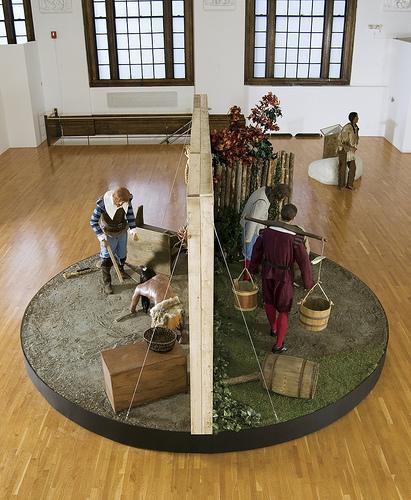
Sam Durant's "Pilgrims and Indians, Planting and Reaping, Learning and Teaching." (Courtesy the artist and Blum & Poe, Los Angeles)

Sam Durant's "Pilgrims and Indians, Planting and Reaping, Learning and Teaching." (Courtesy the artist and Blum & Poe, Los Angeles)

The first installation Capasso takes us to is perhaps the most relevant to a Massachusetts or New England audience. Sam Durant’s “Pilgrims and Indians, Planting and Reaping, Learning and Teaching,” is a life-size diorama with wax figures dressed in historical-period costume on a rotating platform.

“On one side of the platform, we see the traditional, pilgrim Thanksgiving story of cooperation between the pilgrims and the Native Americans,” Capasso explains. “We see a Native American teaching the pilgrims how to plant and fertilize with fish.”

But as the platform revolves, it reveals what Capasso calls “a less-known and certainly less talked-about aspect” of the same Thanksgiving story. The scene depicts Capt. Miles Standish standing above a Pequot Indian, about to beat him with a stick.

Moving to the second floor of the museum, Capasso pulls back a black, velvet curtain and leads us into a darkened room, where a video, Jeremy Blake’s “Winchester,” is projected onto a 10-foot tall screen.

“The story here,” Capasso says, “is that Sarah Winchester, the heir to the Winchester rifle fortune, was a believer in spiritualism around the turn of the last century. And she visited a psychic, who told her that in order to purge herself of the guilt and of the ghosts of all the people killed by Winchester rifles, she would have to build a house and never stop building it until the end of her life.”

In the video is a recurring image of the building itself, which then “melts and morphs,” as Capasso puts it. “The whole video is haunted by these recurring images of these ghostly cowboys who come in and out of focus,” he says. “The whole thing is a meditation on madness.”

Allison Smith's Officer of the 5th New York Volunteer Infantry, Duryée’s Zouaves. (Courtesy of the artist)

Allison Smith's Officer of the 5th New York Volunteer Infantry, Duryée’s Zouaves. (Courtesy of the artist)

We return to the main exhibition hall, where artist Allison Smith has seven life-sized dolls, laid out in crates, ready to be assembled on the floor. They’re soldiers, dressed in bright red and blue Civil War uniforms. She’s made them in her image.

“I think on some level, I’m interested in the socialization of children through toys, but also I think it’s something that makes me feel small, and it makes me feel, you know, childlike and playful,” she says. “It’s really important to me that these are dolls and not mannequins, because I see them as functional objects that I can play with and kind of dress-up and, you know, interact with.”

Smith says she wants people to walk away from her work with the idea that they can take history into their own hands. “That we can all participate in the process of history making. Whether it’s, you know, changing the way it’s been written in the past or forging new kinds of narratives into the future.”

As for Capasso, he says his greatest hope is simply that visitors to “Weird, Old America” have a great time. “I mean, art’s supposed to be fun,” he says. “This isn’t a history museum. It’s artists using American history as the site of a launching pad for free flights of the imagination.

“If people can come and just see how rich our history is, and how something so dry can stimulate something so creative — we will have done our job.”

“The Old, Weird America: Folk Themes in Contemporary Art” is showing at the DeCordova Museum from June 6 through September 7.

WBUR Topics: ·
Your Comments
WBUR Topics
Most Popular
Tweets About @WBUR Twitter
This site is best viewed with: Firefox 3.5 | Explorer 8 | Chrome 2 | Safari 4