Support WBUR
A Grieving Father's Journey From Death Penalty Advocate To Opponent
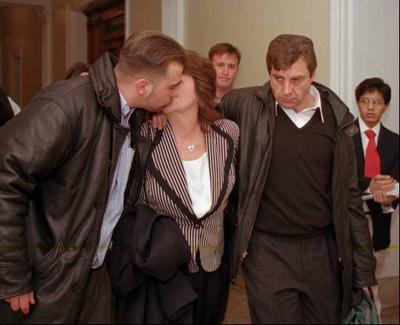
Deeply held beliefs are sometimes subject to change. That's the focus of a new book about one of the most high-profile crimes in New England. Even now, 12 years later, many people remember the horrific details of the kidnapping and murder of 10-year-old Jeffrey Curley. And they remember his father, Bob Curley, who led the fight to bring back the death penalty in Massachusetts after his son's murder.
As the details about the murder emerged, including one suspect's association with the North American Man-Boy Love Association, public outrage intensified and a devastated Bob Curley led the campaign to reinstate the death penalty. Despite Curley's tireless efforts, Massachusetts lawmakers rejected the death penalty, but by just one vote.
Sal Sicari and Charles Jaynes were both convicted of Jeffrey's murder — Sicari was sentenced to life without parole and Jaynes to life with the possibility of parole after 23 years. And two years after their convictions, Bob Curley went public once again — this time to denounce the death penalty.
His journey to the opposite viewpoint is outlined in a new book, "The Ride," in which Boston Globe reporter Brian MacQuarrie documents the intense personal struggles of Curley, a firehouse mechanic from Cambridge, who goes from grieving father and death penalty advocate to still grieving father, but death penalty opponent. Bob Curley and Brian MacQuarrie visited our studios to talk about the new book.
Deborah Becker: Bob, what caused you to change your mind about the death penalty?
Bob Curley: When it all started with Jeffrey, I don't think people go through life thinking about the death penalty. I know I didn't give the death penalty much thought until all of the sudden have something like this happen to one of your loved ones. At that time, I don't know how anybody could not be in favor of the death penalty.
But as time moves along, you know, you can take a step back and you can take a look at the death penalty for what it is, and that's basically what happened with me.
When did the tide start to turn for you? When did you start to say, 'This may not be something I want to go along with anymore'?
Curley: When you see the legal process up close, it doesn't take long to figure out that what's right and what's wrong — justice and the law, and what's right — who can afford a good lawyer, who can't afford a good lawyer — there's a big difference.
Even in this case here, I mean, Jaynes was the worse one of the two, as far as I'm concerned. He had a good lawyer, he got second degree murder with the possibility of parole. Public defendant, Sicari, got life without the possibility of parole. So, you know, that just highlights that the justice system isn't always, works perfect for everybody.
Was it difficult to start to tell people that you had changed your position?
Curley: Yeah. I just, one day, felt like talking about it. It was close to Jeffrey's birthday, too. And I wanted to talk about it publicly, that I had changed my position on the death penalty. I went on TV, and it's strange the way things work, but that weekend was a conference at Boston College where anti-death penalty people from all over the country were there at this conference. And I wound up speaking at that conference that Saturday morning, and it just so happened to be Jeffrey's birthday that it happened.
Was it difficult to tell your family that you had changed your position?
Curley: Oh yeah. Yeah. Yes. Because that afternoon — we have a ritual, we go to Jeffrey's grave on his birthday. And that day we did, and I had some words with my older sons and Jeff's mom. But, that's alright. They still have a different view than I do, but that's fine. I respect their view and they respect mine.
Brian, I'm wondering, why did you decide to write that whole story? The whole arc of Bob's story?
Brian MacQuarrie: Well, when we began the book, we thought it was going to be a fairly straightforward true crime tale about Jeffrey's death and about the death penalty debate.
And the more that I got to sit down with Bob and just heard about the toll that this took on them, it just became to me such a wrenching and important story about how someone cannot only find the courage to change his views, but then find the strength within to endure what that means. I mean, it's ultimately a story, I think, of triumph of the human spirit.
Bob, would you say it's triumph is the message?
Curley: I always wanted the book to be about transformation, about healing and about hope. You can get better. Not everybody does get better, but you can get better if you want to get better. The hardest thing is to just try to not let the anger surface up so much. You gotta let it go, you can't let it eat you up.
How do you feel about them now? Do you forgive them?
Curley: No, I don't forgive them. It's not something you get over with, it's something you carry with you for the rest of your life. I've said many times before, the best advice that I got was, 'You know, it's bad enough that Jaynes and Sicari had killed Jeffrey, don't let them kill you.'
And it took a long time for that to click in with me. You know the best way to honor Jeffrey is to live my life the right way, try to make as much positive come from what happened as I can.
This program aired on June 23, 2009.