Support WBUR
Hospitals Battle Their No. 1 Injury: Falls
About a year ago, something tragic happened at Fairview Hospital. It had been a typical Friday afternoon in the summer. "All of a sudden, out of nowhere, we heard a humongous thud," recalled Nurse Ellen Beckwith, who had been working on that floor.
"So we all went running and this little lady had gotten up — and we're not sure if she had stood and turned, or just stood and fell — but fell backwards," Beckwith said. "We have closets that have a metal sill, and she had hit the back of her head on that sill."
The patient who had fallen was 90 years old. At first, she seemed fine. She had a lump on the back of her head. But she was awake and talking, and her only complaint was a sore back. An hour and a half later, that all changed.
"All of a sudden she went unresponsive and vomited, and she was never responsive after that," Beckwith said. "She died not long into the early morning hours."
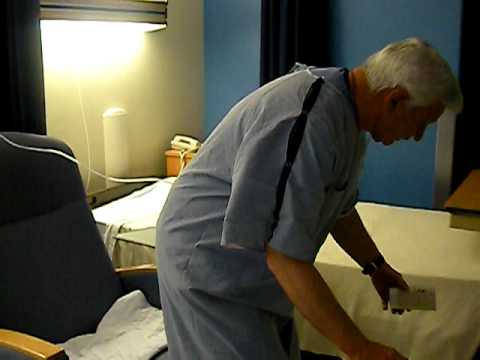
The cause of death was a traumatic brain injury from the fall. Fairview is a tiny hospital in the Berkshires — it has only 25 patient beds — and the accident was devastating. The hospital decided that even though it already had a fall prevention program, it could be more aggressive.
The kind of hospital injuries that make headlines are usually high drama, such as a wrong arm or wrong leg removed, or a surgical instrument left inside a body. But, while much less dramatic, the number-one cause of patient injuries at hospitals is falls.
As she walks down a hallway of patient rooms, Nurse Beckwith points out one way the hospital now identifies patients at risk of falling. Outside several rooms are big stars made of bright yellow construction paper, outlined in red and laminated in plastic. Inside some rooms, there's even more yellow.
"You can look in and see on the closet there's a yellow sheet," Beckwith notes. "That individual is somebody that's a high, high fall risk, so they should be being rounded on every half-hour versus every hour."
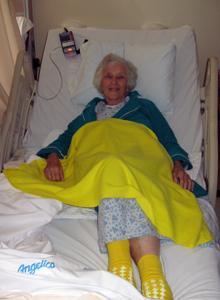
Every patient admitted to Fairview, no matter their age, is evaluated for their risk of falling. Then they're re-evaluated each day they're in the hospital. High-risk patients also get yellow blankets and yellow socks. And one more thing: bed alarms. If a patient at risk of falling tries to get out of bed unattended, the tune "She'll Be Comin' 'Round the Mountain" blares out of a hallway speaker.
It sends nurses running to the room to help. That reassures Janice Wilcoxson, whose 88-year-old mother was recently admitted to Fairview.
"It is very annoying," Wilcoxson said with a laugh. "But it's awesome because I know the minute she gets up, they're right on it. As soon as that alarm goes off, they're in here. Within seconds they're right on it. So it's pretty cool."
These precautions aren't just for elderly people. Even young patients who are relatively healthy are at risk of falling during a hospital stay. Surgery and blood loss can make them weak. Pain medications and anesthesia can make them dizzy. An unfamiliar environment can leave them confused.
"Anything they give you alters your state and your equilibrium, even being in bed for a while," Debra Schermerhorn said. She's only 45, but even she felt unsteady a day after having her gallbladder removed at Fairview. "When you start getting up, your feet aren't where they should be," Schermerhorn adds. "You really could feel that all the oars weren't in the water. You're dopey, for lack of a better word."
Taking that into account, many hospitals are making a number of changes. For example, no diuretics before bedtime. That's because a full bladder might tempt patients to make a bathroom trip by themselves in the middle of the night — a classic scenario for a fall.
Some hospitals avoid drugs that could impair a patient's balance. And they're checking on high-risk patients often to see if they need anything. Tissues? A pain reliever? Help getting into a new position?
These types of measures are happening statewide at hospitals big and small. Like Fairview Hospital, Beth Israel Deaconess Medical Center in Boston evaluates all patients daily for their risk of falling.
Nurse Christine Kristeller said some high-risk patients are given beds that can be lowered almost to the floor so that if they fall out, they won't fall far. "And then what we do is, we put these mats on either side of the bed when the patient is in it," Kristeller said, "so if they did happen to fall out they're going to fall onto a cushioned surface, like a gym mat."
Beth Israel also uses bed alarms, chair alarms and hospital socks with non-slip tread on the top and bottom. And the hospital hangs red signs outside patients' rooms and above their beds to indicate who's at risk of falling.

In addition to protecting patients, there's now also a financial incentive for hospitals to reduce their fall rates. Since last year, Medicare no longer pays hospitals for treatments related to preventable hospital falls.
"In other words, if a patient falls out of bed and needs to have an X-ray or an MRI or a CAT Scan, they're not going to reimburse for that," Kristeller said. Still, Kristeller thinks even the most aggressive fall prevention programs can't prevent all hospital falls. "Unless people were tied down all the time," she said, "that's the only way you would ever prevent falls from happening completely, and that is unacceptable."
But Sharon Inouye worries that's exactly what Medicare's new non-reimbursement policy could lead to. Inouye is a Harvard Medical School professor who studies how reducing delirium in older people can reduce their risk of falling.
"My concern is that in the desire to prevent falls from occurring, hospital staff may want to do things like put up more restraining devices or not let people get up out of bed," Inouye said.
Instead, Inouye wants hospitals to get patients up and walking as soon as possible. Because when a person is confined to bed, she said, "they lose muscle mass, they start to get weak, they lose their balance ability — and that, of course, predisposes to falls, so a lot of dramatic things start to happen as we immobilize a patient in bed."
Many hospitals say only as a last resort do they physically or chemically restrain fall-prone patients. They say a combination of these other techniques is helping reduce fall rates. And now that hospitals' reputations and financial health are on the line, that's strong incentive to keep driving those fall rates down.
This program aired on August 25, 2009.