Support WBUR
Amid Budget Crisis, Beacon Hill Renews Gambling Debate
As Gov. Deval Patrick announced a series of deep cuts to bridge a $600 million budget deficit Thursday, state legislators heard renewed debate over potential revenue from casino gambling.
The Committee on Economic Development heard almost seven hours of testimony from all imaginable corners of the casino divide Thursday. The hearing was the first after House Speaker Robert DeLeo threw his support behind pushing some kind of casino bill into House debate by January 2010.
Each voice at Thursday's hearing spoke with an urgency that is new to the gambling debate.
“How many more firefighters and police officers are we going to have to lay off because this commonwealth doesn’t have the revenue?” said Massachusetts AFL-CIO president Robert Haynes.
“I beg you to take this up. Put 20, to 30, to 40,000 people to work in this commonwealth. Put whatever kind of constraints and issues you need to make this a good industry. But please, do it.”
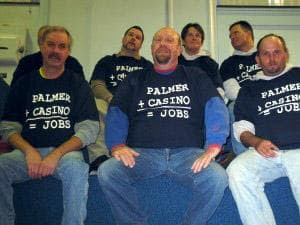
The hearing was interrupted several times by raucous applause from the gallery. Dozens of construction and trade workers wearing blue T-shirts with the words "Palmer + Casinos = Jobs" crowded the Gardner Auditorium at the State House. Palmer, the western Massachusetts town, has been identified as a potential site for a future destination-style resort casino.
Gambling opponents attended the hearing in equal numbers. They urged committee legislators to look past short term gains casinos could bring to the moribund economy.
"I am begging you, despite the pressures from the economy — that are all very real, that I sympathize with, that I experience — to stop," said Kathleen Norbut of United to Stop Slots in Massachusetts. "This is fiscally, poor public policy."
Momentum, however, seems to be with expanding gambling. Gov. Deval Patrick and Senate President Therese Murray both back casinos. Murray has called expanded gambling "inevitable" in Massachusetts. The key shift came when House Speaker Robert DeLeo signaled his willingness to open casinos to debate. He has said a casino bill could be ready for the full House by early next year.
Gambling lobbyists have accelerated their interest and efforts in the state. Gary Piontkowski, president of the Plainridge Racecourse in Plainview, told the committee that if a bill passed, slot machines could be up, running and generating revenue at his racetrack before the end of 2010.
“If slot machines and or any type of gaming, poker tables, whatever the legislature deems suitable, is introduced, we can be up in a matter of months, as opposed to a matter of years just to cite a new gaming facility,” Piontkowski said.
That drew fire from one the committee's most ardent gambling critics. Sen. Susan Tucker told Piontkowski that even if a gambling bill passed with little delay in the legislature, new regulatory commissions and other casino-related state programs would have to be created, and that would take time.
“We’re talking ... two to three years. Best of circumstances," Tucker said. "So please, let’s disabuse the notion that we’re going to have slot parlors up and running any time soon in this state.”
Piontkowski replied, “Senator, I think we need to distinguish between existing, approved gaming facilities in Massachusetts, as opposed to a full-blown brand new casino.”
The exchange highlighted the murky information that continues to surround the gambling issue.
Sixteen proposals are pending on Beacon Hill — on everything from full-blown casinos to racetrack slot machines. No one is sure how much revenue any of the proposals would bring to the state. Legislators at Thursday's hearing frequently asked gambling lobbyists for revenue projections. The replies were often hedged with uncertainties over how the state would tax expanded gambling.
Earlier revenue estimates range from $200 to $500 million per year. However, those numbers rely on a study commissioned by Gov. Patrick several years ago in happier financial times.
“We’re at this point trying to put together what we feel is a proposal that is current for where our economy is today,” said economic development committee co-chair representative Brian Dempsey.
Dempsey said a proposal could emerge from committee by January. Still, budget analysts believe that even the rosiest casino revenue estimate would not put a significant dent in the state's current budget crisis.
That crisis and its inescapable impact on the state remained evident at Thursday's hearing.
Kathleen Scanlan, executive director of the Massachusetts Council on Compulsive Gambling, was one of the last to testify.
“Our belief is that if the state does sponsor, endorse, promote, endorse gambling," Scanlan said, "it really has a responsibility of dealing with the cost of doing that business.”
Scanlan feared the state is unable to deal with such costs now, even without casinos. Also on Thursday, Gov. Deval Patrick announced deep cuts in state programs required to close the state's budget gap. His announcement came just hours before Scanlan gave her testimony.
Before she addressed the committee, Scanlan received a call from her office. The Massachusetts Council on Compulsive Gambling's funding had been cut in half.
This program aired on October 30, 2009.