With Swine Flu, The Thing Hospitals Fear Is Fear Itself
Swine flu is circulating widely in Boston, especially among young people. Children’s Hospital has opened an overflow site to help manage the number of patients coming to its emergency room with flu-like symptoms. But most of those children are just being told to go home, drink fluids and get lots of rest. So the hospital finds itself flooded by sick kids who’d often be better off staying home in bed.
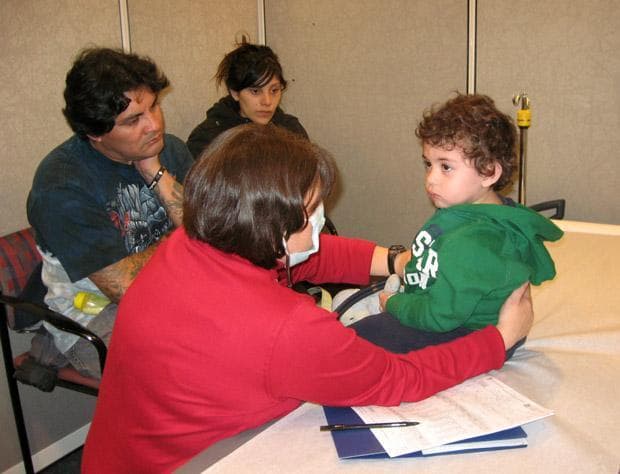
There’s no doubt that 2-year-old Jonathan Parades feels lousy. His eyes are glassy and his brown curls are damp on his forehead, a sure sign of a fever. His mother, Janice, suspects he has the flu.
“In the afternoon he started coughing,” Janice Parades recalls, “and he’s very playful, very active, and all of a sudden he just was laying on the floor, very tired.”
So she brought him to the Children’s Hospital emergency room — and, sure enough, he has almost an 103-degree temperature and a likely case of the H1N1 swine flu. But the treatment he gets is pretty simple: some fever-reducing medicine and a cup of water.
Then Dr. Margot Shuman sends him home. “I think a lot of the not-feeling-well is just the fever at this point,” Dr. Shuman explains to the boy’s mother.
Shuman is a pediatrician at Children’s Hospital, which earlier this week saw a 50 percent jump in sick kids in its emergency room, most of them with presumed cases of H1N1.
But for most children, Shuman says, the swine flu does not call for a trip to the ER. In fact, of the 50 or so kids she’s treated for the flu in the past few weeks, only a handful have been hospitalized. One, for example, developed pneumonia. Another was a three-month-old with a fever.

Children's Hospital has set up a makeshift "alternative care site" to manage the volume of patients with presumed cases of swine flu. (Sacha Pfeiffer/WBUR)
“There’s a lot of panic on the part of parents when they’re hearing all about the children who are really having the serious complications of this,” Shuman says. “But it’s still the vast minority of kids who are having these horrible complications.”
Shuman says only a small percentage of children with H1N1 need to go to a hospital. Those include kids with trouble breathing, dehydration, a fever that goes away and comes back or kids acting delirious or lethargic.
Still, at least 100 children nationwide have died from swine flu and those horror stories have many parents racing to the ER.
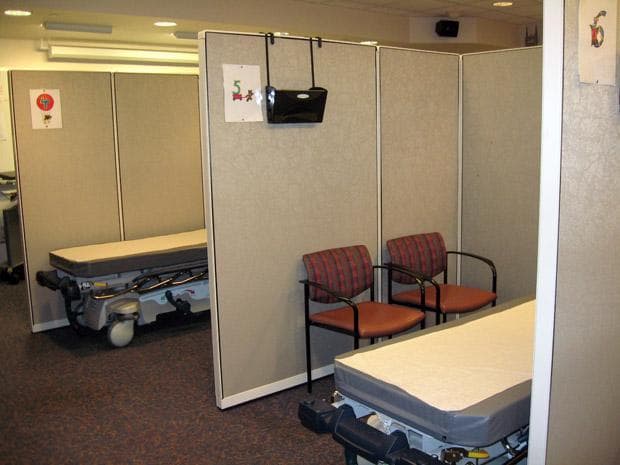
Six mobile hospital beds have been moved to the site, a former meeting room that’s now being used to fast-track patients with flu-like symptoms. (Sacha Pfeiffer/WBUR)
Dr. Mark Waltzman wishes they’d think twice before making that trip. He’s the assistant medical director of the Children’s Hospital emergency department, and he’s walking through a new, makeshift space at the hospital that has six beds, a doctor and two nurses.
“This used to be meeting rooms that, because of the H1N1 outbreak, we have proactively converted to actual examination rooms,” he explains.
Any child who comes to the ER with flu symptoms who’s over two years old and has no other medical problems gets sent here. Without this “alternative care site,” Waltzman says, the ER could be overwhelmed by minor flu cases.
“Families are obviously scared,” Waltzman says. “They’re getting mixed signals. They’re not sure what to do, so they assume, ‘We’ll just go to the teaching hospital down the street and either they’ll reassure us or they’ll give us the magic medicine.’ And, unfortunately, there’s no real magic medicine out there.”
Waltzman says that’s why an emergency room is not the best place for most kids with the flu — especially since being in a hospital exposes them to more germs and might spread the virus.
“This is a disease that should be started off in the primary care’s office,” he says. “The phone call first should be: ‘My child or I have these symptoms: cough, fever, runny nose. What do I do?’ ”
What you do in most cases is just rest, hydrate and hold tight. Otherwise, hospitals are at risk of being swamped not by a deadly virus, but by overreaction to what so far is mostly a mild disease.
- Beacon Hill »
- State House Roundup: That’s Quicksand, That Ain’t Mud
- Evacuation Day Repeal In Legislative ‘Purgatory’
- Listen: After Brown, Republican ‘Gains To Be Made’ In Many Districts
- Commentary »
- Littlefield: Finally, Soccer Has Major-League Problems
- Is Curling A Sport? (Who Cares?)
- Many Winter Olympians Already Have The Gold
- Crime & Justice »
- What’s New In Gardner Case? Just The Year
- Ex-Harvard Student Indicted In Dorm Shooting Death
- Mass. Court Upholds State Gun-Lock Requirement
- Energy »
- Everett Settles In With Its Big, New Neighbor In The Harbor
- Salazar’s Cape Wind Decision Is Difficult, For A Consensus Builder
- Patrick Calls For Plymouth Nuclear Plant Investigation After Vermont Leak
- Environment »
- Fishermen Gather For Summit On Industry’s Fate
- Everett Settles In With Its Big, New Neighbor In The Harbor
- Scientists Say Potential For Red Tide Outbreak Is High
- Ethics »
- Review: Mass. House Spending On DiMasi Case ‘Fair’
- Galluccio Resigns From Senate After Being Jailed
- After Sentencing, Fate Of Galluccio’s Senate Seat Remains Unknown
- Religion »
- As Construction Alters Closed Church, Jamaica Plain Builds Its Community
- Listen: Talk Of Renewal, But Few Decisions In Pope’s Irish Clergy Summit
- Irish Catholics Call For Cardinal Law’s Resignation, Following Clergy Abuse Report
- Sprint To The Senate »
- How He Did It: Behind The Scott Brown Win
- Scott Brown, The New Hero Of The GOP
- Tea Party Credited With Giving Brown A Winning Boost
- H1N1 Swine Flu »
- FAQ: Swine Flu Vaccine Availability
- Mass. Lifts Swine Flu Vaccine Restrictions
- Study: Swine Flu Is Relatively Mild Virus After All
- In Season 3, ‘Breaking Bad’ Characters Get Badder
- Live Video: House Debates Health Care Bill
- Rep. Lynch To Vote Against Health Care Bill
- ‘Not Ted Kennedy Reform’: Rep. Lynch Defends Vote Against Health Care Bill
- Stomach Virus Is Surging In Boston
- A Mural Of Many Colors Is One High School’s Lingua Franca
- Why We Gain Weight As We Age
- Senate To Take Up Unemployment Insurance Extension
- Rep. Gutierrez On Why The Health Bill Has His Vote
- House Opts For Straight Vote On Health Bill
- A Mural Of Many Colors Is One High School’s Lingua Franca
- Live Video: House Debates Health Care Bill
- In Season 3, ‘Breaking Bad’ Characters Get Badder
- Why We Gain Weight As We Age
- Mom-And-Pop Site Busts The Web's Biggest Myths
- Abraham Lincoln Reborn As A Vampire Slayer
- Invasive Plants Spreading As Climate Warms, Study Says
- Irish Catholics Call For Cardinal Law’s Resignation, Following Clergy Abuse Report
- Is The Bible More Violent Than The Quran?
- Profit And 'Peril' In The Secret Nuclear Trade
- Texas Textbook Tussle Could Have National Impact
- Why We Gain Weight As We Age
- Rep. Gutierrez On Why The Health Bill Has His Vote
- Bluff The Listener
- Prediction
- Who's Carl This Time?
- A Mural Of Many Colors Is One High School’s Lingua Franca
- Jail Hosts Exclusive SXSW Concert
- Lightning Fill In The Blank
- Thousands To Rally For Immigration Overhaul
-
Petrie-Flom Center Health Law Policy, Biotechnology and Bioethics Workshop; Glenn Cohen
March 22, 2010
At Harvard Law School, Hauser Hall -
The Three Hour, Learn Everything, Breastfeeding Class
March 22, 2010
At Crunchy Granola Baby -
ENCOUNTERING SLAVERY AND RACE IN NEW ENGLAND lecture at Myrtle Baptist Church
March 22, 2010
At Myrtle Baptist Church -
Bruce Marshall Monday Night Open Mic
March 22, 2010
At Smoken' Joes's


[...] [...]
There was a good discussion of H1N1, carried on WBUR on Wednesday, 7 October:
http://wamu.org/programs/dr/09/10/07.php#27155
Pete: How do you know Sacha did not ask questions? Do you differentiate between a doctor at Children’s Hospital and the government? Are they supposed to agree or disagree independently of the issue or problem?
[...] one dose is enough for everyone except children under the age of 10, who need two doses. NPR’s Morning Edition interviewed Children’s experts about what parents should do when they think their child has the [...]
[...] [...]
Sacha,
That is not an answer, its an echo of an assumption. Is that how reporters do things? Take Gov’t pronouncements, re-write them and publish them without asking questions? The media is promoting the fear surrounding this virus, but continue to peddle that fear with few facts.
I visit this site less and less because of this type of complacent journalism and now the increased advertising- Oh, sorry -”underwriting”.
Hi — WBUR’s Sacha Pfeiffer here. In response to Elizabeth’s question below: it’s true that the state, following CDC recommendations, is no longer testing people for what type of flu they may have. But most people now exhibiting flu-like symptoms are presumed to have the H1N1 swine flu virus because it’s generally too early in the season for regular seasonal flu. The seasonal flu should begin circulating soon, however, and when that happens it will be difficult to distinguish between the two strains without being tested.
How do we even know that people whow are sick have swine flu? I thought that they don’t even test for it anymore. More importantly, I was hoping someone educated (like someone at WBUR!) could respond to the article below. Here is the link:
http://articles.mercola.com/sites/articles/archive/2009/10/27/Obama-Declares-Swine-Flu-Emergency.aspx
Thank you for your help.