Massachusetts As Model: Can The Nation Afford Health Reform?
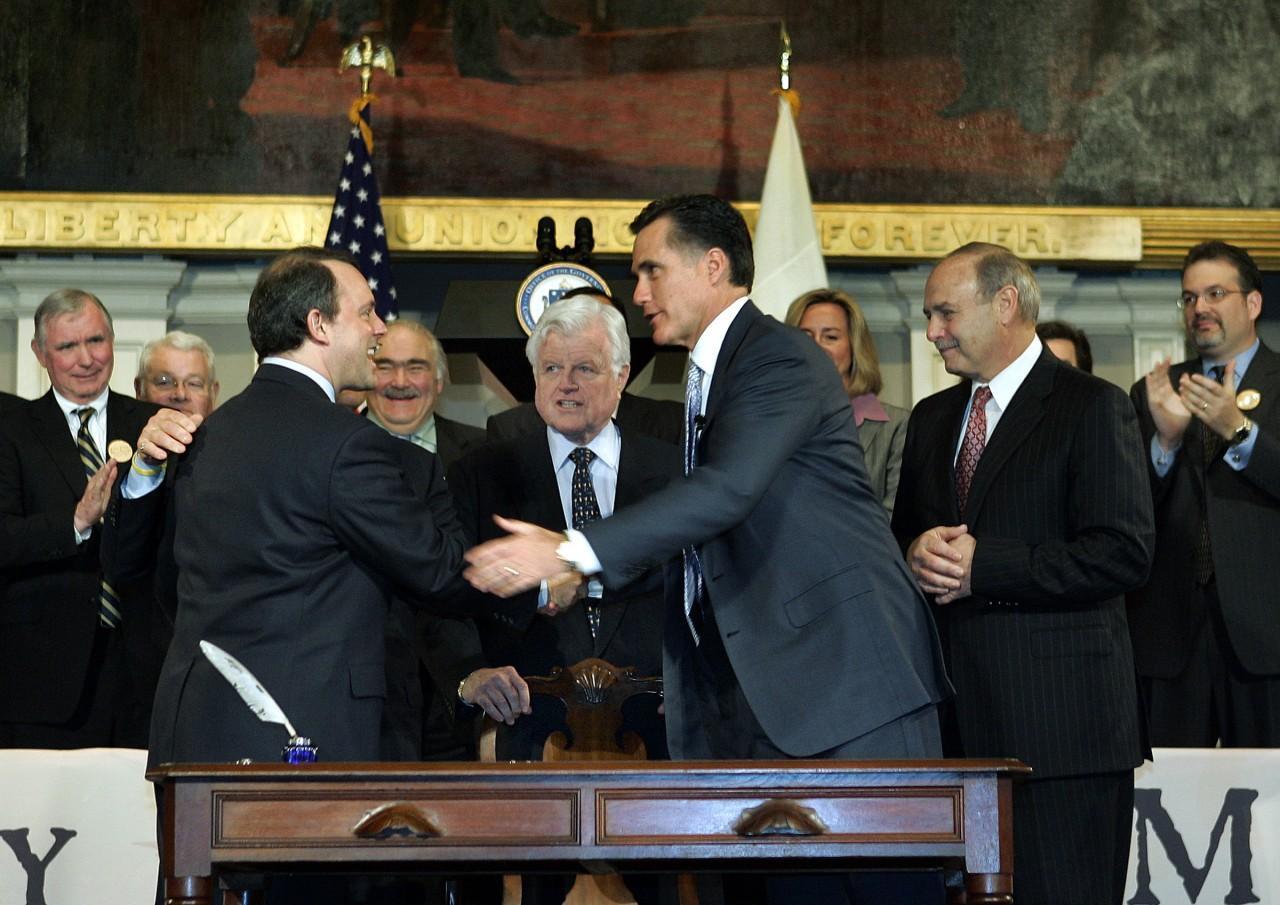
Then-Massachusetts Gov. Mitt Romney, center right, shakes hands with then-Mass. Health and Human Services Secretary Timothy Murphy as then-Sen. Edward Kennedy, center, looks on after signing into law a landmark bill designed to guarantee virtually all Massachusetts residents have health insurance on April 12, 2006. (AP)
BOSTON — When Massachusetts elects a new U.S. senator in January, that person could end up voting on the national health care reform bill being debated in Congress. The proposal is being modeled in part after the health reform law passed here in 2006 — and three years later, the state is still grappling with some of the details.
This is the first in a two-part series on the key political lessons of Massachusetts’ health care reform law, as WBUR’s Sacha Pfeiffer and Karen Brown of member station WFCR in western Massachusetts team up to look at the issue of affordability.
Urban Vs. Rural Reform
Whichever candidate lands in Congress is going to have to represent urban and rural viewpoints on health care reform.
When people debate the status of Massachusetts health reform, the key question tends to be: Is it affordable? More than 97 percent of all people in the state now have health insurance. Some of them get it through state-subsidized health plans, but those subsidies cost nearly a billion dollars a year.
Some critics say that has come at the expense of other needs, one of them being the state’s safety net hospitals. Those are the hospitals that serve mostly poor patients, and many of them are in western Massachusetts and other places outside Boston.
There are safety net hospitals in the Boston area, too, such as Boston Medical Center and Cambridge Hospital. They rely on reimbursement from the state to help pay for the subsidized care they provide, just like all the other safety net hospitals.
But the hospitals in western Massachusetts say they get even less state aid than those in Boston. In fact, they have just filed a lawsuit on that very matter. People like Hank Porten, president of Holyoke Medical Center, say the hospitals are having a hard time serving their patients.
“If you’re in a community that is not in dealing with the poor quotients that we do, then health care reform may be good for you,” Porten says. “But for communities that are heavily supporting the poor, the formula is not working.”
Reimbursements For Medicaid Patients
Part of the formula that Porten is talking about is how much doctors and hospitals get reimbursed for their Medicaid patients. As the economy has nose-dived, the state has reduced those reimbursements. So a hospital like Holyoke Medical Center, which has more than 70 percent Medicaid patients, has had to cut services and staff.
Some health care reformers say it’s better that patients have insurance than show up at the hospital uninsured. Hank Porten disagrees with them.
In the past, uninsured patients were covered by a special state fund that Porten says paid better than Medicaid. The problem now, he says, is that the state is spending so much for insurance plans for the low- and moderate-income residents that there’s very little money leftover for hospitals like his.
So Porten’s main advice to anyone who wants to replicate this system is to make sure there’s enough money to go around from the get-go.
Otherwise, he says, “you’re going to start causing big cracks in the system: physicians will leave, and hospitals will have to close services. So there has to be some continuity in how you’re going to fund this.”
Of course, there are plenty of people in Massachusetts who don’t think health reform is a money drain. When you ask Jon Kingsdale how state health reform is going, he says it’s been a huge success. Kingsdale runs the Connector, which oversees the state’s reform effort.
“There is a myth that covering most people in Massachusetts has been unaffordable,” Kingsale says. “I underscore the word myth because I think it is, frankly, a politically motivated attack on national health reform that is almost fact-free.”
Kingsdale says the cost of Massachusetts health reform is only about 1 percent of the state budget — hardly a budget buster. And he blames the recession for making health reform feel like more of a financial burden than it should.
Cover First, Figure It Out Later
There’s also the problem that health care costs keep going up. That adds to the burden on the state and also on individuals who buy insurance.
So Massachusetts created a special commission that’s looking into ways to cut those costs. One of its proposals is that doctors get a fixed amount of money each year to spend per patient. Kingsdale says that shows that health reform is a work in progress.
“Inevitably, a major bill on national reform will lead to a series of additional legislation to do mid-course corrections and improvements as we go along,” he says. “We’ve seen that in Massachusetts.
It’s probably worth noting that the state hasn’t done any payment reforms yet, and no one thinks that’s going to happen easily. In the meantime, the state is cutting some of the benefits it started with, like dental full health care for legal immigrants, and it’s increasing co-pays for its state plans.
But Kingsdale says in the meantime it’s important to get health insurance for as many people as possible. That’s the lesson he thinks Washington should take from Massachusetts: Cover people first, then figure out how to pay for all that coverage.
Congress is trying to figure out how to do both of those at once — and you can see how hard that is from the heated debate happening on Capitol Hill.
- Beacon Hill »
- State House Roundup: That’s Quicksand, That Ain’t Mud
- Evacuation Day Repeal In Legislative ‘Purgatory’
- Listen: After Brown, Republican ‘Gains To Be Made’ In Many Districts
- Commentary »
- Littlefield: Finally, Soccer Has Major-League Problems
- Is Curling A Sport? (Who Cares?)
- Many Winter Olympians Already Have The Gold
- Crime & Justice »
- What’s New In Gardner Case? Just The Year
- Ex-Harvard Student Indicted In Dorm Shooting Death
- Mass. Court Upholds State Gun-Lock Requirement
- Energy »
- Everett Settles In With Its Big, New Neighbor In The Harbor
- Salazar’s Cape Wind Decision Is Difficult, For A Consensus Builder
- Patrick Calls For Plymouth Nuclear Plant Investigation After Vermont Leak
- Environment »
- Fishermen Gather For Summit On Industry’s Fate
- Everett Settles In With Its Big, New Neighbor In The Harbor
- Scientists Say Potential For Red Tide Outbreak Is High
- Ethics »
- Review: Mass. House Spending On DiMasi Case ‘Fair’
- Galluccio Resigns From Senate After Being Jailed
- After Sentencing, Fate Of Galluccio’s Senate Seat Remains Unknown
- Religion »
- As Construction Alters Closed Church, Jamaica Plain Builds Its Community
- Listen: Talk Of Renewal, But Few Decisions In Pope’s Irish Clergy Summit
- Irish Catholics Call For Cardinal Law’s Resignation, Following Clergy Abuse Report
- Sprint To The Senate »
- How He Did It: Behind The Scott Brown Win
- Scott Brown, The New Hero Of The GOP
- Tea Party Credited With Giving Brown A Winning Boost
- H1N1 Swine Flu »
- FAQ: Swine Flu Vaccine Availability
- Mass. Lifts Swine Flu Vaccine Restrictions
- Study: Swine Flu Is Relatively Mild Virus After All
WBUR journalists present up-to-the-minute news, feature reports and analysis about the accelerated race to succeed the late Sen. Edward M. Kennedy, who served Massachusetts for 47 years.
- #Obama Restores Cash-Strapped #ACORN http://tinyurl.com/yjenoxq #teaparty #palin #GOP #sgp #hhrs #iamthemob #glennbeck #masen #dems #p2
- RT @Reenit: RT @MikeWise07: Sites and sounds today http://bit.ly/9IZlHq #KILLTHEBILL #sgp #hhrs #healthcare #hc #hir #hcr #obamacare #iamthemob #masen
- RT @MikeWise07: Sites and sounds today http://bit.ly/9IZlHq #KILLTHEBILL #sgp #hhrs #healthcare #hc #hir #hcr #obamacare #iamthemob #masen
- Sites and sounds today http://bit.ly/9IZlHq #KILLTHEBILL #sgp #hhrs #healthcare #hc #hir #hcr #obamacare #iamthemob #masen
- Rep. Lynch To Vote Against Health Care Bill
- A Mural Of Many Colors Is One High School’s Lingua Franca
- A Tale Of Three Cities: Budget Cuts Around Mass.
- In Season 3, ‘Breaking Bad’ Characters Get Badder
- Senate To Take Up Unemployment Insurance Extension
- Stomach Virus Is Surging In Boston
- Rep. Gutierrez On Why The Health Bill Has His Vote
- What’s New In Gardner Case? Just The Year
- ‘Not Ted Kennedy Reform’: Rep. Lynch Defends Vote Against Health Care Bill
- Why We Gain Weight As We Age
- A Mural Of Many Colors Is One High School’s Lingua Franca
- Why We Gain Weight As We Age
- Stomach Virus Is Surging In Boston
- The ‘Star’ of 2009, Seafood Industry Swims Against Economic Trends
- Toyota Deals Get Customers Back To Showrooms
- A Tale Of Three Cities: Budget Cuts Around Mass.
- Mom-And-Pop Site Busts The Web's Biggest Myths
- How A Few Made Millions Betting Against The Market
- ‘Not Ted Kennedy Reform’: Rep. Lynch Defends Vote Against Health Care Bill
- Boston Medical Workers Prepare For Haiti’s Unfamiliar Trauma
- WBUR Changes Weekend Program Lineup (90)
- Share Your Voting Experiences Today (84)
- Edward Kennedy, The Senate's Last Lion, Is Dead At 77 (65)
- Dems Question Why Brown Is Gaining On Coakley (64)
- Seeking Your Ideas For WBUR iPhone App (53)
- Irish Catholics Call For Cardinal Law's Resignation, Following Clergy Abuse Report (51)
- Brown Hits Back After Negative Coakley Ad (46)
- Obama Accepts Nobel Peace Prize As 'Call To Action' (45)
- Hollywood East's Less-Than Red Carpet Arrival (45)
- 'Absolutely' Wrong To Call Coakley-Brown Race A Statistical Tie (43)
- A Tale Of Three Cities: Budget Cuts Around Mass.
- Rep. Gutierrez On Why The Health Bill Has His Vote
- A Mural Of Many Colors Is One High School’s Lingua Franca
- Texas Textbook Tussle Could Have National Impact
- Boston Medical Workers Prepare For Haiti’s Unfamiliar Trauma
- Deaths Revive Cornell's Reputation As 'Suicide School'
- How A Few Made Millions Betting Against The Market
- Teachers Skeptical Of Obama's Education Plan
- Karl Rove 'In The Fight' Again With New Memoir
- Why We Gain Weight As We Age


Here’s an idea: Stop paying blindly for medical mistakes. My wife was almost killed at Johns Hopkins cardiology due to negligence. A $2k procedure wound up costing $200k. The insurance company paid without blinking and OUR insurance rates went up. Google “Adventures in Cardiology” to read all about it.
http://adventuresincardiology.com.
HELLO PEOPLE!!!!!! If you are on Medicare, Military champus or Tricare, or Medicaid …..You are on a government run plan!!! Wake up! They are just trying to pay the hospitals less than what they pay now which by the way is like 40 cents on the dollar……..Do some homework.
[...] In this case, cost-sharing refers to how much you pay for your health insurance versus how much your employer pays. One thing people may not realize: If you can’t afford your employer’s health plan, you’re stuck. You are automatically disqualified from the state’s subsidized plan. Part 1: Can The Nation Afford Health Reform? [...]
The answer is No, we cannot afford “Heath Reform” in the U.S. if that means everyone has health care because for many people that will mean the “government” will supply health care to those who, for any reason, can’t pay for their own. But by “government” means that the taxpayer will pay for it and, bottom line, we cannot afford that. We re already hopelessly in debt and no one has come up with a plan to control the rapid medical cost inflation, much less by Federal intervention.
Massachusetts healthcare requirements are not working. Where health insurance costs over $12,000 per year for a couple, and $25,000 per year for a family, citizens are being broken economically. The solution is to restructure the healthcare system and institute universal healthcare the way other civilized, developed countries have done. The MA solution is worse than no solution. It simply attempts to move the bill from the shoulders of the state to the shoulders of the citizens who can least afford to pay for it.
the focus on access and coverage is unfortunately misguided. neither federal health reform nor the current MA initiative does nearly enough to contain costs. without that key component as MA has learned the “success” of either will be severely compromised. take chronic illness as one example. MA has not followed the lead of many other states in initiating a comprehensive population wide program for the adult disabled to manage cost in this area.
LITTLE GIRL ON A PLANE
A Congressman was seated next to a little girl on an
airplane. He turned to her and said, ‘Let’s talk. I’ve heard that flights go quicker if you strike up a conversation with your fellow passenger.’
The little girl, who had just opened her book, closed it slowly and said to the total stranger, ‘What would you like to talk about?’
‘Oh, I don’t know,’ said the congressman. ‘How about global warming or universal health care’, and he smiles smugly.
OK, ‘ she said. ‘Those could be interesting topics. But let me ask you a question first. A horse, a cow, and a deer all eat the same stuff – grass. Yet a deer excretes little pellets, while a cow turns out a flat patty, and a horse produces clumps of dried grass. Why do you suppose that is?’
The legislator, visibly surprised by the little girl’s intelligence, thinks about it and says, ‘Hmmm, I have no idea.’
To which the little girl replies, ‘Do you really feel qualified to discuss global warming or universal health care when you don’t know s**?
[...] Reporter Sacha Pfeiffer and Karen Brown, of WFCR in Springfield, team up to report on the costs and other obs… across the state. Hospitals that serve the poor are suffering with reduced reimbursements, they [...]
I have to say, this story was informative, but I was very turned off by its blatant and inadequate emulation of NPR’s Planet Money format. Pfeiffer and Brown weren’t having a conversation – they were reporting two stories edited to make it seem like a conversation. The story was supposed to focus on the urban/rural issues regarding health care, but it just turned into a story about replicating healthcare.
Please stick to what you are good at: straight-forward, in-depth local reporting. The format left a bad taste in my mouth.