A New Frequency In Boston Public Radio News
BOSTON — This market has basically added a public radio news station.
WGBH may be better known for its TV channels. But it has taken over a commercial classical music radio station. That’s letting WGBH change its own programming to more directly compete with WBUR, long the dominant NPR news station in Boston. So what does this mean for the public radio listener?
WBGH finalized its purchase of WCRB for $14 million earlier this month. The commercial classical music station now becomes non-profit. And that changes the game for WGBH.
Jon Abbott, the general manager of WGBH, says his station is now free to drop classical music from its lineup on WGBH-FM.
“For us, our challenge was we really had three things we did especially well: news, classical music and jazz,” Abbott said. “And so the WCRB opportunity affords us the wider canvas to make a more consistent commitment to our news programs.”
“Public radio listeners in Boston should be elated about this,” said Mark Ramsey, a radio industry analyst. “Because this means there’s another outlet to serve a greater scope of their interests.”
WBGH is launching two daily talk programs. The prominent TV host Emily Rooney will host one of them. The station is also hiring two reporters. And it will still keep jazz in the evenings.
But going from one to two information stations doesn’t necessarily mean that listener financial support will double. Neither will the toned-down advertising called underwriting, on which public radio stations also depend.
That worries WBUR General Manager Paul La Camera.
“Whether the support system is there in corporate underwriting and listener donations to support two robust, vigorous news and information stations — that’s to be seen,” La Camera said.
WGBH’s move to a more uniform format is not a new strategy for public radio stations nationwide.
In Seattle, KUOW competes with KPLU. Both stations air Morning Edition and All Things Considered from National Public Radio. Both have strong local newsrooms.
The program director at KUOW, Jeff Hansen, said the net result is that the Seattle public radio audience is bigger.
However, “the two stations have less listening at that time of the day than they would if only one station were airing Morning Edition,” Hansen added. “So there’s a net increase to the market in listening, but a loss of listening to individual stations, if any of that makes sense.”
The trend in Washington state can also be seen in reverse in Washington, D.C. Two public radio news stations there were going head to head. Then one changed wholesale to classical music. The number of listeners went up at each.
Across the country, Los Angeles is home to one of the more competitive public radio markets. The general manager of KCRW, Ruth Seymour, saw her station lose listeners when a new competitor came along. But she says her station lost complacency, too.
“We’re a better station because they’re there,” Seymour said. “They’re probably a better station because we’re here.”
Each market is different. But Seymour says what public radio stations everywhere need to do better is get new listeners. And she says competition can help with that. “If you worry about the people you have, you’ll never have any more than the people you have,” she said.
Which is why some industry analysts criticize WGBH for stopping short of its potential for new programming.
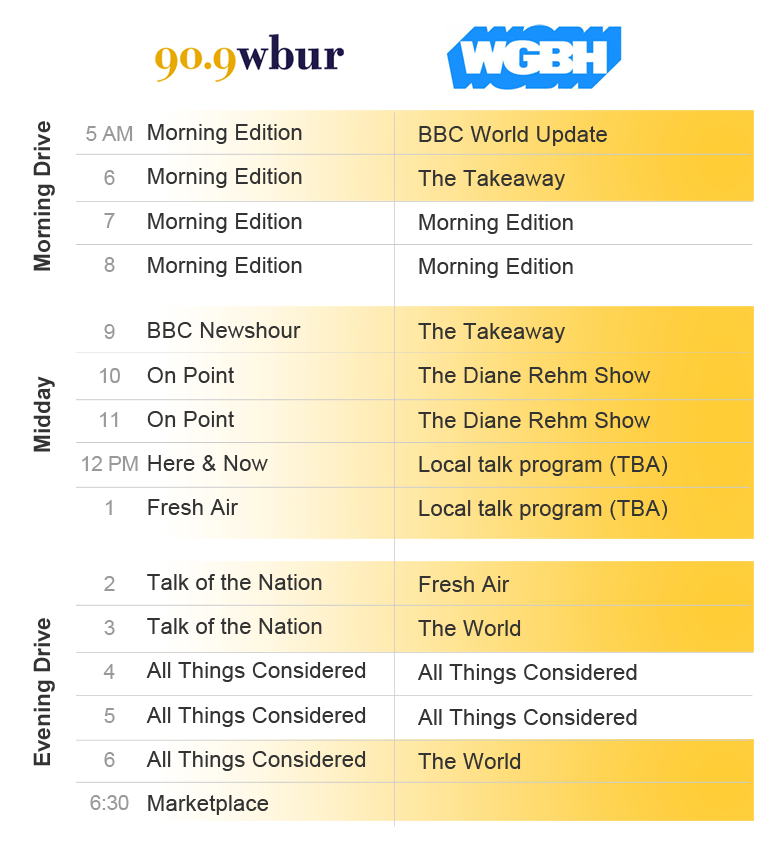
Radio consultant Mark Ramsey says the more differentiated and distinctive radio programming is, the better for listeners. He calls it unfortunate that both WGBH and WBUR air the same programs, Morning Edition and All Things Considered, during the key parts of the day.
“The point in having two alternatives is that they’re actual alternatives,” Ramsey said. “Those are huge blocks of the day in which the two stations sound almost exactly the same. That’s not choice, that’s redundancy.”
Now, WGBH had already been airing those news shows. It left those alone. It’s just adding new talk programming in between. The station’s general manager, Jon Abbott, said public radio listeners here will benefit with more choice.
“Boston’s really fortunate because it’s going to have two accomplished stations and the chance for folks who really want to stay engaged and informed to have more at their fingertips, more at their ears,” he said. “And I don’t see it really so much as competition as an ambition we both share to do better by Boston and by this region to keep them informed.”
“You know, it’s funny, public radio can be very genteel,” said WBUR GM Paul La Camera.
“A couple of us came out of the commercial side of the business and so, you know, the competitive aspect now is exhilarating and inspiring,” he went on. “We have no intention of surrendering any of the ground that WBUR enjoys in Boston right now and, in fact, we intend to gain even higher ground.”
What is clear is that both WBUR and WGBH have more than just each other to worry about. Their futures may depend more on how well they harness the ever-growing power and importance of digital media.
- Beacon Hill »
- Listen: After Brown, Republican ‘Gains To Be Made’ In Many Districts
- Republicans Hope To Double Their Beacon Hill Presence
- Republicans Early Targets at Southie Breakfast
- Commentary »
- Littlefield: Finally, Soccer Has Major-League Problems
- Is Curling A Sport? (Who Cares?)
- Many Winter Olympians Already Have The Gold
- Crime & Justice »
- Ex-Harvard Student Indicted In Dorm Shooting Death
- Mass. Court Upholds State Gun-Lock Requirement
- Boeri: Bishop Story Has More Holes Than A Sieve
- Energy »
- Everett Settles In With Its Big, New Neighbor In The Harbor
- Salazar’s Cape Wind Decision Is Difficult, For A Consensus Builder
- Patrick Calls For Plymouth Nuclear Plant Investigation After Vermont Leak
- Environment »
- Fishermen Gather For Summit On Industry’s Fate
- Everett Settles In With Its Big, New Neighbor In The Harbor
- Scientists Say Potential For Red Tide Outbreak Is High
- Ethics »
- Review: Mass. House Spending On DiMasi Case ‘Fair’
- Galluccio Resigns From Senate After Being Jailed
- After Sentencing, Fate Of Galluccio’s Senate Seat Remains Unknown
- Religion »
- As Construction Alters Closed Church, Jamaica Plain Builds Its Community
- Listen: Talk Of Renewal, But Few Decisions In Pope’s Irish Clergy Summit
- Irish Catholics Call For Cardinal Law’s Resignation, Following Clergy Abuse Report
- Sprint To The Senate »
- How He Did It: Behind The Scott Brown Win
- Scott Brown, The New Hero Of The GOP
- Tea Party Credited With Giving Brown A Winning Boost
- H1N1 Swine Flu »
- FAQ: Swine Flu Vaccine Availability
- Mass. Lifts Swine Flu Vaccine Restrictions
- Study: Swine Flu Is Relatively Mild Virus After All
- Rain Damage, Detours Hinder Commutes In Northeast
- Senate To Take Up Unemployment Insurance Extension
- Stomach Virus Is Surging In Boston
- Patrick Declares State Of Emergency As Rain Storm Continues
- Heavy Rain Continues To Pour On Mass.
- Why We Gain Weight As We Age
- UAW Brokers First Union Contract Under Tribal Law
- Unemployment Rate Doubles For Older Women
- Rough Weather Hits Southern New England
- Coffee Party Founder Wants Common Grounds
- Stomach Virus Is Surging In Boston
- Unemployment Rate Doubles For Older Women
- The End Of 9-to-5: When Work Time Is Anytime
- The End Of 9-To-5: When Work Time Is Anytime
- UAW Brokers First Union Contract Under Tribal Law
- Rabbi Kushner: An 'Accommodation' With God
- Heavy Rain Continues To Pour On Mass.
- Why Making Healthful Foods Cheaper Isn't Enough
- Why We Gain Weight As We Age
- More Employers Make Room For Work-Life Balance
- Peter Gabriel: No Guitars, No Drums, All Covers
- Why We Gain Weight As We Age
- Jesus And The Hidden Contradictions Of The Gospels
- St. Patrick’s Roast As Comedy Club? ‘No, Nay, Never No More’
- Obama Proposes Dismantling No Child Left Behind
- Coffee Party Founder Wants Common Grounds
- Umm Kulthum: 'The Lady' Of Cairo
- The Outsiders Who Foresaw The Subprime Crisis
- Obama's Attorney General Under Attack
- Calif. Governor Candidates Clash At GOP Convention
-
Distinguished Writers Series: Francine Prose
March 16, 2010
At Newhouse Center for the Humanities, Wellesley College -
Demystifying the Townsends and Goddards: An Exploration of Newport Cabinetmakers
March 16, 2010
At Doris Duke's Rough Point Mansion -
Atrium School Founder's Lecture with acclaimed author, Tracy Winn
March 16, 2010
At Atrium School -
The Art of the Wellesley College Multifaith Center
March 16, 2010
At Houghton Chapel, Wellesley College


How the mighty have fallen. WGBH is doomed with crippling overhead and radio programs that sound like Geraldo Rivera on home-made whiskey.
Who in the WORLD are these consultants, and who actually pays for this insane advise?
I’m FURIOUS with WGBH for relinquishing the classical format on 89.7.I will never give them another cent. WGBH’s signal (formerly WCRB 99.5) is inaudible and static-y in my section of Boston and, I can’t get it at all past about Framingham on the MA Pike. WCRB’s selling the signal to the country station a couple of years ago was a big mistake. That is most likely why they lost major listenership and went out of business. There is now effectively only one classical alternative on the entire dial, except for Harvard radio which is my new station since abandoning WGBH. Harvard does a GREAT job, and plays music which isn’t the usual 20 pieces we are all sick to death of. (I am a professional musician) I have always relied on WBUR for the news, that is, after THEY abandoned the classical music programming, which in my opinion was far better than WGBH’s. I admire the Washington state model in which the two public stations complement one another and listenership has gone up at both. Why is this incredibly intelligent and monetarily successful model not being embraced by WGBH? They are making a TON of enemies in the professional classical music community in Boston. And the redundancy at certain news times is so ridiculous, as others have pointed out. This situation just reminds me of today’s economic climate which is geared to price of stock, NOT customer satisfaction. Today’s CEO’s are trained to think about one thing only, the sacred “Bottom Line”. And they will trod over workers, customers and even their own reputation to meet some industry standard of financially viable, based on very short range criteria. It is a sad trend, and speaks to a set of values which I do not share.
Paul La Camera’s whiney voice is sooooo annoying. He should not be on air, “thanking” people and begging for money. A major turn-off.
With regards to Jeff Boudreau’s comment about WUMB, perhaps WUMB should change to all classical music. The classical radio station that WGBH bought can’t be heard south of Boston, but WUMB’s station can be heard on Cape Cod.
Almost everything on WBUR and WGBH is available via the internet and iTunes podcast
No pledge drives, no interruptions, no breaks, all free !
BOOO! Why would they take away my classical music? First WBUR, then WGBH! ARgh!
I’m having a hard time understanding why WGBH is competing, now working with, WBUR especially sine the programming will be nearly identical. And besides, don’t program podcasts make choosing between two different radio stations irrelevant anyways?
Early predictions & observations:
* NPR frequently gets accused of having a liberal bias, but with WBUR, I’ve never been able to pick up on it. To me, it’s just a good, solid, informational news station. So far, that hasn’t changed.
* Something needs to be done about the pledge drives. Either come up with new strategies, or coordinate to have them during the same periods, or something. Didn’t WBUR just have one right before Thanksgiving, 3 weeks ago? Promising that this one is “the last pledge of the year” isn’t encouraging when it’s December 18th and January is just a couple short weeks away. Listeners are just going to bounce to the station that isn’t groveling for money if it’s all the same shows anyway.
* Since WBUR has been having pledge week again, I’ve been listening to the WGBH shows on the way to & from work this week. Maybe it’s just the editorial angle of “The World”, maybe it’s the fact that the Copenhagen climate change conference is this week, but what I’m hearing on WGBH seems *much* more liberal than anything I ever hear on WBUR. And *I’m* a liberal: I don’t mind hearing voices that echo my personal view of the world, but I also want to hear any reasonable counterbalance to that on the other side (or, gosh, not put everything on a simple left-right spectrum.
* My prediction: if neither station blinks and they keep plunging ahead as competing, overlapping NPR News stations, then WBUR ends up taking the “CNN” role of centrist, mainstream news coverage, while WGBH takes the “MSNBC” role of left-leaning coverage, as a counterbalance to right-leaning talk shows on the commercial end of the spectrum.
Correction, “Supporters of Folk and Blues on WGBH” was created 11/7/09.
Since Ms. Teehan introduced WUMB into a thread about WGBH’s programming changes……
1. To learn more of WGBH’s program and format changes impact opon the Boston-area folk and blues communities, read “Supporters of Folk and Blues on WGBH” –
http://www.facebook.com/group.php?gid=201481030324&ref=ts
a facebook group created 11/7/08, when news of the demise of the programs were posted to NEFolknRoots –
http://groups.yahoo.com/group/NorthEastFolknRoots/message/8578
2. Ms Teehan’s (1) suggestion (“The folk and blues community will just have to tune in to WUMB 91.9, the other public radio station in Boston”), may be true for the wee hours or weekends, when vestiges of those genre can be heard. But many in the Boston folk and blues communities have given up on WUMB (2). About two years ago WUMB switched format from those genres (actually folk and roots, as still mandated by its mission statement on the office of enrollment website) to “music mix”, which is some kind of federally-mandated hodge podge that includes a lot of rock, contemporary country and pop-folk.
WUMB’s Monday-Friday evening programming, some 20 hours/week, is the broadcast and repeat broadcast of “World Cafe”, produced by pop station WXPN and syndicated through NPR –
http://www.npr.org/templates/rundowns/rundown.php?prgId=39&agg=1
At the time of the folk-to”music mix” switch, “World Cafe” replaced locally produced programs.
WUMB’s Monday-Friday daytime hours are filled with songs selected by a music director who has a AAA background (WBOS, WZLX), many of which are played over and over and over and over again ad nausium. That is NOT folk programming.
Unlike Naomi Arenberg, Brad Paul and Brendan Hogan, who produced their own programs, WUMB’s “on-air personalities”, two of whom have >30 years folk experience each, do not have the freedom to produce their own shows and are reduced automatons repeating the same scripted lines about the artists and songs played. What a waste of talent!
3. If one wishes to listen to true folk, blues, Celtic, bluegrass, Cajun and zydeco programs Monday through Friday daytime, I suggest using the NEFolknRoots calendar –
http://groups.yahoo.com/group/NorthEastFolknRoots/cal
as a guide.
Jeff Boudreau
Independent not-for-profit folk concert producer
http://notlobmusic.googlepages.com
(1) Ms. Teehan has a vested interest in WUMB, as UMass Boston vice-chancellor or enrollment, she is the station’s boss.
(2) WUMB’s Arbitron numbers continue to decline –
Sep-09
0.4
59,300
Oct-09
0.3
44,300
Nov-09
0.2
33,500
Source –
http://www.radio-info.com/site/markets/grid/boston
Perhaps if Ms. Teehan and WUMB created a forum similar to this one to allow members of the folk and roots community to freely and publicly express themselves, and took the community’s input seriously, WUMB’s Arbitron ratings would not be shrinking.
The folk and blues community will just have to tune in to WUMB 91.9, the other public radio station in Boston.
Well said, Sarah
How sad that there is no longer any room for folk music. How sad, too, that there is competition between ‘BUR and ‘GBH–does that mean that we listeners will have our ears constantly assaulted by money ads instead of mostly? It is enough to drive one to CDs all the time!
What doesn’t get said in this is that WGBH has not only dropped classical music but it’s long running folk and blues shows. That’s an area where it could have stayed competitive – and been faithful to the”public” part of public radio by providing a vital outlet to the folk and blues world. As a musician and longtime supporter of both GBH and BUR, I think my money will go to BUR only in the future.