When Rivers Run Dry: Northeast Wrestles With Water Shortages
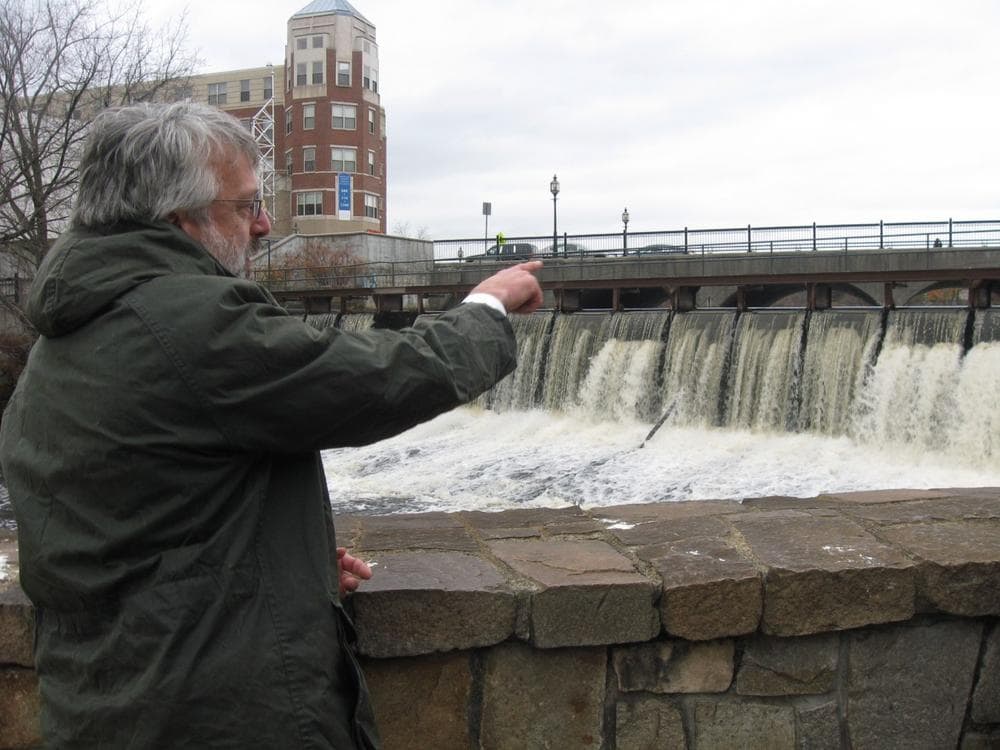
Bob Zimmerman of the Charles River Watershed Association points to the gushing Moody Street Dam in Waltham, which can slow to a trickle in the summer. (Sacha Pfeiffer/WBUR)
WALTHAM, Mass. — If you really use your imagination, this sounds a little bit like Niagara Falls. But it’s just the Moody Street Dam, where the Charles River isn’t always so thunderous.
“Literally, at times in the summertime, particularly in August and early September, this would be a trickle coming over this dam,” said Bob Zimmerman, executive director of the Charles River Watershed Association. “And there are times where it doesn’t flow at all.”
When rivers run low, that threatens the wildlife that depend on the rivers for survival. So Zimmerman says states need to get serious about limiting how much water is taken out of streams and rivers for human use.
“If we don’t do that,” he cautioned, “these rivers are going to seriously suffer, and we really will run into a shortage-of-water problem.”
We get drinking water from many places, including wells and reservoirs, such as the Quabbin. But we also get it from rivers and streams, where we share it with fish.
That isn’t easy. For one thing, stream flow isn’t a constant. When snow melts in the spring, rivers rise. In the heat of the summer, they slow down — yet that’s when people want the most water.
And it’s when our systems have pumped rivers dry.
“That really is not acceptable,” said Laurie Burt, commissioner of the Massachusetts Department of Environmental Protection.
“The challenge,” she added, “is how do we make sure that doesn’t happen, but that we are also providing water when it’s needed and where it’s needed?”
Four prominent conservation groups recently resigned from a state panel in Massachusetts because of a new policy they said could let rivers turn to mud. They rejoined after Burt’s office rescinded that policy.
“What we urgently need, and has been needed for a very long time,” Burt said, “is to be able to predict how much water can safely be withdrawn from a river basin.”
Thousands of fish were killed because rivers were pumped dry in Massachusetts and Connecticut. Some reservoirs in New York are dangerously low. In Maine, Vermont and New Hampshire, snow-making takes millions of gallons of water from streams and rivers.
And Elizabeth Gara, executive director of the Connecticut Water Works Association, is worried.
“People are so used to turning on the faucet and having a nice, clean, ample supply of water,” Gara said, “and they don’t understand all of the work and all of the money that goes into making sure that that water is coming to them in that way.”
Connecticut has proposed new rules that would redirect more water to rivers and streams and less to public use.
But Gara warns this could hamper economic growth and force water utilities to restrict people from filling swimming pools and washing cars.
“We have to be very careful when we deal with water allocation policies that we make sure that when we’re trying to protect aquatic life,” Gara said, “that we don’t do that to the detriment of human life.”
But some states are already imposing tough restrictions.
Vermont, for example, regulates how much water ski resorts can divert. Maine sets a minimum flow for its streams and rivers. And Massachusetts is working to define the amount of water that can be taken safely from its waterways.
Mark Smith of the Nature Conservancy says more states should consider these kinds of steps.
“As I like to say, fish can’t hold their breath,” Smith said. “So even if [a river] is just dry for a day or two, and that’s not natural, it really can cause fish kills and very dramatic outcomes.”
Of course, a lot of money — millions of dollars — has gone into reservoirs and water treatment facilities. So if restoring a dry river means removing a dam or decommissioning a treatment plant, that’s probably going to cause a big fight.
But Smith says some communities have taken those dramatic measures. Case in point: the town of Reading stopped using its wells because they were sucking too much water out of the Ipswich River.
“It’s often pitted as fish versus people, or people versus fish,” Smith said. “But the issue that we’re working on is how to make it an ‘and’ statement — that it’s water for people and water for nature, and how do you really figure that out?”
For now, there’s no one answer. It’s a long-term question that the federal government lets the states decide. But it’s important to resolve because — even in this water-rich region — demand threatens supply.
- Beacon Hill »
- Evacuation Day Repeal In Legislative ‘Purgatory’
- Listen: After Brown, Republican ‘Gains To Be Made’ In Many Districts
- Republicans Hope To Double Their Beacon Hill Presence
- Commentary »
- Littlefield: Finally, Soccer Has Major-League Problems
- Is Curling A Sport? (Who Cares?)
- Many Winter Olympians Already Have The Gold
- Crime & Justice »
- What’s New In Gardner Case? Just The Year
- Ex-Harvard Student Indicted In Dorm Shooting Death
- Mass. Court Upholds State Gun-Lock Requirement
- Energy »
- Everett Settles In With Its Big, New Neighbor In The Harbor
- Salazar’s Cape Wind Decision Is Difficult, For A Consensus Builder
- Patrick Calls For Plymouth Nuclear Plant Investigation After Vermont Leak
- Environment »
- Fishermen Gather For Summit On Industry’s Fate
- Everett Settles In With Its Big, New Neighbor In The Harbor
- Scientists Say Potential For Red Tide Outbreak Is High
- Ethics »
- Review: Mass. House Spending On DiMasi Case ‘Fair’
- Galluccio Resigns From Senate After Being Jailed
- After Sentencing, Fate Of Galluccio’s Senate Seat Remains Unknown
- Religion »
- As Construction Alters Closed Church, Jamaica Plain Builds Its Community
- Listen: Talk Of Renewal, But Few Decisions In Pope’s Irish Clergy Summit
- Irish Catholics Call For Cardinal Law’s Resignation, Following Clergy Abuse Report
- Sprint To The Senate »
- How He Did It: Behind The Scott Brown Win
- Scott Brown, The New Hero Of The GOP
- Tea Party Credited With Giving Brown A Winning Boost
- H1N1 Swine Flu »
- FAQ: Swine Flu Vaccine Availability
- Mass. Lifts Swine Flu Vaccine Restrictions
- Study: Swine Flu Is Relatively Mild Virus After All
- A Mural Of Many Colors Is One High School’s Lingua Franca
- A Tale Of Three Cities: Budget Cuts Around Mass.
- Rep. Lynch To Vote Against Health Care Bill
- Senate To Take Up Unemployment Insurance Extension
- Rep. Gutierrez On Why The Health Bill Has His Vote
- What’s New In Gardner Case? Just The Year
- Stomach Virus Is Surging In Boston
- ‘Not Ted Kennedy Reform’: Rep. Lynch Defends Vote Against Health Care Bill
- Texas Textbook Tussle Could Have National Impact
- Why We Gain Weight As We Age
- A Mural Of Many Colors Is One High School’s Lingua Franca
- Why We Gain Weight As We Age
- Stomach Virus Is Surging In Boston
- The ‘Star’ of 2009, Seafood Industry Swims Against Economic Trends
- Toyota Deals Get Customers Back To Showrooms
- A Tale Of Three Cities: Budget Cuts Around Mass.
- How A Few Made Millions Betting Against The Market
- ‘Not Ted Kennedy Reform’: Rep. Lynch Defends Vote Against Health Care Bill
- Boston Medical Workers Prepare For Haiti’s Unfamiliar Trauma
- Deaths Revive Cornell's Reputation As 'Suicide School'
- A Tale Of Three Cities: Budget Cuts Around Mass.
- Rep. Gutierrez On Why The Health Bill Has His Vote
- A Mural Of Many Colors Is One High School’s Lingua Franca
- Boston Medical Workers Prepare For Haiti’s Unfamiliar Trauma
- Texas Textbook Tussle Could Have National Impact
- Deaths Revive Cornell's Reputation As 'Suicide School'
- How A Few Made Millions Betting Against The Market
- Teachers Skeptical Of Obama's Education Plan
- Karl Rove 'In The Fight' Again With New Memoir
- Is The Bible More Violent Than The Quran?
-
Singers' Workshop presented by Blue Heron Renaissance Choir
March 20, 2010
At Church of the Good Shepherd -
Face Painting Fun at The Discovery Museums
March 20, 2010
At The Discovery Museums -
Heritage Craft Fair
March 20, 2010
At Keefe Technical High School -
Brbara Pym Society Spring Conference
March 20, 2010
At Harvard University Barker Center


I co-authored an article in 2007 that showed data, for 6 MA towns in the past ~20 years, that the # of days per year where the towns was under a water-use restriction (voluntary or mandatory) has increased, while the amount of precipitation has also increased (or at least not decreased).
Peter, your comment makes the assumption that human population growth is flat or negative. Do you really think it is? In fact it as growing and become more tightly clustered in higher densities, increasing dramatically the local water needs of the human population. Unfortunately, the supply of fresh water is finite. As we take water out of our environment for public and industrial uses we take it away from the natural world and often pollute it badly before returning it to it’s source making it unusable by either. Your skepticism that our increasing population is not impacting water resources defies common sense.
As I understand it, most of the water that goes into the sewerage outfall pipe is fresh. That water leaks into the porous sewerage system instead of returning to the lakes and streams.Maybe we could get some TARP money to fix this archaic system.
In addition to creating legistlature to protect our waterways from overuse, I think that we should educate the public about ways to conserve water right at home. I do not think that we can keep pretending that water is a given and not a precious resource. If we take the wildlife out of the equation, which I certainly do not condone, we are still looking at a picture in which fresh water is finite, whether we like it or not.
Peter, I’m not sure statistics are needed, although they would be required before any substantive action is taken. In my town, accelerated development is causing the water company to pump more water from our reservoir and underground wells and they want to open more wells to accommodate growth. That activity is having a dramatic impact on the Weir River, which in the summer, often ceases to exist — which never used to be the case.
It seems to me that this is a lot of hand wringing, but about what? Is there less precipitation than “before”? Do the ski resorts keep and store the water now, after the skiing season? I would like to see some comparative statistics about increasing water use and precipitation in New England over a decade and whether that increase reflects a net loss, gain, or is stable.