Support WBUR
Economic Roundtable: 14 Tough Months In Massachusetts
In late 2008, the federal government had just initiated the first wave of bailouts. Economists had begun to warn that the country was entering a deep recession. Massachusetts lawmakers said they would have to consider cutbacks in local aid to cities and towns. To get a sense of the fears and frustrations of everyday people, WBUR invited a diverse group of Massachusetts residents to come into our studios and share their experiences in a worsening economy.
- Schlander Campbell: lead dental X-ray technician at Boston Medical Center
- Helen Ramirez: office manager for Chelsea Police Department
- Dave Ratner: owner of Dave's Pet Foods
- Bob Sicotte: contract worker for Fiberfit Insulation
- Jerry Rappaport, Jr.: owner of real-estate investment management firm New Boston Fund
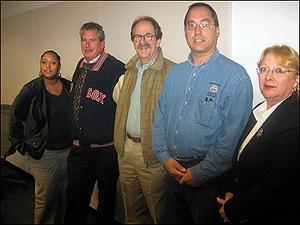
The group came into our studios first in October 2008, again in March 2009 and finally in January 2010. After 14 months, the economy continues to stagnate. The housing market is showing signs that sales are picking up, but prices remain down. A recent labor market report found job losses slowing, but not as fast as some analysts expected.
Listen back through the three conversations to hear what they faced, what they overcame and the challenges they still see ahead.
October 2008:
Schlander feels she is “at a crunch,” and worries she will soon have to choose between heating her home, putting food on her table and filling her gas tank.
Helen is coping with having recently gone from a two-income household to a one-income household, and has been trying to sell her home for 200 days — without luck. “I’d like to see some relief, I guess,” she says.
Dave has recently moved two of his stores into larger spaces and is trying to rent out some of that space to help with his “huge mortgage,” but says there aren’t any “retail people crazy enough besides me.”
Bob is concerned that work might dry up if the banks stopped lending money. At 54 years old, Bob worries about sending his daughter to nursing school while preparing for retirement.
Jerry is confronting "an economy as bad as I've ever confronted in my lifetime." The housing market is frozen and the business community is hamstrung. "When you depend upon the banks," he says, "they're in as big a crisis as they've been since the Depression."
March 2009:
Schlander says “it’s definitely been a hard winter.” She’s been working hard to cut back on her heating bills, but she says she’ll still need to get on a budget plan to pay it all off.
Helen is still trying to sell her home. She had hoped she could get some help from the new government programs, but her good record meant she wasn’t able to qualify for any mortgage relief. She tried to refinance, but she’s lost all the equity on her house. Helen says she’s “hanging on by her fingernails.”
Dave considers himself pretty lucky. As a business owner, he says his profits are down and he’s in “survival mode,” but being in the pet industry has kept him afloat. No matter how bad it gets people won’t stop feeding their pets — but rather than buy the more expensive, all-natural dog foods, they’re choosing to go for the generic stuff.
Bob is down to a four-day work week. His union instituted the shortened week in an effort to prevent further layoffs after a round in January. But, like Dave, Bob says he feels pretty lucky compared to many other union workers in the area. He says his trade is doing “a lot better than all the other trades around Boston.”
January 2010:
Helen, who had considered walking away from her house, sought financial advice and decided to stick it out. She was able to refinance at a lower rate. "I'm not feeling 100 percent confident," she says, "but I do feel better."
Dave continues to consider himself lucky to be in the pet food business. "We're still getting customers coming through the door," he says.
Bob is back to working five days a week, thanks to a lucrative project his union landed with the Dana Farber Cancer Center. He's working as a foreman. But many of his friends aren't so lucky. He estimates 30 percent of them are unemployed. "The industry is just so bad right now," he says. "You'd be hard-pressed to find a crane in the city."
Jerry says his company has weathered "as brutal a year" as he could imagine — letting go 20 percent of their workforce. Commercial real-estate values have fallen 40 percent in the last year and a half. The good news, he says, is the cooperation from banks he's been working with.
This program aired on January 7, 2010. The audio for this program is not available.