Listen LIVE button

WBURLike It Or Not, Poe Was A Boston Boy

Published January 19, 2010  Updated January 21
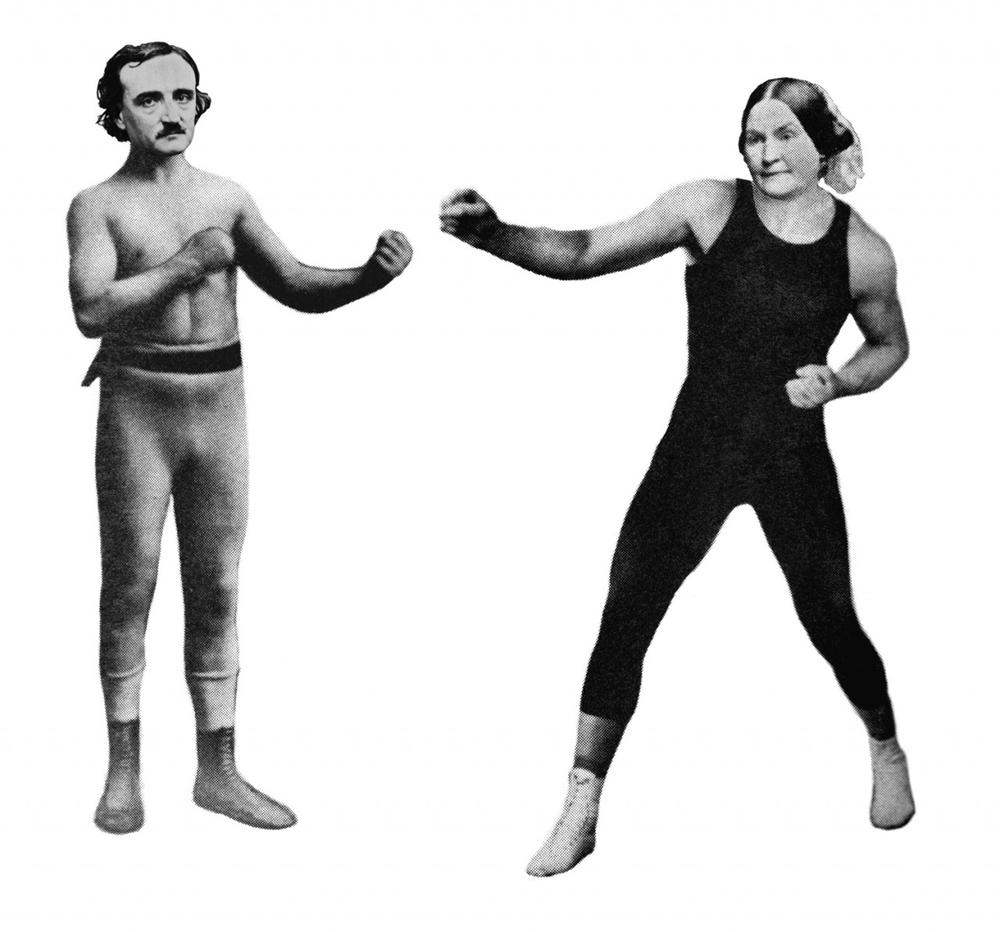
Edgar Allan Poe, proprietor and editor of the Broadway Journal, v. Cornelia Wells  Walter, editor of the Evening Transcript. (Image by Kerry Burke, Media Technology Services, Boston College)

Edgar Allan Poe often sparred with other Boston writers, whom he thought of as overly high-brow and didactic. In 1845, Poe, then proprietor and editor of the Broadway Journal, engaged in rhetorical combat with Cornelia Walter, a Boston Evening Transcript editor. (Image by Kerry Burke, Media Technology Services, Boston College)

BOSTON — On this day, 201 years ago, gothic writer Edgar Allan Poe was born. The master of the macabre came into this world right here in Boston. But, as legend has it, Poe hated his home town — and Boston hated Poe right back.

Now Poe scholar Paul Lewis wants to set the record straight with a new exhibition that reunites the horror writer with his birth place. It’s called “The Raven and the Frog Pond” and it’s currently open at the Boston Public Library.

As it turns out, one of Poe’s most famous short stories, “The Tell-Tale Heart,” was first published in a Boston literary journal in 1843. The publication is one of Lewis’ strongest pieces of “literary evidence” connecting Poe with the town where he was born.

Lewis curated the show and is also a literature professor at Boston College. As he showed me around the gathering of objects from the library’s holdings and private collections, Lewis pointed to another bit of proof: the first edition of the gothic writer’s first book of poetry, “Tamerlane and Other Poems.”

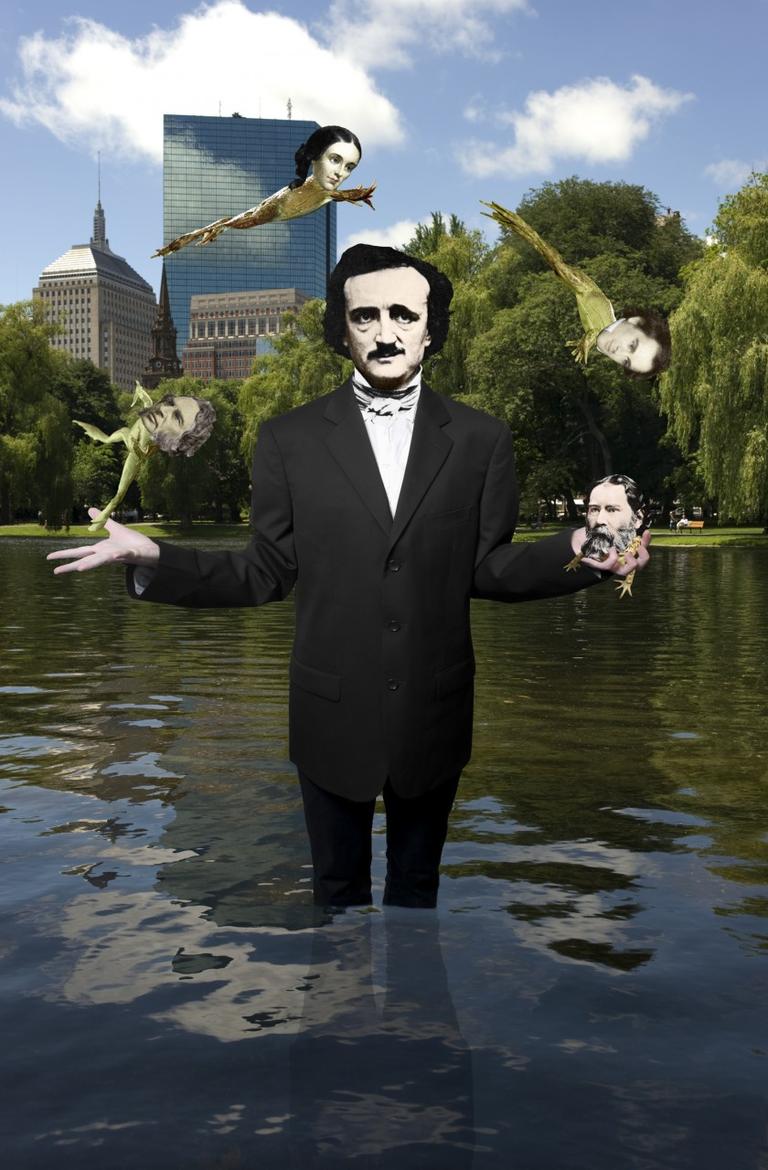
A. Henry Wadsworth Longfellow B. Margaret Fuller C. Nathanial Hawthorne D. James Russell Lowell (Image created by Kerry Burke, Media Technology Services, Boston College)

Poe called Bostonians "Frogpondians," because of their moral croakings. Among the Boston authors he was harshly critical of were, from left, Henry Wadsworth Longfellow, Margaret Fuller, Nathanial Hawthorne and James Russell Lowell. (Kerry Burke)

“He published it here in Boston in 1827 when he was 18 years old,” Lewis explained, “and he wrote on this very crude cover ‘by a Bostonian’ in the author line. You don’t write that in the author line of your first book if you hate everything about Boston.”

Lewis argues that Poe’s time in Boston influenced his development as a writer. But advocates in other cities where Poe lived are also laying claim to his legacy, including Edward Petit, the self-appointed “Philly Poe Guy.”

“Philadelphia was really the place that honed and helped shape Poe’s craft,” Petit said. “You know, the kind of works that we still read, that stuff happened in Philadelphia.”

Then Petit listed off Poe’s greatest hits: ” ‘The Black Hat,’ ‘Murders in the Rue Morgue,’ ‘Fall of the House of Usher,’ ‘Pit and the Pendulum,’ ‘William Wilson,’ ‘The Gold Bug’ — and he began writing ‘The Raven’ while he was still living in Philadelphia.”

This is just the kind of literary sparring Poe himself would’ve eaten up, according to Boston advocate Paul Lewis. In 1845, the author engaged in rhetorical combat with Cornelia Walter, a Boston Evening Transcript editor who shredded one of Poe’s public lectures.

“She writes 19 snarky comments about Poe,” Lewis said, “making fun of his name and generally saying that people walked out on his performance and it was terrible. And he writes back, calls us ‘Frogpondians,’ says that were boring and makes some of his most critical comments.”

Poe called Bostonians “Frogpondians” because of their moralistic croaking. This conflict fed the notion that Poe and Bostonians were at each other’s throats. The nickname was used in good fun though, according to Lewis. He said Poe saw literary criticism as a “contact sport,” and that before he was recognized as a gothic author, he was known as a harsh literary critic, earning him the nickname “the Tomahawk Man.”

“Boston writers like Henry Wadsworth Longfellow, James Russell Lowell and many others, he thought of them as doing this high-brow, moralistic, didactic writing in which they were using poems and stories to convey the truths that they wanted people to believe,” Lewis said. “He felt no, these kinds of literature should be fun.”

And, of course, Poe went on to write some of the most entertaining stories that have gone on to scare the willies out of generations of readers in Boston, and beyond.

WBUR Topics · Arts · Boston
Your Comments
Comments RSS
  • I am a lonely but hot woman longing to meet someone special on here. Are you interested? If yes, you may want to leave check my pics under the name sweetnsassy4u on the famous hot goth site G o t h i c f l i r t s .c o m. I think everyone need to meet some miracle after all the terrible stuff in the news .

    Posted by sara on January 20, 2010, at 5:30 AM
  • I don’t believe that Poe liked his town. It’s just a feeling that I have, like the Tell-Tale’s Heart who hears the heart beating. For me, I feel something that just says “No.”

    Posted by Wonhee on January 19, 2010, at 6:51 PM
  • I actually learned a lot about Edgar Allan Poe’s Boston connections at our debate last month and at the new exhibition in the Boston Public Library. Poe was not just accidentally born there (his mother lived there) and the writers of that city did help him hone his craft because he hated most of their literary values (except fame). But this still doesn’t make a good case for Boston as the central place for Poe’s literary legacy.

    Poe may have sharpened his skills on the whetstone of Boston’s literary traditions, but he forged his sword in Philadelphia.

    Or how about another sports metaphor: Should the Philadelphia Flyers claim Bobby Orr’s Boston Bruin hockey legacy because he played so well against the Flyers? No, fierce opposition makes a player/writer stronger, but it doesn’t outweigh the tradition that helped create it. In Paul Lewis’ logic, Bobby Orr is a Flyer (or Canadien or Black Hawk).

    Posted by Philly Poe Guy on January 19, 2010, at 4:48 PM
  • Congratulations to Professor Paul Lewis for his exhibit at the Boston Public Library highlighting Poe’s relationship with Boston and for another fine interview. This article represents one more step towards setting the record straight concerning Poe and the city of his birth. Philadelphians can say what they want, but I agree with Professor Lewis that Boston has a stronger, though less obvious, claim to Poe than Philadelphia. While Philadelphia offered Poe an environment in which he wrote many of his best-known works, Boston was his “home,” the city of his birth and the stage upon which he most wanted to be accepted. Poe’s literary aesthetic developed in opposition to some of Boston’s most prominent men and women of letters, bringing out both the best and the worst in Poe. Sometimes the most acrimonious relationships are the most significant. Such, I believe, is the case with Poe and Boston.

    Posted by Philip Phillips on January 19, 2010, at 11:58 AM
Have something to say?
Please stay on topic, be civil, and be brief. These comments are moderated by WBUR, but you are solely responsible for the content of your comments. By commenting, you agree to our Community Discussion Rules.

WBUR Topics
WBUR Program
Radio Boston
Most Popular
This site is best viewed with: Firefox | Explorer 8 | Chrome | Safari | Weather data provided by Yahoo!