Support WBUR
Salazar Visits Nantucket Sound To Hear Cape Wind Concerns
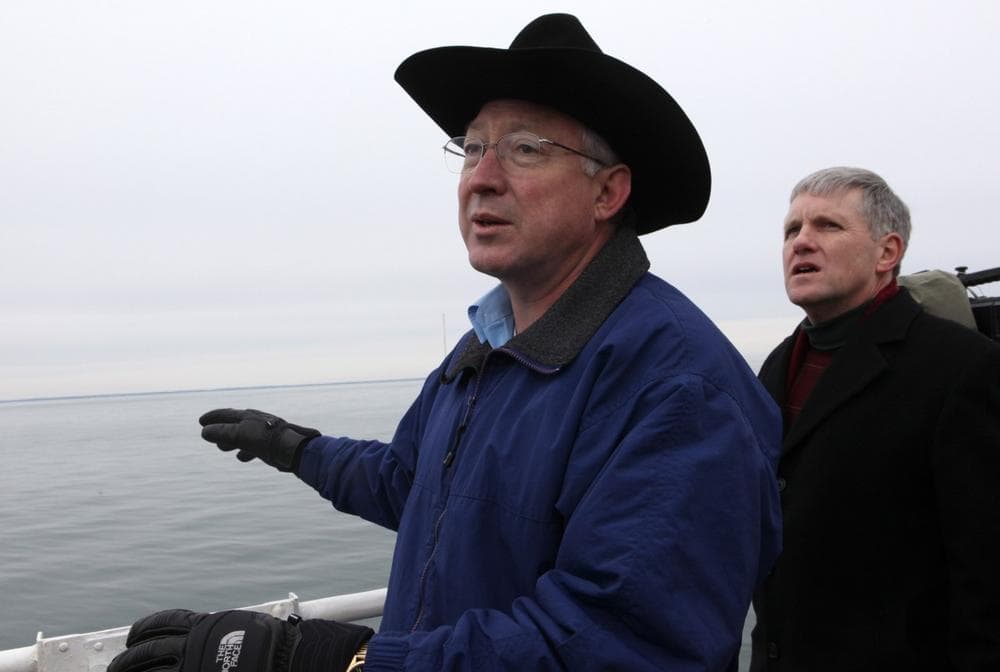
Not holding his breath for a consensus. That’s how the head of the Department of the Interior, Ken Salazar, put it Tuesday on a trip to Nantucket Sound. Salazar said he came to the site of a proposed wind farm that has divided Cape residents to get a better sense of the land issues at stake.
It was an unusually still day. Instead of the usual three-foot waves, Nantucket Sound was almost glassy, with hardly a hint of the steady winds that could drive the nation’s first offshore wind farm. Looking out over the proposed Cape Wind site from the deck of a Coast Guard buoy tender, and wearing his trademark cowboy hat, Salazar said this is what he came for.
"I’m a person of the outdoors," he said. "I’ve been a farmer and a rancher all my life. So I can look at maps and understand longitudinal lines. But they don’t mean very much to me until I actually get out and get the feel and smell of the place."
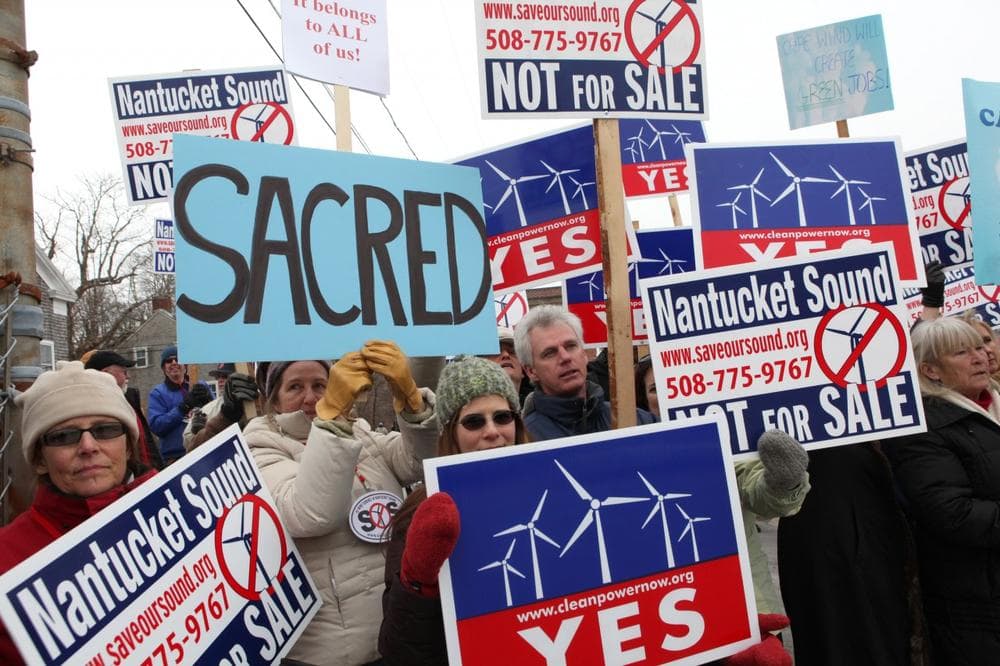
Salazar said he also wanted to sense the meaning of this place to the Wampanoag tribes that live on the sound. He had spent the morning with them, beginning at dawn.
"With the Mashpee out on the ocean very early in the morning," he said, "watching the crimson of the sky and watching the sun rise was information gathering for me as we deal with what is a very difficult decision."
A decision that everyone seems to be waiting for. As the fight over Cape Wind appears to be nearing its zenith, the tribal voice has gotten louder.
Also along on the visit was federal archaeologist Chris Horrell, who studied the Cape Wind site by drilling down under the sandy shoals. And in those core sediments he dug out, he found leafy material and an insect: the head of an ant. What that tells him is that 6,000 to 8,000 years ago, the Cape Wind site was above water.
And, Horrell said, Native Americans were around then. "But I want to be clear," he said, "that there was no archeological evidence uncovered in the core data. Just the presence of a land surface that could have once been used by Native Americans in this region."
There may be the appearance that tribal objections are surfacing in a last-ditch attempt to kill the energy project. But Deputy Undersecretary for Indian Affairs Del Laverdure, who accompanied Salazar on the Nantucket Sound visit, said the tribes were weighing in as early as 2004.
"They’ve had correspondence at the time with the Army Corps of Engineers and others," Laverdure said. "They’ve raised these concerns in the past. So the facts really speak for themselves."
It’s mainly this Native voice out of the crescendo of stakeholders that Salazar came to listen to. But both supporters and opponents of the wind energy plan interpreted Salazar's visit as a vindication for each side.
Audra Parker, who heads the Alliance to Protect Nantucket Sound, said Salazar’s visit helps her cause. "Anyone that experiences Nantucket Sound firsthand," she said, "that goes out there on the water, that sees the sunrise, couldn’t help but appreciate why Nantucket Sound really is worthy of national protection."
However, Cape Wind supporters read the visit differently. Barbara Hill, of Clean Power Now, said the only thing the secretary saw was that opponents' concerns are overstated. "Based on his language that he consistently uses, his decisions will be based on sound science." Hill said. "And if that's the case, I can't imagine there won't be a positive record of decision on this project."
Salazar said if all the supporters and opponents can’t come to an agreement by April, he will make the final say on a permit for Cape Wind. Either the arguments against outweigh the benefit, or he’ll give his approval with the condition that mitigation is offered to those whose interests are being hurt.
Salazar tipped his cowboy hat, but not his hand.
This program aired on February 3, 2010. The audio for this program is not available.