Invasive Plants Spreading As Climate Warms, Study Says
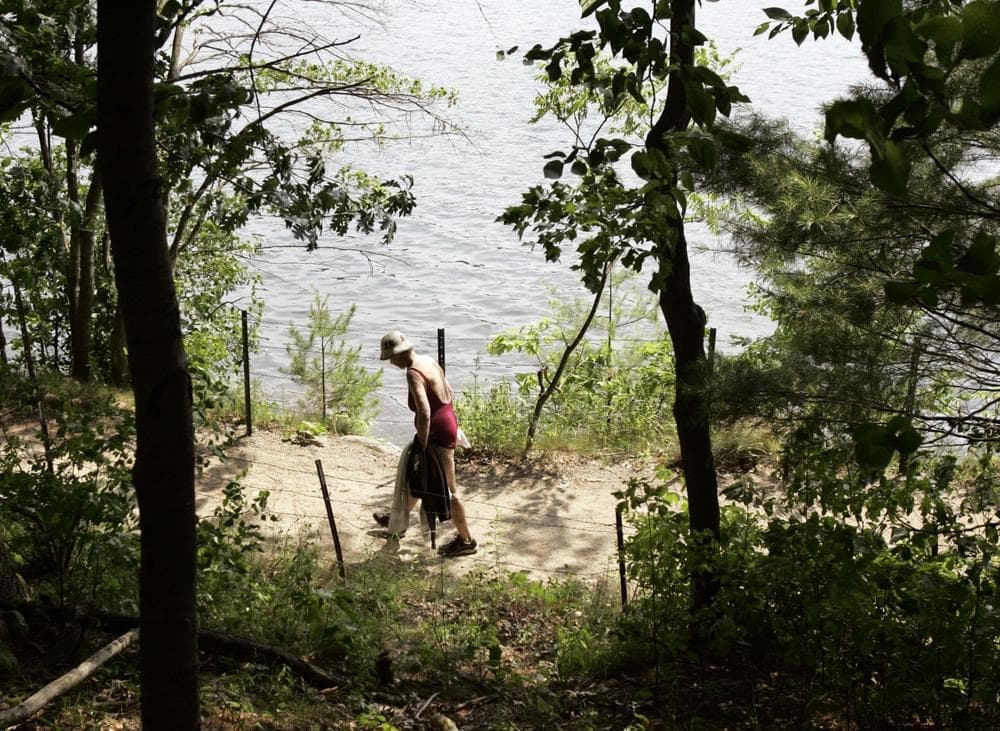
A woman walks along a trail at Walden Pond in Concord, Mass., June 2007. A Harvard study focused on invasive plants around the pond. (AP Photo/Elise Amendola)
BOSTON — As the climate continues to change, non-native plants — especially invasive ones — could become even more widespread and destructive, according to a new Harvard study (PDF).
The researchers found that some invasive plants have begun to flower earlier in the year as average annual temperatures have gone up.
Early growth appears to give them a chance to dominate an area and destroy surrounding wildlife habitat, as well as cause other environmental problems.
It is not clear why some invasive plants flower sooner than native ones as the weather warms.
But one possible reason, according to the study’s author, Charles Davis, an assistant professor in Harvard’s Department of Organismic and Evolutionary Biology, is that by growing bigger earlier, invasive plants prevent native species from getting sun.
“Maybe it’s because these things are getting such an early jump-start on the season that they’re producing leaves much earlier,” Davis explained, “so they have a competitive advantage and they’re shading out or excluding native species that are in this part of the world.”
In some instances — such as in the case of purple loosestrife, a fast-growing weed that has become prevalent in parts of the state — flowering is occurring three weeks earlier than it has in the past.
The study focused on plants around Walden Pond, where the average annual temperature has increased by about four degrees Fahrenheit since the mid-1800s.
But Davis said his findings are probably also applicable to the rest of New England and to parts of Europe and Asia that have a similar climate.
“To what extent, though, we’re able to scale or apply these results to other parts of the world, we really just don’t know yet,” he added.
Invasive plants and other non-native species can have devastating impacts on the environment. They can disrupt ecological systems, cut off waterways, displace native species, and interfere with agricultural efforts.
But Davis said there is a benefit to knowing which invasive species are likely to thrive as the climate changes: people can develop better conservation strategies in an effort to keep ecosystems more balanced and protect them from non-native invaders.
“We can nip those problems in the bud, so to speak,” he said.
The Walden Pond area has become a valuable source of data for climate change research because Henry David Thoreau kept detailed, meticulous records on vegetation around the pond — including information on flowering times — dating to the 1850s.
Using the same data, Davis and scientists from Boston University found in a 2008 study that roughly a quarter to a third of the plant species documented by Thoreau have disappeared.
Davis believes climate change is also responsible for that phenomenon, as well as for his finding that familiar plant species such as lilies, orchids, violets, roses and dogwoods are dying off around Walden Pond.
The current study appears in the journal, PLoS ONE. Researchers from Boston University and Duke University also contributed.
- Beacon Hill »
- Mass. Senate Passes School Nutrition Bill
- Mass. Senate Passes Anti-Bullying Legislation
- Mass. Senate Approves Lawrence Recovery Plan
- Commentary »
- Littlefield: Finally, Soccer Has Major-League Problems
- Is Curling A Sport? (Who Cares?)
- Many Winter Olympians Already Have The Gold
- Crime & Justice »
- Mass. Court Upholds State Gun-Lock Requirement
- Boeri: Bishop Story Has More Holes Than A Sieve
- 4 Police Reports Mention Bishop Family ‘Spat’ Before ‘86 Shooting (Interactive)
- Energy »
- Everett Settles In With Its Big, New Neighbor In The Harbor
- Salazar’s Cape Wind Decision Is Difficult, For A Consensus Builder
- Patrick Calls For Plymouth Nuclear Plant Investigation After Vermont Leak
- Environment »
- Fishermen Gather For Summit On Industry’s Fate
- Everett Settles In With Its Big, New Neighbor In The Harbor
- Scientists Say Potential For Red Tide Outbreak Is High
- Ethics »
- Review: Mass. House Spending On DiMasi Case ‘Fair’
- Galluccio Resigns From Senate After Being Jailed
- After Sentencing, Fate Of Galluccio’s Senate Seat Remains Unknown
- Religion »
- As Construction Alters Closed Church, Jamaica Plain Builds Its Community
- Listen: Talk Of Renewal, But Few Decisions In Pope’s Irish Clergy Summit
- Irish Catholics Call For Cardinal Law’s Resignation, Following Clergy Abuse Report
- Sprint To The Senate »
- How He Did It: Behind The Scott Brown Win
- Scott Brown, The New Hero Of The GOP
- Tea Party Credited With Giving Brown A Winning Boost
- H1N1 Swine Flu »
- FAQ: Swine Flu Vaccine Availability
- Mass. Lifts Swine Flu Vaccine Restrictions
- Study: Swine Flu Is Relatively Mild Virus After All
- Senate To Take Up Unemployment Insurance Extension
- Stomach Virus Is Surging In Boston
- Hanks, Spielberg Strike Out For 'The Pacific'
- Why We Gain Weight As We Age
- Listen: Mass. Women Uniquely Affected By Recession, Study Says
- Former Shortstop Garciaparra Signs With Sox To Retire
- Female WWII Pilots: The Original Fly Girls
- 'Whip Smart': Memoirs Of A Dominatrix
- The Teen Brain: It's Just Not Grown Up Yet
- Students 'Stand And Deliver' For Former Teacher
- Stomach Virus Is Surging In Boston
- Letters To Haiti Provide A Different Kind Of Help
- The Teen Brain: It's Just Not Grown Up Yet
- Former Shortstop Garciaparra Signs With Sox To Retire
- Female WWII Pilots: The Original Fly Girls
- Listen: Mass. Women Uniquely Affected By Recession, Study Says
- Good Teaching Is About Hard Work, Not A Halo
- Study: Single Parents In Mass. Don’t Earn Enough
- Haitian Poet Feels The ‘Afterworld’ In His Native Land
- Protecting Companies That Mix Profitability, Values
- A Professor's Diatribe ... Set To Music
- 'Whip Smart': Memoirs Of A Dominatrix
- Female WWII Pilots: The Original Fly Girls
- After Financial Ruin, Plotting America's 'Comeback'
- The Teen Brain: It's Just Not Grown Up Yet
- Listen: Mass. Women Uniquely Affected By Recession, Study Says
- Listen: ‘Generous’ For Sox To Take Back Garciaparra, Shaughnessy Says
- Why We Gain Weight As We Age
- Anyone Remember What's In The Health Care Bill?
- Patty Larkin: 25 Songs, 25 Friends, 25 Years
-
Challenges and Opportunities
March 11, 2010
At Boston University School of Education -
Erasmus Lectures: Rob Zuidam, Dutch composer
March 11, 2010
At Paine Hall at Harvard University -
Calling All Educators: Julie Hahnke presents curriculum for The Grey Ghost
March 11, 2010
At Cornerstone Books -
The Plausibility of Life: Resolving Darwin's Dilemma
March 11, 2010
At Harvard Museum of Natural History


More fear mongering by the environmentalists.
Invasive status is conservationist term, typically referring to non-native plants that have become a severe management problem. historically, though, you are totally right, many plants have ‘invaded’ New England following the deglaciation. so while this research is somewhat discouraging from a conservationist aspect, it is very interesting from an evolutionary aspect in that it provides insight into how species adapt to changing environments.
What is an “invasive plant”? A plant which is not currently seen? From the Ice Age on, there must have been many plants which were not here which have “invaded” and become established in the area. And does that mean that the newcomers aren’t an improvement and shouldn’t be welcome? It looks like the plants are adapting to global warming. That’s good, isn’t it?