Listen LIVE button

WBURAs Battle Nears End, Cape Wind Still Divides

Published February 5, 2010  UPDATED 7:50 AM

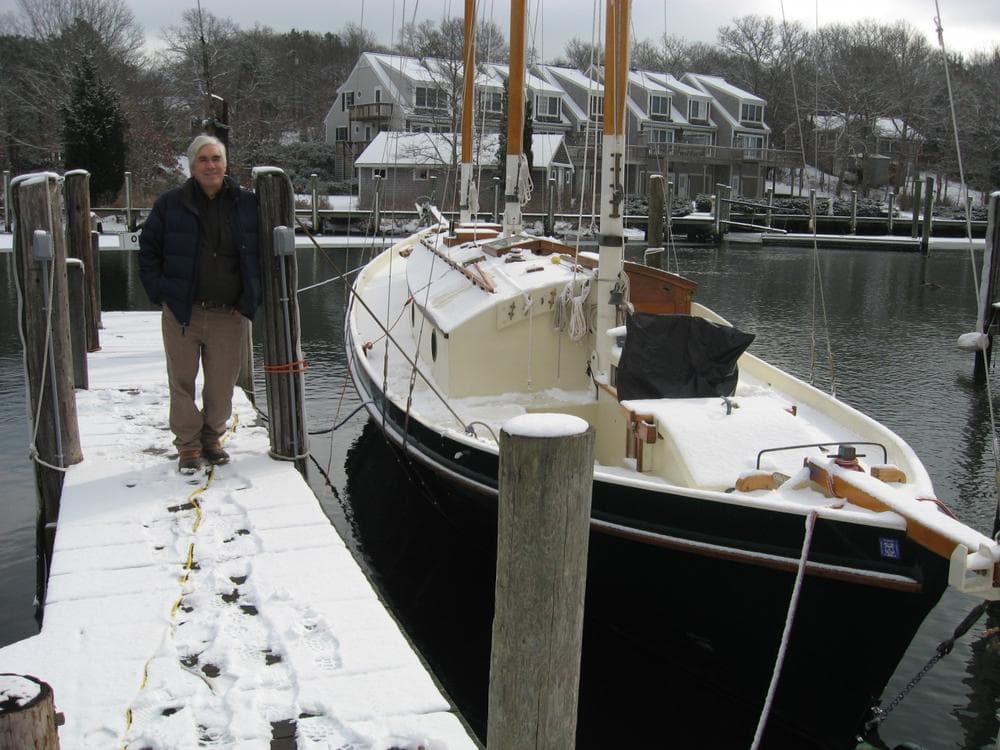
EAST FALMOUTH, Mass. — At 63, Bill Eddy has old-man-and-the-sea white hair. His face is a little wind-beaten from sailing all his life. Over the same period of time that the fight over Cape Wind has been building, Bill Eddy has been building something else: a sailboat.

“It’s just amazing to me that I actually got it done,” Eddy said. “When I think about how it started, and now looking at it, I’m amazed that I didn’t give up.”

Bill Eddy of East Falmouth built his own schooner, and would one day soon like to sail through the proposed wind farm known as Cape Wind. (WBUR/Curt Nickisch)

Bill Eddy of East Falmouth built his own schooner, and would one day soon like to sail through the proposed wind farm known as Cape Wind. (Curt Nickisch/WBUR)

Bill grew up on Martha’s Vineyard. He knows people who are against Cape Wind because they say the turbines would scour their view. Bill is not one of them. He loves the wind. He loves the sound of it in his sails, and he knows its power. He is willing to give up part of the horizon he loves for clean energy.

“I have a firm, firm belief,” Eddy said. “We may have to, for one generation, be willing to sacrifice a very small portion of a coastal sea off the coast of Massachusetts to launch this new future.”

Bill is an Episcopal priest, and for him, Cape Wind is also about social justice. He thinks it’s time for the people on the Cape and islands to share in the sacrifice for the energy that drives modern life.
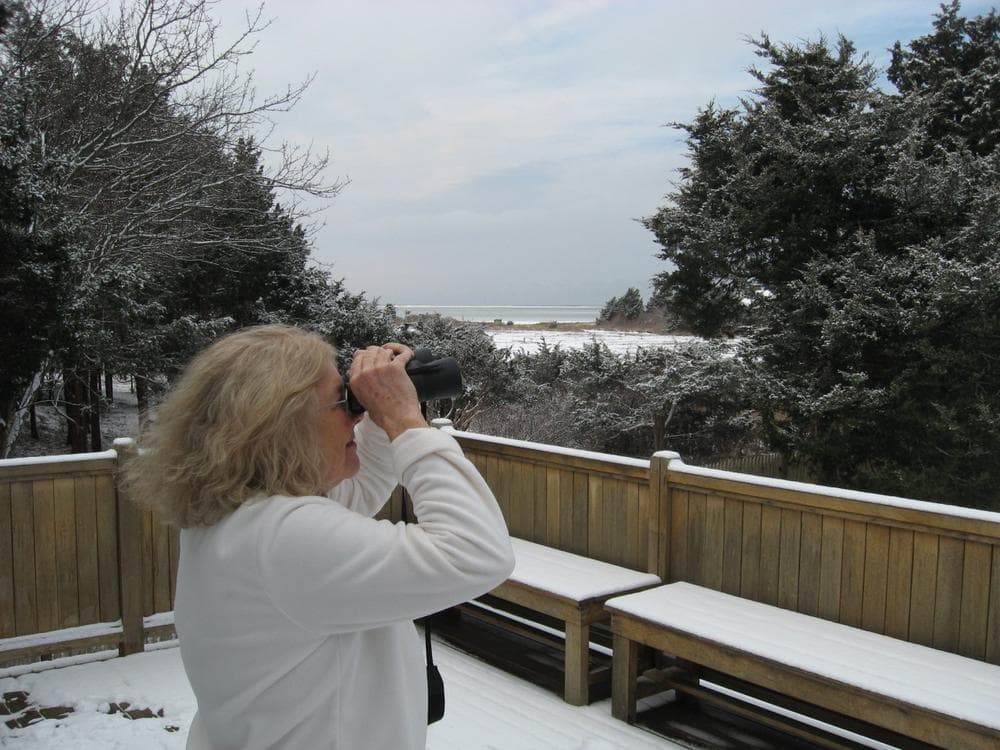
Martha Powers of West Yarmouth enjoys birdwatching from her porch with a view toward Nantucket Sound. She fears for the songbirds that would be killed by Cape Wind turbines. (WBUR/Curt Nickisch)

Martha Powers of West Yarmouth enjoys birdwatching from her porch with a view toward Nantucket Sound. She fears for the songbirds that would be killed by Cape Wind turbines. (Curt Nickisch/WBUR)

“Consider for just a moment,” he said, “the sacrifice that’s already being made by the thousands of our American citizens who live where their mountains are being removed for coal. What about the thousands of American men and women who are serving overseas in Iraq and places to protect the oil is that we import? To be honest with you, the 130 turbines of the wind farm, I’d prefer any one of them to one more marker in Arlington National Cemetery.”

A few miles away, Martha Powers feels just as passionately about Cape Wind, but she’s against it.

She’s about the same age as Bill and lives in a similar spot, at the end of a marsh off of Lewis Bay. Her dad bought the cottage in 1958. She spent summers here as a kid. Now she’s a librarian and has moved in for good. She keeps binoculars by the back porch to watch the great blue herons and ospreys every day.

“This project would tear a big hole in that whole web of life there that could never be repaired,” she said. “All the animals that live in the ocean beneath that water, and that fly above that water, it would be horrific. I can almost see it, like a bomb, to me, it feels.”

Martha is worried about energy use, and global warming, too. But for her, Cape Wind would have a negative environmental impact. “It’s not going to make any difference, this one wind farm,” Powers said. “You would have to build, I don’t know, hundreds of wind farms of this size to have any slight impact on global warming.”

Instead, she’s worried about the birds that would be killed by the spinning blades of the wind turbines. She can’t bear the thought of migratory warblers being thumped into the sea. Her Christmas card this year was a photo of a chickadee perched on her finger.

“When you feel those little feet on your hand, trusting, it’s an amazing experience,” she said. “So to kill them is just such a horrible thought. That’s the hardest thing for me to accept about this project.”

A few miles away, Cape Wind supporter Bill Eddy celebrated the holidays with wind farm in mind, too. He put Christmas lights on the masts of his sailboat.

“I just know that, in a year or so, I’ll be able to go out to the wind farm, and move through it and feel a tremendous sense of completion and unity in my life,” Eddy said. “It’ll be the wind in my sails and the winds in the blades of the turbine that will somehow make me feel that something very old and something very new is bringing about a most wondrous evolution.”

Whether that evolution starts on Nantucket Sound is up to the U.S. Department of the Interior. If Cape Wind supporters and opponents don’t come to an agreement themselves, Secretary Ken Salazar will decide by April.

WBUR Topics: Boston   Cape Wind   Energy   Environment  
Your Comments
Comments RSS
  • Ms. Kruse of Mass Audubon offers Mass Audubon’s support for Cape Wind. Yet, Mass Audubon is participating in the collection of data, analysis of the same, and commenting on the Cape Wind project as an MMS Key Partner in the NEPA review process of Cape Wind. NEPA analysis should avoid taking on a project advocacy position as that’s the definition of bias in a NEPA review.

    The condition of Mass Audubon’s “support” for Cape Wind is acceptance of Adaptive Management that the federal regulator, USFWS, under the ESA Section 7 review process, states is doomed to failure. Adaptive Management monitoring and mitigation is handled by contract, worth about $8 million dollars over the term prescribed by Mass Audubon in their “Challenge” press release.

    With friends like Mass Audubon, birds don’t need cats.

    As for Cape Wind, with a “no bid” deal for Nantucket Sound, they’ve never been vetted in a competitive bidding process.

    Who are these guys? Cape Wind, EMI, UPC, Wind Management, LLC, Wind Partners, LLC?

    http://bjdurk.newsvine.com/_news/2010/02/23/3941508-who-are-these-guys-cape-wind-emi-upc-first-wind-ivpc

    Posted by Barbara Durkin on February 23, 2010, at 6:50 PM
  • I would like to see a mock-up to what exactly will be seen from the shore. How big will the windmills look from the nearest land? Also, some history of how many times a year the native tribe do a sunrise greeting.

    Posted by Anne Gyles on February 10, 2010, at 10:05 AM
  • Ship of fools.

    Posted by Mike on February 8, 2010, at 8:41 PM
  • I’m wondering what happened to the earlier, many anti Cape Wind comments, which appeared here in the “Comments”. Very intelligent counterpoints against the proposed windmills had been written. One person, who I happen to know – Mr. Ellery Schemp – wrote asking questions regarding what type of wind turbine and its blades are the developers proposing to use in the project? Another mentioned sea water and salt effecting the turbines – etc.
    I’m all for saving the environment and realize the sad fact that many who are against the turbines are from the gas and oil industry, but I’m not one of them. Since we are supposed to be moving towards clean energy, and cutting back our usage, I wonder if there has been a study completed of whether energy usage has gone down enough among commercial businesses and households so that if there are wind turbines built, they can replace the older power plants/technologies. Will it eventually be possible to replace the power plant in Sandwich,
    eventually, for example, so that the wind turbines and other types of newer technologies are the only utilized technologies?
    I’ve heard, also, that National Grid, who we have as our power supplier, will be one of the buyers of the generated power from the wind turbines. I know that, since we have been cutting back our energy use considerably, National Grid is trying to make up their profits by splitting the “Distribution Charge”, so that energy usage over 600kWhs, costs a higher rate than that Distribution Charge which is at 600kWhs or below that 600kWhs rate. We actually can’t cut back that much more than what we’ve already accomplished; I’ll have to turn off my radio.

    Posted by Ruth Baker on February 7, 2010, at 10:24 PM
  • I have just finished reading the new Minerals Management report, the section on the birds which focuses on two species only (because they are endangered or threatened). What is said throughout this report is that there is not enough information, more studies are needed. Some conclusions are reached by extrapolation and guesswork. These two species could have problems, but we really don’t know their flight paths or flight heights or their avoidance behaviors (p. 5-34). The Roseate terns may have more troubles than the piping plovers because they go through arial displays during courtship. Migrating birds, other than these two, have not been studied. Nantucket Sound is in a migratory pathway. It is illegal to kill migrating birds. I am not against a wind farm. I wish we could be more carefull about doing something like this. Mass Audobon approves so many think that is good, but they have done minimal research and don’t object to this location even though the government has said that migratory pathways should not be obstructed. Why can’t thinking people plan for the best location with the least problems for putting in a wind farm?

    Posted by Susan V. Powers on February 7, 2010, at 6:59 PM
  • Carl, you can dowload it here or subscribe to the Radio Boston (or any other WBUR) podcast on this page. Enjoy!

    Posted by Curt Nickisch on February 7, 2010, at 9:23 AM
  • Where can I listen to the debate of the windfarm that aired on Friday at 1pm?

    Posted by Carl B. Freeman on February 7, 2010, at 8:57 AM
  • “The law locks up the man and woman
    Who steals the goose from off the Common,
    But lets the greater felon loose
    Who steals the Common from the goose”
    Hopefully, Secretary Salazar will not let the “Common” be turbined in to a colossal junkyard – what happens when one or more of these “cuisinarts” fail, and how much time and money will it cost to repair? We have a seemingly simple windmill here on Nantucket which broke within the past few months and there is still no “fix” in site – and it’s on terra firma!!!

    Posted by John C. West, MD on February 6, 2010, at 1:58 PM
  • We’ve all read history books in school and been shocked as to how such large groups of people could perpetuate obvious ignorance ( i.e- racism, sexism, etc). Clinging to notions just because they are convenient has had catastrophic effects all over the world and appears to most people today as stupid and inexcusable. Although many ordinary people have always disagreed with such ignorance, often only the famous leaders of movements that countered ignorance tend to be credited for working against it. In order to make a clear, concise history, the dynamic societies around these figures have been unfairly overshadowed by their embarrassing, ignorant sector. When children learn about 21st Century America, lets not be eternally remembered as an absurd people that shot down progress in clean energy because some were hung up on its physical appearance, implications that are almost nonexistent in comparison to those of global warming, and the lethargic attitude that a small step in the right direction is not worth taking.

    Posted by Katie Elliott on February 5, 2010, at 9:07 PM
  • Anyone opposed to Cape Wind is supporting terrorism, pure and simple. It’s time to wake up and realize that unless we build a comprehensive alternative energy system in America we’ll have no views left to spoil and no fish to bother.

    This project is a bargain compared to the cost of Middle east oil!

    Posted by brian on February 5, 2010, at 1:45 PM
  • So far there isn’t a perfect solution to energy generation, meaning one that doesn’t harm anything. Looking at the big picture, I wonder about the environmental and health damage caused by coal-fired electrical plants. Acid rain damaging the inland aquatic systems? Polluted air which everyone has to breathe? It seems to me that the far-reaching effects of coal pollution on our water supplies and breathing air are much more detrimental to more living things than the possible bird mortality count. Besides, the turbine blades can be designed to be noticeable to birds.

    And also, I don’t live on the Cape or islands, but I would welcome a turbine in my back yard. Every day I would look at it and smile, knowing it represents a negative difference in the amount of air pollution from fossil-fuels. Maybe some enterprising Cape Cod residents can make a business giving boat tours of the wind farm. I would certainly go on one.

    Posted by Julie on February 5, 2010, at 12:47 PM
  • Problems in this world are caused by old mentality, antiquated thought, fear of adaptation and ignorance.

    Posted by rich on February 5, 2010, at 12:37 PM
  • Technical studies have shown that the turbines will have little or no impact on the birds. But the naysayers have made up their minds and don’t want to be confused by inconvenient facts. Between the NIMBY’s, Indian sacred grounds, and other obstructionists, it is a wonder that we can anything built in this country.

    Posted by Rudolf on February 5, 2010, at 11:42 AM
  • William, those are great and worthy questions, but perhaps outside of the scope of this single story. For a more in-depth look at the broad scope of issues around Cape Wind, do tune into Radio Boston today (Friday) at 1pm, where you can call in with those questions.

    Posted by Curt Nickisch on February 5, 2010, at 11:21 AM
  • Shouldn’t we make the decision on Cape Wind based on facts, not opinions and emotions, ie. soldiers dying for foreign oil vs. warblers struck by turbines. Shouldn’t we be fully informed of the economic pros and cons instead? Will the public see better long term electricity rates? Should a private developer profit from huge gov’t subsidies? Are there other locations that offer decent payback based on area winds, that don’t base their economy on tourism (natural beauty), or is the Nantucket sound site so good because of wind efficiency? Can Curt Nickish analyze these questions in detail rather than relay the opinions of two folks? This is a more complicated issue requiring more info and better analysis than the recent article by Mr. Nickish.

    Posted by William Townshend on February 5, 2010, at 10:59 AM
  • Thank you, Curt Nikisch, for this story. Bill Eddy, the Episcopal priest sailor, is brilliant. I love his comment on the sacrifices people are making for coal (our mountaintops and valleys) and oil (casualties in Iraq). The bird lady is misinformed. The Massachusetts Audobon Society supports Cape Wind. And is there any data to support her claim on harm to aquatic life?
    Catherine Willinger, Newton, MA

    Posted by Catherine Willinger on February 5, 2010, at 10:02 AM
  • I am with Bill Eddy. We must begin somewhere and why not the Cape. My first hand knowledge of windfarms comes from many trips to Ireland,a place where, for generations, they had burned their land in the form of peat bricks.I have walked through a farm right on the sea’s edge. Gulls fly all around diving for food and not once have I seen a dead bird, of any type. The cows graze in the pasture beneath the turbines. As you travel inland, the turbines are part of the distant landscapes mixed with the trees planted against erosion. Sheep roam unbothered by the towers. We have reached a point where, we too, must adapt for the health of our planet and our beloved Cape Cod.

    Posted by Sandy Burdick on February 5, 2010, at 9:56 AM
  • Massachusetts Audobon Scoeity supports approval of Cape Wind. Here’s the press release on January 13, 2010:

    Response to Obama Administration’s Position on Cape Wind

    In the wake of today’s Cape Wind stakeholder meetings with US Department of the Interior Secretary Ken Salazar in Washington, DC, Mass Audubon continues to encourage Mr. Salazar to make a timely and positive decision on Cape Wind based on the merits of the project.

    “A positive Cape Wind decision from the Obama Administration will be a giant leap forward for America as it finally and seriously participates in reducing the effects of climate change and sends a strong message to the international community,” said Jack Clarke, Mass Audubon’s director of public policy and government relations.

    “Cape Wind should begin to open up global markets for offshore renewable energy in this country and smooth the way for other offshore proposals in the Northeast, mid-Atlantic and Great Lakes,” he continued. “Wind resources in these three regions alone are capable of providing 900,000 megawatts of electricity—an amount equivalent to the nation’s current total installed capacity. And they are located near the country’s largest centers of energy use where, up until now, little energy is produced and carbon emissions are high. This is a decision long overdue.”

    Mass Audubon has been involved with the Cape Wind project since August 2001. We have submitted extensive review comments and independent field research and issued a Cape Wind Challenge. We have performed careful environmental reviews of Cape Wind and other wind energy projects.

    ###
    CONTACT: Jan Kruse
    781-259-2134
    jkruse@massaudubon.org
    Jack Clarke
    617-962-5187
    jclarke@massaudubon.org

    Posted by Catherine Willinger on February 5, 2010, at 9:55 AM
  • Bill Eddy hit the nail on the head. His inspiring words capture what I think project opponents often lose sight of: The Big Picture. To say “It’s not going to make any difference, this one wind farm” is the wrong attitude to have when our country is facing the problems Mr. Eddy points out such as mountain-top removal (I wonder if the people responsible for MTR think to themselves “Well it’s not going to make any difference, this one mountain…”). Cape Wind needs to move forward and so do hundreds of other renewable energy projects. This is just the beginning.

    Posted by Sarah Cote on February 5, 2010, at 9:45 AM
  • I’m with Martha Powers. Cape Wind siting in Nantucket Sound is in conflict with Best Science as the federal government’s that states to avoid migratory flyways and areas where endangered species are present when siting wind turbines.

    USA Today
    September 21, 2009

    Bird deaths present problem at wind farms

    http://www.usatoday.com/news/nation/environment/2009-09-21-wind-farms_N.htm?csp=34&loc=interstitialskip&POE=click-refer#Register

    “Salazar said new technology in the design of turbines and more careful placement, such as outside of migratory paths and away from ridgelines, can reduce bird deaths.”

    Mass Audubon’s testimony on Cape Wind to the USACE:

    Mass Audubon’s comments on the Cape Wind DEIS on February 23, 2005; to Ms. Karen Kirk Adams, the Cape Wind Energy Project Manager U.S. Army Corps of Engineers, New England District — Reference File No. NAE-2004-338-1, EOEA No. 12643:

    “By utilizing other bird mortality data provided in the DEIS, Mass Audubon staff scientists arrived at avian mortalities that ranged from 2,300 to 6,600 collision deaths per year.”

    http://www.massaudubon.org/PDF/CapeWindDEIS.pdf

    Posted by Barbara Durkin on February 5, 2010, at 8:50 AM
Have something to say?
Please stay on topic, be civil, and be brief. These comments are moderated by WBUR, but you are solely responsible for the content of your comments. By commenting, you agree to our Community Discussion Rules.

WBUR Topics
Most Popular
This site is best viewed with: Firefox 3.5 | Explorer 8 | Chrome 2 | Safari 4 | Weather provided by Yahoo!