Support WBUR
Madoff Whistle-Blower Remembers: 'No One Would Listen'
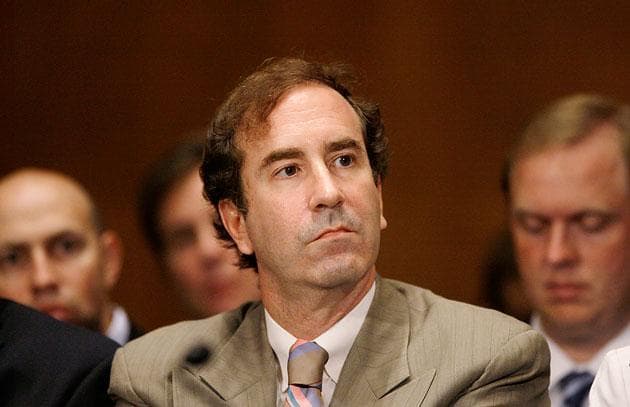
The man who tried futilely for 10 years to expose the largest Ponzi scheme in history has written a book about his failed crusade.
"No One Would Listen: A True Financial Thriller" (Amazon.com) is released March 2. Harry Markopolos relives his tragic tale, how he discovered Bernard Madoff was a fraud, how he tried for years to get the Securities and Exchange Commission to investigate, how no one would listen.
Madoff became a national symbol for Wall Street greed. Markopolos, an ordinary-seeming if quirky finance whiz, has been harder to peg. Just why was he the only one to figure it out? Why did he alone try so hard for years to expose the scam? Why didn’t anybody listen?
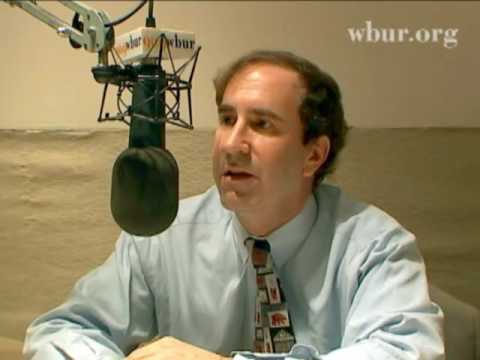
Markopolos is embarking on a national media tour to tout his book. He’ll be on "The Daily Show with Jon Stewart," the "Today" show, and a bunch of others. WBUR’s Curt Nickisch got the first radio interview with the man who’s still coming to terms with the fact he’d always been right about Madoff, but it didn’t do any good. Here’s the story.
"I always think of the terrible tragedy. It’s just a hard thing for me to live with."
Harry Markopolos
It was a cold day in December 2008. Harry Markopolos was at a Boston-area karate studio, where his twin boys were getting lessons. His phone buzzed with two voicemails from friends of his. That’s when Harry found out his fight was over, and that his nemesis had surrendered.
“They called to inform me that Madoff had turned himself in and admitted to a $50 billion Ponzi scheme,” Harry says. “I returned those two calls as quickly as I could, and I felt a tremendous burst of energy and then I almost fainted.”
Harry fell against a railing, grabbed it to hold on. What was racing through his mind was complicated. Vindication, definitely. Harry had known Madoff to be a fraud for almost 10 years. And he had told the authorities again and again. Now he knew — they knew — he was right. But there was also sorrow. For people who were just now finding out -– what Harry always knew would happen -– that they had lost everything.
“Since the news broke on Dec. 11 (2008), I have not been able to get a full night’s sleep. I wake up and contemplate it in the early hours of the morning. And I always think of the terrible tragedy. It’s just a hard thing for me to live with.”
But Harry can also live with the fact that he tried. This 53-year-old with brown eyes and a little bit of a comb-over turned something that didn’t add up into an obsession.
“Harry was, or is, a math whiz,” says Frank Casey, who worked with Harry back in 1999, when it all started.
“And to be honest with you, he was sort of geeky. If you know what I mean.”
“Really didn’t want to have interpersonal skills with other members of the firm because he just liked doing what he did.”
Harry saw Madoff as a domestic terrorist. Somebody who was undermining the U.S. financial system. Somebody who had 60 billion reasons for not wanting Harry asking questions.
Frank was a marketing guy at the small Boston company Rampart Investments. Harry is what Frank called “the brains.” The guy who came up with and managed the complex investment products that it was Frank’s job to go out and sell on commission.
“I saw in him a tremendous power that was sort of untapped,” Frank says. “And I figured I could make a buck off of it.”
Frank thought: If Harry could model something on what this bigwig down in New York — this Bernie Madoff — was apparently doing, that would bring in some dough. So Frank made a trip to New York. Got the basic info on how Madoff said he was investing and what the returns looked like. To be honest, it didn’t make sense to Frank. But he was like, what do I know? If Harry can copy this, we’re in the money.
“So I go to Harry and say, why can’t you do this for us? And he looks at it for five minutes I swear, and he says, this thing’s a fraud. I said, Wow.”
That’s when they knew, all the way back in 1999, that Bernard Madoff, the respected former NASDAQ chairman and adviser to the feds, was a fraud.
So what do you do with that? In the financial business, if something doesn’t smell right, you just stay away. But there’s something about Harry that turned this into a 10-year crusade.
Harry In The Army
Harry grew up in Erie, Penn. He went to a Catholic school, where the discipline and moral education made an impression. He went on to a Jesuit college on an Army scholarship and served afterward in the Maryland Army National Guard.
“Quite frankly up until that point in my career I had never run into anyone that was that dedicated,” says Colonel Michael Schleupner, who remembers the first time he met Harry.
It was 2:30 in the morning. Everyone else was sacked out. Harry was charging around in a Jeep like it was World War III.
“In addition to being a hard worker, Harry is a very very bright man,” Schleupner says. “In fact, in many ways, I often wondered how he wound up in the military. He doesn’t suffer fools very well. Some people were turned off by the fact that he was very blunt in the way he spoke. I wasn’t the least bit disturbed about that though, because he always delivered.”
Harry eventually left the Army for a career in financial services -– it seemed like a good fit for his analytical mind. But that military background came out in his growing fixation on the Ponzi scheme.
Harry kept a loaded shotgun in his home office. He assembled a team modeled on an anti-terrorist cell.
For one, Harry saw Madoff as a domestic terrorist. Somebody who was undermining the U.S. financial system. And two, Harry saw Madoff as a lethal enemy. Somebody who had 60 billion reasons for not wanting Harry asking questions. Harry was pretty sure Madoff was taking in some dirty money offshore from organized crime and drug cartels. If they found out Madoff was duping them, Harry says, Bernie would get whacked.
“Madoff had his life on the line and I felt that — to protect his secret — I didn’t think I would be long for this world if he discovered what I was doing,” Harry says.
So Harry kept a loaded shotgun in his home office. And assembled a team modeled on an anti-terrorist cell. His assistant, Neil Chelo, was one member. Frank Casey, the marketing guy, was another. And Frank recruited Michael Ocrant, a journalist who covered the hedge-fund industry. They gathered information in the field. Frank says Harry took point. He was the one who went to the Securities and Exchange Commission.
“Harry carried the heavy sandbags to the SEC,” Frank says. “And Neil and I and Mike had scoops, and we’d dig up sand and put it in the bags for him. Opportunistically. And he would lug them down.”
Harry first chose to go to the SEC in 2000 because that was the proper channel. The agency had the authority to walk right into Madoff’s operation and blow the scheme wide open. The Boston office listened to Harry. But they passed it on to the New York office, which had jurisdiction. Harry says he didn’t hear from New York.
At first Harry and his team thought the SEC was just complacent. So in 2001, Mike Ocrant, the journalist, published an article questioning Madoff. Within a week, Frank Casey remembers, the investor magazine Barron’s followed suit.
“Well, Harry, I and Neil were giving each other high fives on Monday morning after Barron’s came out, because we thought the SEC was going to ride to the rescue. Everybody reads Barron’s! Surely! Nothing. Nothing. Nothing happened. For months.”
Forget complacent, they thought. The SEC’s just incompetent.
The problem was, they had the smoke, but no gun. So they figured: Find more smoke. Put that smell of gunpowder right under the SEC’s nose.
Dinosaur Tracks
Harry went to talk to someone for advice: Pat Burns, who works for a fraud watchdog group in Washington. He remembers the day Harry laid it out for him. Burns got this surreal feeling.
“And it’s sort of like you’re going out and you’re looking for tracks, and you know the old cartoon movie where they pan back and you realize you’re standing in the track,” Burns says. “It’s a dinosaur track -– that was the scenario that we were in. Harry was tracking dinosaurs. He was tracking a very big animal.”
"And we are in Boston, sort of like the little kid in that story, The emperor has no clothes! And we’re yelling it, but nobody’s listening."
For the first few years, Harry didn’t know exactly what kind of animal. How exactly Madoff was making such fantastic returns. He had two theories: either a kind of insider trading or a Ponzi scheme, where investors are paid supposed returns by money coming in from new investors.
It wasn’t until 2002, when Harry traveled to Europe for business, that he figured out which. He kept meeting money managers, who bragged about having a “special relationship” with Bernie.
“And when you hear it the first time,” Harry says, “you take it at face value. When you hear it the second time, you get suspicious. And after you’ve heard it 14 times in two weeks, you know it’s a Ponzi scheme."
Harry Markopolos now knew where to focus his team. Whenever one of them would meet, say, a risk manager at some international bank, they’d ask, What do you know about Bernie? By this time, Harry had newborn twin sons. He could use the sleep. But he’d still stay up at night when they were down, to work on the case.
In 2005, he went back to the SEC with his most damning warning ever, in plain English: “The world’s largest hedge fund is a fraud.” He spelled out more than two dozen red flags. Common sense signals that Madoff was running a multi-billion-dollar Ponzi scheme.
The SEC wouldn’t comment for this story. A report from the SEC at the time reveals it doubted Harry, but looked into Madoff anyway, out of “an overabundance of caution.” The SEC found no fraud.
The Emperor Has No Clothes
One person at the SEC who’s not authorized to talk says some people at the agency got Harry. But he rubbed most the wrong way. And they couldn’t get past that to really listen to him. Frank Casey can only imagine.
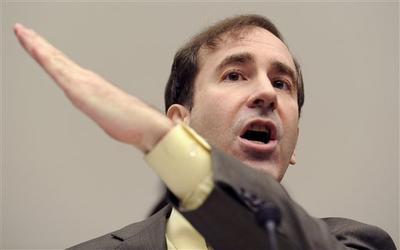
“I mean, you’re telling me, here’s this idiot in Boston who’s a math geek. He’s kind of quirky. He wears an orange shirt and mismatched tie and a math whiz. And he’s kind of got no interpersonal skills -– not real smooth.”
And then there was the New York-Boston mistrust. Bernard Madoff was a big deal in the Big Apple. He used to run a stock exchange. He sat on advisory boards to the SEC.
“Bernie’s in New York. And everyone kneels down to the emperor in New York, and everyone was afraid to say the emperor has no clothes,” Frank says.
“And we are in Boston, sort of like the little kid in that story, The emperor has no clothes! And we’re yelling it, but nobody’s listening.”
The years went on with nobody listening. 2006. 2007. 2008. Frank and Harry and Neil were no longer working at the same company anymore. They could have, you know, fallen out of touch. But Harry would not let it go.
Despite their continuing efforts, they totally missed a whole layer to the Ponzi scheme, which, ironically, has become the most public.
“We were not perfect in our investigation,” Harry says. “One of the things we missed, and it was pretty obvious –- in retrospect of course, was that Madoff was raiding the temples! That he was destroying the Jewish community here at home.”
See, Harry and his team had had only really known about the money from wealthy clients at European banks and the private hedge funds around New York City that funneled investor money to Madoff. They didn’t know about people like Nancy Robinson, who lived 10 minutes away, in Newton. She had more than a million dollars in an account directly with Madoff. Nancy remembers getting her statement in November 2008.
“The economy had started to really collapse. According to this statement we had treasury bonds, U.S. Treasury bonds, and I thought, good, smart move, that was really safe!” Nancy laughs.
She didn’t get any more statements after that. The Ponzi scheme collapsed -– couldn’t raise enough new money to pay off investors who were cashing out. Bernard Madoff turned himself in on Dec. 11, when he decided it was time.
Harry’s former commander, Col. Mike Schleupner, remembers seeing on the news that a little known Massachusetts finance guy by the name of Harry Markopolos had been trying for almost a decade to expose the scam:
“I — when I heard that he was the one, I couldn’t help but just smile. There’s something about Harry... He simply... keeps coming and coming and coming. He simply doesn’t give up.”
So far, only one of the victims has contacted Harry to say thanks for not giving up. It’s Nancy Robinson of Newton:
“He was a crusader!” she says. “He wrote how many memos and how many e-mails. Out of a sense of duty, or obligation. Which is astounding. Thank you, Harry! That’s my message: Thank you, Harry!”
<a href="http://www.wbur.org/2009/04/21/nickisch-markopolos-transcript">Read transcripts of the WBUR interview with Markopolos</a>
Harry isn’t ready to hear that. For now, he’s been struggling to find the good in something that’s been so horribly bad for so many. It’s funny. Long before the victims knew how Madoff would change their lives, Harry already knew that Bernie was changing his.
Because a few years ago, when Harry felt the futility but still he could not let it go, he came to a realization: That this was what he was supposed to do. Ferret out financial fraud, figure out how it worked, and then expose it.
So he left his job at the investment firm to start his own business. As a fraud investigator. Looking to blow the whistle on companies that are cheating investors and taxpayers. Without the Ponzi scheme, Harry says he’d still be working in the financial system, but not necessarily trying to change it. What took him on the new path was Madoff. Chasing Madoff, Harry says, as futile as that was.
“I’m willing to stand up here and tell you that I failed. And it’s $65 billion worth of failure. There are some things to be proud of, and there are some things that I wish had gone a lot different. I don’t mind failing big. I hope to succeed big later on in life. So far I may not have, but I’m gonna keep trying until I do.”
Harry Markopolos won’t say what cases he’s working on now, at least not yet. Chances are the next time the guy with the orange shirt and mismatched tie goes to the authorities with an unbelievable story, they’ll listen.