WBURThe Depreciating American Dream, Part 5: FAQ Who Should Buy A Home, And When?
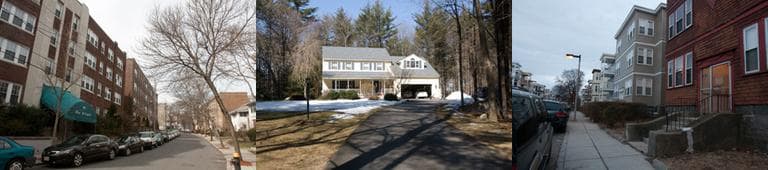
(Jess Bidgood for WBUR)

This week we’ve been running a series called The Depreciating American Dream. We’ve heard from homeowners who wish they’d never bought. We’ve heard from renters relieved to be renting.

The question of owning versus renting is something Nicolas Retsinas has studied quite a bit. He co-directs the Joint Center for Housing Studies at Harvard University. Retsinas sat down with WBUR’s Bob Oakes to answer some questions about who should own and when.


BOB OAKES: This series has pointed out some of the painful downsides to owning. Have we gone too far in touting renting?

NICOLAS RETSINAS: I don’t know we’ve gone too far. Certainly, renting has reemerged as a viable and plausible option. I think what we may have done, however, is understate the value of owning. And I think that’s something that perhaps has to be revisited.

What do you mean by that?

Well, I think it’s become pretty clear in the past few years that if you bought a home expecting appreciation to climb, expecting it to be the best investment you’ve ever made, you were really disappointed. Indeed, it turned out to be a very bad economic decision if you bought at the height of the boom.

But at some point, when we’re reminded that you buy a home to live in, I think what you’ll find — if all things are equal — that most people would prefer to own than rent.

So profile this for us. Who should own?

People who should own are: people who clearly are unlikely to move in at least five to seven years, therefore, they can withstand another down cycle; people who want some control over their property and, in particular, are interested in making some modifications to their property overall; and people who find the the neighborhood where there are more owning options than rental options more conducive to the way they want to live.

Do you find that potential homeowners ask themselves questions that get to those points you’re making?

I think more so today than yesterday. Within the past five or so years, people were more likely to look at the purchase of a home as an investment choice — their own sense of what was happening on the market, how much their home would increase in value.

I think we’ve learned that home prices don’t always go up. We’ve learned that it may not necessarily be a good investment.

So I think people are going to be more likely to ask those questions. Are they going to ask them sufficiently with enough detail? I’m not sure. But I think they’re more likely to ask them today than they were yesterday.

What’s the one question you think homeowners most ignore and the one they really need to be looking at?

The key question is: Am I pretty sure I can’t imagine any plausible circumstances where I’m going to be forced to sell over the next sort-of five or six years. If they ask that question and answer it positively, that is to say: there will be some stability to where they live, where they work, over time, then owning a home can be an OK option. If they don’t ask it, they run the risk of having it be a very poor investment.

What do you think homeowners and people who are thinking about home ownership have learned from the housing crash?

They’ve learned a lot. First and foremost they’ve learned it is not a risk-free purchase. They’ve learned that prices can go down as well as can go up. And I hope they’ve learned — I really hope they’ve learned — that you can borrow too much. And you should only borrow what you can comfortably afford to pay back. You shouldn’t borrow based on what you expect future values to be.

On the downside, has the housing crash also taught some homeowners that it’s all too simple to walk away from what turns out to be a bad investment?

I think it has. In investments, sometimes you don’t want to throw good money after bad. Again, it’s that re-definition of what a home is. When we start rethinking of the home as a place to live, then I think we’d be a little more cautious about walking away.
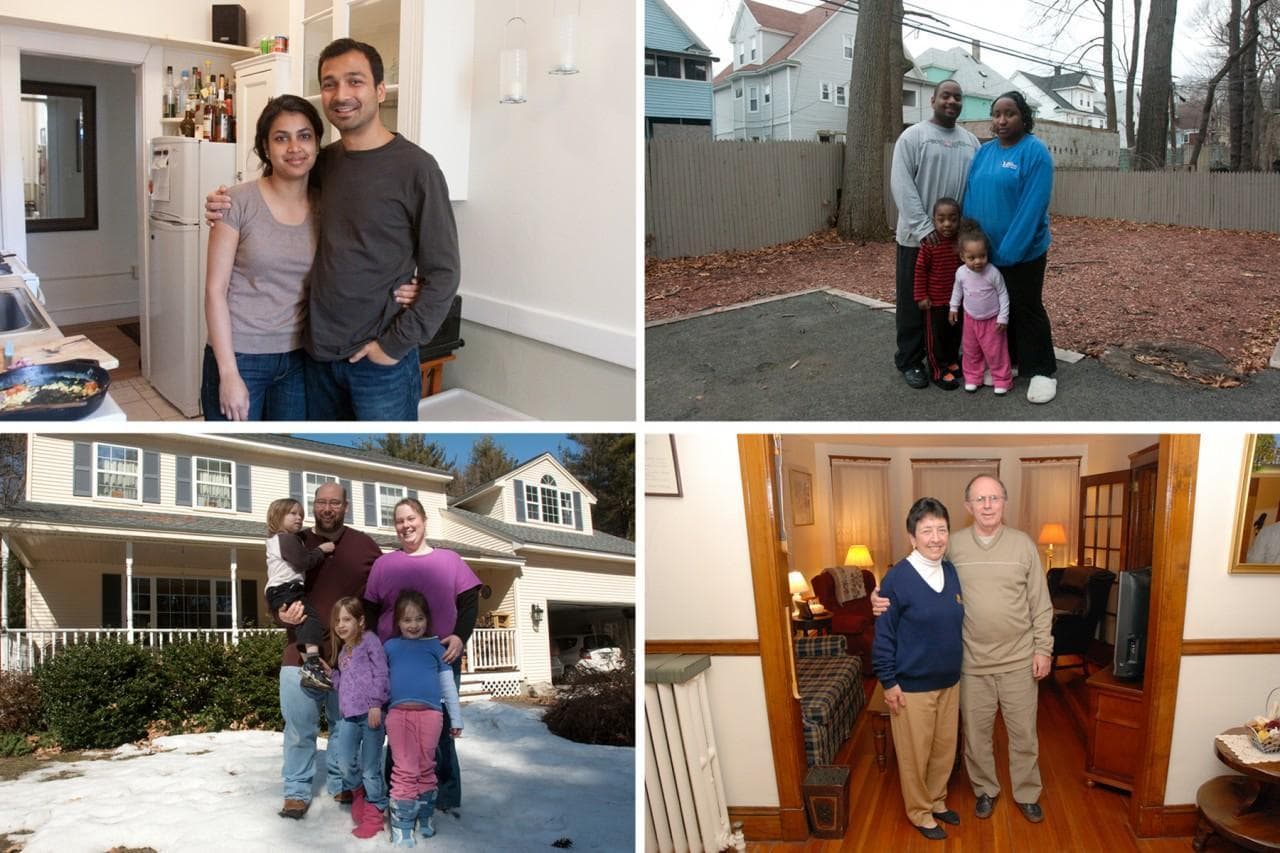
These people, detailed throughout our series, have had unique experiences with home owning and renting. (Jess Bidgood for WBUR & Andrew Phelps/WBUR) (Click to enlarge.)

Are banks and lending institutions at least at partial fault for making people think of their homes not necessarily as your home, but as an investment? Because you have to go far and wide now to find a bank or lending institution that keeps the mortgage.

You’re absolutely right. The mortgage industry changed. And mortgage bankers got paid for transactions. They did not get paid based on the performance of the loan. Indeed, they very often sold the loan to another investor.

Secondly, the other major change is for many banking institutions — not all — underwriting was based on future valuation of the property, not on the ability to pay of the borrower. We have to get back to banking where ability to pay becomes the primary criteria.

Will that help reinstate this image of the house as your family home?

I think it will. Maybe we’ll reach a point in time where you won’t have to turn on the TV and see “flipper” being promoted as a viable sort of option. Maybe it’s just: homeowner or renter.

Indeed, when the dust finally settles, for some people owning is going to be best. For other people renting is going to be best. We need to ensure that balance and both options exist.

What should government do now to help buyers make better decisions?

The government has to make sure that the risk of buying a home — in terms of the mortgage, the characteristics of the mortgage — are completely transparent to the borrower. The government has to make sure it doesn’t skew or stir the family to one decision or another.

It seem to me the goal of government should try to promote that every household, every family has a decent place to live. Not that every family is an owner.

WBUR Topics · Boston · Economy & Business
Please follow our community rules when engaging in comment discussion on wbur.org.
  • Duane Smith

    I bought a home 7 years ago. I guess I am one of the few to have made money. I bought in the Southend area of Boston. Got a 3.125 percent mtg. And had 2 tenants to help with the bills. Lucky? Maybe a little. But, mostly careful and well advised.
    Location and don’t over-buy are the basics to follow in Real Estate.

  • http://www.wbur.org Cas

    There is no substitute for owning. That said, there is a proper way to do it. If you cannot put down a minimum of 20%, and cannot handle basic home repairs (either because you’re a DIY person or because you can afford to hire someone to do it for you), you have no business owning a house. A lot of people (Fannie & Freddie) confused home occupancy w/ home ownership. The fact is, if you have a 0% down mortgage then guess what – you’re still renting, your landlord just happens to be a bank with no obligation to care for the property. Buying like that is pure stupidity. We keep talking about the “Decline in the American Dream”… the American Dream of home ownership is alive & well. It will never be replaced. People just need to follow the rules and not think that they’re entitled to own a home when they can’t pay thier credit card bills and have no commas in thier savings account. If you work hard & save hard before you buy, you can do it right, and you WILL win. People need to buy a house that they can actually afford, not one that they can barely make payments on. If you buy smart, pay it down early, and take care of it, then whatever else happens you will ALWAYS have a roof over your head. Plus, I take issue with the statement that houses will not “always” appreciate. They most certainly will in the course of a 30 year mortgage. A house that cost $6k in 1950 cost $35k in 1975 and $300k in 2000. Any article that focuses just on the inflated pricing of the last decade and the market correction of the last 2 years is fatally flawed. Inflation will drive the pricing of houses (and everything else) up, and if you buy a home and keep it, you WILL make your money back. And, when you retire, you don’t have to pay rent to anyone – you will OWN your home.
    Rent is a sucker’s bet. Always has been; always will be.

  • Renee

    I disagree very much with Cas, just because you do not put 20% down doesn’t mean that you cannot pay your bills on time, are not credit worthy or that you do not have money set aside for home emergencies. Whether you put 0%, 5%, 10%, 20% or half of the purchase price down you are still paying down a mortgage each month and living in YOUR home rather then renting and providing your money to a landlord who is earning his or her equity. And the hard workers who own are taking more of that hard earned money home because you do pay less in taxes as a homeowner. How is it not better to pay down a mortgage and improve your financial situation, move up the food chain if you will in this market if you can then? There are a lot of situations, scenarios and plain old life circumstances that are being cut of the picture with such a blanket view on what someone’s bank account should look like. Yes is it best to have tons saved and 20% or more down, absolutely but it doesn’t mean that if you don’t pigeon hole fit into this category that you do not have a right (or the ability for that matter) to own a home. I believe people did purchase way beyond their means but with home prices continuing to drop many individuals who perhaps didn’t see purchasing a home as a possibility are now seeing it as something they can afford to do and still improve their financial situation. So kudos to them for committing to what will most likely be their biggest purchase in life (not as an investment to cash in on but as their home that provides future stability) and kudos to the financial institutions backed by the government and others who did not give in to the mortgage nonsense and stood by the correct qualifications and restrictions for home ownership that are now still able to provide financing and continue to allow people who are ready and financially solvent to purchase a home for the first time.

  • Kaidran

    Renting is only a “suckers bet” if you do not have the willpower to invest the money you save.

    What really annoys me is the people that own houses trying to convince us that we should be buying at their inflated prices, which only results in sustaining the high price of their houses.

  • liza

    @Cas: “Rent is a sucker’s bet. Always has been; always will be.”
    In light of the points you made, I don’t understand your arriving at that conclusion, because, as you said, “If you cannot put down a minimum of 20%, and cannot handle basic home repairs … you have no business owning a house.” This applies to many people, and no, they should not buy a house – but they’re a sucker if they rent? What am I missing – where do you think they should live?
    As well, right now, many, many people have less job security than ever, so that buying a house is now a very risky investment: if you suddenly have to move to find employment elsewhere, you will probably face the nightmare of being stuck paying a mortgage on a house while living and renting in another city.

    Renters are suckers? My parents in NYC never owned a house, never had the burdens or worries, and managed to make quite a substantial profit on the money they invested well, instead of on the down payment they would have put on a house, not to mention all the free time they had to spend on things other than house maintenance; their 25 years of retirement were free of debt, worry, and home repair!
    Owning is not for everyone, just as renting isn’t.

    Isn’t it time for us to realize that if this is what the “American Dream” is about, we need to rethink what we want our dreams to be? Like how about the dream of a fair and equitable society, where our taxes are not going to wage illegal, immoral wars and occupations of other countries, put millions of its citizens in prison, and enrich the military-industrial complex, but are used to provide all its citizens with not only healthcare and public transportation and a sound infrastructure, but affordable housing, education, childcare and paid family leave policies (as in civilized countries)? A country who takes care of its sick and elderly? A country who treasures its natural beauties more than its shopping malls? There are so many dreams we could have….

  • http://twitter.com/ms_q Andrea Q

    Excellent points, liza.

  • http://simonwdesign.com Simon Waters

    I like owning because, when it cones to money pits, renting is a hole from which money never returns. Owning eventually ends up with a tangible asset. I like that.

  • Gus

    Saying people should only buy if they plan on staying 5 to 7 years sounds like common sense, but it has huge implications. Right now the average (mean) time people own a home is about 6 years, with the median time being undoubtedly smaller. Therefore, if this recommendation is followed, home ownership rates would be cut by more than half. Does Mr. Retsinas really think the home ownership rate should drop from 67% now to about 30%?

    Also, why does he think 5 to 7 years is enough? The peak in 1988 in the Boston area wasn’t reached again until 9 years later. The peak reached in 2005 will (almost) certainly not be reached again by 2012, and it definitely won’t be reached this year. There are many examples of peak real estate prices not being regained for more than 7 years. Isn’t a much longer expected time of ownership prudent?

  • Itamar Turner-Trauring

    Retsinas was utterly wrong about the biggest issue in housing over the past decade. In 2006, for example, he wrote an op-ed (http://www.jchs.harvard.edu/media/housing_wail.html) in which he disagreed with what he called “wailing Cassandras” predicting housing prices will fall and the economy will collapse. Instead, he argued that prices will merely moderate (in the boom areas!) and that the economy will do just fine.

    Further, the Center receives (certainly in 2006) some significant amount of money from organizations like the National Association of Realtors, Fannie Mae, Freddie Mac and the National Association of Home Builders, all of whom had a vested interest in continuation of the bubble. It’s hard to prove how much this affected Retsinas and the Center’s views; being honest but disastrously wrong would still seem like a sufficient reason not to cite someone as an “expert”.

    Seeing as housing prices did collapse, and the economy is still not doing fine, I am disappointed WBUR was unable to interview a real expert who actually realized the impact of the housing bubble in advance.

  • Tanya

    Agreed, great points by Liza!

  • john furr

    “Rent is a sucker’s bet. Always has been; always will be.”

    Well this sucker is doing far better than my friends and family that decided buying was smart.

    They have negative equity, I have positive equity. Suckers game…if you say so.

    I’ll buy when the time is right. But right now the time is right for a lot of people to loose their shirts (and it sucks) on housing. 2011-2012 will be the time to buy again.

    Yeah you might make money no matter what on a 30y mortgage, but if you time it right you will not only make significantly more, but you will spend less every month as well. Suckers game…if you say so.

    BTW there are other things you can invested all the money you save by renting..

  • Jay

    First…if you can’t put 20% down doesnt mean you shouldnt buy. Study up on personal finance a little more. Why would somebody want to put 20% down on a home when they can put the minimum down and take the other and invest it in something earning 8-9% ror which is atleast 3-4% above the current mortgage rate for fha loans and even more for others. atleast by doing this you are maintaining the value of a dollar in regards to inflation…just sayin!

More stories in 'Economy & Business'
UNDERWRITING
Most Popular
Shop Now
Amazon.com
SUPPORT
This site is best viewed with: Firefox | Internet Explorer 9 | Chrome | Safari