WBURIn ‘Chair City,’ Budget Cuts Are ‘Amputating’ Municipal Services

This spring, WBUR is examining how the state budget crisis is reverberating in cities and towns across Massachusetts. In our report earlier this month, Hull students and parents have been forced to pay for extracurricular activities, such as theater, themselves. The tour continues with David Boeri in Gardner, where cuts have bitten deep into a once-thriving city’s services.

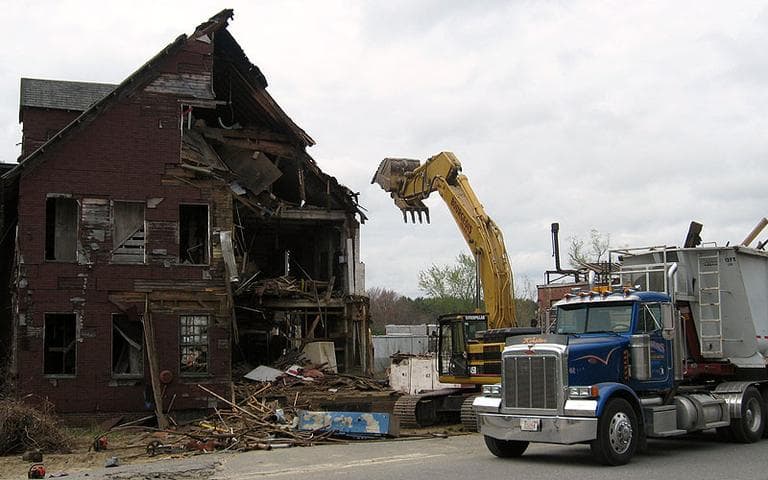
A wrecking crew demolishes the S. Bent & Brothers, Inc., chair-making complex in Gardner. (David Boeri/WBUR)

GARDNER, Mass. — Across from the mill pond and the cemetery where the founders of S. Bent & Brothers, Inc., are buried, a wrecking crew has been knocking down the chair-making complex that once co-starred with a constellation of furniture makers that shone for a century and a half. And not just the buildings are disappearing. Still fresh is the imprint of the newly removed old tracks that once connected S. Bent & Brothers to the mainline that crossed Massachusetts.

As a 7,500-foot-long train full of freight rolls through here every night, it accentuates the economic decline of a city where once there was every reason to stop, when Gardner factories turned out four million chairs a year and it was the chair-making capital of the world.

“It used to be a booming city at one time,” says city employee John Hallock.

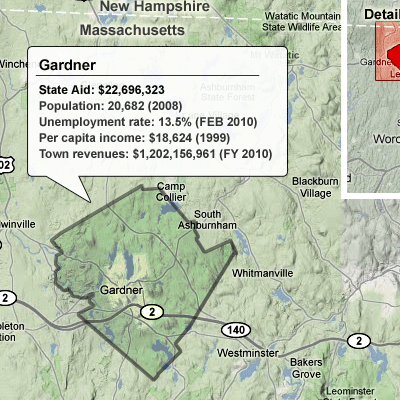
MAP: Gardner's fiscal situation (Jesse Costa/WBUR) (Click to enlarge)

Even at mid-century, he recalls, when furniture makers started turning to North Carolina — as they’ve since turned to Asia — Gardner mills were still strong and hungry for workers.

“You could have a job and leave it and five minutes later, you’d be walking into another one,” Hallock says. “Oh, yeah. We had a lot of employment here.”

Powered by industry, the city of 20,000 — one of the smallest cities in Massachusetts — built its own municipal golf course and indoor swimming pool, a hospital, a community college, grand parks and stately buildings, like the Georgian red brick City Hall on the common.

Now the last big factory has pulled out and the trains roll by without stopping. And atop the long-term decline and loss of local revenues, the recession-triggered budget crisis has grown like weeds on the side tracks.

Gardner’s young, upbeat second-term mayor, Mark Hawke, provides a downbeat tour of cuts, consolidation and streamlining necessitated by acute cuts in local aid now that the state’s revenues have hit hard times.

“Engineer’s office,” he points out. “We used to have an engineer, assistant engineer, a surveyor, auto cad person and the clerk. Cut the staff in half here.”

Down the quiet hallway, where his foot steps echo, he passes an empty office.
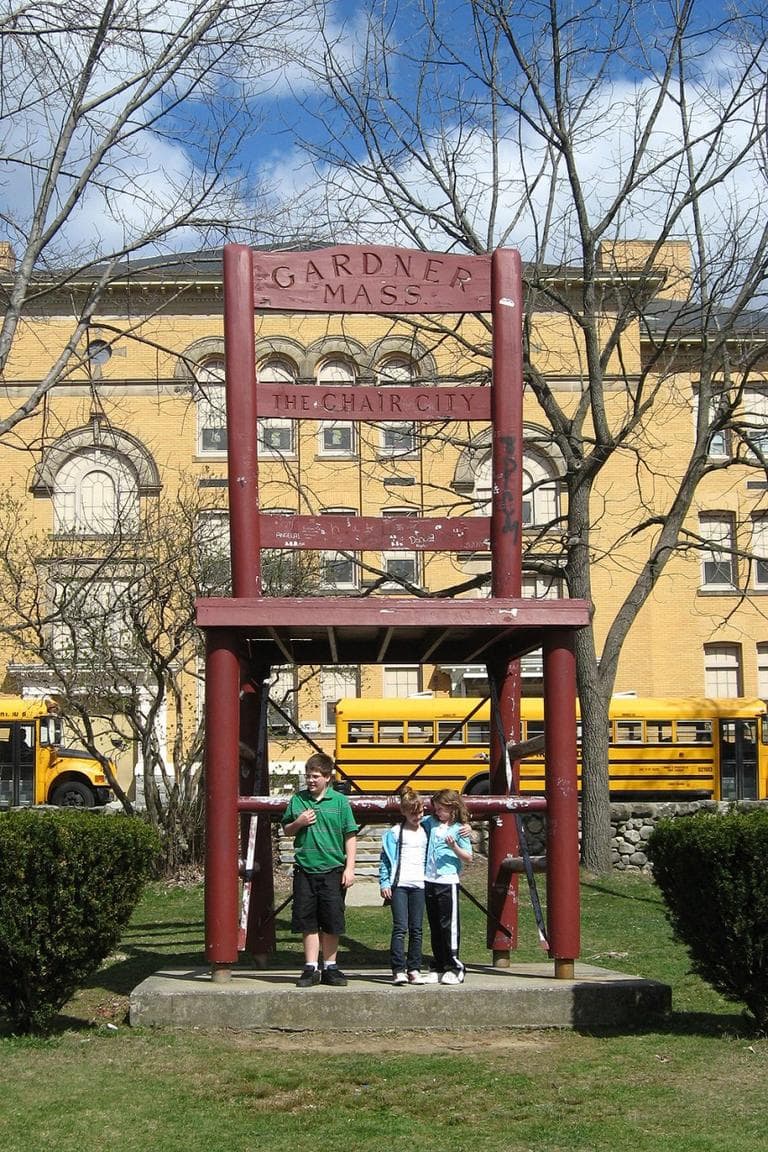
Children gather round 'Chair City's landmark. (David Boeri/WBUR)

“We used to have a local building inspector as well as a building commissioner,” Hawke says, “but we had to let them go.”

Hawke introduces me to department heads with no hands. Not even a part-time clerk.

“Scott Brown for Senate” signs tucked into his office reveal the mayor’s lean-thinking, small-is-beautiful philosophy of government. But Mayor Efficiency notes you can only streamline and consolidate local government so much before it turns ridiculous.

“The department of municipal grounds, parks, playgrounds, cemetery, forestry, flood control, insect control, golf course and swimming pool,” he points out. “One clerk.”

And don’t count on finding the department head in his office, either. Michael Gonyeo is too busy mowing grass, digging holes at the cemetery or cutting trees, where I caught up with him.

“We have a list on my desk right now — it’s probably six-years-old — it’s a list of people who have called because they need tree work. Branches and limbs have fallen in their yards or on their roofs,” he says. “We haven’t gotten to them.”

If you live in Gardner and there’s a death in your family, the grounds crew will make sure the hole gets dug in the cemetery. You’ll have to wait for tree work. And don’t even think about calling to get your cat out of the tree.

“I hate when they yell at you and swear at you and hang up the phone,” Gonyeo says, who is as conscientious a city employee as you can find. “I understand their frustration but we’re only four guys and we can only do so much.”

That will change when the new budget comes in: They’ll be only three, says Hawke.

What becomes apparent in Gardner, as I talk with the 37-year-old mayor, is how the core functions of municipal government are shrinking to the four corners of police, fire, schools and streets — which themselves are stressed and competing for available funds.

At a recent budget meeting, Hawke told his department heads to forget about their wish lists. They amounted to $2.5 million, and he still has to cut another $600,000 from the proposed budget to balance it.

“There’s really nobody left in City Hall to cut,” he observes.

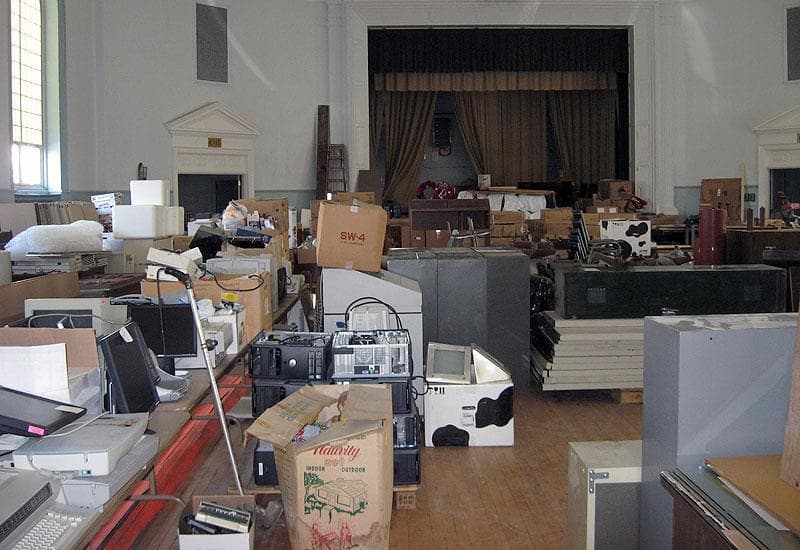
'We can't afford to fix it, we can't afford to tear it down,' Mayor Hawke says of City Hall's auditorium. Now it's for storage. (David Boeri/WBUR) (Click to enlarge)

“You can only right (the) size of government so much — which I’m a big fan of — until it becomes the right size,” he adds. “But, after that, as I said, you’re just amputating.”

It was time to say good-bye — in part because Gardner City Hall now closes at noon on Fridays to save a half day. But first Mayor Hawke wanted to show me the building’s auditorium.

“Watch your step,” he cautions as the door opens into a grand, high-ceilinged ballroom with a balcony befitting a place called “Chair City.”

There’s a hole in the floor, floor boards are warped, a once-leaky roof has flaked the paint off the ceiling, light streams through abundant single-pane windows, and there’s been no working heat since the leaking underground oil tanks for the furnace were removed a few years ago.

“We can’t afford to fix it, we can’t afford to tear it down,” Hawke says. “This is just a microcosm of what’s happening across the state to local government as a whole. We can’t afford to fix the buildings that we operate in and we can’t afford to have staff in them (either).”

And soon when the Gardner finds out how much — or, more to the point — how little it’s going to get in state aid, it may be emptying still more chairs in The Chair City.

WBUR Topics · Boston · Economy & Business · Politics
Please follow our community rules when engaging in comment discussion on wbur.org.
  • Rob

    I moved out of Gardner 5 years ago, my grandparents settled there from Europe in the early 20′th century, my father and my siblings were all born there. It was, and is, a marvelous little city with a strong sense of community.

    I have fond memories of my childhood in the 60′s and 70′s when the chair factories ruled. I would ride my bicycle to downtown and have sawdust in my eyes from the open windows of the buzzing chair shops.The downtown was thriving with Sears and J.C. Pennys having stores, and local favorite Goodnow Pearsons. Anyone my age remembers that it wasn’t Christmas season until Goodnows put up their decorations. And every year at Christmas, for some reason, they would have a caged monkey in the childrens toy department

    I recently told a friend of mine that we were lucky, in that we were the last to see a town where you could be born,schooled, work get married and die and probably never have to leave the city, and I knew many people that did just that. In the late 70′s I saw the manufacturing base slowly leave town and the transition to another bedroom community, and with it such a loss as new people moved in, just for a home and no real sense of the history or the community that was Gardner.

  • Rudolf

    Those chairs, that are not being produced in Gardner, are being imported, mainly from China. They represent jobs that were exported; China is eating our lunch. That is the root cause of our troubled economy: too many goods are being imported. Until we recognize the problem and do something about it, we won’t have a recovery in the U.S.A. and our country will be in decline.

  • http://www.algonquinsweeping.com Ron Lichtenstein

    As a life long Massachusetts resident and economic development professional it is amazing to realize how far we have fallen as a state. David’s recent story on Gardner, MA was superb. It sort of lays out perfectly for me where Massachusetts once was a great machine of leadership and now we are not even functioning as a bare bones service provider for the taxpayers.
    The real question I think people are going to start asking themselves shortly is ” why even live here” to begin with. Gardner’s mayor seems to have missed the Reagan dictum which was ” less government.”…not no government.

  • http://web.me.com/benphoto2 Ben Savoie

    I Shot a photo documentary 2 years ago of the closing of Nichols & Stone. The last of the major chair factories. They lasted 151 years. I worked there briefly in 73-74. My brother worked there 35 years who recently took his life from despair. The sad tale of the city. Please check out http://web.me.com/benphoto2
    Ben Savoie

  • Groghan

    Mr. Lichtenstein’s comment, “Gardner’s mayor seems to have missed the Reagan dictum which was ” less government.”…not no government” is baffling. I don’t see how you can lay Gardner’s decades-long economic decline at the feet of a two-term Mayor, unless it’s just a gratuitous cheap shot because Mr. Hawke happens to be a Republican.

  • Jesse

    After my first two years in Gardner, my family will be in the home I bought for many years to come. While I can’t say that the city is on it’s way up, I have hope that as i take care of my 85 year old home and update it, that others are doing the same around me. I see it in places, and hope for expansion of that trend. It’s a great place and I love it.

  • stevelaudig

    $1,000,000 per troop per year for wars in Afghanistan and Iraq and 850+ military bases around the world. what exactly is it protecting except the income of arms manufacturers.

  • Anon Omous

    Let it burn!
    This system is not worth saving.

  • http://surroundingsgallery.com Chuck Heidorn

    I moved to Gardner from Jamaica Plain in Boston 25 years ago and found a hard working community proud of their city. It’s true that the manufacturing base is gone and we are in transition from what was Gardner to what will be. Transitions are always painful.

    Although the factories left the area, the craft, inventiveness and creativity remains and will be the saving grace of this resilient little city. Gardner has it’s problems to be sure as every community out here does but they are manageable and for those who meet the problems with ideas and perseverance, a great place to live and work will emerge.

  • Hercy Lord

    It way past time for sturdy, capable men and women to get out and do some labor to keep their towns and cities clean and running. Our pioneering ancestors HELPED each other with barn raisings, crop harvesting, and keeping their town center clean. With a shovel and some material pot holes can be filled and tamped down, buildings can be scraped and painted, trees cut and removed. Everyone sign a waiver that they will NOT sue. Don’t expect pay, just get out and WORK. Consider YOUR town part of your home. Local handymen and contractors can provide the “how to” and towns people provide the labor. At some point things get so run down, that it becomes a fiscal nightmare to try and correct. Forget that you pay taxes for these services, just get out and HELP.

  • Tim Bo

    Everyone needs to stop buying Chinese made junk with their American dollars, you need to start producing and manufacturing again, so what if goods are more expensive we don’t need three cars, four tv’s and all the junk we fill our homes with, community is more important than consumerism.

  • Matt

    ***Everyone needs to stop buying Chinese made junk with their American dollars, you need to start producing and manufacturing again, so what if goods are more expensive***

    “So what” if goods are more expensive??? That’s MY savings and MY retirement you’re talking about. I’m not going to spend more just so cities in Massachusetts can tax the everlovin’-sh!t out of companies as they’ve always done!

    This town “built its own municipal golf course and indoor swimming pool, a hospital, a community college, grand parks and stately buildings, like the Georgian red brick City Hall on the common” and it did it on the back of the company and people that provided most of its employment. Someone needs to go back and read “The Goose that Laid the Golden Eggs”. Sadly, it seems a lot of people think it’s a kids’ story.

  • Windee

    “China is eating our lunch. That is the root cause of our troubled economy”

    Um, no. Taxes are the root cause of your troubled economy. In a state where >50% of your income is given up to taxes and government-mandated spending (e.g., health insurance), it’s no surprise businesses are folding and/or moving out of state or overseas.

  • Scott Gallant

    “China is eating our lunch. That is the root cause of our troubled economy”

    Um, no. Taxes are the root cause of your troubled economy.

    Um, No again!!! Under a classic economic model, workers in America would have to compete with Chinese laborers getting paid around 25 cent an hour. Can an American family live off less than that?

    And why is it that other western industrialized nations can pull themselves together economically with higher tax rates?

    The old-and-tired “taxes are evil” gibberish doesn’t answer the question why American companies for the last 15 years had made record profits even before they shipped the work overseas.

    More working-class apologists for the very class that’s been taking far more than their fair share for 30 years. Pathetic!

  • Rebecca

    Outsourcing has destroyed America’s economy, has caused increased unemployment, which leads to people vacating and moving elsewhere to look for work including overseas.
    So many of the historical buildings in Gardner have been sacrificed the the bulldozer gods, much of it without significant documentation of who worked where and when, which would be a genealogical and historical asset to researchers. Those small etchings on the wall of so and so was here have significance and now they are all gone to join the apparitions of those whose backs Gardner was built on.

  • Rebecca

    Outsourcing has destroyed America’s economy, has caused increased unemployment, which leads to people vacating and moving elsewhere to look for work including overseas.
    So many of the historical buildings in Gardner have been sacrificed to the bulldozer gods, much of it without significant documentation of who worked where and when, which would be a genealogical and historical asset to researchers. Those small etchings on the wall of so and so was here have significance and now they are all gone to join the apparitions of those whose backs Gardner was built on.

  • http://www.carolynkamuda.com Carolyn Kamuda

    I moved to Gardner in 1987 to work for the local radio station (WGAW). At the time is was a lively station with lots of listeners and I felt a real sense of community. I stayed here although I could have lived any place in the world at the time because I had little responsibility. Instead I chose to start a small business (Real Estate) and decided to do something good for the community. I was chosen by the Mayor at the time to serve on the Arts Lottery Council and was able to write and receive a grant to start an Artists Association. This past month, I attended their 22nd Anniversary Exhibit. Some things can survive when people want to make it happen. Gardner has many, many good qualities. It’s a safe place to raise your children, there is a sense of commuinity here and people are warm and friendly. Gardner can survive these tough enconomic times. It will not be easy but there is much to offer here and with the right combination of luck and creativity, I think Gardner can be a destination… A place where people visit and enjoy and perhaps even to live. Belief can make it happen!

  • Bill Lottero

    Windee, you kinda
    sound like a tea bagger wind bag with the coloring of how MA raises taxes.–
    every state pursues a tax revenue mixture.

    I acknowledge that for individual income tax collections as a
    percentage of states’ total tax collections in 2008, Massachusetts ranked second highest in the United States at 57.2%. The US
    average being 35.9% for the same year. However, individual income tax is but
    one source of a state’s tax revenues.  Thus,
    it is more appropriate to consider a state’s whole tax mix strategy. For
    example, let us compare the MA state tax mixture to that of Tennessee and New
    Hampshire which have the lowest state individual income tax collections
    respectively as this may illuminate the point.


    Tennessee for example has the highest general sales
    tax making up % 59.22 of all its tax revenues. If fact, Tennessee is the third
    highest in the nation for general
    sales tax collections as a percent of states’ tax collections-2008. While New Hampshire with a 27.31% corporate
    income tax collection as a percent of States’ tax collections-2008 is the
    highest in the nation

    I am sure
    arguments can be made for or against any of tax mixture strategies. Certainly,
    some mixtures are far more regressive than others- i.e. a tax that takes a larger percentage from low-income people
    than from high-income people. A regressive tax tends to increase the
    total percentage of income paid on those who must pay the tax. Thus, those who
    have a higher income pay less of their total income on items taxed. Keeping
    that in mind, it would seem Tennessee’s tax strategy might needs some
    adjustments. In contrast, according to The Massachusetts Budget and Policy
    Center “Over the last 29 years the share
    of income that was collected as taxes in Massachusetts declined by 24 percent.
    This is the sharpest drop in state and local taxes as a proportion of personal
    income among all 50 states

    Windee, you kinda
    sound like a tea bagger wind bag with the coloring of how MA raises taxes.–
    every state pursues a tax revenue mixture.

    I acknowledge that for individual income tax collections as a
    percentage of states’ total tax collections in 2008, Massachusetts ranked second highest in the United States at 57.2%. The US
    average being 35.9% for the same year. However, individual income tax is but
    one source of a state’s tax revenues.  Thus,
    it is more appropriate to consider a state’s whole tax mix strategy. For
    example, let us compare the MA state tax mixture to that of Tennessee and New
    Hampshire which have the lowest state individual income tax collections
    respectively as this may illuminate the point.


    Tennessee for example has the highest general sales
    tax making up % 59.22 of all its tax revenues. If fact, Tennessee is the third
    highest in the nation for general
    sales tax collections as a percent of states’ tax collections-2008. While New Hampshire with a 27.31% corporate
    income tax collection as a percent of States’ tax collections-2008 is the
    highest in the nation

    I am sure
    arguments can be made for or against any of tax mixture strategies. Certainly,
    some mixtures are far more regressive than others- i.e. a tax that takes a larger percentage from low-income people
    than from high-income people. A regressive tax tends to increase the
    total percentage of income paid on those who must pay the tax. Thus, those who
    have a higher income pay less of their total income on items taxed. Keeping
    that in mind, it would seem Tennessee’s tax strategy might needs some
    adjustments. In contrast, according to The Massachusetts Budget and Policy
    Center “Over the last 29 years the share
    of income that was collected as taxes in Massachusetts declined by 24 percent.
    This is the sharpest drop in state and local taxes as a proportion of personal
    income among all 50 states

More stories in 'Politics'
UNDERWRITING
Most Popular
SUPPORT
SUPPORT
This site is best viewed with: Firefox | Internet Explorer 9 | Chrome | Safari