WBUR

Invisible Communities: Forced Out, Guatemalans Learn The Power Of Visibility

Illegal immigration has gotten a lot of recent attention with the passage of Arizona’s controversial law. What often gets lost, however, is how immigration — legal and illegal — changes our country and our state. But few really know what goes on within these communities — to many, they are “invisible.” This is Part 1 of a WBUR Series: Invisible Communities.

NEW BEDFORD, Mass. — In 2007, federal agents hauled off 361 immigrants from a factory in New Bedford. At the time, it was the biggest workplace raid in the country. Boston media outlets documented the event in graphic detail.

“Today there were horror stories of workers fleeing the building and even jumping into New Bedford Harbor to escape the federal agents,” recounted one WBZ-TV reporter.

Juana Garcia was working inside the Michael Bianco, Inc. factory that day.

“When I saw that the agents carried guns I thought they were going to shoot us,” Garcia says in Spanish. “I thought we were all going to die that day.”

Garcia and many others were sent to Texas. Many women with small children were released but Garcia refused to divulge any information about her two-year-old son. She was afraid that immigration agents would pick him up, even though he’s a United States citizen.

“They lived, in a sense, underground, under the table. We didn’t know they were there.”
–Immigration attorney John Willshire Carrera

It wasn’t until her son got very sick and his doctor sent a letter to immigration officials that they sent her back to New Bedford. Garcia had been detained nine days.

“When I returned home, I approached my son and he didn’t recognize me,” Garcia says. “For him, I was already a stranger.”

Some would say Garcia and her family never should have come here, that they brought this trouble on themselves. But Garcia says leaving Guatemala was the only way to stay alive.

“We were not welcome in the country,” she says of Guatemala. “It’s like we are animals. Actually, worse than animals.”

Garcia and about half of the people detained in the 2007 raid belong to an ethnic group called the Maya K’iche — indigenous Guatemalans. The Maya K’iche have had a bad relationship with the Spaniards who colonized Guatemala. The relationship culminated in a long, bloody civil war. So many Maya K’iche died in the war that the United Nations called it a genocide.

Listen: Atty. Carrera On The 2007 Raid

The civil war officially ended in 1996. But many say that didn’t stop the persecution of the Maya K’iche. So, rather than continue to face it, Garcia and her family moved illegally to America.

“When we arrived here, we never thought of talking to anyone,” Garcia explains. “We saw that there were a lot of Maya K’iche here and people from our same town, but we didn’t talk to them, and even less to strangers who weren’t K’iche.”

Here in New Bedford, Garcia and her family didn’t talk because they were traumatized by what they suffered in Guatemala. That meant they never learned that some of the most established people in the group had won political asylum based on their experience in Guatemala.

“They lived, in a sense, underground, under the table,” says John Willshire Carrera, a longtime immigration attorney with Greater Boston Legal Services. “We didn’t know they were there. We’ve been doing immigrants rights work for years.”

But when agents stormed that factory, it changed everything for this community. The group at once became visible. Ironically, it took the raid to improve the lives of many Maya K’iche.

That’s thanks in part to Anibal Lucas.

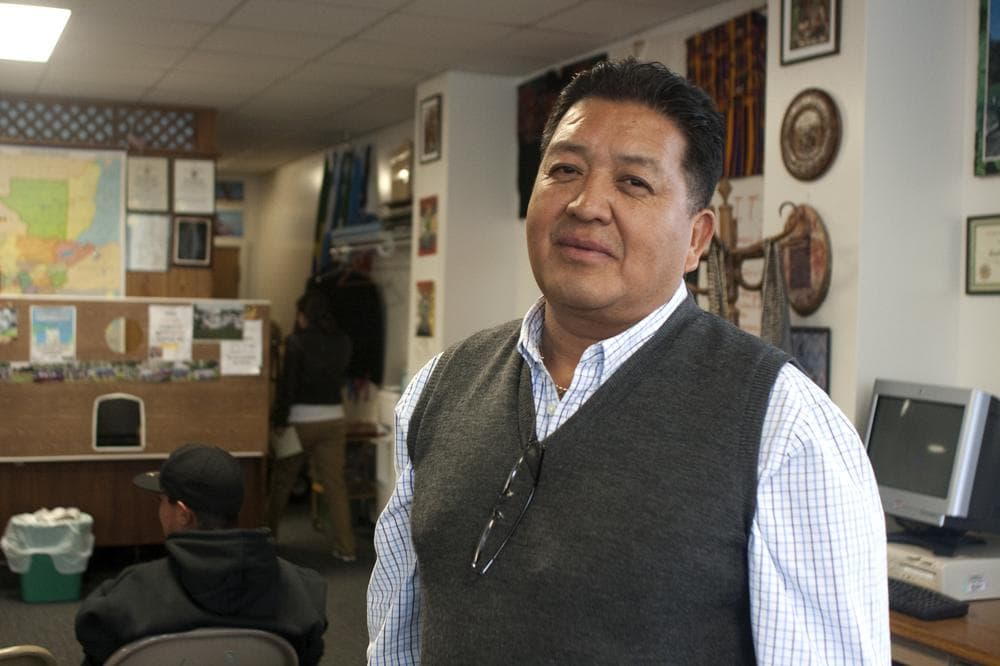
Anibal Lucas runs Organizacion Maya K'iche in New Bedford. He started it to teach kids the Maya K'iche language, but it's become the first place the immigrants go for legal help, English language classes and social gatherings. (Jess Bidgood for WBUR)

Sitting in his storefront office in New Bedford, Lucas talks on his cell phone. It’s 7 p.m. and someone has just called looking for a ride to Boston the next day. Lucas sighs.

“What’s the latest you can be there,” he says.

Lucas is the unlikely hero of the Maya K’iche.

He is a grumpy man with two small kids at home, but he has spent the last three years ferrying people from New Bedford to Boston. He realized after the raid that his community would have a hard time fighting deportation since many of them don’t drive and wouldn’t make it to their court appointments in Boston. So Lucas and one of his assistants have done most of the driving.

Lucas never intended to be an organizer. He started Organizacion Maya K’iche before the raid to help educate children about the Maya K’iche language. Few members of the community visited the office. But now, because of his work helping people after the raid, he’s become the center of this community, sponsoring classes on immigrant rights at work and even arranging social gatherings.

“It’s been a lot of work,” he says in Spanish. “First of all, we don’t speak English. And we didn’t know anything about computers. I didn’t know how to write. It was really hard for me.”

In March, Lucas took about 50 Maya K’iche members to Washington for a national immigration reform rally. Just a few years ago, these people were afraid of leaving their homes and now they’re marching on Washington. All of this can be traced back to the raid of 2007.

“Remembering back on that day, at that moment, it was awful,” says Juana Capir, a 30-year-old who was detained, in Spanish. “But at the same time, I think I’m better off because of the raid.”

Capir has a green card now because she met an attorney after she was detained. After getting her green card, Capir became less afraid to do things. Now she visits her children’s school and escorts other Maya K’iche women to court. She marched on Washington.

We realized we had rights. We started to understand how to live here, and that’s when I started to take charge of my life.
–Juana Garcia

She’s not the only one who’s changed her mind about the raid. Martina Hernandez received political asylum and is on her way to getting her green card. “Difficult and terrible things happened to me, but sometimes I thank God that they did,” she says in Spanish.

Garcia, in the meantime, is still waiting for an answer from an immigration judge.

Chopping vegetables in her home, she is surrounded by memories of the raid. Her nephew has received a green card after being detained that day. Her son still shows signs of trauma from being separated from her.

She’s too hoping to receive asylum, but, for now, she says the raid gave her less tangible benefits.

“We realized we had rights,” she says. “We started to understand how to live here, and that’s when I started to take charge of my life.”

The legacy of the raid remains complicated. Dozens of people were deported back to Guatemala. However, many are still trying to win political asylum. Some are getting green cards, and so are their friends and family who weren’t even part of the raid. But the bigger legacy might be that this community, once underground, was forced out of hiding, and they’ve decided to make the most of it.

WBUR Topics · Boston
  • http://www.buddhaspillow.blogspot.com Paul Creeden

    The personal stories of illegal immigrants are often heart-rending. Here we have more. However, there is another story of insular monoculturalism, drugs and organized crime. This seldom gets any coverage on NPR. These communities are not hidden if you live in poverty beside them and also live with the less savory aspects of illegal immigration. Perhaps more attention can be paid to low-income American citizens whose neighborhoods are bearing the stress of integrating these immigrants into American society.

  • Dave

    To Paul Creeden: The million dollar question is what percentage of these immigrants end up getting involved in the unsavory lifestyles. Clearly the reason is lack of economic opportunity and perhaps, as the story illustrates, the immigrants’ lack of understanding their rights and ability to integrate into American society – not the fact that these people are immigrants. Of course, that is small comfort if the immigrants near where you live are engaged in dangerous, illegal activities. I do agree wholeheartedly with your last point: we could help both the low-income Americans AND the low-income immigrants with education and opportunities. If not, perhaps the problem is with our economic system and its’ inability to create opportunities.

  • Anibal Lucas

    Blanca felicitaciones nos as hecho un buen comentariouna buena redacion mucha gracias mil gracias

  • Rob Matthews

    This is an important story that is timeless in what is often called the American Melting pot. Thank you WBUR. Right now it happens to be Guatemalan’s sticking out of the pot but in the past it could have been Irish, Germans, Chinese, Cambodian’s. Most of these groups want to be part of American culture believe it or not. Contrary to conventional wisdom these groups often want to be American and Patriotic. They don’t want bi-lingual education. We project these values on to them-by mistake. Much of this is discussed in the prominent polictal scientest Samual Huntigton’s book “Who are We” and previously in
    Most readers who are not political scientists know Huntington from his book “The Clash of Civilizations and the Remaking of World Order,” which was published in 1996, and which proposed that cultural differences would be the major cause of global tension in the future.

    Read more: http://www.newyorker.com/archive/2004/05/17/040517crbo_books#ixzz0nXYDdfUz

  • Agatha

    Great series! Thank you so much for writing about such an important subject!

  • Omar Abdillahi

    Great article! And a great read as well. Thanks

  • Sophia

    One thing that surprised me was some immigrants benefited from the raid.

  • Jack

    I was surprised how many of these immigrants were able to sneak into the U.S. illegally. I also wonder what happened to the immigrants who dived into river…

  • http://bancroftschool.org Atticus

    I was surprised that some maya k’iche accually benefitted from the raid and that they just took people away from their families.

  • Sophia

    I was surprised that immigrants actually benefited from the raid.

  • Abby

    This broadcast puts a face on the issues of immigration. A great resource for teaching about modern immigration.

  • Alyssa

    I was surprised that even though Lucas was a grumpy man he still dedicated his time to bringing people from New Bedford to Boston.

  • Matthew Edwards

    i thought that the raid helping people was surprising because raids usually help only the people that execute the raid benefit.

  • Joyce

    I was surprised that although they were detained, they still got green cards and they realized they had rights. I feel bad for the people that had to stay in prison for a long time, and the others that were sent back to their warring home country.

  • u dont need to Know

    This broadcast really helped me understand how big an issue the world thinks immigration is

  • Miky

    I think that we are handling immigration in Massachusetts a lot better than in Arizona!!!!! We are considering the immigrants life. :)

    :)

  • Allison

    I think that it is so weird how in the end the Guatamalens benefitted from the raid. Facinating!

    :P

  • John

    I think that illegal immigration is the stupidest thing because it can be solved the same way china did it hundreds of years ago… a really big wall instead of a stupid little fence and a thermal cam plus if we have more jobs open for border patrol then less people will be jobless. amen to that.

  • Carly

    I was surprised that immigrants actually benefited from the raid.

  • Katie B

    I was surprised that the Maya K’iche were persecuted so badly that they hid in factories just to avoid the Spaniards. I felt that it was sad that very few of the Maya K’iche got a chance to really live life to the fullest.

  • Claudio

    I think that this topic is very important and this is something that should be fixed with the Mayan government because this is something that i know is able to be fixed.This was something very interesting nice job.

  • Monica

    I think this broadcast was a little slow, to me it had a lot of supporting details, sadly it made it long for some kids. Though, I was surprised was how part of the workers were deported, and without their family! Poor guys! I was glad to hear how the raid made life a little better though for some other immigrants.

  • Justin

    I was really surprised when they said that they got benefits from the raid. (I think that it’s really cool how things like that can benefit someone.)

  • Chocolate Cornet :P

    I was very surprised and shocked that we actually separated families. I think it was a cruel thing to do.

  • so and so

    I was surprised that the raid happened in Mass.

  • Aislinn

    It’s really sad to hear of all of those immigrant people being taken away from their families. I’m glad to hear most of them got to go back to their families.

  • http://www.wbur.org/2010/05/10/invisible-communities-i Jesse

    I was surprised that the Maya K’iche went through all of this just to live in America. Wouldn’t it of been easier and more private to live in Canada.

  • Andrew

    I think the is webcast was a little boring but sad. I feel bad for the Maya K’iche because most of them were killed.

  • Woody

    I thought that this broadcast was very inspiring, because many people came to Massachusetts and took on a new life. I think that this message is very important for people to learn about.

  • Emily

    I believe that it is sad for some but happy for others. It is very sad for some because they got sent back and separated from their families, others lost their “suppliers” after they were deported to Guatemala, and some were imprisoned.it was Good because some got green cards and learned there rights as a new American citizen.

  • Cornelia Rosheen Saoirse Grimaldi Thornton

    I am very surprised that the Maya K’iche benefited from the raid. I would never have thought that it would be helpful.

  • Mehmet Ulas Yakupolugh

    I think that this broadcast was very informative. Like how it said that the raid sent some Maya K’iche people to America.

  • Ben (awesomeness)

    The immigrants were persecuted so strongly that they had to hide in factories. Also people were jumping into the bay to escape the government.

  • muffy

    I would NOT be able to live like that! I would be sooo bored. They are very brave to come to America and live like that. I would just go to another country where I had more rights.

  • alt

    I was surprised by the fact that the Maya K’iche benefited by the raid. I was also surprised that they are now allowed to have a Green Card.

  • Robert Holloway

    I enjoyed reading this article. I find it amazing that entire communities of unregistered immigrants can live in our country unnoticed. I also find the fact that being detained and brought to Texas actually had a positive impact on some of them very interesting.
    All in all, a truly engaging article.

  • Bon Qui Qui

    This is a depressing article. There are some sad stories about the different families and the consequences of the raid. But there were some good stories about benefits for instance how some of them got green cards :)

  • Aurea

    I was shocked that the government treated immigrants so harshly. I really liked the article, because it showed different people’s perspectives on the subject.

  • Jorge (george)

    I was surprised that this event happened and I was totally oblivious to the indigenous peoples strife and worry. That government is terrible to take a mother away from her son or daughter. Really the govt. is to blame for this because the govt. should have been monitoring the illegal immigrants in MA. @:I

  • Izzy

    I think that this is a bad and unfair thing to do. First, they take them away from their family and send them far away. They should be allowed a trial. If it gets so bad that people have to go into hiding and jump into the oceans to get away from the government. Something has to be done.

  • Kyles :)

    This was an interesting broadcast. It was sad to hear about all the deaths that occurred and that people were separating from their families but it sounds like it was for the better in some case. Also, it was sad to hear about how they either deported you out of the country or sent you to Texas. In America today that is considered not right. The only good part of the broadcast was when people received green cards and invitations to political asylums.

  • Markus

    I was very surprised that they had to take the illegals all the way to Texas. I do not know how the Maya K’iche survived by just speaking their own language. I could have never done that.

  • Noah

    I thought this was an interesting article because there were many benefits and drawbacks to the raid. At the beginning of the broadcast, it seemed like a act of pure persecution. Then they explained all the benefits of the raid, so it sounded like it was a great idea to raid a factory and put all the people working there in a detainment center. At the end of the broadcast, they talked about all the negative effects of the raid. Overall, I think that the Maya K’iche could’ve gained the benefits of the raid in a purely non-violent way at some point. The raid wasn’t a good idea.

  • Akhil

    I think that this was an interesting article because Juana didn’t tell the agents that she had a 2 year old son because they were letting everyone else with a little kid go to back to their family. I was really surprised that agents with guns came to the factory that would be really scary for me if I was there in real life. I was glad when I found out the doctor sent a note that her son was sick because she got to go back to her family. When I found out that the raid helped the Maya K’iche i was really surprised. I am glad I listened to this article because it tought me a lot about life for the Maya K’iche.

  • http://www.bancroftschool.org Hiyo Pranav Gulukota

    Hiyo, this is Pranav Gulukota saying that the indigenous people are cruel and shouldn’t have seperated families and deported innocent people. I also think that unless they were forced out of Guatemala they shouldn’t leave. Have some pride for your nation. I understand that these people although still speak their native dialogue and were forced out of their nation. But when you analyse the situation you have to say that some of the people that came weren’t forced to, help your nation! I respect the people that were forced out of their nation and understand why they came, and I am definitely on their side in court.

  • grace

    I think that the Maya K’iche are being treated unfairly. Instead of detaining them we should help them to become citizens. I was surprised that they had to go through genocide.I did not expect that.I think that we should do more FOR the immigrants. They came here for protection, not rejection and mistreatment.This article made me more aware of this problem.

  • brooke

    I think this article is very important. I was suprised on how the people found some benefits from the raid, and didn’t just give up. What happened to them was very unfair and bad.

Most Popular
SUPPORT