WBURInvisible Communities, Part 4: Haitians Say They’re Haitian, Not African-American

Illegal immigration has gotten a lot of recent attention with the passage of Arizona’s controversial law. What often gets lost, however, is how immigration — legal and illegal — changes our country and our state. But few really know what goes on within these communities — to many, they are “invisible.” This is Part 4 of a WBUR series: Invisible Communities.

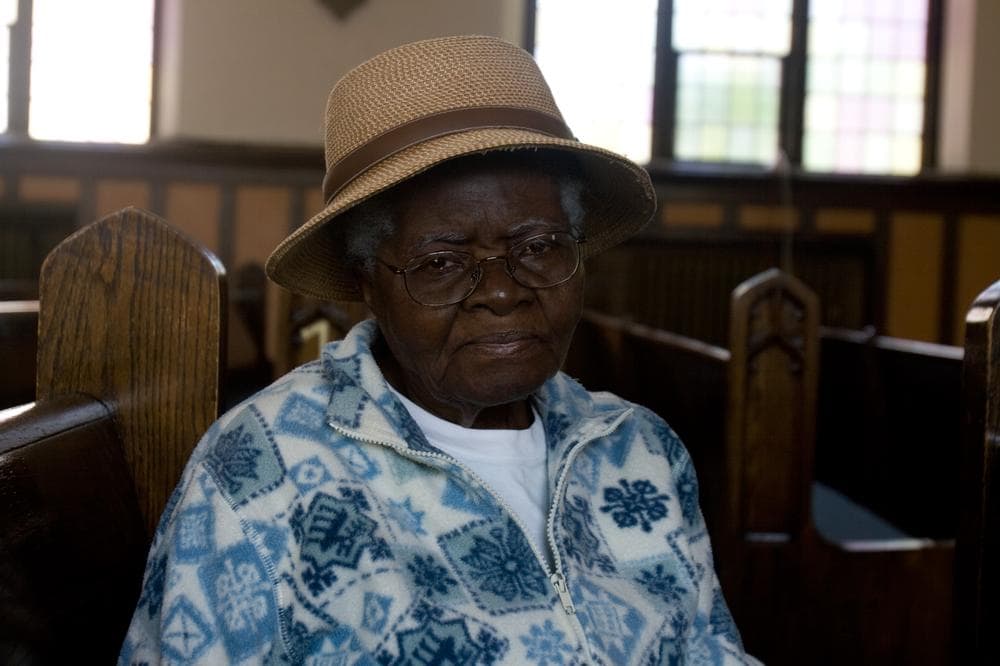
Jacqueline LaGuerre sits in the church where her husband is a pastor, Philadelphie Seventh Day Adventist Church, in Malden. (Jess Bidgood for WBUR)

BOSTON — Rhode Milord LeBlanc teaches English as a second language at a Haitian nonprofit in Mattapan Square — the heart of Greater Boston’s Haitian community. Her students are mostly Haitian, with a smattering of immigrants from the Dominican Republic.

“Some people like me, I’m Haitian-American,” she says. “That means my family is from Haiti, but I was born here. I feel more Haitian than American because of the way I was raised.”

Then she turns to her class of adults. “Do you feel that you’re more Dominican or more American? Or more Haitian or more American?”

The students yell out their answers. The split in the room is remarkable. The Haitians have United States passports and have been here for years. But they say they are more Haitian than American. The Dominicans have been in the U.S. for less than a year, but they feel as American as Dominican.
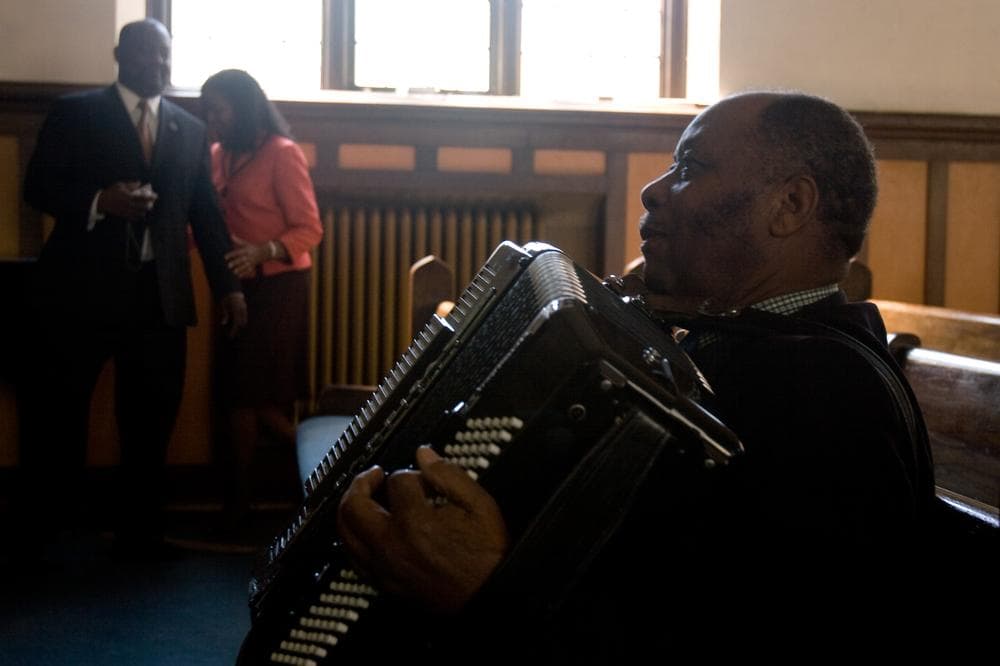
Pastor Janel Lareche, a retired minister from Haiti, practices accordion before a midday service at Philadelphie Seventh Day Aventist Church, a Haitian parish in Malden. (Jess Bidgood for WBUR)

LeBlanc and others say that for Haitians, this has everything to do with Haiti’s unique language and formal customs inherited from the French, who colonized the country. But many researchers say there’s something else going on.

“If you’re in Haiti and you look at the black community here, what do you see? It’s hip-hop,” says Alix Cantave, the associate director of the Trotter Institute for the Study of Black Culture at the University of Massachusetts Boston.

“It’s housing projects,” Cantave says. “It’s all these things, so that’s the image they migrate with. It’s the perception that it’s everything not to do, in a way, between the adults. So you don’t want your children to go and imitate African-American behavior.”

Researchers like Cantave, and Christina Greer at Fordham University, argue that Haitians maintain their “Haitianness” because they think it will help them.

“Based on where they perceive black Americans and where black Americans perceive where they are on the fictitious totem pole, many Haitian immigrants choose to maintain their ethnic identity,” Greer says. The political science professor is writing a book about how Caribbean and African immigrants are maintaining their ethnic identity in America.

So Haitians are trying to become visible by defining themselves as separate from African-Americans. Twenty-nine-year-old Jean Franck Fenelon makes no secret about why he identifies as Haitian.

“Immigrants make progress over the years,” Fenelon says. “Over time we would climb up one rung of that ladder, and then another and another. But being an African-American, it’s static. There’s no upward mobility. And so that’s always been my thought as well. That if you say you’re African-American, the doors are not going to be open for you.”

Fenelon, and Jacqueline Laguerre, a Haitian-born nurse, say they appreciate the struggles that African-Americans endured here for centuries.

“If I can be here in the United States, enjoying a piece of the ‘American Pie,’ it’s because they have suffered a lot to cause me to be accepted,” Laguerre says.

“Based on where they perceive black Americans and where black Americans perceive where they are on the fictitious totem pole, many Haitian immigrants choose to maintain their ethnic identity.”
–Prof. Christina Greer

Still, she has this gentle caveat.

“Without wanting to generalize, because you can’t say that ‘all Haitians are this, all Haitians are that.’ But there are a lot of African-Americans who have lost their way, who are sort of at a loss,” Laguerre says. “They are not doing well in society. And so people might tend to distance themselves from African-Americans because of some stereotypes.”

Mukiya Baker-Gomez does political organizing in Mattapan and Hyde Park — neighborhoods where many Haitians and African-Americans live side-by-side. She identifies herself as an African-American and says it’s not helpful to pay attention to stereotypes.

“I don’t think that helps us at all,” she says. “We’ve got to move beyond that. That’s madness. We’ve got to understand that there is a collective of people that are impacted everyday because of the color of skin. When you open up your mouth that might be another factor. But the first factor is the color of your skin.”

Baker-Gomez says she was surprised to hear that these attitudes exist among many Haitians. And she doesn’t feel like there’s a divide among African-Americans and Haitians in Boston.

But Cantave says there is a divide and the perceptions Haitians have of African-Americans have blocked stronger political coalitions among the two groups. And that doesn’t even address the perceptions African-Americans might have of Haitians.

But all this means is there are really two communities in Mattapan: Haitian and African-American.

“There’s no common community space that would bring everybody together,” Cantave says. “And none of the organizations down there see that as a priority.”

Sister Julie Noel Jean waits for church to begin at Philadelphie Seventh Day Adventist Church in Malden. (Jess Bidgood for WBUR)

Just mentioning such intra-racial tension is considered taboo. “There’s an element of, ‘let’s not air dirty laundry,’ ” Greer says.

“There are many issues that occur within the black community that still stay within the black community, and this is one of them,” she adds. “There is ethnic tension that still occurs and has occurred for several years, but what I argue is that it’s occurring because there are scarce resources and and a sense of competition.”

Greer says one way to build solidarity between these groups is to talk about what it means to be black now. She says people can no longer use 19th- and 20th-century definitions of black Americans, such as “descendants of slavery” and “Civil Rights generation.”

“As the 21st century has shown us, that’s only a portion of who comprises the African-American population in the United States,” Greer says.

It’s a conversation that’s already happening, especially among second- and third-generation Haitian-Americans and their African-American classmates, friends and co-workers.

Teacher LeBlanc had this experience when she went to college. There, she clung to the African-American students, in part because they were the only other black people in the school. Eventually, they confronted her about her Haitian identity.

“I didn’t get mad or anything like that,” she says. “But they’d be like, ‘Why do you call yourself Haitian? You’re not Haitian! You’re black!’” In the beginning this bothered her but eventually she decided it wasn’t a big deal.

“I’m still a minority,” LeBlanc says. “We’re still in the fight together. I’m still a woman, so I’m a double minority.”

LeBlanc wants to gain visibility for Haitians’ own American story. And it will be up to African-Americans and Haitians — not to mention black immigrants from Africa and the rest of the Caribbean — to rewrite the story of Black America, making room for all of its chapters.

This story originally aired on May 13. It re-aired Dec. 28.

WBUR Topics · Boston
Please follow our community rules when engaging in comment discussion on wbur.org.
  • Diane Patenaude

    As a white person working recently with a Hatian-owned family business, we were speaking about the fact that there are not many black-owned businesses in white communities, and I realized I couldn’t address the family members as “African Americans” because they were not from Africa. Hopefully I didn’t offend them using the term “black”. That was the first time I encountered and realized this issue, as you refer to it above.

    • GUEST

      I was born in Haiti and have been living in the US for fourteen years. One day, I plan to become a US citizen, and I will want to be referred to as a Haitian-American. Why? I want to hold on to my Haitian identity.  I do not want to be called  African-American, not because I have any prejudice against African-Americans, but because if I do, my Haitian identity gets swallowed up.  African-Americans want to be recognized as African-Americans and not just plain American, in order to affirm their African identity.  In the same token, I want to be called Haitian to affirm my Haitian identity. By doing so, I want it to be understood I am not rejecting my common heritage with African-Americans.  In the contrary, by affirming my Haitian heritage,  I am embracing my African roots and my blackness, which I share with them.  Personally, I don’t highlight our differences. Haitians and Americans are both fighters, fighters against slavery, oppression, marginalization, and discrimination.  Let us remember our common heritage and common struggle, and maybe then we can join forces together to make our society a better place for people of black skin in general, no matter what our ethnicity. 

  • http://fromoaklandtoboston.blogspot.com J. Joseph

    This article raised the same points that even within my family, there are divisions. My mother is Haitian though she has been in this country for over 30 years. However, I was born and raised in the United States and I find myself straddling two cultures. Whenever I am surrounded by people of color, I almost always get surprised looks when I mention I’m Haitian. With other people, I guess it’s assumed that I’m African American.

    I really regret that I didn’t check “other” on the census because I realize when money and resources gets allocated to the African American community, there won’t be anyone advocating for the people of Caribbean descent. Haitian, Jamaicans, Guyanese and others have different needs than the non-immigrant Black person. And though we all ultimately have to deal with the same issues as people of color, immigrants have other battles to overcome within their own groups and society.

  • yvonne

    why can’t this story be streamed/listened to?

  • Leny B.

    As a Haitian living in the US for more than 30 years, I have grown accustomed to the “American” way of life. Yet as a Black man I never identify myself as African American. I may be of African decent but identify more as Haitian than American. My cultural background and heritage is very different than that of African American; though my physical appearance is mainly “Black”, my cultural make up includes whites from France on both sides of the family, African from West Africa, Spaniard from my maternal grand-mother, South American from that same side and Caribbean indian from my father’s side. So when I am generalized as African American, all of my ethnic roots are discarded; my identity is in that make up and can not be denied. My final appearance may be seen as looking like African American but my genetic make up has more than 7 different cultures in it. Though I can identify with the struggles, admire many black American pioneers, I have my own heros from my own ancestry. One of the things that most shocked me when I first came to America was to be identified as a “Black” man instead of a man, a distinction that was never made in my original country. I did not know I was “Black” until I came to America.

    • Maskiravis

      I like why you wrote, I feel like one day America will be like the Balkans. Poeple are too different, race is too muchof an issue, the glass sealing is too prevalent, the American economic model is too corporate, I think this shareholder, stock mainframe is corrupt and does not serve most people.

  • Christie Ik

    It is unfortunate that people of color are all referred to as African-American, even when they view themselves differently. However, I think that there has to be a term to incorporate all people of color that is not the word “black”. I understand that African-American is in use, in order to avoid the use of “black”. That said, we have to be very careful not to fractionalize people of color because that will seriously hurt us as a group. As the Haitians well know, there is power in number. We are already a minority and cannot afford to build tensions of any kind within the community of color. As an immigrant, I see the opportunities that are missed by the African-Americans. I do not blame them for that, because if any of us had their experience, without a different point of reference that immigrants bring, we may not be different. All said, I think that immigrant black and African-American communities should mentor each other, so that we all achieve the American dream just as white people from different cultures do.

  • vm

    i’m a white american and its funny to hear haitians almost be ashamed of being called african american. in this country you’re worst off if you’re a immigrant with an accient particularlly a west indian one. african americans made it possible for them to be here and work so haitians should embrace that and be proud. most black americans that i speak with do not want to be called haitian as a matter of fact they get upset if you accuse them of being one. the same with jamaicans they will almost kill you if you call them haitian because of the history that haitians have. haitians will try to connect with us white people before they do with african americans but we appreciate african americans over you. i know that its mean but that’s the way it is because they are american and you want to pretend to be something that you’re not and you look more african than african americans. so to try and dismiss it is insane.

  • Harryo

    It’s interesting that Black immigrants, be they from Africa, Brazil, Europe or the Caribbean don’t consider themselves part of the African American community until they experience good old fashion American type of racism and then they come running to the NAACP or the EEOC seeking to file a complaint or discrimination lawsuit. What many Black immigrants don’t seem to understand is to many White Americans, they could care less if you’re from South Central or South Africa much in the same way many whites see no difference between a Chinese and Japanese or an Mexican and a Cuban. Maybe it’s the bond of language, but it seems that Asian and Spanish speaking immigrants have much less of a problem of bonding with their U.S. born counterparts than native born African Americans and Black immigrants. There’s a reggae song with the lyrics of “wherever you go, you’re a Black man.” Regardless of what country a Black person hails from, they still are descendents of Africans and if one hold a U.S. passport or naturalization papers, you’re a U.S. citizen; thus the term African American applies even though you may be of Haitian, Jamacian or Nigerian nationality.

  • vm

    one last note its funny how dominicans also look down on haitians and they do not want to be considered one. dominicans did not accept them in their country and they did not want to be called haitian under any condition. if you read the history of haitians and dominicans you will see that they too want to seperate themself from them. come on haitians you come from a very poor country. african americans were the first people to step up and help when you had that huge hurrican and money poured in for you. for the guy that says he didn’t know he was black until he came to america please stop how can you not. to christie you are not different so what do you mean by that you are haitian. do you know that many white people would love for you to divide? haitians are in for a rude awakening if they believe that they are better off being seperated from african americans. open your eyes because to me you are black and a immigrant in a very small group with little representation. keep of the good work haitians you will stand alone and fall alone!!!

  • Christie Ik

    I agree with Harryo 100%

  • Indira Alvarez

    Bianca Vazquez Tonnes’s story on Haitian and being called African American was very good and it hit home for me. I am an African-American Latino woman and I remember when I was an undergraduate student in 1991 at UMass/Boston and the separation and discrimination I endured from African Americans, Caribbean’s and Latinos. Because I was born and raised in Panama I was told that I had no rights to call myself an African-American and at the same time I had issues with my Latino brothers and sisters because I acted “too black” (whatever that meant) but up to this day today 19 years later I am very proud to call myself an African American Latina woman; I cannot change the simple fact that my skin is BLACK and I was born in central america; which makes me an African-American. The separation that we have within our own communities saddens me; as if it’s not enough what our ancestors went through during slavery here in this country and throughout the caribbean and latin america. Yes, my people, slavery happened all over the Americas (North, Central and South) as well as throughout the Caribbean’s, so let us address this issue head-on and accept that we are ALL Africans or African Americans whether or not we like it, we came either on “AMISTAD” or the Nina, the Pinta or the Santa Maria or some other slave ship, we are all one people. Finally, there is a lot of beauty and culture that comes with being of African descent and we must embrace it no matter what part of the globe we are from.

  • Cas L.

    In the United States, Race is made a great dividing issue. Because the majority of the people living here are immigrants to this country (NOT Natives of this country)we must identify ourselves. Many of us believe that the only out-right Americans are Whites, who rarely call themselves European Americans. This is mostly because of a disconnect in their own cultural heritage and a history of racial dominance in this country. Newer White immigrants identify as White but also as Greek or Russian or German- with or without the American hyphen. Sometimes they experience discrimination from other Whites because of their language and cultural practices. Nevertheless, they still benefit from having white skin and being able to defer to the White category. When people identify with and celebrate their own ETHNICITY, those in the same RACE category should not stir up drama. Our race and skin color give us many similar experiences (like racism or priviledge), but our ethnicity and cultures do make us different(food, music, customs). People really do need to be educated on the differnces between race, nationality, ethnicity and culture. Stand up against our common issues of oppression. Celebrate and learn about what makes us unique. Fight on behalf of your brothers for their concerns and plight. But don’t let other people decide for you about who you are. I am an American citizen. I celebrate my Haitian American cultural experiences. I am Black. If I move to Jamaica and IF I establish citizenship, then I would be Jamaican; I would still value my Haitian and American cultural traditions. Perhaps, I would still have a barbeque on the 4th of July. I would still eat my Haitian Sqaush soup on January 1st. But I would also adopt some of the traditions of my new country. My race would still be Black.

  • Timo

    This discussion is pretty wonderful, particularly for white folks, like myself, who thought they knew more than they actually do about Afro-Americans and other people of color living in America. Having numerous close friends from both childhood and adulthood who are ‘people of color’ and having lived in mixed neighborhoods most of my life, I am aware that there is an unspoken color-line within the Afro-American community itself and that many struggle with that. I’ve often heard both very positive and very negative takes on the ‘Haitian’ community from these same friends. The positives are a certain admiration for Haitians’ strong sense of community and of ‘sticking together’ and their work ethic, but at the same time there seems to be a class/cultural divide where many Afro-Americans I know resent that very sense of Haitian separateness and ambition, wonderng or feeling that Haitians feel ‘superior’ to them or refuse to be ‘American’. Given the strong French cultural influence of Haitian culture is yet another divide that upsets and/or confuses my friends. Some other of my friends who are all city people, think of Haitians much the same way my parents thought of recent Irish immigrants in the 1950s and 60s. That they are ‘country bumpkins’ or ‘rural’ people, unsophisticated, uneducated and not wise in the ways of city folks. These multiple divisions within the larger minority community are reflective of what I remember as a child in the majority white community growing up in the 50s and 60s. They can be overcome with time and with frequent venues like this chat forum and other forums that allow everyone to really ‘hear’ each other. I actually do remember that in my childhood of almost 50 years ago, the one family that was most badly treated, shunned and discriminated against was a family of blonde, blue-eyed Protestants that had had the ‘audacity’ to move into our nearly all Irish-Catholic working-class neighborhood. They were hated and feared not because they were so very different from us, but rather because they were ‘not like us’ in Religion and at the same time, they were totally indistinguishable from us from the point of view of any ‘outside’ person. This happened at the same time the first large wave of Cuban immigrants were arriving in large numbers in our community in JP. The new Cuban immigrants were genuinely more acceptable to us, even though Spanish-speaking, because they were Catholic, like us, and our priests and nuns made a point of constantly telling us to welcome them. They were also seen as refugees from Castro’s dreaded communists and therefore had a certain political status in our eyes. Afro-Americans were among the very first people to arrive on this continent, over 100 years before there even was an America, so if there are any ‘first families’ here they are certainly not my ancestors or those of most white Americans but rather those of the Afro-American community. Given how slavery and historical racism has kept the Afro-american community in political, economic and social isolation and segregation for these many centuries I am not totally surprised to see that there may well be some resentment toward newer arrivals (Haitian, Jamaican, Caribbean, African and other groups of immigrants)who don’t carry that historical knowledge or burden and who may seem to succeed quicker and faster economically and politically than their native counterparts. Forums like this get all our eyes and minds opened so we can understand each other a bit better and maybe break down or dissolve some of the many divisions that still exist and keep us apart.

  • soulshadow55

    Leny B: I understand your point about wanting to identify as a Haitian American because of your multi-ethnic background. Haitian-americans have a culture so different from the experience that native black americans have. When you include the spector of language, food, country, etc. you definitely have had a different cultural experience. But we must understand that we are all children of the trans-atlantic slave trade. We are all jewels that were forcefull tossed across the globe. There are so many reasons why black-americans, native africans and blacks from the Caribbean don’t have much unity. Writing about that would take several pages – which we don’t have here.

    Having family members from many different countries and languages is a good thing. It certainly widens your cultural sphere and cultural awareness.

    You might also take into consideration that most, if not all, black-americans have multi-ethnic backgrounds as well. We are mixed with Native American Indian, English, Irish, Scottish, French, Dutch, etc. Remember the Europeans who settled the US were from all of Europe, not just France. My personal background is Native American, Irish and African. My nephew just married a young woman from Tanzania. So their child will be Native American, African-american, Tanzanian and Irish. There has always been a funny saying in the black-american community that if a white person shakes their family tree hard enough a black person will fall out! Because we know that coming from such a harsh slave background there was much forced sex with our slave masters. That’s a fact that needs no further explanation. But up until recently our mixed heritage wasn’t seen as something to grag about. Because we were treated so poorly we didn’t want to mention that we were mixed, we didn’t want to be reminded of how it came about.

    Now with people of all cultures becoming more mature and being able to discuss these issues in the past without animosity, more black americans can say “hey, I’ve got this and that in my family.” Many white americans are even more comfortable with saying that they had a black grandparent or great-grandparent. So I understand your point but I also think that your experience is something that’s common among lots of black americans as well.

  • Kerline

    It is very sad reading these comments. I thought this story was supposed to be about Haitian Identity–not about Haitians speaking against African-Americans. As Africans, we suffered enough—and we should not let ourselves be placed in a position to speak negatively against each other. Clearly, this piece doesn’t reflect the opinions of many–Haitians and African-Americans.
    WBUR,it’s my hope that your staff will follow-up–and bring more people with different point of views and experience into this very complex conversation. I don’t think this story works in favor/represent the Haitian community in a very positive way. At this moment in time, Haitians have enough to deal with–division or speak out against any other group is a bad idea!

  • Omar Abdillahi

    I’ve always had these discussions with my Haitian and West Indian friends and my conclusions were that if the child listened and respected their parents they often claimed identify themselves with their parent’s culture and ethnic group. There are also some good work done by a Harvard professor, Mary Waters, in her book entitled “Black Identities”. Great piece BVT!

  • Michelle

    I find the comments made by the Haitian Americans in the article to be extremely offensive. “So you don’t want your children to go and imitate African-American behavior.” Apparently, the Haitian American who offered that commentary should expand her horizons and become aware of the many African Americans whose behavior she should feel privileged to have her children imitate such as scholar Henry Louis Gates. “That if you say you’re African-American, the doors are not going to be open for you.” I guess becoming like Barak Obama who recently listed himself in the Census as African American is not a “door-opener.” Ultimately, there is good and bad in all races and cultures. It seems to me, however, that the persons interviewed for this article, rather than saying they want to call themselves Haitian Americans out of a sense of pride in their culture, do so because they don’t want to be associated with African American culture which they seem to view quite negatively. Seriously, with all the problems Haiti has a nation, you should really be looking inward and deal with those issues before ignorantly buying into stereotypes about others.

  • CHRIS in Atlanta

    Coming from Ga, I never really knew anything about Haitians. My narrow view of world as I had been raised was that if you were not white, you were brown. We, I am African American, despite having clear lineage to German and Irish ancestry. Per Dr. Henry Gates, this is true, of most Afircan Americans as well. For a Haitian to say that they are not African American, is suggesting that they too srung from an Island, with nothing prior to that point in time. In fact, they are More African American than most because the purity of their lineage is greater as it relates to Africa. Perhaps, African-Haitian-Amercian to be exact, but to fall short of being African American, that is just pure ignorance. You are brown and we love you anyway.

  • Denise Baker-Bradley

    It really, really offends me when people take the liberty to make broad stroke stereotypes about African Americans!! First, the statistics are blurred and that is because some of the lack of “upward mobility and static” are due to other ethnicities being identified as African Americans. How can anyone from the Haitian ethnicity, say such blatantly ignorant statements like African Americans do not have upward mobility??? If that were the case, Haitians…which is an ethnicity not a race, would not be able to immigrate to the United States and have the civil rights and liberties they have!! Be reminded that black African Americans with exception of the Native Americans fought that fight and sacrificed for the leisure ALL people of color,now experience!!! It always amazes me when people do not do their homework on the history of the country they now call home. More than that, to talk about another ethnicity, in particular African Americans, the one ethnic group that made it possible for black people to have freedom in the United States, like they are dirt on the bottom of your shoe….is extremely disrespectful!! I really do not understand how people feel comfortable making statements like that, however, I would LOVE to have an open forum to freely discuss how it contributes to the assimilation factor and lack of cultural competence!!!!

    • Williams Qualis

      Two thumbs up is all imma say

  • Joey D

    You cannot win with this crap. You really cannot. No matter how PC you might try to be, someone somewhere will be offended and say you’re racist. Why can’t we all just be American? That would be so much easier.

  • D.Cabey

    It is not right to just interview a couple of Haitians and title your article “Haitians say they’re Haitian, not African-American.” I hope that you know two or three Haitians cannot speak for all Haitians. If they told you this, it is their opinion, not all Haitians’. For all of you, do not let others lead you to fight against each other. It is time to avoid being trapped in those things, as you have been for generations. I want people to stop labeling others. Why can’t you just call people of color who you were born in the US Americans? Why do you have to add an “African” in front of American? Probably, their ancestors were form Africa. Why do you not call white people “European-Americans as their ancestors were from Europe? Stop these ethnic and racial divisions. they will take us nowhere. If you were born in the US, you are American. How simple is this? Stop putting labels on others.

  • Ali Al-Sabbagh

    I was born in the States and have Haitian roots. In the States, does not matter where you were born the people that categorized us with their racial superiority just see “niggers.”

    So it is better to be cooperative rather then on different fronts.

    It is interesting that some Haitians feel as if they would rather not identify with African-Americans. It could be because of multiple things that stem from ignorance. Usually it is a class issue to put down others in a race. There are Black Americans that do the same thing. To have aspirations to do better in life is a human thing but to put down people in the process and not work as a community can be referenced to our colonial past.

    After being schooled on the history, legacy, and struggles of African-Americans it liberated me in this society to identify with them.

    After being schooled on the history, legacy, and struggles of Haitians it liberated me in this society to identify with them.

    After being schooled on the history, legacy, and struggles of Africans it liberated me in this society to identify with them.

    After being schooled on the history, legacy, and struggles of all people it liberated me in this society to identify with them…

    So if you love people and someone happened to think you were Haitian when your African-American or

    Say you were African but that person thought you were Haitian or

    Say you were African- American but that person thought you were African …

    Is that an insult or is that a simple mistake based on the color of your skin assuming it is black.

    People have to realize that being black is a passport in this world. When you travel places not to bring backwardness from your culture and impose it on others. Instead appreciate the world that they are willing to reveal to you (with good character) that is wonderful to claim as your own.

  • Ali Al-Sabbagh

    Haitians are African-Americans by definition, located on the western hemisphere. We are all from the America’s being from the Diaspora. The one thing that we have in common is our African roots and being victimized by the African Holocaust. Our strength is where we see ourselves as a part of a Pan-African movement linking the diaspora with the African motherland. This was an example of W.E.B Du Bois, Marcus Garvey, Malcolm X and other great African freedom fighters. This focuses on what unites us rather than divides us.

  • http://becky@thecrushpop.com Becky

    Haitians refer to themselves as Haitian America because thats the fact of the matter. We have our own culture and language that we identify with and its not fair to say African American for your convenience. If an american moved to Germany or anywhere else, I wouldn’t expect them to forget their culture and just adapt to whatever that countries customs are. We have the right to label ourselves accordingly. I am Haitian American and the way I was raised and the things I hold valuable most definitely differ from my african american counterparts and there is nothing wrong with that. In fact, its absurd that there is even talk about this distinction. Korean and Japanese americans identify as such, or should we just call them all asian americans?

  • Matthew

    Can you all get together and write a book? Its like no matter what you are called you still have a problem with it. PLEASE for the love of God just come to a consensus.

  • http://www.wehaitians.com Prof. Yves A. Isidor

    NO NEED FOR HOSTILITY BETWEEN AFRICAN-AMERICANS AND HAITIAN-AMERICANS

    First, must I identify myself as a Haiti native born.

    I find it to be beyond reason and logic, if not, too, superbly ingrateful, for a few unauthorized young Haitian-Americans, who apparently do not have a sense of United States’ history, in racial discrimination terms, to permit themselves, by way of wbur, a Boston’s radio station, to go to undetermined length with the perception that they not identify themselves as African-Americans, rather Haitian-Americans, because the former ones are perceived to be “social deviants” by the general population, comprising mostly of people who are of the European race, alternately, white, as they say in the vernacular.

    Long before the minuscule number of those Haitian-Americans were born, their parents arrived in the U.S. from Haiti, where they knew only the heavy-duty, bloodthirsty dictatorships of both, Francois “Papa Doc” Duvalier and son Jean-Claude “Baby Doc” Duvalier, also causing them to endure blanket abject poverty, which unfortunately is still the norm, everyday in the U.S. was rather a sad inhuman affair of racism for African-Americans, depriving them of even the rudimentary economic opportunities and many others needed to not only materialize their material conditions, but also to progress in many other ways in life.

    Now that those same Haitian-Americans are, too, the beneficiaries of the long, painful struggle of African-Americans, certainly with the help of untold number of caucasian persons, to consign to the archives of history the many ugly manifestations of racism, regrettably they seem committed to be the new Brutuses of their transplated African brothers and sisters, as the unpleasant words uttered by them suggest.

    Those few Haitian-Americans certainly do not speak for the whole of the state of Massachusetts hard working Haitian-Aamerican, Haitian community, which especially after the January 12 fierce earthquake needs the assistance of everyone – black Americans, white Americans and others – to, hopefully, rebuild their nearly eviscerated native nation of Haiti.

    On behalf of the state Massachusetts Haitian-American community and others, I urge the African-Americans to invite their intelligence not to permit the use of unpleasant words by a reduced number of Haitian-Americans to translate into hostily between two groups of honest, hard working people of color.

    If I may further express myself, I sincerely offer my expressions of regret. Only together can we all – white Americans, black Americans, to cite only these ones – progress and be certain that the U.S., the nation we cherish so much continues to be at the top prestige pyramid of the most advanced sovereign states in the world.

    The writer, Yves A. Isidor, who teaches economics at the University of Massachusetts-Dartmouth, is executive editor of wehaitians.com, a democracy and human rights journal.

  • Mike

    I’ve been in this country for two years and i’m trying to be as successful as i can. Most Haitian-Americans i see, those who were born here, don’t really think about success but some are very successful; By all means they see the needs to separate themselves from the African-Americans and they behave better. The way African-Americans are acting here in Elizabeth and Newark, NJ, if that’s how they behave everywhere, then i say it’s good for Haitians to keep their Identity.
    BTW, just like there are few white men who marry black females, there are very few Haitians who marry African-Americans. We mostly marry our Haitian countryman/women,we also marry the Hispanics, Europeans and Canadians, and white Americans. Since there are a lot of biracial Haitian-Americans, you shouldn’t be surprised to know that they separate themselves from African-Americans, but the main reason is that we behave better here in America than them (African-Americans), so we have to keep our identity.

  • Milderd Arisitide

    most of us haitians don’t say we are black americans because we was raised different from them but they try to compare our problems to their problems all the time my ancestore are from African not me my mother is from Cap Haitien Haiti my father also I’m from West Palm Beach,Florida but I go by how I was raised,and thats Haitian so all these opinions are a bunch of nonsense to us

  • Milderd Arisitide

    Also get sick of these black americans trying to get us to bring hatred towards our Haitian people they don’t pull this shit with jamaicans,or somalians,or the afro latinos so they need to stop trying to pull this shit on us most haitians are just going by how they was raised,and thats that these black americans stay trying to get us on their side after how they used to pick on haitians,and then said it was the media that controlled them to do that naw they did it own their own I mean we got enough problems of our own that we have to worry about,and all they is trying to do is add more problems on to us with this ignorance we don’t need all of that they should find somebody else to put these problems on they need to quit debating with us they do it too damn much take it to somebody else who feels like debating with them its like some of these black americans like to cause stress us haitians just want to be happy at some point of time in our life so let us be that

  • Milderd Arisitide

    then they say that they was the only people who helped check this out other people was helping out haitian to,and I can name alot of folks who helped us out so some of you black americans need to quit saying you were the only people to help Haitians if that was the case no help would have been done for them come on now

  • John C

    Before anyone claims being offended here, and puts their two cents in, I think it’s more important to ask ourselves, “Why am I feeling offended about this?”

    I am a white male and am married to a beautiful, caring, cultured and intelligent Haitian woman who has lived here for nearly ten years.

    Immigrants in general seem to understand on a fundamental level, perhaps without actively embracing it, that integration is the key to upward mobility in American society. I find that many in my wife’s community embody this spirit, and are looked down upon by self-proclaimed African-Americans as Uncle Toms, or sell-outs for this.

    I’ll turn it around to those taking offense, and tell you a closed mind cannot learn. If someone is offended, I suspect they’re unwilling to acknowledge the glaring truths for this.

    The article hits the nail on the head, and yes it is counter-productive to take personal umbrage, but to refuse someone’s to express that sentiment is un-American.

    Thank you for this outstanding story. To all, I wish you a happy upcoming Martin Luther King Day. Let us not forget his real message and dream.

  • IsabelleC

    You all make no sense at all. Were are not saying that were not Africans if you’re black you know you have African roots, thats undeniable; but we are not African American because we are different.

    Being African American doesn’t describe the color of your skin; it almost like a way of life, mixing in culture, the way you speak sometimes, your values and goals in life. Though it varies by class you will see they can identify with each other before they identify with someone of different racial background thats just black. If there need be a term for blacks then it cant be African american.

    Moreover for the person who stated your black your African and if you have a U.S. passport your African american; are you serious then go to France or Canada and your white and you have either countries passport does that make you French or Canadian; i don’t think so.

    I identify myself as being Haitian because i was born in Haiti, my parents are Haitian and my thoughts and ideas, goals and values and life differ then that of an African american; though i know im African, again we differ here to because we weren’t raised alike.

    So before i identify myself with either group, i identify myself with what i know and that is my Haitian culture.

    Moreover, you have to understand that most immigrants that come here are poor and looking for a better life and they end up in the ghetto communities. So they are introduced to many African Americans who are doing no good and thats the truth. There kids don’t meet these high achieving African Americans that are out there.

    There examples are teens getting pregnant, selling drugs, fights or all that negativity that parents don’t want their kids associated with and don’t mention what the media teaches them about African Americans.

    A Haitian teen and an African american teen are very different from each other; even in the way they respect their parents. many of my friends have done stuff to there parents that i cant even dream of doing to my mother because i know its not right then there are those consequences that it seem African Americans teens don’t seem to face.

    I could go on and on but people we are different and feel its wrong to call myself African american at all when i am not, i don’t apply for a scholarship if it says African american because i cant identify with the culture, it has to say black because that i know i am.

    Furthermore i have never had an African American give me any problem because i identified myself with being Haitian, that Ive never heard of and i don’t get offended if someone thinks im African american or any other race, i find it pleasing and funny.

    -Perspective of a nine-teen year old
    Rutgers University Undergraduate

  • Mhwebb9052

    I am sick of people acting like African Americans don’t share the same value system as every one else. We were here in the 50′s , 60′s and 70′s when a person with dark skin could not get a bank loan or go to the same schools or colleges as whites. Then immigrants come over to the United States after the struggles over and say we don’t share the same values, we only marry our own culture, whites or hispanics. We fought to be in the American military, we fought to go to places of higher education, while other cultures reap the benifit.

    • Maskiravis

      This is my opinion, I understand your grievance and as a person born of a different country, I want to thank people like Dr Martin Luther King and Malcolm X and jesse Jacskon, al Sharpton, and Representative Clyburns of SC and others for their sacrifice. They have paved the way for an America that can be sweeter to people of color. Thanks to their efforts, the US had to hold itself accountable for its actions, I also want to thank President Lyndon Johnson for having the courage to do the right think. It is odd how a white prez did more for black people in one term than Obama has done in 2.5 years. The is friction between ghetto Black AMERICANS and other ethnicity, and vice versa. We should have an intercollegiate dialogue once every  6 months to understand each other, united we can accomplish more than being divided, we should not unite simply because of race. we should unite because of circumstances.

  • VenezulaHaitianroots1

    Before small-minded individuals try and criticize my Haitian fanmi, I want to remind ya’ll, Haitians fought in the American Revolution helping the U.S. gain independence before we gained our own independence and a Haitian is the creator, father of Chicago. Our ancesters were here for centuries, we have alot of history with the U.S. We share similiarities with African-Americans but we also share differences. Differences in culture, language, and alot of other things. We are our own group, we are Haitians. I was born in the U.S. but I don’t consider myself African-American or American, I consider myself Haitian-American.

  • Truth Writer

    Do you hear French or Italian people say they as not white? This is silly…

    • Stacey Samedi

      well french and italian people are not white… they are french and italian
      …. maybe you mean british or european who label themselves as white?

More stories in 'Boston'
UNDERWRITING
Most Popular
Shop Now
Amazon.com
SUPPORT
This site is best viewed with: Firefox | Internet Explorer 9 | Chrome | Safari