WBURStudy: Forests Declining Throughout New England
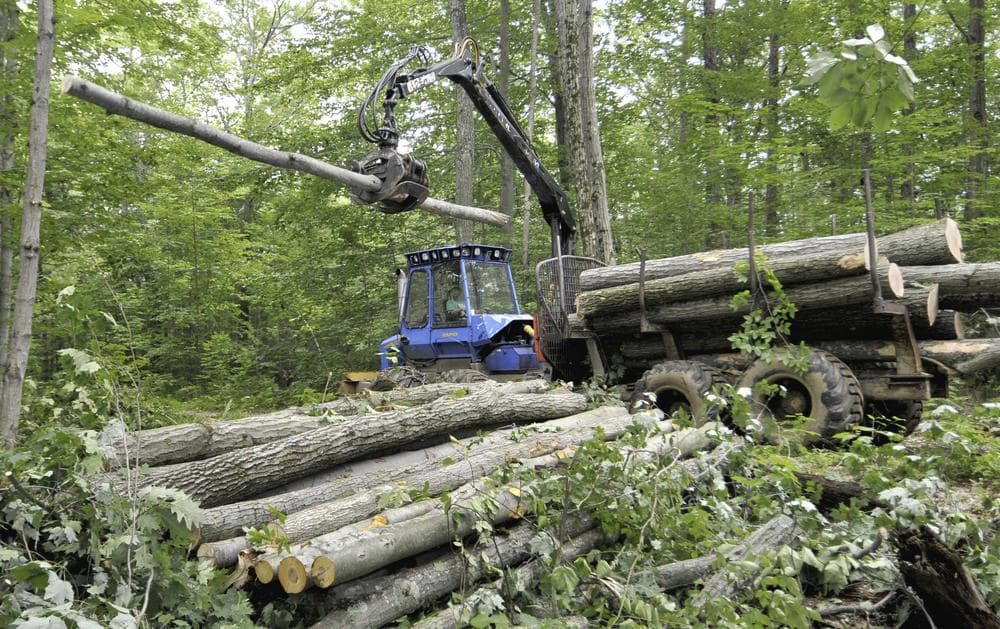
Forest products harvester Justin Gundlach uses a forwarder to offload firewood from a clearing harvest in Great Mountain Forest in Norfolk, Conn. (AP)

Correction appended — A new Harvard University study shows that forests are declining throughout New England, prompting local conservationists to call for more of the region’s forestland to be protected.

The most forested states in the country are in New England. Maine has the most, followed by New Hampshire. Massachusetts is No. 15, in the top third of states.

But over the past two centuries, the region’s forests have been steadily shrinking. (see correction appended below)

“The main threat to forests right now is development, and the development threat is very pronounced in southern New England, so that would be Connecticut, Rhode Island and Massachusetts, although the trend absolutely exists in New Hampshire, Vermont and Maine, as well,” said Clarisse Hart with the Harvard Forest, a Harvard-run center for ecology and forestry research that did the study.

To counteract that decline, the researchers recommend that 70 percent of New England’s forests be conserved as either managed woodlands or wildlife reserves. They say it’s an ambitious target, but one that would help the region’s tourism industry and maintain the environmental good that forests do.

Where New England ranks among the most-forested states in the country:

  • #1 Maine (85.8% forest cover)
  • #2 New Hampshire (78.4% forest cover)
  • #4 Vermont (75.7% forest cover)
  • #13 Connecticut (54.7% forest cover)
  • #15 Massachusetts (52.5% forest cover)
  • #18 Rhode Island (50.8% forest cover)

Source: U.S. Forest Service, 2002

Correction: It is not correct that over the past two centuries New England’s forests have been steadily shrinking. The region’s forests are now on the decline, but that is happening only after widespread reforestation in New England over the past 200 years. For more historical background, see the message posted below by WBUR reporter Sacha Pfeiffer.

WBUR Topics · Boston · Environment · Health
Please follow our community rules when engaging in comment discussion on wbur.org.
  • Alex Parra

    I find this report rather curious and particularly the statement that “over the past two centuries, the region’s forests have been steadily shrinking.” When I see pictures at the turn of the last century of the two areas I know best in Massachusetts – Concord/Carlisle and Orleans/Brester – there is nary a tree in site. Concord/Carlisle now boasts Harvard University’s own Estabrook Woods and Brewster has Nickerson State Park.

    The report is also curious in that one of the goals of at least some state conservation programs has been the restoration of adequate grassland habitats, which have been disappearing due to the decline of farming and the gradual reforestation of many of those habitat areas.

  • AJ

    This statement is not true and not what the study says: “But over the past two centuries, the region’s forests have been steadily shrinking.” It is well known that New England’s forests recovered after the land-clearing by European settlers. The study from the Harvard Forest actually indicates that the forest is now declining AFTER 200 years of recovering. See the actual study here:
    http://www.wildlandsandwoodlands.org/

  • Brian Donahue

    AJ is correct. As the report shows, New England forests substantially recovered between about 1850 and 1970. Since then, forest has been declining as the rate of suburban sprawl has overtaken the rate of farmland abandonment.

    New England is presently about 80% forested. The report calls for accelerated conservation over the next few decades so that does not fall below 70%. This leaves plenty of room for “smart growth,” and for the protection and even expansion of farmland and grassland habitats as mentioned by Alex Parra below.

  • http://www.wbur.org/news/wbur/people/spfeiffer Sacha Pfeiffer

    Hi — Sacha Pfeiffer here, from WBUR. Thank you, Alex, AJ and Brian, for your comments. You are all correct: it is not the case that “over the past two centuries, the region’s forests have been steadily shrinking,” as my original story said. What is correct is the following: after widespread reforestation in New England over the past 200 years, the region’s forest cover is now on the decline. A correction has been posted above.

    Some additional information: New England’s forests hit an all-time low in roughly 1830, after colonial settlers did widespread cutting to convert forests into agricultural land. Then, when settlers began to abandon their farms around the time of the Industrial Revolution, the region’s forests had a chance to bounce back.

    In fact, during the 19th and 20th centuries the eastern U.S. experienced an “explosion of green,” according to the “Wildlands and Woodlands” report that AJ mentions below. Today, New England is the country’s most-forested region, with 33 million forest acres out of 42 million total acres, according to that report.

    Here’s some parting food for thought from Clarisse Hart of the Harvard Forest, who is quoted in my story above: “Here we are again at incredible forest cover — about 80 percent. So it’s almost like we’re the colonial settlers coming back, and what are we going to do this time?”

More stories in 'Health'
UNDERWRITING
Most Popular
SUPPORT
SUPPORT
This site is best viewed with: Firefox | Internet Explorer 9 | Chrome | Safari