Support WBUR
Review Shows No Racial Bias In Cambridge Arrests
Let's review the story again: It's July 2009. Henry Louis Gates, Jr. comes home from a trip to China. The door to his house is stuck, so he and his driver — who is also black — try to force it open. A woman walking by is alarmed and convinces someone with a cell phone to call 911. James Crowley — a white sergeant from the Cambridge Police Department — comes to investigate.
Gates tells Crowley that he lives in the house and Crowley asks him for identification to prove it. Meantime, Gates asks Crowley for his name and badge number.
"Why are you not responding to me?" Gates recalled asking Crowley. "Are you not responding to me because you're a white police officer and I'm a black man?"
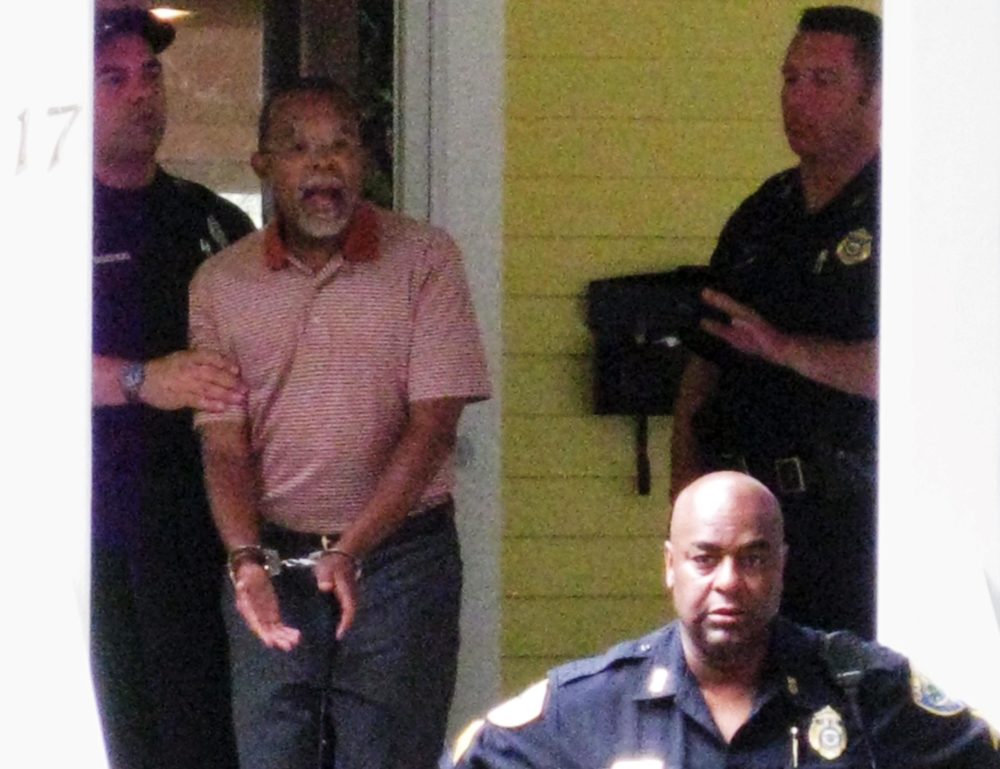
In the police report, Crowley says he did respond, but Gates continued to ask for his name. And Gates allegedly called Crowley a racist. The sergeant arrested the 58-year-old professor for disorderly conduct.
Disorderly conduct is a highly subjective and discretionary type of arrest. Experts say it can be a good indicator of racial bias in a police department.
But a new review of such arrests, conducted by the New England Center for Investigative Reporting, finds no evidence of racial bias in the Cambridge Police Department.
David Harris, a law professor at the University of Pittsburgh and an expert on racial profiling, vetted the study's findings.
"What we see here is that at least as far as the use of the disorderly conduct statute, race does not seem to play a role in who gets arrested and who doesn't," Prof. Harris said.
The study analyzed disorderly conduct arrests in the department going back five years. It found that 57 percent of the people arrested were white and 34 percent were black. The racial breakdown of arrests almost exactly mirrored the racial composition of the population that Cambridge police investigated for disorderly conduct.
In many ways, the study shows that Gates' arrest was an aberration. Most people arrested for disorderly conduct in Cambridge are much younger and are arrested in busy public squares — not on their front porch.
Gates did have one thing in common with many arrested for disorderly conduct: He talked back to police. More than 60 percent of those arrested for disorderly conduct involved some sort of inflammatory speech.
Study Methodology:
The New England Center for Investigative Reporting reviewed more than 2,000 pages of government documents to analyze the Cambridge Police Department’s record on disorderly conduct arrests.
It worked with John Lamberth, one of the nation’s leading experts on racial profiling, to devise the best way to assess the department’s work. While many people might want to compare the racial breakdown of arrests to the city’s racial composition, Lamberth warned that this would be misleading because it does not take into account where police are actually working. Instead, he suggested that the arrests be compared to the population of people investigated for disorderly conduct.
Lamberth helped NECIR create a sample pool of people investigated during the first half of 2008, including disorderly conduct arrests as well as the 911 calls most likely to result in a disorderly conduct arrests. These 911 calls involved people complaining about disturbances.
The racial breakdown of the sample pool was 37 percent black and 54 percent white. Those numbers closely mirrored the number of blacks, 34 percent, and whites, 57 percent, arrested between 2004 and 2009. In addition to Lamberth, four other racial profiling experts reviewed NECIR’s methodology and agreed that this was the best way to conduct the analysis.
-- NECIR
Some citizen advocates argue that mouthing off to police isn't enough to warrant putting someone in jail, and that it violates freedom of speech. But police argue that there's always behavior that goes along with talking back that could trigger wider social disorder.
After the Gates arrest, Cambridge Police Department did its own study of disorderly conduct arrests and concluded that there's no pattern of racial profiling in the department.
"All too often, police administrators have said that that doesn't exist within our police department," said Cambridge Police Commissioner Robert Haas. "Now we can demonstrate in very clear terms and through our actions, which I think speak much louder than our words, that that type of activity is not taking place within the city."
Haas wouldn't answer direct questions about the Gates arrest and Crowley's conduct, but Crowley did issue a statement.
"I have always known that the accusations of racism leveled against me were false," he wrote. "I have never and will never use race to affect how I do my job."
But for others who have examined this case, the study doesn't explain everything.
For University of Nebraska Professor Sam Walker, these findings don't eliminate the possibility that conscious or unconscious racial bias influenced Gates' arrest.
"The major finding points us in the direction of focusing on this one particular officer," Prof. Walker said, referring to Crowley.
For example, the study doesn't examine the arrest history of Sgt. Crowley. He only made one disorderly conduct arrest during the five-year period — Gates.
Prof. Walker thinks it's curious that the only time Crowley arrested anyone on this charge, it was a black man on his front porch.
But Prof. Harris doesn't make much of Crowley's single disorderly arrest. He says we don't know enough about Crowley's work history and assignments. Still, he says the study can't settle the debate about what happened during Gates' arrest.
"These numbers, this data can't tell us anything about the individual facts of that day, about what happened, about what was in the mind of the two men that were there," he said. "Race could very well still have played a role in that sense."
Perhaps no study could answer those questions. But, based on this study, there is good evidence that dispels the idea that Cambridge police disproportionately arrest blacks for disorderly conduct.
More:
This program aired on June 17, 2010.