In Plymouth, Buggies And Birds Battle For Beach Space
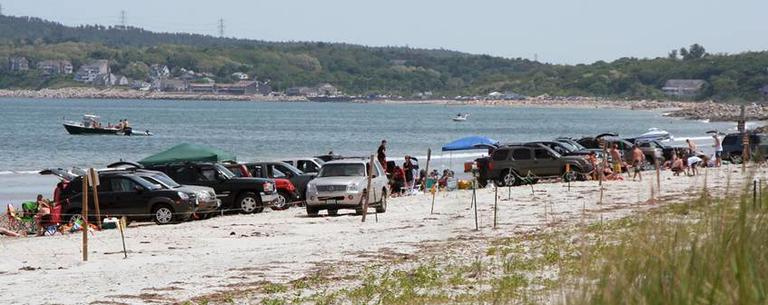
Vehicles are parked near the water at Plymouth Beach. (Courtesy Goldenrod Foundation)
PLYMOUTH, Mass. — A contest between beach buggies and birds on beaches heats up at a hearing in Boston on Tuesday.
An environmental group wants tighter restrictions to protect the piping plover on Plymouth’s most popular beach. But the owners of off-road-vehicles are saying they want their beaches back.
That argument swirls at Plymouth Harbor, an inlet protected from the open Atlantic by a narrow strip of low sandy barrier beach that sticks out three miles. Out toward the point, thousands of birds clamor, dive for fish, pull up worms and invertebrates, sit on nests and feed their young.
People know it as Long Beach. The birds know it as their breeding grounds.
Biologist Scott Hecker has been studying shorebirds on Long Beach for 23 years.
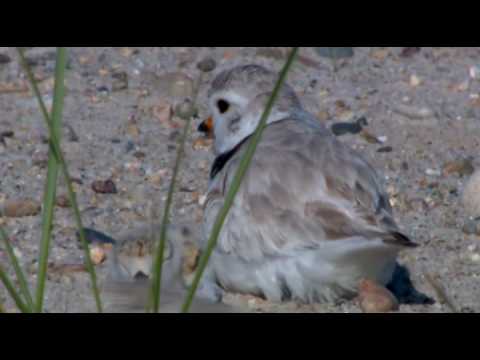
“Ahead on the tidal flat there’s a pair of piping plovers with a very small chick. The chick is probably no more than a few days old,” Hecker said, pointing out a brown and white cotton ball with a beak scurrying across the flats on orange toothpick legs.
Its parents migrated here from the Gulf Coast somewhere between late March and May and began to nest — right where generations of Plymouth residents used to drive their beach buggies with their own broods.
But Karen Fantasia, of Plymouth, who’s here with her son, can’t drive out onto the beach today. “The birdies and their nests have taken over the beach and now we’re unable to come down to where we used to,” Fantasia said.
Fantasia hasn’t been able to drive out since the beginning of June because plovers made a nest close to the entrance where off-road vehicles drive onto the beach. According to the rules, vehicles have to stay 100 yards away from the chicks until they can fly. By that measure, the entrance probably won’t reopen until the end of July.
Fantasia would like to see the birds go away.
“Re-migrate them, put them in one certain place where there’s not a public beach, maybe a shoreline where people don’t go,” Fantasia said.
Since piping plovers have been migrating here as long as there’s been a beach — which predates the Pilgrims by 5,000 to 10,000 years — relocating them is problematic at best. But relocating the cars has had a dramatic effect and a happy one from the plovers’ side of things.
Under the pressure of state and federal law, and of biologist Hecker, for the last 20 years the Town of Plymouth has had to protect the birds, their nests and their eggs from cars, dogs and people on the beach.
And in that time, Hecker says, the plover population on Plymouth Beach has grown.
“It’s been going up since 1990 when there was none, and last year had 24 pairs,” Hecker said.
Fencing or roping-off plover nests and restricting off-road vehicles has had the same dramatic effect on beaches all over the state, Hecker says. From 1987 to last year, the numbers jumped from 126 pairs to 575 pairs.
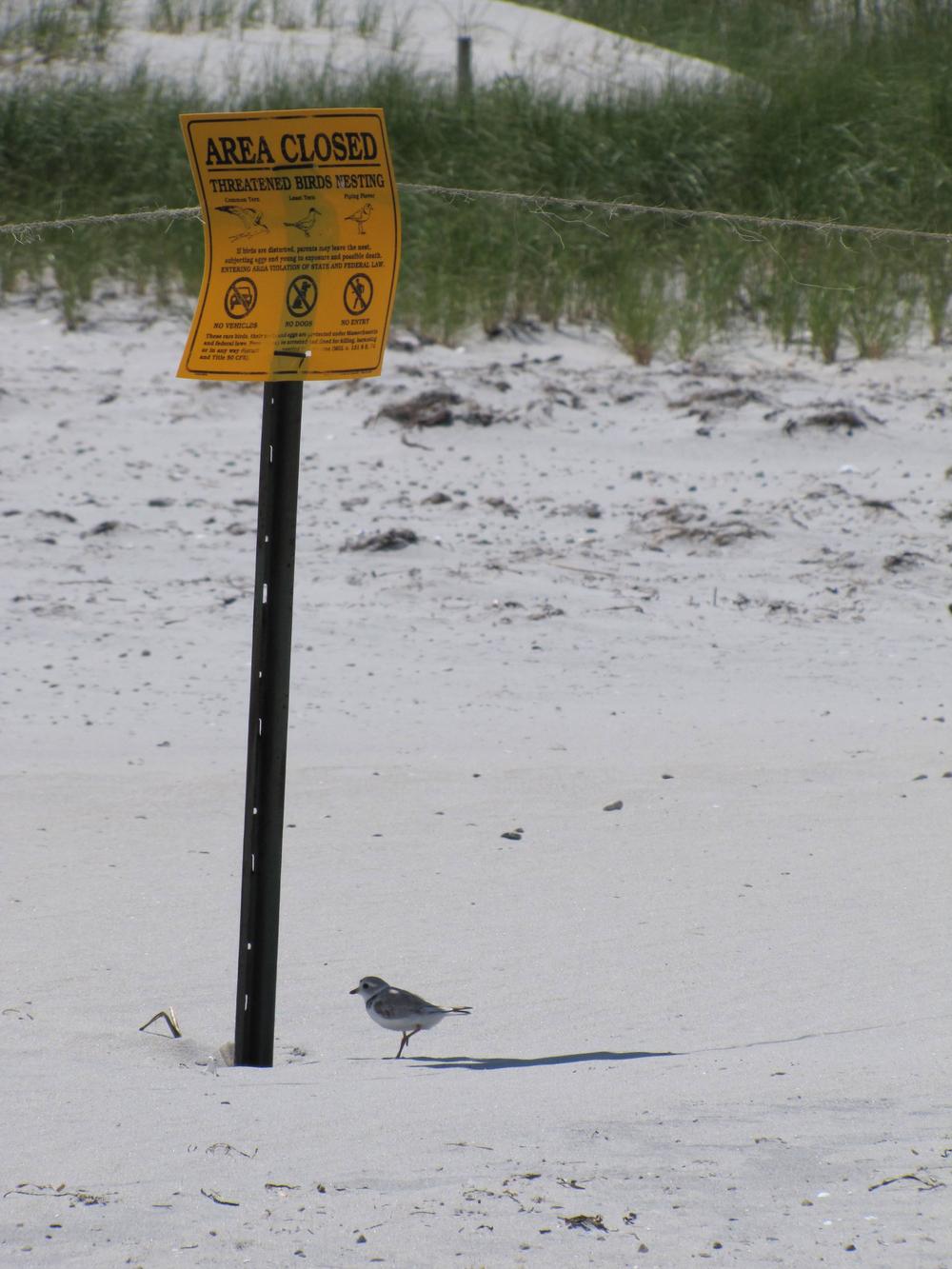
A piping plover is seen next to a sign forbidding beachgoers from driving off-road vehicles near the plovers' nesting grounds. (Courtesy Scott Hecker)
And why stop now, asks Hecker, whose Coastal Waterbird Program for Audubon has been credited with that increase.
“I think if the vehicles were restricted further and more protection was given the birds, the number will go up,” Hecker said.
That’s precisely what Hecker and his new employer, the Goldenrod Foundation of Plymouth, want to see. At a state hearing in Boston this week, they will argue that Plymouth’s beach management plan doesn’t go far enough, and the state isn’t requiring enough of towns like Plymouth to protect the plovers.
As a result, the Goldenrod Foundation says the town and the the state are violating the Massachusetts Endangered Species Act.
Once again, the one-ounce plover is at the center of a one-ton controversy that’s re-opened the wounds of resentful Plymouth residents. One of those is Rich Whelpley.
“We’re saying, if it’s already succeeding and the birds are coming back, why do we need more regulation?” Whelpley asked. He has organized a petition drive that’s linked to the Facebook page, “Let’s Take Back Plymouth’s Long Beach.”
Over 600 people have joined in opposing “all suggestions and demands that will further limit our access to our beach.”
“You’ve got to make a decision. We care about the wildlife. We care about the people. Do we care about them equally?” Whelpley said. “Or do we say: people aren’t important, they can do something else, this beach is for the birds. And that’s the end of the story.”
Hecker and Goldenrod say that plovers can co-exist with people and that the current restrictions don’t keep people from walking on the beach. They restrict cars, though Whelpley and other off-road vehicle drivers say walking up the beach to spend the day with the family is too much without a car.
On the subject of vehicles, the attorney for Goldenrod, William Henchy, is clear.
“Certainly when these birds are present and breeding, there simply in our view is no room for vehicles and the birds to co-exist because the birds suffer when that happens,” Henchy said.
According to the federal government, piping plovers are the smallest population of shorebirds on the Atlantic coast.
Its vulnerability is even more apparent in the wake of the catastrophic BP oil spill. Most of these birds winter on the American shoreline of the Gulf Coast. They migrated here before the spill, but they will soon return with their fledglings to beaches that are heavily oiled.
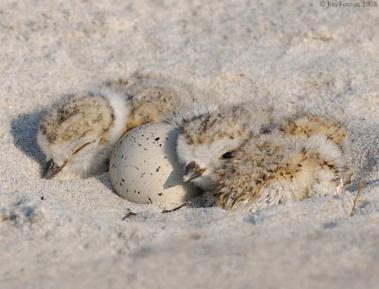
Nestled in the sand, piping plovers and their eggs are hard to see. (Courtesy Goldenrod Foundation)
“Considering that the entire 70 percent of the the entire population in the world are in the Gulf, there’s going to be a significant potential impact,” Hecker said.
To him, that’s all the more reason to try to increase the population of piping plovers here on Long Beach in Plymouth, by increasing chicks’ chances of survival. He points to a chick leaving the nest where it’s been protected by a rope that fences it off. But the chick passes under the rope and crosses out into the corridor where vehicles would normally be free to pass.
“That’s the difficulty to protecting the young,” Hecker said. “They have to go outside the rope to get enough food to survive, so they come out of the roping onto the tidal flats to get their food.”
So even when vehicles are keeping their proper distance, they can scare the birds and disrupt their ability to find food, says Henchy.
“When birds are present and breeding the science is very clear that vehicles adversely affect productivity and their ability to survive,” Henchy said.
It’s a direct violation of the state’s Endangered Species Act to allow those disruptions, even when they do not inflict direct harm, Henchy claims.
Making that argument at this week’s hearings may well increase the population of piping plovers, but it will also intensify the argument over beach buggies in Plymouth.
- Beacon-hill »
- State House Roundup: The Power Lines
- State House Roundup: An Intentional Community
- State House Roundup: Milkbone Underwear
- Commentary »
- With New Sox, Manny’s Worth Watching
- New Newton North Induces An Alum’s Jealousy
- Fantasy, Football, Come True
- Crime-justice »
- Gadson Sentencing A Symbol Of Multi-Generational Crime
- Brookline Police Search For Missing Officer
- Court Nixes Hiring Of Mass. Man To Probation Dept.
- Election-2010 »
- State House Roundup: The Power Lines
- Mass. Gov. Patrick Fundraising Picks Up In August
- In Kitchen Refuge, Patrick Rules
- Energy »
- Mass. Court Rejects Challenge To Cape Wind Permit
- Reps. Have Plan To Kill LNG Terminal In Mass.
- Mass. AG: Cape Wind Power Deal In Public Interest
- Environment »
- Chelsea Gets $2M To Help Control Diesel Exhaust
- Mass. Court Rejects Challenge To Cape Wind Permit
- EPA Sued Over High Cape Cod Nitrogen Levels
- Media »
- Worcester Telegram Begins Charging For Some Online Content
- Mass. Newspaper Erects Commenter Paywall
- Remembrance: Longtime Boston TV Newsman John Henning Dies
- Religion »
- Religious Relic Stolen In Boston Recovered In Vt.
- Rise Of Independent Groups Influencing Judaism
- Boston Advocates: New Vatican Rules On Punishing Clergy Abuse Fall Short
- Swine-flu »
- FAQ: Swine Flu Vaccine Availability
- Mass. Lifts Swine Flu Vaccine Restrictions
- Study: Swine Flu Is Relatively Mild Virus After All
- Friday's Show
Questions For Carol Johnson, Chief Of Boston Public Schools
Next week, more than 56,000 Boston public-school students will walk into the classroom for the first day of school. And while classrooms may look the same, much has changed behind the scenes. We talk with Boston School District Superintendent about Race to the Top funding, turnaround schools, merit pay and the contract negotiations with the Boston Teachers Union. More... - Week In Review: Earl, Unemployment, Governor’s Race
- Hurricane Earl, On New England’s Doorstep
- How To Meet A Nice Harvard Boy
- Hurricane Earl Races Toward New England Waters
- Hurricane #Earl: Live Updates From The Newsroom
- Remembering Esther Earl
- Your Boston Weekend: September 3-6
- Forecast: Earl Likely To Pass 50 Miles Off Nantucket
- Now We Are Alone: Living On Without Our Sons
- The Bard, Picasso Make The Berkshires A Worthy Trip
- Gadson Sentencing A Symbol Of Multi-Generational Crime
- ‘Same Old Place,’ New Pizza Recipe
- In Kitchen Refuge, Patrick Rules
- 'Same Old Place,' New Pizza Recipe
- Jokes To Tell Your Parents For Rosh Hashana
- How To Meet A Nice Harvard Boy
- Harvard Student Center Beckons Non-Believers
- Can Cognitive Exercise Speed Up Dementia?
- Hurricane Earl Races Toward New England Waters
- Freelancers Fight State's Independent Contractor Law
- The Bard, Picasso Make The Berkshires A Worthy Trip
- Earl Weakens To A Category 1
- A Casual Encounter With The Week's News
- Critics Target States' Double-Dipping Pensioners
- Safer For Your Soul, But Is Kosher Healthier, Too?
- Scientist Watches Glacier Melt Beneath His Feet
- A Village Sacrificed For China's Greater Good
- In Kitchen Refuge, Patrick Rules
- Boy Howdy! You Can Deep Fry Beer
- Opening Panel Round
- At Almost $200M, Newton North Shines
- Bluff The Listener
Sound Bites, Friday: Earl Edition
A roundup of links, tweets and other nuggets about Earl, our swirly friend. More...- Your Boston Weekend: September 3-6
- How To Meet A Nice Harvard Boy
- Friday Morning: Baker Closes In, Dems’ Donations Surge, And Yes, Earl
- Hurricane #Earl: Live Updates From The Newsroom


This comment thread got out of hand and was closed. Several comments were removed for violating our Community Discussion Rules. I expect civility and respect from the wbur.org community.
Hmmm, so where do Scott Hecker and Goldenrod make their home? That’s right, Long Beach. “The Goldenrod Foundation operates projects from its cottage situated in the coastal dunes of a barrier beach in Plymouth, Massachusetts.” Does Scott park his own SUV in the parking lot and walk the rest of the way to his home?? Seems to me the residents of Long Beach have a vested interest in keeping outsiders aways from their backyard.
These folks are of the same ilk as those who build their party, vacation ‘homes’ so close to the shoreline they need to put them on poles! What’s the point of that!? Can’t wait till gas reaches $5/gal.
David Boeri here.
Having been berated out on Long Beach last week for being with some f’in’ weirdos trying to protect plovers, let me weigh in against the name calling here. A second part of the story that has fascinated and bothered me is the deep divide with no seemingly middle here. Red state vs. blue state, spotted owl vs.logging, snowmobiling vs. snowshoeing, blue collar vs. white collar, and everyone angry and condemning the other side.
I’ve covered a lot of environmental issues. I’ve been a commercial fishermen, I hunted bowhead whales with Eskimo hunters, I went to graduate school in forestry, and covered clear cutting on Indian lands and Mayan lands. I always thought that being an environmentalist also meant communicating with people and understanding their story and perspective.
Most of the ORV owners I met in Plymouth are I like the ORV people I knew on the Cape. Some might have bumper stickers that say “Tastes Like Chicken”. Some, like a former Plymouth selectman, might comment that he won’t be unhappy if piping plovers go the way of the Dodo Bird or Tyrannasaurus Rex. But most of them express a concern for the birds’ welfare and are pleased that the birds are making a comback. If they are wrong or misinformed in thinking they can have access to the beach without harming the birds, isn’t that a call for communication or an invitation to talk about the biology of the birds and some environmental principles?
Calling people lazy, ignorant, and selfish doesn’t win anybody over, or do anything to protect piping plovers.
And behavior and attitudes don’t change overnight. Sandy Cotti, who owns Sandy’s restaurant at the start of Long Beach, took her kids out to the beach for years. Generations of Plymouth families have driven out to the point together; some of their best family memories are connected to time spent together, swiwming, fishing, in front of campfires and barbeques, out at the beach.
My children and I fondly remember going out to Race Point with an family in Provincetown; it was their way of getting back to the old days, even if in a four by four.
Personally, I prefer hiking, snowshoeing, birding, and off-road wilderness.
The piping plovers are a small threatened population worth saving. In the end, there those seeking protection and those wanting to drive out to the beach during the breeding season may not be able to come to an agreement. State officials and the courts may make the decision instead.
But I can’t help thinking that the failure here has been the lack of outreach by those wanting more restrictions to communicate their concerns beyond fellow conservationists, to explain and educate people about the natural history of plovers, and why, for instance, it’s impractical to re-migrate the plovers to another beach.
That was a well-intentioned if misinformed idea, by the way, and the good news is that the person with the suggestion actually cared enough about the status of piping plovers. Compared to the bumper plovers the other white meat, that’s progress. There are people on the other side that migth be convinced, or that might in some way change your minds.
Note to Karen Fantasia:
Why do you take your son to the beach, exactly? To appreciate the beauty of the natural world? So point out the beauty of these tiny creatures in the video accompanying this article. Explain that to preserve this experience for his children someday, it’s necessary to walk to his favorite beach spot.
look at a map. the beach is a mile out on the penisula.
there is very limited parking in the lot at Plymouth beach. without this access nobody could get out there.
I’m with those who can’t understand why people have to drive onto the beach. If you want to hang out in your SUV, maybe a rest area would be a better spot. The beach is for walking on, lying on, picnicking on. It’s a place where people can be peaceful and revitalize themselves. We can jog, play paddle games, swim and meander. Do we really need the noise, fumes and dirt of on- and off-road vehicles? I bet those are the same people who complain about seagulls and dogs on a beach. Can we not EVER get away from machines?
The Crossover (which is where 4X4 vehicles can drive onto a small fenced-in strip of the beach) opened for the season on Saturday May 29th.
This area was limited to 30-40 vehicles. this accounts to probably 100 feet of the beach which stretches another mile out to Goose Point.
At some points in past years I believe access was open to over 200 vehicles.
The following week of the 7th, the Crossover was closed a few days due to the hatching of a nest. Once the birds moved from their nest the Crossover was once again opened with limited access (30 cars).
The limited access continued until June 24th when another nest hatched and the Crossover was closed. It has been 20 days since that closure and still the Crossover is not open.
So far this summer the limited access to the beach has been available for only about 23 out of 46 days.
For people like myself who work during the week, this means that weather permitting, I had about 16 weekend days where I could have even possibly been out there. that is if i could get one of the 30 spots.
Summers in New England are short enough as it is. Hopefully access will open up again and we can enjoy the month of August before the Crossover closes again on Labor Day weekend.
The birds are thriving, we are complying with the restrictions and this talk of permanent closure is INSANE
The beach can be enjoyed without the use of an internal combustion engine — and in my view it is best enjoyed that way. Protection of our shore birds is critical and well worth a bit of inconvenience to beach drivers.
The thoughtlessness and selfishness of people driving onto a beach is sickening. What they do to the beach, scarring and eroding it, is bad enough even if the plovers weren’t an issue, and they are a species survival issue. Laziness is the bottom line here. Ban vehicles from the beach. No one has the “right” to destroy because they can’t find an “easy” way to carry their coolers and umbrellas and wheel their toddlers. Please think beyond your little bubble.
Re-migrate the birds? Someone didn’t pay attention in school science classes.
Get the cars, trucks, SUVs, jet skis, loud motor boats, and motorized whatever off the beach and away from the shoreline. These creations of the 1900’s-present are eyesores, safety issues, and unwanted pollution (noise, environmental, etc.) for the 99.999% of humans going to the beach to relax and be with nature.
Drive your SUV and commune in the mall parking lot, where cars, trucks and SUVs belong.
The birds need the beach to survive. The people need to drive onto the beach to…do what, exactly? When I go to the beach, I want to enjoy the sand and the water. If I wanted to look at a bunch of SUVs, I’d go to a shopping mall parking lot or a car dealership.
This could be one of the most ridiculous things I’ve ever heard. I mean if there are only a few hundred of these birds left, what on earth would make you want to displace them? Especially for something as pointless as driving an extra few yards onto a beach. In all seriousness that could be one of the trashiest activities I’ve ever heard of.
Well it’s nice to see that the species Homo Sapien Ignoramus is thriving on our beeches with their gas guzzling SUV’s.
Buggies? What buggies, these people drive their SUV’s onto the beech’s which is a pretty ugly sight. Not to mention the damage done to the beech by all these 2000+ pound SUV’s driving on them.
These people need to think of the bigger picture other than their own selfish pleasures of driving from home to the beech to plant their fat butts down for an afternoon.
Disgusting people.
Seriously! The whole beach is 3 miles long? Who are these people that can’t tote some things for a mile? Banning cars from the beach is the best thing that could ever happen, for the people! Why would I want to go to a beach that people use as a parking lot? Ridiculous.
Boo-freaking-hoo! So you can’t drive on the beach a couple of months, so what??? It is amazing that some humans just can’t get over themselves & their “rights”. Maybe start thinking beyond yourselves and reconnect with some other inhabitants on this earth for a change. Re-migrate, your kidding right?? These birds were here LOOONGGG time before you, honey. Guess what, I don’t like where your living, so we are going to move your house to a major highway. What? You have toddlers, well I guess they will just have to learn to move faster huh??? Sheesh!!!