WBURA Conversation With Muslims And Jews

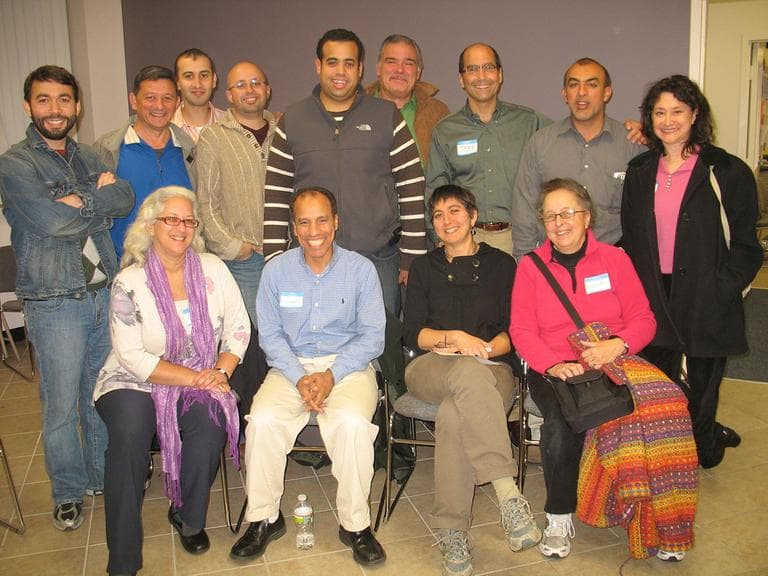
Members of the Muslim American Civic and Cultural Association and Temple Hillel B’nai Torah. (Martha Bebinger/WBUR)

BOSTON — Packaged bombs allegedly mailed by Islamic militants in Yemen, but intercepted before they reached synagogues in Chicago, have once again sparked tensions between Muslims and Jews. But a small group from each religion is vowing to unravel that tension. Thirteen members of the Muslim American Civic and Cultural Association in Malden and Temple Hillel B’nai Torah in West Roxbury have started a series of conversations about politics, stereotypes and the conflicts that have divided Muslims and Jews for centuries.

“My name is Yacine Ibrahimi. I grew up in Morrocco and moved here in 1996,” Ibrahimi says to members of the group seated in a circle of folding chairs.

Members continue around the circle.

“I’m Nomi Herbstman. I was born in Brooklyn. I think the reason I’m here is the studies that came out in the last 12 months that I have more DNA in common with the people in this room than I do from any country of origin in Europe and I’m also here because (Israeli Prime Minister Benyamin) Netanyahu doesn’t speak for me,” she says.

“I was born in Algeria. I came here in 1988,” Hakim Khoulani  says. “My hope from this discussion is to understand what is so different from the Jewish religion and Islam. We have the same God, why are we so far apart?”

Group members read and agree on a list of ground rules that include trying to keep comments in the first person, agreeing to disagree, and being discreet afterward.

The Need For Open Dialogue

On this night, the first question for the group is: why is it important for Jews and Muslims to engage with each other in the U.S. today? Leslie Belay is moved by news of the intercepted cargo bombs.

“We are always on the defensive. Muslims have to come out and start talking to people — not just to Jews — and clear our name basically.”
–co-moderator of the discussion,
Mohamed Khafif

“What more urgent reason is there for Americans, Muslims and Jews to talk to one another?” Belay asks. “We can’t allow these things to happen either as victims or as perpetrators, in our names.”

“I think it would be naïve to say we don’t carry our own stereotypes,” says Mohamed Brahimi. “The usefulness of these dialogues is that we all get together and kick these things around and check their validity. This is the place where authenticity is being checked.”

Some members of the group are worried about what they call a growing intolerance for Muslims. Herbstman mentions the boycott of Campbell’s Soup because the company has introduced a Halal line of soups.

“I think of all the various foods in the supermarket that have a U on it or a K in the triangle and I don’t see anyone boycotting that,” Herbstman says. “Why should Muslim Americans feel less at home in the supermarket than Jewish Americans?”

“Muslims spend so much time defining who they are not,” laments participant and co-moderator Mohamed Khafif. “We are always on the defensive. Muslims have to come out and start talking to people — not just to Jews — and clear our name basically. Some of us are trying to do this, others people are just, they’re in shock; they’re hiding.”

Dispelling Negative Stereotypes

“You raise the issue of the anti-Muslim sentiment,” says Mark Gurvich, leaning forward in his chair. “And you know, as Jews we can have two reactions to that. We can sigh and say, ‘Wow, glad someone else is getting it and not us.’ Or we can say, ‘if we don’t join against this and other attacks on groups, it may not be us today but it will be us tomorrow.’ So it’s a matter of values; it’s also a matter of self-interest.”

“But On the other hand,” says Merle Wolofsky, “I for one feel threatened as a Jew in this world. Some of the threat, I have to say, is coming from the Muslim world. I know it’s not everybody, but it’s coming from there and I feel threatened by it.”

“I think hate comes from ignorance,” says Yacine Ibrahimi. “People don’t know about Islam. Us as Muslims, we have done a terrible job of promoting ourselves. We don’t take opportunities to explain what our religion is about and that’s what’s causing this.”

On the flipside, says Ibrahimi, many Muslims don’t know much about Judaism.

“I’m going to ask everyone to stand up. This is where we stretch our legs a little bit,” says participant and co-moderator, Jeff Stone. He sends the Muslims to one end of the room with a big sheet of paper and a marker and the Jews to the other.

“For Jewish participants,” asks Stone, “what comes to mind when you think of Muslims? What are some of the most difficult issues that are confusing or hard to discuss? Same thing for Muslim members. ”

“OK, this is a place to get it out. We won’t be able to discuss all the things that come out in depth tonight, I’m sure you know that, but this will help us understand where we are at the things we are going to discuss as we move along.”

The Jews start their list of stereotypes with: the subjugation of women, that Muslims are anti-gay, that Muslims think Islam should rule the world. Herbstman adds, “that Muslims will never accept a Jewish presence in Palestine or Canaan.”

And although some members disagree, these Jews also add, “Islam in particular has a history in the Quran and Mohammed’s life of violence, and so is it integral?” Another participant says it is hard for her to put that sentiment in writing.

The Muslim list of stereotypes starts with: Jews are affluent, they control the media, Jews are an introverted community, and they add, “they occupy influential positions and we don’t. They always feel struggling and threatened, scared — they play that card.”

When the two groups sit down, Stone says “I personally think that the Muslims were a little nicer than they had to be.”

“You want another couple of minutes to add to your list?” offers Belay, laughing.

The Muslims, it turns out, wrote about American Jews, not all Jews, while the Jews from West Roxbury listed stereotypes for Muslims writ large.

“When we’re in our stereotype mode, we’re not making fine distinctions” laughs Belay.

“OK, but these are representative fears,” says Stone, trying to focus the group. “These things are out there so, yeah, Miriam.”

“I’ve two reactions,” offers Miriam Messenger. “One is how much on that list is old, like things never change, the stereotypes. And the second thing is that last piece, I thought was just particularly wise, around threatened, scared. We’re a religion and a people living in post-traumatic stress and we’ve never really dealt with some of our trauma.”

Mark Gurvich takes on the stereotypes about Jews in positions of power and affluence.

“The reality is, you may have chosen the wrong congregation,” warns Gurvich, laughing. “There’s very few, at least in our congregation, that are actually in business, a lot of professionals and higher degrees. There actually are poor Jews, particularly around some metropolitan areas.”

Looking at the list of Muslim stereotypes, Mohamed Brahimi picks up the anti-gay example.

“I found it to be pretty accurate,” says Brahimi. “And granted, Islam teaches you it’s not a way of life. Yet, that’s between them and their Lord.”

“What’s GBLT, GLBT?” asks Mohamed Khafif.

The Jews explain it’s the acronym for Gay, Lesbian, Bisexual and Transgender people. Then they start to laugh.

“That’s the point,” says Belay as Khafif, embarrassed, says, “It sounded like the name of a sandwich.”

It wouldn’t be Kosher or Halal, several members point out.

Khafif moves on to another topic.

“The subjugation of women,” he sighs. “It’s cultural.” In reality, argues Khafif, the Prophet Mohamed elevated the role of women when he established himself in Medina.

“He built a mosque and a marketplace, and he made the women in charge of the marketplace,” says Khafif. “They had leadership positions, they were teachers. Some of the greatest scholars of Islam were taught by women. “It’s part of Muslims not understanding their religion and this is where you get this male domination. It’s basically ignorance.”

“There’s very rich territory here,” says Stone, “we could talk a lot about this and other things but I need to hold that.”

The moderators ask everyone what they will remember about tonight.

Mohamed Hashimi says, “I didn’t know the Jewish people, even with power and wealth, and they still feel insecure.”

Stone offers, “my gratitude for the willingness for everyone in the room to engage each other.”

And El Mostapha Quanass says, “I feel there is a hope for (the) Jewish community and Muslim community to get together and defend each other and be as one.”

The group plans to meet four more times through April. We’ll check back as they conclude.

WBUR Topics · Boston
Please follow our community rules when engaging in comment discussion on wbur.org.
  • Inci Kaya

    The narrator invited us to send in questions that we’d want to ask if we were there. Here is mine:

    If you could suspend all the judgement, post-traumatic stress disorder and fear that we’ve harbored against one another over the last several thousand years, and look at a Jew (if you are Muslim) or a Muslim (if you are a Jew) with clean, pure, unencumbered and uninfested eyes and mind, what would you say about the individual across from you? What features /characteristics attract you to him/her?

    (I think that at an individual level both Jews and Muslims will find a lot more in common than they realize. If they could just suspend the looming shadow of the past for long enough!)

  • Marcelo

    I am neither Jewish not Muslim but find the idea of this meeting heartwarming. It’s not going to fix all the problems we have with misconceptions and tensions between communities, but it’s a healthy start, an opening for dialogue. This should be happening between all sorts of communities, not just in the US, but around the world!

  • tama zorn

    In contrast to the last comment, I actually think we need to know more about our history, particularly our collective and integrated history, than less. For example, it might be important to know all the times in which Muslims and Jews intersected as allies and colleagues: that Maimonides was Salahdin’s doctor, that Moors and Jews were friends and fellow scholars who were driven out of catholic spain and portugal, etc. Our mutual history consists of so much more than the present antagonism.

  • Sherrie Noble

    In the legal structures of both religions please explain the concepts of marriage, family law and the rights of women to end marriages which put them and their children at risk of violence. I am especially interested in the time it takes to end the marriage and the ability of the women to obtain realistic economic settlements and develop economic independence.

  • Patricia Melnick

    Great story! This was so interesting & educational

  • Ahmed Walu

    I still haven’t seen someone who is really articulate and knowledgeable to speak on behalf of the Muslims, the reason I am saying this is that I keep hearing these stupid comments about Islam against gays, women, violence etc. it sounds just like Islam is a strange religion, the problem is that these questions mostly come from people either driven by hatred or ignorance. Christianity is nothing but an upgrade of Judaism, and Islam is nothing but an upgrade of the Christianity. What I mean by upgrade is bug fixes just like in software world, but the core is the same, a Muslim who does not believe in Jesus (as aprophet), or Juish prophet is going straight to hell. Again both Christianity & Judaism have violence, go and read the old testament and new testament, and believe those guys who ask these questions never read them end to end, that’s a shame, same goes for those stupid who suicide & kill innocent people,.. they don’t read for themselves. We are all same no one is better than the other, let’s all do good and help each other, life is too short to argue or fight.
    Ahmed

  • http://www.youtube.com/watch?v=n_3J2d0C7Io Sandy Adkins

    http://www.youtube.com/watch?v=n_3J2d0C7Io more people should be like this old woman :-) She is Awesome

  • James Critchlow

    Throughout my life I’ve been privileged to know and work with many fine Muslims, and I know that these “crazies” in the news are an aberration, also that most of the practices that we abhor are perversions of the true faith. I’m also aware that some of the finest advances of world civilization were made under Islam. One nagging question haunts me, though. If it’s true that non-Muslims are prohibited from entering Mecca, what does that say about attitudes toward other religions?

  • Massgopguy

    Ahmed, you couldn’t be more wrong. Judaism is about the salvation of the Jewish people and Israel living in peace amongst the nations. Christianity is about personal salvation. Islam is a political movement of world domination.

  • Mohamed Brahimi

    Dear James Critchlow,
    It was really heart warmoing to read your comment. I am very grateful for your vouching for an entire community. It speaks volumes of your kindness. I have to add that it has been my experience that those who believe that Islam stands for antagonism are but a voice in the wilderness, nonethless, one with higher decibels.
    I have asked around and was told that non Muslims are free to enter MECCA, they just can’t go onto sacred sights. The question that one would ask is why would such a restriction be in place? was movement limited to non Muslims in the times of Prophet Mohammed (PBUH)? I would venture to guess that it was not and that people from different creeds were free to move about the land. I challenge anyone to prove to me that this was NOT just another retarded inventions put in place by the “geniuses” of Al Saud family.
    Thank you

  • Mohamed Khafif

    Dear James Critchlow,
    Mecca represents a sanctuary for Islam, it is the symbol of the worship of one God,Muslims are expected to go there once in their lifetime to fulfill the fifth pillar of Islam,Hajj.
    To allow tourists in Mecca will without any doubt interfere with Muslims properly performing their religious rites and has nothing to do with being intolerant towards people of other faith.
    Muslims literally spend the whole day and a great portion of the night inside the sacred mosque when in Mecca, and only retreat to their hotels to eat or sleep, they completely divorce themselves from the pleasures of this ephemeral world, so to keep the place pure and free from distractions to the worshipers it has been restricted to Muslims only.
    Mosques around the world are open to non Muslims to visit, the only requirement is one must take off his or her shoes before entering.
    Thank you for your kind words.
    Mohamed Khafif

  • Mohamed Khafif

    Dear Sherrie Noble, I came across this essay in Islamonline I hope it answers some of your questions.

    Islam occupies the middle ground between Christianity and Judaism with respect to divorce. Marriage in Islam is a sanctified bond that should not be broken except for compelling reasons. Couples are instructed to pursue all possible remedies whenever their marriages are in danger. Divorce is not to be resorted to except when there is no other way out. In a nutshell, Islam recognizes divorce, yet it discourages it by all means. Let us focus on the recognition side first. Islam does recognize the right of both partners to end their matrimonial relationship. Islam gives the husband the right for Talaq (divorce). Moreover, Islam, unlike Judaism, grants the wife the right to dissolve the marriage through what is known as Khula’. 36 If the husband dissolves the marriage by divorcing his wife, he cannot retrieve any of the marriage gifts he has given her. The Quran explicitly prohibits the divorcing husbands from taking back their marriage gifts no matter how expensive or valuable these gifts might be:

    “But if you decide to take one wife in place of another, even if you had given the latter a whole treasure for dower, take not the least bit of it back; Would you take it by slander and a manifest wrong?” (Quran 4:20).

    In the case of the wife choosing to end the marriage, she may return the marriage gifts to her husband. Returning the marriage gifts in this case is a fair compensation for the husband who is keen to keep his wife while she chooses to leave him. The Quran has instructed Muslim men not to take back any of the gifts they have given to their wives except in the case of the wife choosing to dissolve the marriage:

    “It is not lawful for you (Men) to take back any of your gifts except when both parties fear that they would be unable to keep the limits ordained by Allah. There is no blame on either of them if she give something for her freedom. These are the limits ordained by Allah so do not transgress them” (Quran 2:229).

    Also, a woman came to the Prophet Muhammad seeking the dissolution of her marriage, she told the Prophet that she did not have any complaints against her husband’s character or manners. Her only problem was that she honestly did not like him to the extent of not being able to live with him any longer. The Prophet asked her: “Would you give him his garden (the marriage gift he had given her) back?” she said: “Yes”. The Prophet then instructed the man to take back his garden and accept the dissolution of the marriage (Bukhari).

    In some cases, A Muslim wife might be willing to keep her marriage but find herself obliged to claim for a divorce because of some compelling reasons such as: Cruelty of the husband, desertion without a reason, a husband not fulfilling his conjugal responsibilities, etc. In these cases the Muslim court dissolves the marriage. 37

    In short, Islam has offered the Muslim woman some unequaled rights: she can end the marriage through Khula’ and she can sue for a divorce. A Muslim wife can never become chained by a recalcitrant husband. It was these rights that enticed Jewish women who lived in the early Islamic societies of the seventh century C.E. to seek to obtain bills of divorce from their Jewish husbands in Muslim courts. The Rabbis declared these bills null and void. In order to end this practice, the Rabbis gave new rights and privileges to Jewish women in an attempt to weaken the appeal of the Muslim courts. Jewish women living in Christian countries were not offered any similar privileges since the Roman law of divorce practiced there was no more attractive than the Jewish law. 38

    Let us now focus our attention on how Islam discourages divorce. The Prophet of Islam told the believers that:

    “among all the permitted acts, divorce is the most hateful to God” (Abu Dawood).

    A Muslim man should not divorce his wife just because he dislikes her. The Quran instructs Muslim men to be kind to their wives even in cases of lukewarm emotions or feelings of dislike:

    “Live with them (your wives) on a footing of kindness and equity. If you dislike them it may be that you dislike something in which Allah has placed a great deal of good” (Quran 4:19).

    Prophet Muhammad gave a similar instruction:

    ” A believing man must not hate a believing woman. If he dislikes one of her traits he will be pleased with another” (Muslim).

    The Prophet has also emphasized that the best Muslims are those who are best to their wives:

    “The believers who show the most perfect faith are those who have the best character and the best of you are those who are best to their wives” (Tirmidthi).

    However, Islam is a practical religion and it does recognize that there are circumstances in which a marriage becomes on the verge of collapsing. In such cases, a mere advice of kindness or self restraint is no viable solution. So, what to do in order to save a marriage in these cases? The Quran offers some practical advice for the spouse (husband or wife) whose partner (wife or husband) is the wrongdoer. For the husband whose wife’s ill-conduct is threatening the marriage, the Quran gives four types of advice as detailed in the following verses:

    “As to those women on whose part you fear disloyalty and ill-conduct, (1) Admonish them, (2) refuse to share their beds, (3) beat them; but if they return to obedience seek not against them means of annoyance: For Allah is Most High, Great. (4) If you fear a break between them, appoint two arbiters, one from his family and the other from hers; If they wish for peace, Allah will cause their reconciliation” (Quran 4:34-35).

    The first three are to be tried first. If they fail, then the help of the families concerned should be sought. It has to be noted, in the light of the above verses, that beating the rebellious wife is a temporary measure that is resorted to as third in line in cases of extreme necessity in hopes that it might remedy the wrongdoing of the wife. If it does, the husband is not allowed by any means to continue any annoyance to the wife as explicitly mentioned in the verse. If it does not, the husband is still not allowed to use this measure any longer and the final avenue of the family-assisted reconciliation has to be explored.

    Prophet Muhammad has instructed Muslim husbands that they should not have recourse to these measures except in extreme cases such as open lewdness committed by the wife. Even in these cases the punishment should be slight and if the wife desists, the husband is not permitted to irritate her:

    “In case they are guilty of open lewdness you may leave them alone in their beds and inflict slight punishment. If they are obedient to you, do not seek against them any means of annoyance” (Tirmidthi)

    Furthermore, the Prophet of Islam has condemned any unjustifiable beating. Some Muslim wives complained to him that their husbands had beaten them. Hearing that, the Prophet categorically stated that:

    “Those who do so (beat their wives) are not the best among you” (Abu Dawood).

    It has to be remembered at this point that the Prophet has also said:

    “The best of you is he who is best to his family, and I am the best among you to my family” (Tirmidthi).

    The Prophet advised one Muslim woman, whose name was Fatimah bint Qais, not to marry a man because the man was known for beating women:

    “I went to the Prophet and said: Abul Jahm and Mu’awiah have proposed to marry me. The Prophet (by way of advice) said: As to Mu’awiah he is very poor and Abul Jahm is accustomed to beating women” (Muslim).

    It has to be noted that the Talmud sanctions wife beating as chastisement for the purpose of discipline. 39 The husband is not restricted to the extreme cases such as those of open lewdness. He is allowed to beat his wife even if she just refuses to do her house work. Moreover, he is not limited only to the use of light punishment. He is permitted to break his wife’s stubbornness by the lash or by starving her. 40

    For the wife whose husband’s ill-conduct is the cause for the marriage’s near collapse, the Quran offers the following advice:

    “If a wife fears cruelty or desertion on her husband’s part, there is no blame on them if they arrange an amicable settlement between themselves; and such settlement is best” (Quran 4:128).

    In this case, the wife is advised to seek reconciliation with her husband (with or without family assistance). It is notable that the Quran is not advising the wife to resort to the two measures of abstention from sex and beating. The reason for this disparity might be to protect the wife from a violent physical reaction by her already misbehaving husband. Such a violent physical reaction will do both the wife and the marriage more harm than good. Some Muslim scholars have suggested that the court can apply these measures against the husband on the wife’s behalf. That is, the court first admonishes the rebellious husband, then forbids him his wife’s bed, and finally executes a symbolic beating. 41

    To sum up, Islam offers Muslim married couples much viable advice to save their marriages in cases of trouble and tension. If one of the partners is jeopardizing the matrimonial relationship, the other partner is advised by the Quran to do whatever possible and effective in order to save this sacred bond. If all the measures fail, Islam allows the partners to separate peacefully and amicably.

  • Mohammad Hussein

    I am Mohammad from Ramallah-Palestine. Certainly I have a very wide experience as a Moslem with Jews. I believe that both sides need to learn what otherside believes. This can be realized mostly by reading the literature that the other writes about himself, not just to read antibooks and articles. Hence I am the first and the only Palestinian Moslem who studied JEWISH STUDIES at Hebrew College in Newton ma for the master degree, then I translated number of very important Jewish books from Hebrew and English into Arabic. I translated Maiminides MISHNEH TORAH and Buber’s HASIDISM AND MODERN MAN. But who cares for what I have done. Is there anybody Jewish or Moslem  interested in using my translations for readers of Arabic raeding a direct literature about Jews? Islamic and Jewish organizations are mostly interested in getting money to the organization and to find jobs to their friends. The same thing can be said about peace organizations. I have struggled three years working on my “Translation for Peace” project, but faced with closed ears. Therefore I am very skeptic about what good people say about peace between Jews and Moslems and the need to come closer and knowing each other. This is what my wide experiene has taught me. You may contact me on: m54david@yahoo.com

More stories in 'Boston'
UNDERWRITING
Most Popular
SUPPORT
SUPPORT
This site is best viewed with: Firefox | Internet Explorer 9 | Chrome | Safari