WBURDoc Calls For End To High-Cost-Test Addiction
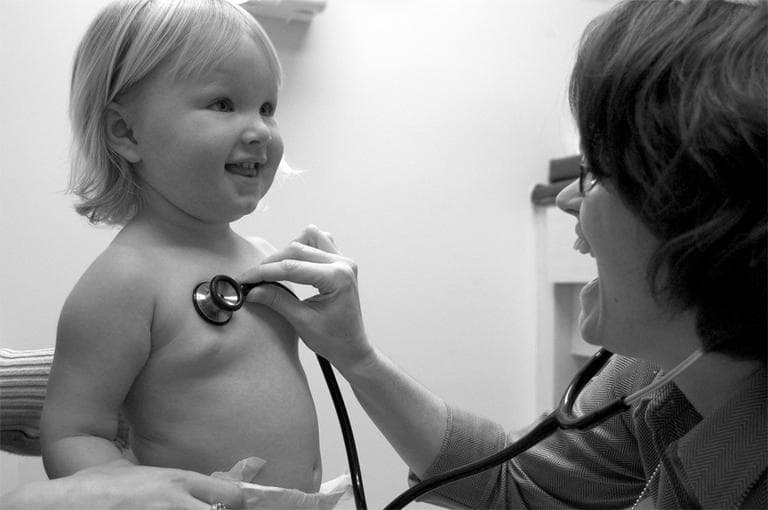
Dr. Sean Palfrey of Boston Medical Center and the Boston University School of Medicine argues for a return to basics. (dmason/Flickr)

Dr. Sean Palfrey of Boston Medical Center and the Boston University School of Medicine argues for a return to basics. (dmason/Flickr)

BOSTON — Massachusetts, along with the rest of the county, is trying to find a way to make health care less expensive. One way to do that is to limit the use of expensive tests, many of which are often unnecessary. But can doctors — especially young doctors — break that habit?

One Boston doctor says they should.

In an article Wednesday in the New England Journal of Medicine, Dr. Sean Palfrey of Boston Medical Center and the Boston University School of Medicine argues for a return to basics. He says the health care system should move away from relying so heavily on high-tech testing.

But in an interview with WBUR’s All Things Considered host Sacha Pfeiffer, he acknowledges that for many doctors, that won’t be easy to do. A main reason for that, he says, is that “we’re at a time in history when we’re faced with a huge amount of scientific and technological information, and the health care system doesn’t know how to use it best.”

Sacha Pfeiffer: This overtesting problem is something you care very deeply about because it’s something that you see the results of in your day-to-day practice. Can you talk about how that plays out on a daily basis?

Dr. Sean Palfrey: The effects are two- or three-fold. On the one hand, most tests cause pain. Second, they may give us information either we don’t want or that is confusing, And, third, because they do cost millions and millions of dollars, I think they’re part of the reason why we are unable to cover all of the children and all of the adults in this country with health care.

Many doctors worry about the danger of not performing a test or performing a test too late. Do you think doctors overestimate that danger?

They don’t want to miss anything, and so they want to cover all possible bases by doing testing and investigating thoroughly. They do it also because they aren’t given the time by the health care reimbursement system to spend time thinking or to see the child again or the patient again. So follow-up without doing testing is actually considerably cheaper in some ways, but more expensive in others.

You’ve written that doctors must “rediscover the value of clinical judgment.” Are you saying, ‘Forget the fancy tests; just use your stethoscope, or just feel the neck glands, or just feel that swollen abdomen’? Are you saying get back to the simple laying-on-of-hands of doctoring?

We need to use all the technology that we’ve got but we need to use it sparingly and intelligently. Doctors need to understand and learn the benefits and the adverse effects of new fancy tests.

But don’t patients expect fancy tests at this point? Haven’t patients been conditioned to think, ‘If all the doctor did is put a stethoscope on my chest, how could he possibly have diagnosed me correctly?’

That’s part of what this paper is saying: we need to educate families that more medicine is not better medicine. We need to teach them also that there are some problems with actually doing studies, like the CAT scans that are now so much discussed. We did them like water because they gave us good information, but they were costly and they created a lot of radiation exposure.

But, in the meantime, fancier and newer and higher-tech diagnostics are coming out all the time, so you seem to be fighting the tide here.

No. I think we need to use those fancier diagnostic tests when we need them. We have the opportunity in the U.S. to use the technology and the knowledge that we have so effectively that we create the best health system in the world. But we are not doing that right now.

And you think if we do do that, we actually can create a lower-cost health care system that also gives people better treatment?

Correct. A more balanced health care system will be more effective and less costly.

WBUR Topics · Boston · Health · Science & Technology
Please follow our community rules when engaging in comment discussion on wbur.org.
  • Anonymous

    I can’t help but wonder if the wealthy will get an echo-cardiogram while the rest of us will get the stethoscope. If you have the gold standard insurance, then you might get the PET Scan to check for reoccurance of cancer. Otherwise, depend on your doctor probing your abdomen by hand.
    Who will decide?

    • michaeld

      Don’t underestimate the effectiveness of the skilled clinician, relying on less-technologically-mediated (though not unmediated) senses and experience, or to assume that the radiological scan is the gold standard, without its own dangers. Part of the problem is that despite best efforts of medical educators like Abraham Verghese of Stanford Med, the US healthcare systems devalues basic clinical skill and drums it out of our physicians as soon as they enter clinical practice.

      I say: let the rich have their routine PET and CAT scans, and let them subsidize skilled, universal human health care for the rest of us.

    • michaeld

      Don’t underestimate the effectiveness of the skilled clinician, relying on less-technologically-mediated (though not unmediated) senses and experience, or to assume that the radiological scan is the gold standard, without its own dangers. Part of the problem is that despite best efforts of medical educators like Abraham Verghese of Stanford Med, the US healthcare systems devalues basic clinical skill and drums it out of our physicians as soon as they enter clinical practice.

      I say: let the rich have their routine PET and CAT scans, and let them subsidize skilled, universal human health care for the rest of us.

  • skoorb62

    There is an excellent discussion of the overuse of CAT scans for children and adults in Science, 25Feb11 p1002, magazine. One hospital, Mass General, has installed software, prepared at great expense, to help doctors make better choices. The effect has been excellent and has improved the practice of medicine possibly with less risk and better long term outcomes. This work can be extended much more widely to improve medical practice.

  • Charles H. Bagley MD

    Unnecessary testing is routine and driven by the fee schedule; I (a practicing Neurologist) could not make a living if I didn’t routinely perform EMG testing in my office for example. Only 10% of EMGs are necessary. Pay someone who is fellowship trained in EMG $200/hour to do EMG testing (technician can do the NCV) and disallow self referral. The quality of the EMGs would be better and most of the current EMGs would be eliminated because of the self referral factor.
    The best way to eliminate unnecessary tests is to treat the patient and resolve the signs and symptoms of their condition. The fee schedule is structured to favor proprietary forces (patentable drugs, specialist procedures that utilize proprietary tools etc.) There are so many examples of treatments that are not proprietary that the medical profession has refused to recognize that I have concluded that: for most patients seeking treatment from a physician in the US, there is someone somewhere doing some kind of therapy (often “alternative” medicine but also treatments that are established in the conventional literature such as providing a heel lift for a back pain patient with a short leg—a diagnosis that is routinely missed by MDs, chiropractors, physical therapists who see these patients. Curing disease is not profitable in a fee for service system and the track record of curing disease by medical profession is not very good. I personally am reluctant to go to a conventional MD because of what I see in the medical profession and the understanding I have from my own experience in finding better and cheaper solutions for many different conditions.

More stories in 'Science & Technology'
UNDERWRITING
Most Popular
Shop Now
Amazon.com
SUPPORT
WBUR Programs
This site is best viewed with: Firefox | Internet Explorer 9 | Chrome | Safari