Support WBUR
For Veterans Returning Home, Finding Work Can Be Especially Hard
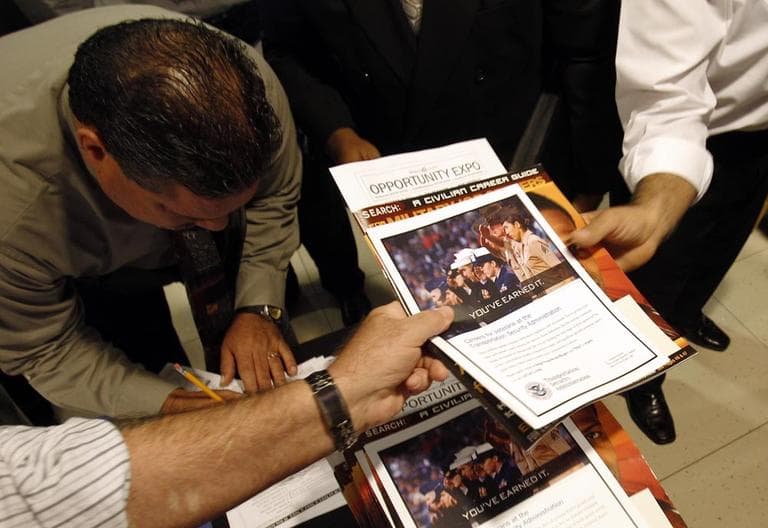
Thousands of veterans will be coming home from Iraq next month as part of President Obama's withdrawal plan, and many of them will immediately begin searching for jobs. In this challenging economy, and with many returning servicemen and women not having college degrees, they could face quite a challenge in their hunt for work.
In recognition of that, the U.S. Senate on Thursday unanimously passed a bill to help unemployed veterans get jobs by giving tax credits to employers who hire returning military personnel. But even with that boost, some veterans will need considerable assistance navigating the job search process, as WBUR's Sacha Pfeiffer discovered when she recently attended a veterans career seminar held at Suffolk University and co-sponsored by the state.
BOSTON — Jacques Duverna is sitting alone at a table, away from all the action of the veterans career fair he's attending in downtown Boston. Duverna is a young Army National Guardsman, dressed sharply in a tweed sports coat and fedora, but his mood doesn't seem to match the outfit.
When asked how his job search is going, Duverna admits he hasn't actually started.
"It's really hard, coming straight from a deployment and trying to readjust yourself to civilian life," he said. "It's been an up and down struggle, figuring out what I really want to do...I can't seem to listen to my own self."
After high school, Duverna and his girlfriend had a baby. He said that in the years before he entered the National Guard, he was pretty messed up, and he credits the military with straightening him out. But now that he's back, he's still nothing more than a high-school graduate — on paper.
"It's really hard, coming straight from a deployment and trying to readjust yourself to civilian life."
Jacques Duverna, Army National Guardsman
"I've been lost since I've been back," he said. "The thing is, you hear about all the veterans getting all these benefits. They get all this help, but you call a couple of numbers and nobody knows what you're talking about or how to help you. That itself is discouraging."
Nearly all the veterans at this career fair said they're frustrated that their military service doesn't mean more to employers. It's hard for them to explain to a civilian what all those acronyms and military-speak actually translate into as career skills. And even if some employers are impressed by military service, Duverna said it can also get in the way.
"It's a double-edged sword, too; it's a flip of coin," he said "Because they can say, 'OK, this person, he's just been overseas, he has a lot of things he's probably dealing with. Do we need this problem?'"
Duverna said he sees it often when he talks to people without military experience.
"Since I've been home, people always ask me, the first thing they ask me is, 'Are you OK?' " he said. "Meaning, do I have problems in the head, is my head on straight? There's a million other questions they could ask me, but that's the first question they ask me."
Asked what he would say if he were in a job interview and an employer asked him what special qualities his military service would give him over a civilian interviewing for the same job, Duverna pauses for a few seconds.
"Wow," he said. "Shoot. Gotta put me on the spot."
When the question is repeated, Duverna digs for an answer.
"Alright, um, I would guarantee you an honest employee. Disciplined. On time," he said. "Next time you interview me, I'll be better."
He will be better if the counselors at the career fair, including veterans representative Michael Falasca, do their jobs well. It's Falasca's mission to help veterans figure out their career paths.
Falasca has a kind of bulldog look to him — he's a veteran himself, of the Gulf War — and he has this advice for guys in Duverna's situation: "Go to school. Use that opportunity, use that GI bill, go to school, pick up a part-time job. You don't necessarily have to go to a college setting; you can go and pick up a trade. That's the only thing that's going to help you right now, especially with the job market and the qualified people that are in the market right now not getting jobs."
But Falasca said probably the hardest thing for young men and women just coming back from military service is getting their heads into a place where they can even think about a career.
"What I've noticed is for the first five years or so, when you come back, you don't want anyone's help," he said. "You know, you're 24, 25 years old, you just got back from 18-and-a-half months of hell. I wouldn't be thinking about going anywhere that had anything to do with the state. They volunteered for a federal organization and it brought them to war for 18 months."
Falasca remembers what it was like.
"It took me 24 months to get used to sitting in a room with a lot of people," he said. "How long is it going to take them, I don't know. I still to this day don't sit with my back facing a door. And that's almost 20 years later. It just takes a person about five years to turn that corner and say, 'Yeah, maybe I do need to go out and get help.'"
And Falasca said even for the veterans who seem fine and get a job as soon as they get back, "you'll notice them, too, about two years, three years into it, they'll have hit their fourth or fifth job," and don't understand why they keep getting into arguments and getting fired. The minute they come in and they explain it to me, I know exactly what it is and I'm not a medical doctor," he said.
Falasca sees veterans in their 60s coming in who have never held down a job for longer than five years. "That's someone that did not get the help that they need," he said. "And that can't happen."
This program aired on November 11, 2011.