Support WBUR
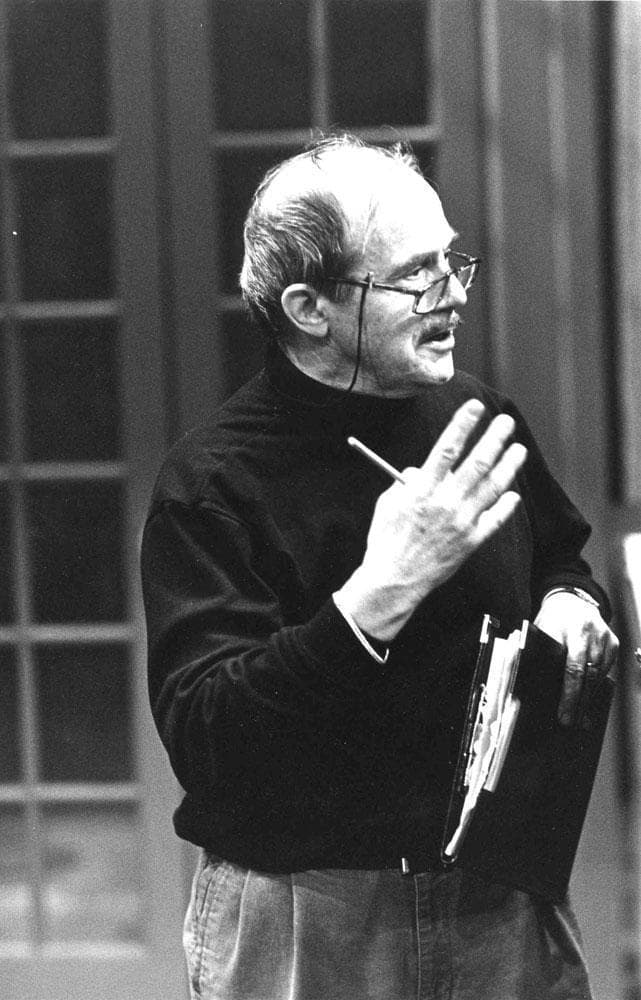
David Wheeler, Force In Boston Theater, Dies
It’s impossible to talk about David Wheeler, who died Wednesday of respiratory and heart failure at the age of 86, without listing the actors he brought to the Theatre Company of Boston in the mid-1960s — Al Pacino, Dustin Hoffman, Robert De Niro, Robert Duvall, Spalding Gray, Stockard Channing, Ralph Waite, Paul Benedict, John Cazale, Blythe Danner, Jon Voight, James Woods.
I was a sophomore at Boston University back then, when I first stumbled across Theatre Company of Boston — and I do mean stumble as the itinerant company seemingly had a different, more inconspicuous home every year, so it wasn’t easy to find them. And frankly, the names of those actors meant nothing to me in those pre-“Graduate-Godfather” days. What was more important were the productions themselves and the brave new playwrights Wheeler, the artistic director, championed — Edward Albee, Harold Pinter, Samuel Beckett, Sam Shepard, Adrienne Kennedy, as well as Bertolt Brecht and other 20th century masters.
And what productions. The first play I saw there was Albee’s “Tiny Alice,” starring Waite and Benedict and it’s the first time I remember chills going up my spine in a theater as Wheeler and company were able to plug into something mysterious in the religious sense, something transformative. It was certainly transformative for me. Before too long I switched majors from journalism to English at BU. Whatever Wheeler and the theater were offering, I wanted more.
And more he gave us. When Channel 5 experimented in the 1980s with producing plays on television, the station turned to Wheeler to direct them. I was a television critic at the Boston Globe at the time and for all the interviews I did with Peter Falk, Mary Tyler Moore or whomever, I was most nervous approaching Wheeler. I said that he was probably sick of people telling him how much Theatre Company of Boston meant to people and he replied along the lines of, “Oh, noooo! I’m never sick of hearing that,” and then regaling me with story after story about theater and the ‘60s. I wish I had had a tape recorder, though I do remember that Pacino and Hoffman had a falling out over a woman and people who knew them had to take sides. “I felt that Al needed support. I don’t think Dusty needed anybody,” he said.
Wheeler also had some success in New York with Pacino, who was by then a made man as an actor. But Robert Brustein, the head of the American Repertory Theatre, was wise enough to enlist him as part of his stable of directors when he came to Cambridge. Ironically, Wheeler’s 20th century iconoclasts and the way he directed them, represented the conservative, representational part of ART’s programming. As Brustein writes in “The Lively ART,” “ART congenial resident director David Wheeler was responsible for most of our Shaw productions (including 'Misalliance,' 'Major Barbara,' 'Heartbreak House,' and 'Man and Superman') and two of our Pinters ('The Homecoming' and 'The Caretaker'), almost all of them popular hits in a community that adores British plays.”
I don’t think it had anything to do with Anglophilia. I think it had to do with the clarity, insight and imagination that Wheeler brought to whatever he was directing — making the text come first and adapting the acting, set design, lighting and everything else to serve those words, whether it was the British classics, Paula Vogel’s “How I Learned to Drive,” Don DeLillo’s “Valparaiso” and “The Day Room,” or Brustein’s own “Nobody Dies on Friday.” These were often in stark contrast to ART auteur directors like Robert Wilson, for whom the words were almost incidental to the total theatric experience.
Wheeler’s last great success for ART was Pinter’s “No Man’s Land” in 2007, starring his old pal, Paul Benedict. As I wrote in the Globe at the time: “Seeing Wheeler and Benedict excel in the same way that they did 40 years ago, seemed to stop time in its tracks … Here were two men who have been remarkably true to their craft and to their aesthetic — with a detour to “The Jeffersons” and Hollywood in Benedict’s case — for the better part of half a century. To see Benedict jaw with his fellow actors exactly as he did in the ‘60s made it seem as if art and ART, had its own temporal rules that didn’t bow to the workaday rules of the real world.”
Also starring in that production was Lewis Wheeler, David’s son, who’s become one of Boston’s leading leading men. Lewis isn’t the only symbol of Wheeler’s legacy in Boston. Until his death, Wheeler had been active in the area’s rising mid-size theater scene, directing productions at the New Repertory Theatre (then in Newton), the Gloucester Stage Company, the Wellfleet Harbor Actors Theater under former artistic head Jeff Zinn, Company One and the Underground Railway Theatre in Cambridge’s Central Square.
You could say that Wheeler represented all that was great in Boston theater. But I remember Albee coming to Boston as guest of honor of the Elliot Norton Awards and wanting to know where David Wheeler was. His face lit up when they were reunited. Albee never forgets his friends (or his enemies).
So just say that David Wheeler represented all that’s great about theater. The statement doesn’t need any qualification.
This program aired on January 5, 2012. The audio for this program is not available.