Support WBUR
Boston EMT Returns To Boston Marathon Explosion Site
For many, the Boston Marathon bombings are not a personal memory, but rather a series of images broadcast in the days after the blasts.
You have probably have seen the photo of a man being pushed in a wheelchair, his legs ruined by the blasts. That man, Jeff Bauman, would lose both his legs.
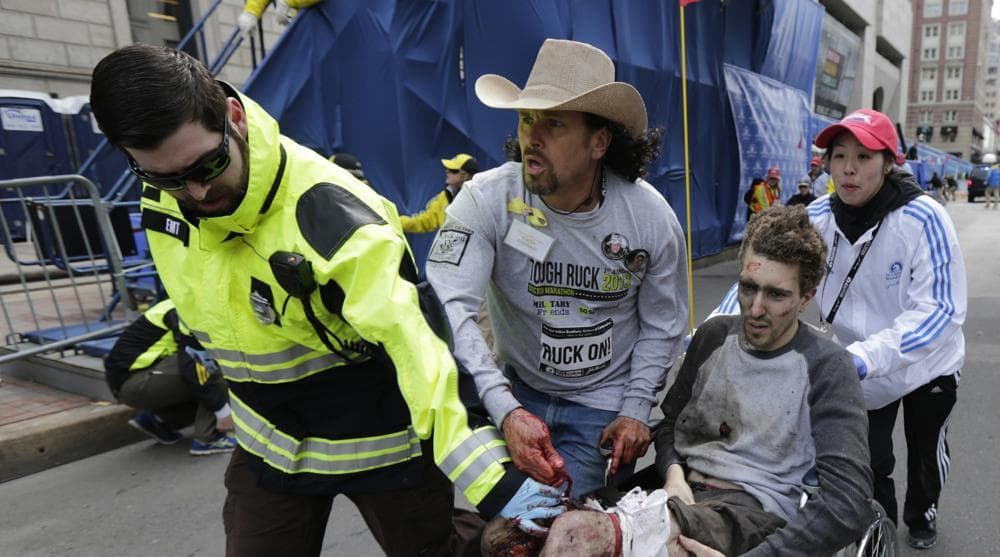
In the same photo, running alongside Bauman, is an EMT who has his left hand on Bauman's wounded right leg. That EMT is Paul Mitchell, who works for the city of Boston's Emergency Medical Service. Recently, Mitchell returned to the explosion site for the first time.
'Everyone Is A Red Patient'
Mitchell remembers the moment the first bomb went off and a perfect spring day turned to chaos.
"I can still hear that, the blast, how loud it was, and I remember it seeming like everything froze," Mitchell recalled. "Everyone sort of stood still for the first one."
Standing at the bomb site, Mitchell tried to process what happened that day.
"There were patients that were severely injured, acutely sick patients everywhere," Mitchell said. "And they train you to triage the priority of the patient and treat if necessary, and I just remember my first thought being everyone is a red patient, or an acute patient, or a priority one patient, whatever you want to call them, everyone."
He says that he and other first responders made do with what they had. For some, that meant using belts as tourniquets. For Mitchell, it meant many trips between the medical tent and the crime scene.
"I was running back and forth, yeah, I was running and we don't usually run in EMS," he said. "We usually, you know, slow and steady, but I was running that day. The one thing that I didn't want and that I haven't had is regret, and I'm glad for that. I didn't want that. I didn't want to regret not doing something, or not doing enough."
Mitchell was born in Boston, grew up in Savin Hill and Hingham, and now lives in an apartment in South Boston. After the explosion, he says he needed the familiar comfort of being with his family in Hingham. There, he avoided media accounts of the bombings, giving himself time to process what he had been through.
The bombing was the only time in his career where he questioned his own safety.
"No one was prepared for explosions ripping through the city that day, no one was prepared. And the fact that there was two of them and we didn't know if there was going to be more of them, sure, I was scared for my safety, absolutely, as was I imagine everyone that ran in personal safety aside."
After two days he returned to his life in Boston and his EMT job, but the drive up from the South Shore was difficult.
"I realized that I was driving in complete silence and I went, 'Oh, what am I doing?' And I turned the radio on and the first thing I heard was, I believe, the mother of one of the victims who passed away talking about her daughter, and I just broke down, it just got to me," Mitchell recalled. "I had been emotional prior to that, but everything kind of came to a head there and the rest of the ride to work was pretty crappy."
Boston EMS, the Boston Fire Department and Boston Police Department have brought in experts to help identify first responders who may be suffering from post traumatic stress disorder — or PTSD — and to help everyone with the recovery process. Mitchell says psychologists tell him he doesn't have PTSD because he has been improving every day since the attack.
"I've had a bunch of sad days, I don't want to call them horrible days because that day was a horrible day, but I've had a bunch of emotional days. They've been fewer recently and less difficult."
Mitchell is now back to working regular hours and getting back to living a regular life.
"I saw some kids playing, there's a playgound near my apartment, and I just remember it was the first time I think I'd really smiled in a couple of days, and it was just seeing how happy kids can be," he said. "So I think a lot of the people that have kids and their own families are relying a lot on that."
This program aired on May 2, 2013.