Support WBUR
Boston In Books: The Character Of A City
The inaugural Boston Book Festival is bringing authors from around the country to Copley Square this weekend. It’s a celebration of all things books, and we thought we’d examine books and stories that use Boston as a place setting.
What are your favorite books about Boston? Do you feel like you live in Henry James’s version of Boston, or Dennis Lehane’s?
Do you identify with Henry David Thoreau’s Concord as described in “Walden,” or with Michael Patrick MacDonald’s Southie from “All Souls?”
Share your own favorite passages about Boston in the comments.
[asset]2009/wbur_1023_panning-the-harbor/boston.html[/asset]
From "Blindspot," a novel by Jane Kamensky and Jill Lepore
…I have since read that Boston’s founder, a proper Puritan named John Winthrop, proclaimed to his followers in 1630, as they neared shore: ‘We shall be a City upon a Hill, the eyes of all people are upon us; so that if we shall deal falsely with our God, we shall be made a story and a byword through the world.’ Now, careful reader, I ask you this: From such a lofty start, can any city do less than fall? ‘Tis a small port, and charming enough. But it does not content itself with its smallness, its slack bustle, its less-than-profound harbor. Nay, ‘twould be Jersualem. Here is a town that, by pretending to be more than it is, makes itself less. I had rather not draw an overhasty conclusion. But I have to wonder whether this is what hobbles Boston: its oversized ambition.
[asset]2009/wbur_1023_panning-the-harbor/cambridge.html[/asset]
From "Blindspot"
A pleasant village, scant and scattered, waited on the other side [of the Charles]. This town of Cambridge boasts little trade, save the traffic in diplomas, which the brightest sons of New England earn by years of papery toil. The College is a monument to the noblest aspirations of the American colonies. And in these parts, it passes for ancient, for ‘twas founded in the year 1636. But, compared to the centuries-old stone spires of Edinburgh, ‘tis not much to look at: five brick buildings, surrounding a Yard, enclosed by a low wall. Students in black gowns and square hats walked briskly across the lawn. The freshmen, and only the freshmen, went bare-headed, and bowed at ten paces before every upperclassman they encountered. We traveled past four large brick halls, the most imposing of which was but half built, before passing a small stone chapel.
Southie
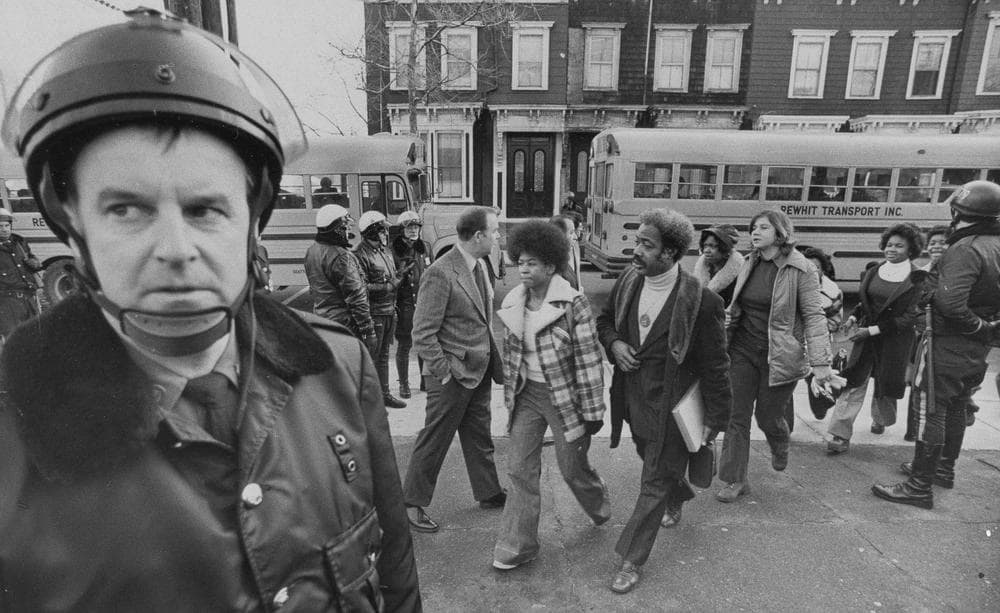
From "All Souls," a memoir by Michael Patrick MacDonald
There was no way we would’ve believed integration could work in Southie. Even Nellie, who’d lived with a black man and had a daughter by him, feared Southie opinion. She used to sneak our cousin Lisa in and out of Old Colony in blankets once she realized she wouldn’t be able to pass her off as “half-Italian.” But before long, Ma was inviting our Puerto Rican neighbors into the house to teach them Irish step dancing and to play a few tunes on the accordion.
Walden Pond

From "Walden," an autobiography by Henry David Thoreau
I was seated by the shore of a small pond, about a mile and a half south of the village of Concord and somewhat higher than it, in the midst of an extensive wood between that town and Lincoln, and about two miles south of that our only field known to fame, Concord Battle Ground; but I was so low in the woods that the opposite shore, half a mile off, like the rest, covered with wood, was my most distant horizon. For the first week, whenever I looked out on the pond it impressed me like a tarn high up on the side of a mountain, its bottom far above the surface of other lakes, and, as the sun arose, I saw it throwing off its nightly clothing of mist, and here and there, by degrees, its soft ripples or its smooth reflecting surface was revealed, while the mists, like ghosts, were stealthily withdrawing in every direction into the woods, as at the breaking up of some nocturnal conventicle. The very dew seemed to hang upon the trees later into the day than usual, as on the sides of mountains.
Boston Common
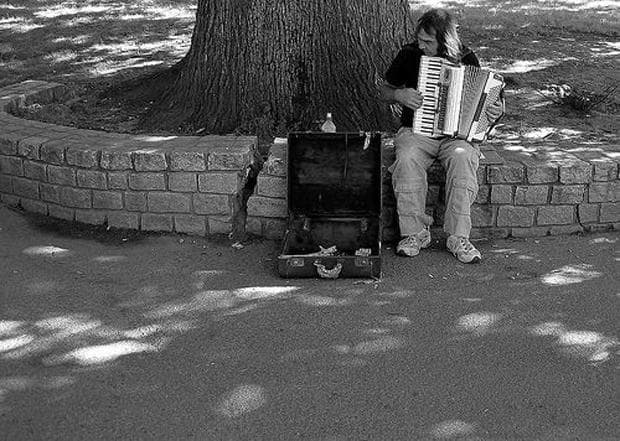
From "Financial District," a short story by Lynn Heitman
This was supposed to have been the best day of her life...Waking refreshed, she had decided to forgo the planned cab ride and walk to work instead. She usually walked for the exercise, but today she had noticed things. People in soft pants and flip-flops out on the Comm. Ave. Mall with their dogs, yawning and standing by with their baggies until there was a pile to clean up. The flowers in the Public Garden. Even the accordion-playing busker on the Common sounded good to her. She’d seen him there often, sitting on the same low brick wall under a tree, squeezing out sad French ballads, collecting tips from the well-dressed army of posers and wannabes making its weary way to the Financial District for another day in the MUTUAL FUND CAPITAL OF THE WORLD! She had never given him a penny. She didn’t believe in rewarding mediocrity. Also, he smelled.
But today she had admired his work ethic. Today she had slipped a twenty into his collection cup because everything was good and everyone was kind and even living in Boston wasn’t so bad because today, after six long years in this second-rate backwater town, she would be named Managing Director. She would cross the magic line, get her ticket punched, and one day soon, get back home to New York where they would surely have to take her seriously now.
This program aired on October 23, 2009. The audio for this program is not available.