WBURSalazar’s Cape Wind Decision Is Difficult, For A Consensus Builder
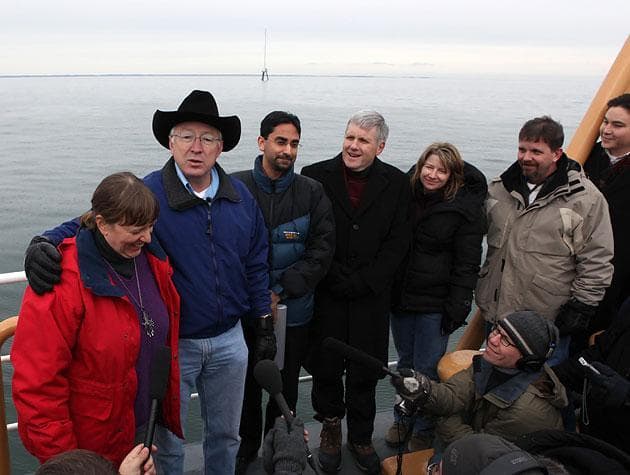
Interior Secretary Ken Salazar, second from left, puts an arm around Minerals Management Service Director Liz Birdbaum, far left, during a news conference aboard the Coast Guard's Ida Lewis buoy tender on a tour of Nantucket Sound on Feb. 2. (Julia Cumes/AP)

BOSTON — The fate of Cape Wind, a proposed $900 million wind farm in Nantucket Sound, likely rests with one man: U.S. Interior Secretary Ken Salazar.

Salazar recently toured the sound, in his trademark cowboy hat, and set his sights on a conclusion to a saga that has lasted a decade. He imposed a March 1 deadline for developers and opponents to reach an agreement. With no signs of public progress, the decision could fall to him.

For Bay Staters, that poses a question: Who is Ken Salazar?

Michael Riley, of The Denver Post’s Washington bureau, said Salazar’s Nantucket Sound tour typifies the Colorado native.

“One of the things that he’s famous for is that if there are very, very sticky, difficult problems, he just wades in there,” Riley told WBUR. “He shows up personally, tries to talk to all the parties involved, he tries to see if he can find some sort of middle ground.”

Salazar honed his “middle ground” style in his home state. He was Colorado’s attorney general and spent four years as its U.S. senator before being tapped by President Obama. Riley said Salazar appealed to a wide variety of constituencies with his folksy image. A precursor to Sen. Scott Brown, Salazar drove through Colorado in his pickup truck while campaigning for Senate.

“Certainly when he was in Colorado, he was known for being the kind of politician who could play very much to the middle,” Riley said. “Colorado was known as a red state for a long time and has been leaning blue, and Ken Salazar has played a big role in that.”

“It’s a big part of the Obama agenda, and it’s not something he’s going to let go of easily.”

–Michael Riley, The Denver Post

Salazar used this moderate stance to forge consensus on issues of judicial nominations and immigration in the Senate. Since becoming interior secretary, Salazar carved a deal with Pennsylvania landowners over a 9/11 memorial and settled a civil suit brought by Native Americans against the federal government.

Cape Wind, however, presents a challenge to Salazar’s penchant for consensus. He has recast the focus of the Interior Department upon renewable energy, a move that has squared him against oil and gas interests.

“Under the Obama administration he has indeed, I think, taken a more aggressive line in many issues that suggest renewable energy and wind power on public lands is a big part of his priorities and his agenda in the Interior Department,” Riley said. “It’s a big part of the Obama agenda, and it’s not something he’s going to let go of easily.”

But the Cape Wind decision gets more complicated for Salazar, because opposition to the project does not end with local residents. Two American Indian tribes, the Aquinnah and Mashpee Wampanoag, say the proposed 130 wind turbines would disturb ancient rituals and burial grounds.

“He’s been, of interior secretaries, an interior secretary that’s really taken Native Americans, their issues and the things that they want addressed seriously,” Riley said. “So it wasn’t a surprise to see him go to Massachusetts to talk to some of the leaders of the Native American communities there to really try to listen.”

Riley does not see easy decisions awaiting Salazar — on Cape Wind or throughout his tenure. “He is in a tough spot, and it’s not just here,” Riley said. “He’s in a tough spot with renewable energy on public lands in general.”

But Riley thinks the secretary will make a decision and won’t waver.

Riley cautiously predicted Salazar would approve the project. “Based on everything we have seen at the Interior Department, this is a keystone to sort of moving forward,” Riley said. “If I had to take a guess, I think that’s where it comes down.”


Click “Listen Now” to hear the full interview with Denver Post reporter Michael Riley.

WBUR Topics · Boston · Environment
Please follow our community rules when engaging in comment discussion on wbur.org.
  • Chris Flaherty

    Time has come, we have to become creative and not allow the BIG OIL Companies control us any longer. Competition with fuel will help us all in the long run. Goog luck Cape Wind.

  • Robbyn Candelaria

    WE have the right to demand clean energy. WE also have a responsibility to ensure that energy projects are done right — at the highest standards of social justice. At the very minimum, new energy projects must not bring harm to any person, community, or nation.

    Because placing offshore wind turbines requires brutal and destructive force, WE must carefully consider what may forever be lost in the process. Sacred areas of Native people are of immeasurable significance and can be neither relocated nor replaced. As such, these places are priceless and vulnerable treasures with which WE have been entrusted.

    Nantucket Sound is just such a sacred place. Unfortunately, this ancient spiritual body could pay the ultimate price- ecologically, historically, and spiritually – for a private developer to sink 130 440-ft. turbines into her fragile habitat. Reckless, not responsible. Governmentally permitting a business into a sacred area to dredge, dig, and decimate would be nothing short of reprehensible.

    Wind is an abundant gift that can and will be channeled from myriad places for ALL people – WE. Cape Wind, however, can power only a fragment of America. In the process, it stands to decimate an ancient sacred place of the first Americans. WE can do so much better than this, America.

  • J. Mark

    Bring on the wind, bring home our troops fighting and dying to protect our access to Middle Eastern oil.

  • Dan Friend

    Michael Riley is incorrect that Cape Wind is a “keystone to sort of moving forward” with offshore wind — unless Riley means that denying it will be keystone to helping other developers avoid problems. Cape Wind has not come to fruition for legitimate reasons — namely that the proposed site is sacred ground to Native residents, it is environmentally sensitive marine habitat, and giant turbines would blight a national historic place. Seriously, just because a developer has “waited a long time,” it does not mean his project is worthy. No matter how the developer might spin it with the media, there are substantial reasons for that long wait. Mr. Riley needs to understand that monolithic permanent structures such as offshore wind grids must be done right the first time, within well-conceived paramaters. First of all, their construction causes so much environmental destruction that we’d better have d___n good reasons for laying to waste eons of Nature’s development — and a d__n good plan for helping it recover. Also, $$$$… Maybe these thoughts will give Mr. Riley more things to consider.

  • Gary X

    From the Martha’s Vineyard Times.
    http://tinyurl.com/ycakt9s
    “Two prominent members of the Wampanoag Tribe of Gay Head (Aquinnah) say there is no historical basis to support claims by tribe leaders that a wind farm in Nantucket Sound would interfere with important cultural ceremonies based on the rising of the sun in the east. They say the claims are fiction.

    Tribe member Jeffrey Madison, in a February 9 letter sent to Ken Salazar, Secretary of the U.S. Department of Interior, supported by a statement signed by eight members of the tribe including Beverly Wright, a tribal council member and former five-term chairman of the tribe, disputed the tribe’s claim about the cultural value of the Cape Wind site.

    Cheryl Andrews-Maltais, chairman of the Wampanoag Tribe of Gay Head, and Bettina Washington, the tribe’s historic preservation officer, have taken the lead in expressing the tribe’s opposition to Cape Wind on cultural and ceremonial grounds, in meetings with state and federal officials.

    Federal law requires Cape Wind to consult with Native American tribes as part of the permitting process. Opposition of the Aquinnah and Mashpee Wampanoag tribe’s elected leadership to Cape Wind on cultural grounds has led to the direct involvement of Mr. Salazar, who has promised to resolve the issues by April.

    “I believe it to be a fabrication, invented by a small number of tribal members who happen to be involved in tribal government and who happen to be opponents of Cape Wind who wish to derail the project,” Mr. Madison wrote. “I do not believe that they understand that creating ceremony to achieve political objectives undermines the credibility of our legitimate cultural values and our people as a whole.”

  • Samuel Richwon

    “Ms. Maltais provided the following comment at 11:30 pm, Wednesday after the Times press deadline:

    ‘It’s truly unfortunate that a few tribal members chose to go outside our process, and opted not to inquire from the cultural representatives or government about traditional and cultural practices, that they may not be familiar with or knowledgeable of, before they sent a letter to the Secretary or media.
    Not everyone in the tribe has the same cultural information or traditional education levels, nor does everyone practice some or all aspects of our ceremony, as evidenced by the comments stated by the few folks who signed the petition.’” (MVTimes)

    Thank you, Cheryl.

    Many people disagree with these letter writers. I personally flinch at the heartless and soul-less way that Cape Wind is using them.

    I, for one, know that Sunrise Ceremonies are traditional spiritual practice throughout the many Algonquian-language Nations. These Nations share both common ancestry and traditional spirituality with the Wampanoag.

    That traditional spirituality and language are alive, and experiencing resurgence, is testament to something extraordinary — and absolutely profound. Yes, sacred.

    My prayers continue to go up for you, Wampanoag Nation. (I consider you one.)

  • http://text.donschaefer.net Don Schaefer

    Let’s not go blindly into wind farms without knowing what a windfall (yes) it is for developers and financiers. Government is throwing billions in subsidies and tax relief on the current politically correct fancy, but that is only because they have no real plan for the radical energy savings we’ve needed for years. Wind power on an industrial scale does not make sense for reliable power generation. However, the profits to be made from the current fancy are enormous. Let’s be clear – the huge profit potential from subsidies and tax write-offs are what is driving development, not interest in solving energy problems.

    From a wind developer:
    “We’ve got more than 100 wind projects in the works currently, many of them only one or two small turbines. The largest is Cape Wind, a 130-turbine offshore project. I think if you look at wind resources on-shore in the US, they are fantastic. And, therefore, I am really wondering why anybody wants to put them up offshore because it’s twice the price. So just as an outsider, I am just scratching my head saying, “Why?”
    http://tinyurl.com/ylpw9lw

    Before we destroy a national and sacred treasure, Nantucket Sound, let’s do our homework and stop being duped by the profiteers. The costs of this project hugely outweigh the benefits, except for a few political and financial interests.

    http://www.energytribune.com/articles.cfm?aid=842

    Wind power has a place, but not in Nantucket Sound.

  • Robbyn Candelaria

    Cape Wind is the wrong answer to the most important question on the test. We must demand better, America.

  • BOb the builder

    CApe wind is awesome and is going to save the world. they have already built offshore windfarms in europe sxo why wont they work here in the USA. I think CApe wind wont be an eysore as it will only look like a half an inch of white fuzz on the horizon.

More stories in 'Environment'
UNDERWRITING
Most Popular
SUPPORT
SUPPORT
This site is best viewed with: Firefox | Internet Explorer 9 | Chrome | Safari