|
Special Series: Bridges & Roads Part II
TEXT OF STORY:
Thousands of drivers brave Massachusetts roads every day.
Maybe you're one of them. If so, you've probably know what
Westin resident, Valerie Mosely is talking about:
VALERIE MOSELY: It's horrible. Right after winter, it's horrible.
It takes too long to fix the potholes. You're driving and
then all of the sudden, bam!, your wheel is hitting a hole,
and then you're wondering if your car is damaged.
Experts agree. The state's transportation system is broken.
And Massachusetts doesn't have the money to repair roads.
A recent report from the Transportation Finance Commission
put the funding gap at a billion dollars a year. In the second
of a special two-part series, WBUR's Meghna Chakrabarti traveled
some rough roads in Western Massachusetts, searching for solutions.
MEGHNA CHAKRABARTI: Gary Roux will tell you communities in
Western Massachusetts are having a tough time smoothing out
the ride for area drivers.
GARY ROUX: They're really having to struggle to do even minimal
types of roadway improvements.
CHAKRABARTI: Roux is the principal planner with the Pioneer
Valley Planning Commission, the regional authority for 43
Western Massachusetts towns.
He says a failing overpass outside Springfield was dropping
chunks of asphalt onto cars passing below. Crashes are common
on congested off-ramps in the region. And Roux believes the
sub-par system is hurting the local economy.
ROUX: If you're restricting your truck traffic, that's adding
more time to travel from point A to B. It's increasing the
fuel cost to transport the goods. It's having a secondary
impact on a residential neighborhood or a school or a hospital.
So, you see all these types of snowball effects that's (sic)
happening because of a deteriorating transportation system.
CHAKRABARTI: Roux says there's been a long and steady decline
in transportation funding to the Pioneer Valley. So road crews
can't keep up with the maintenance backlog. He takes me on
a drive through Springfield to see some examples.
CHAKRABARTI: Ok, and we're going back that way?
ROUX: You're going back that way, you'll come to a light.
You'll take a left at the light. That'll take you right into
the town center.
CHAKRABARTI: A decade ago, the Pioneer Valley received 40
million dollars a year in state and federal transportation
aid. Now it gets only 12 million. Roux believes the drop is
due in part to state funds that were sunk into the Big Dig.
The Pioneer Valley, Roux says, has had to absorb the pain.
ROUX: And I think part of it is just hoping that you'll begin
to play catch up with the investment that you need to get
more projects into construction. You see the sign up ahead?
Bear right onto Route 5.
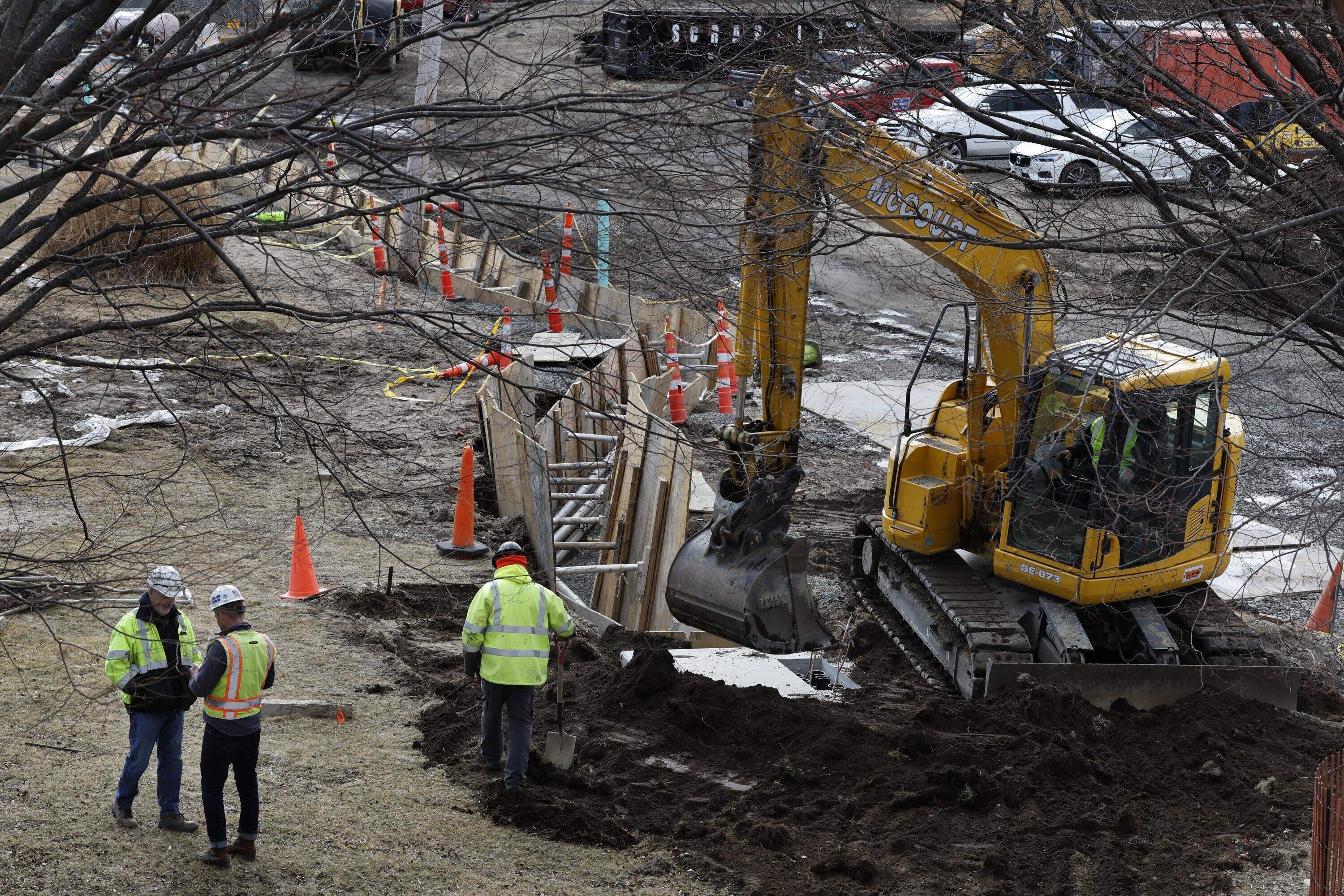
CHAKRABARTI: Route 5 is an essential artery that connects
Springfield to I-91 and Hartford, Connecticut. There's construction
here; broken concrete and orange cones. Closed lanes are slowing
traffic. Roux says the roadway needs significant improvement.
ROUX: Route 5 is being overlaid. This is a road that in parts
has a concrete base that needs to be addressed, so that's
a problem. You're gonna want to take the 57 West exit.
CHAKRABARTI: When the Transportation Finance Commission reported
that Massachusetts faces a transportation funding gap of a
billion dollars a year, panel members called the findings
"shocking". But Gary Roux wasn't surprised.
ROUX: This is nothing new. The communities, I think, have
been saying it louder and longer that they need more money
for road and bridge improvement projects.
CHAKRABARTI: It seems like no one's been listening then,
if it's coming as such a surprise in Boston.
ROUX: I don't think the Highway Department was necessarily
surprised, either.
MASSACHUSETTS SECRETARY OF TRANSPORTATION BERNARD OCOHEN:
We have about 32% of our pavement on state-maintained roadways
that are either in fair condition or in poor condition.
CHAKRABARTI: So says State Transportation Secretary, Bernard
Cohen. A recent report from the American Society of Civil
Engineers put the percentage of crumbling roadways even higher,
saying almost three-quarters of Massachusetts' major roads
are in poor shape. A serious problem, made worse, Cohen says,
by the fact that local communities, like the Pioneer Valley,
count on Federal funds for up to 80-percent of their transportation
dollars.
COHEN: That is funded through the 18-cent federal gas tax.
That gas tax was established in the early 1990s. It was never
indexed. So the amount of revenue coming out of the federal
gas tax hasn't grown virtually at all.
CHAKRABARTI: And, because it's not keeping pace with inflation,
Cohen says the federal highway trust fund may be three years
from falling into the red. Meaning Massachusetts will have
to pay its own way out of the transit funding gap.
But on Beacon Hill, the House and Senate budgets show negligible
change in transportation funding, according to an analysis
by the Massachusetts Budget and Policy Center. The money,
says Joseph Giglio, will have to come from other sources.
JOSEPH GIGLIO: There are only two sources of financing for
transportation. One is taxes. The other is user fees.
CHAKRABARTI: Giglio is a business professor at Northeastern
University, and author of "Driving Questions: Developing
a National Transportation Vision". Raising taxes is a
tall order for politicians, Giglio says. He advocates a controversial,
but increasingly popular, alternative.
GIGLIO: Going in the direction of market-based pricing, which
I might add is where many large states are moving in that
direction, and we would be charging people for actual road
miles traveled based on time of day, based on the type of
vehicle that they travel.
CHAKRABARTI: At least 14 states already have, or are developing,
what's called "congestion pricing". New York Mayor
Michael Bloomberg recently proposed charging roadway user
fees across much of Manhattan. What would that look like in
Massachusetts? Giglio explains:
GIGLIO: Theoretically, the Mass Turnpike authority could
use congestion pricing on portions of route 128, 93, portions
of 95. Those are all cash cows that would generate a substantial
amount of money which in turn, one could consider using to
subsidize other transportation assets that don't function
at a break even level.
CHAKRABARTI: We already pay market prices for water, power,
and gas, Giglio adds, so why not roads? But are you, and average
drivers like Methuen resident Rick Collins, willing to pay?
RICK COLLINS: I think we pay enough. I think the problem
is somewhere else. Maybe, somebody that's handling the money,
I think that's where the problem stems from.
STEPHEN SILVERIA: Somewhere, someone was able to coin the
phrase freeway. There's nothing free about them.
MEGHNA CHAKRABARTI: Stephen Silveria is chairman of the Transportation
Finance Commission, an independent panel created by the legislature
in 2004. The Commission plans to release recommended solutions
to state government this summer. But ultimately, Silveria
believes people's attitudes about transportation need as much
updating as the roads. Pavement, he says, comes at a price.
SILVERIA: They're not free to design. They're not free to
build. They're not free to maintain. I mean I don't know what
there is, outside of air, that millions of people use every
day that doesn't turn out to be particularly expensive to
operate and maintain.
MEGHNA CHAKRABARTI: Silveria won't say if the commission will
recommend new taxes, tolls, or congestion pricing. The transportation
secretary says those options and more are on the table. Experts
insist: to climb out of this funding crisis, Massachusetts
must raise new revenue. But they wonder if lawmakers are willing
to spend the political capital to get it.
For WBUR, I'm Meghna Chakrabarti.
|