Support WBUR
A.R.T. brings a reframed 'Romeo and Juliet' to the stage

The vision of star-crossed lovers takes center stage at American Repertory Theater’s production of “Romeo and Juliet” this fall, a revival of the timeless tragedy. Directed by Diane Paulus, the play will illuminate the power and beauty of Shakespeare’s language. This telling of the classic story, faithful to the original script, won’t be tied to a particular historical period. The show draws inspiration from the bond between the title characters, rather than the divisions and societal ills that keep them apart. The show will run from August 31 through October 6.
Paulus, A.R.T.'s artistic director, emphasized that it was important for her to convey a narrative about the couple’s feelings. “They’re both these heightened poetic souls,” she said. “We’ve talked a lot about the visions that Romeo and Juliet have. They have premonitions, almost like prophecies. They are these two young people who have a vision of where the world is going for them and where the world could go. In many ways, they are determined to not repeat the path of their parents or the generations that came before them.”

Shakespeare’s play is set in Verona, a city plagued by rivalry between two families, the Montagues and the Capulets. When the young Romeo and Juliet, born into feuding households, encounter each other at a party, the orbits of planets seem to change. Meeting in secrecy, the two plan to marry, but their dreams are rapidly upended by a sequence of events that leads to strife and misfortune.
The tale is interpreted with evocative and poignant original music by Alexandre Dai Castaing. The characters, said choreographer and movement director Sidi Larbi Cherkaoui, are wonderfully astute, perceptive, and conscious, perhaps making them the most mature figures in the story. Their scenes are infused with physical language that appears almost sculptural, said Cherkaoui, who even brought a complex vocabulary of motion to moments that do not feature dance. Cherkaoui has worked with Beyoncé, Madonna, and currently serves as ballet director of Le Grand Théâtre de Genève in Switzerland. He last collaborated with Paulus in American Repertory Theater’s staging of the musical “Jagged Little Pill.”
“In very simple gestures, Juliet shows what’s going on in her mind. She’s an artist, so her movement has artistry. Romeo is a bohemian soul,” Cherkaoui said. “Actors really understand intentions. Dancers are used to going from the outside in, and actors need to know what’s going on inside of them. … There’s an incredible precision that I wasn’t expecting from actors. I thought they were going to be more raw, but they’re very, very detailed.”
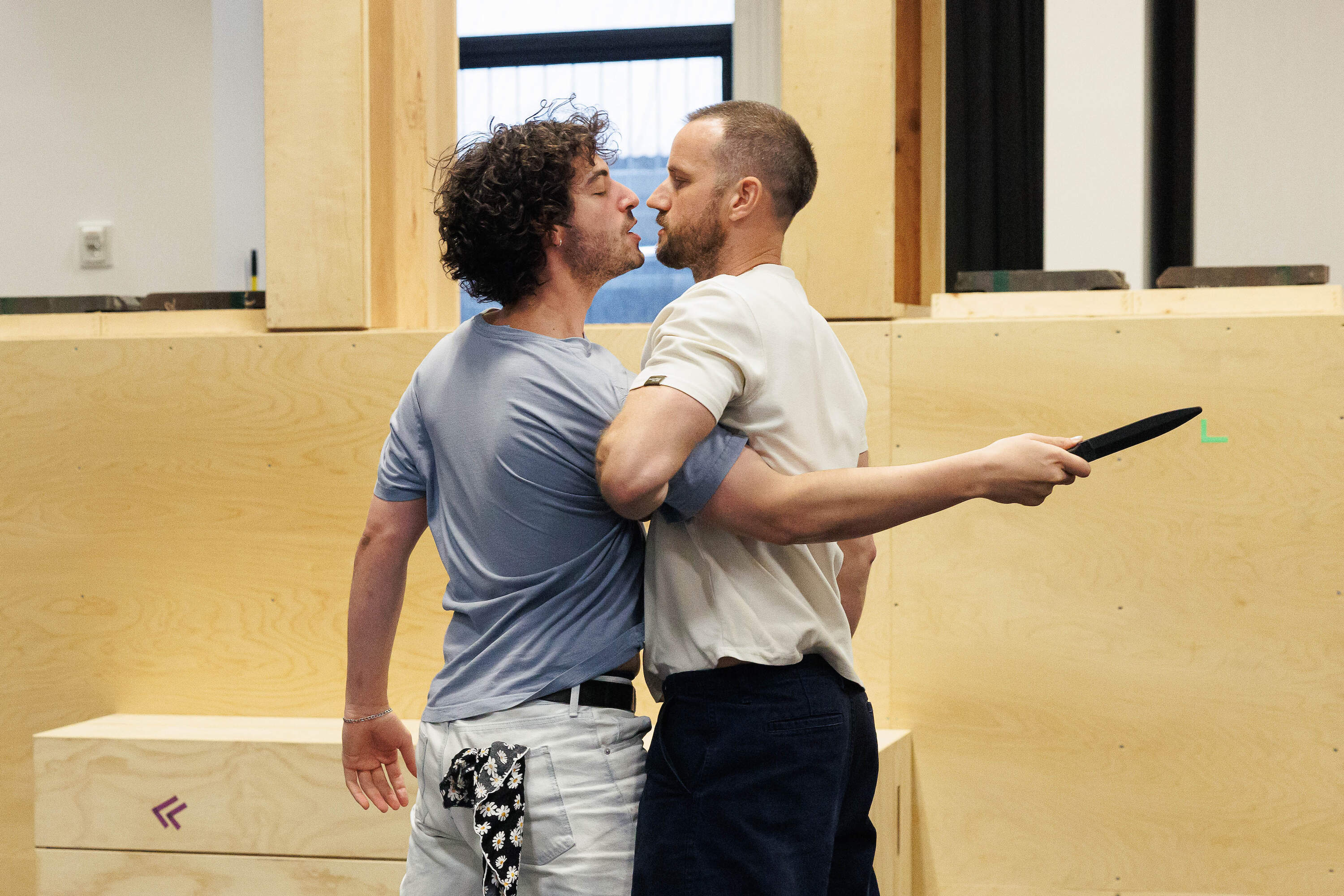
Rudy Pankow, known for his role in the Netflix teen drama series “Outer Banks,” described exploring the character of Romeo as a journey. He identified moments when Romeo transitions, beginning in a hopeful state, feeling “baptized” as a new man, and towards the end of the play, becoming more haunted. In his scenes with Emilia Suárez’s Juliet, the two are often playful, challenging each other and joking. Pankow asked himself many questions as he worked towards finding Romeo’s identity.
“Who is this character, who is he? — Romeo is struggling with that exact question during the entire play, until he and Juliet find each other truly. That’s when he finds himself,” said Pankow. “Romeo is a genuine feeler: ‘I want to find the truth to who I am.’ So many people run from asking those questions because it’s sometimes really scary to admit to whom you may be. He’s a golden character in that he actually, truly sees his flaws, how he doesn’t want to [have] those flaws, and how he wants to fix them.”

Paulus said that in many ways, Juliet is a figure who doesn’t have the same kind of freedom that Romeo has; she is subject to the decisions of her father. For this reason, her discovery of her own determination within a set of societal and familial constraints is even more powerful. Suárez spoke to the character traits that she discerned while reading Shakespeare’s language, her intelligence, bravery, and drive. At times, Juliet’s speech reveals a childlike manner, such as when she asks that Romeo be cut “out in little stars,” that the world might view the night as exquisite. Studying the text, Suárez paid careful attention to cadence, finding passages where Juliet interrupts the rhythm of her own speech and correlating them to her inner turmoil. Over the course of the play, she realizes a deeper sense of who she is, finding joy and meaning within a fraught world.
Ultimately, the bond that Juliet finds with Romeo, which is often described in celestial terms, as a heightened reality, offers a kind of recognition.
“They meet each other and feel they know each other,” said Suárez. “They feel they see each other. That gives them a sense of safety that their homes had never given them.”
"Romeo and Juliet" runs at the American Repertory Theater from Aug. 31 - Oct. 6.