Support WBUR
Emerson restricts protest on campus as students return
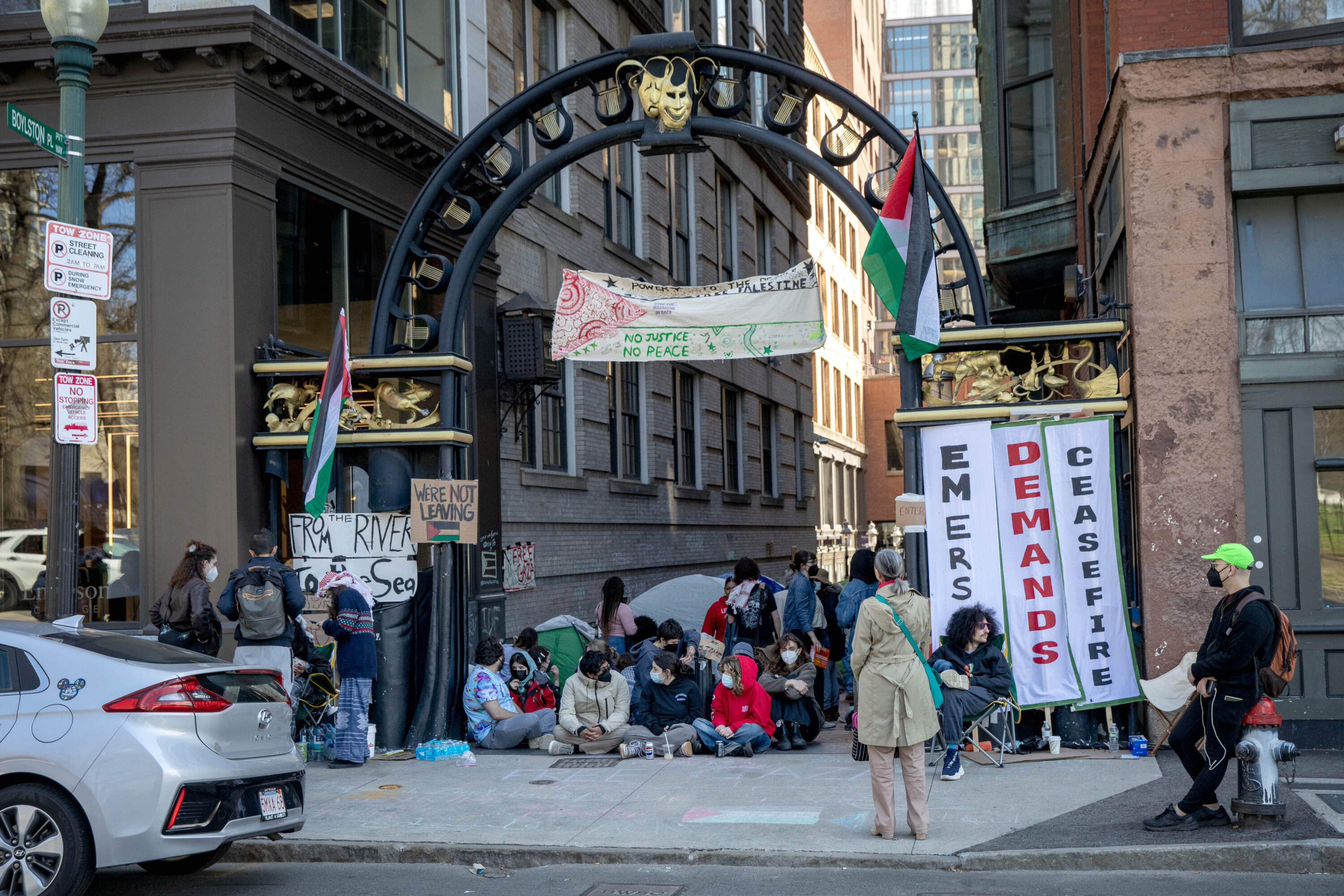
Emerson College issued new policies that restrict student protest on campus as the new school year begins. The last academic year ended with the arrest of 118 people at a pro-Palestinian protest encampment outside Emerson.
"Together, we have worked hard to apply the many lessons learned last year. We heard the community’s desire for more clarity and transparency around policies and processes that lay out responsibility and accountability for actions on campus," wrote Emerson President Jay M. Bernhardt in a letter announcing the change.
The spring protests and encampments at Emerson, Harvard and schools across the country were part of a movement protesting the Israel-Hamas war in Gaza and university investment in companies that demonstrators say support Israel's war effort. Many college presidents have come under fire for their handling of the protests, with some leaving their role as a result of the backlash. Nationwide, college and universities have been updating their protest policies in anticipation of more protests in the new school year.
The policy, announced ahead of the start of classes this week, bans demonstrating on Boylston Place Alley, the site of the protests and encampment last spring. The alley is partially city property, Boston officials said in April. City police had warned student demonstrators of impending arrests because they were violating city ordinances by keeping the tents in an area that exists as a public right-of-way. Emerson's new policies also bans tents and structures put up in protest.
The policy prohibits protests on much of Emerson's property, including classrooms, administrative offices, performance spaces, residence halls, the library and "any other space designated, temporarily or permanently, by the College as an inappropriate protest location."
Students will now have to pre-register demonstrations at specific campus locations and can only protest between 8 a.m. and 7 p.m. Students are also required to show an Emerson ID and remove face masks if requested by college staff. Those protesting the ongoing war in Gaza frequently cover their faces.
"It is important to note that Emerson College is a private institution, not a public forum, and is not subject to the First Amendment protections of the U.S. Constitution," the policy reads.
It also states that any students who break the rules will face discipline. College faculty that break the policy or "facilitate" others breaking the policy are also subject to discipline and termination.
In a post on the school's website introducing the rules, the college said it "encourages safe outdoor demonstrations conducted on public property, such as the Boston Common," which is across the street from the school, and provided links to park demonstration policies.
The college says the rules were informed by Harvard University's policies to "promote free discourse and not restrict speech by silencing others."
MIT requires students to reserve space for demonstration. Their policy, updated on Aug. 30, also bans encampments and tents as part of protests. Northeastern University also issued an update to their policy in August. Their rules prohibit protest encampments and projecting messages on the side on university buildings.
Tufts does not require protests to register with the university, according to their website, but discourages students from wearing face masks and coverings to conceal identity. Protests are restricted from some campus locations, including residents halls, classrooms and university statues. They also prohibit overnight protests.