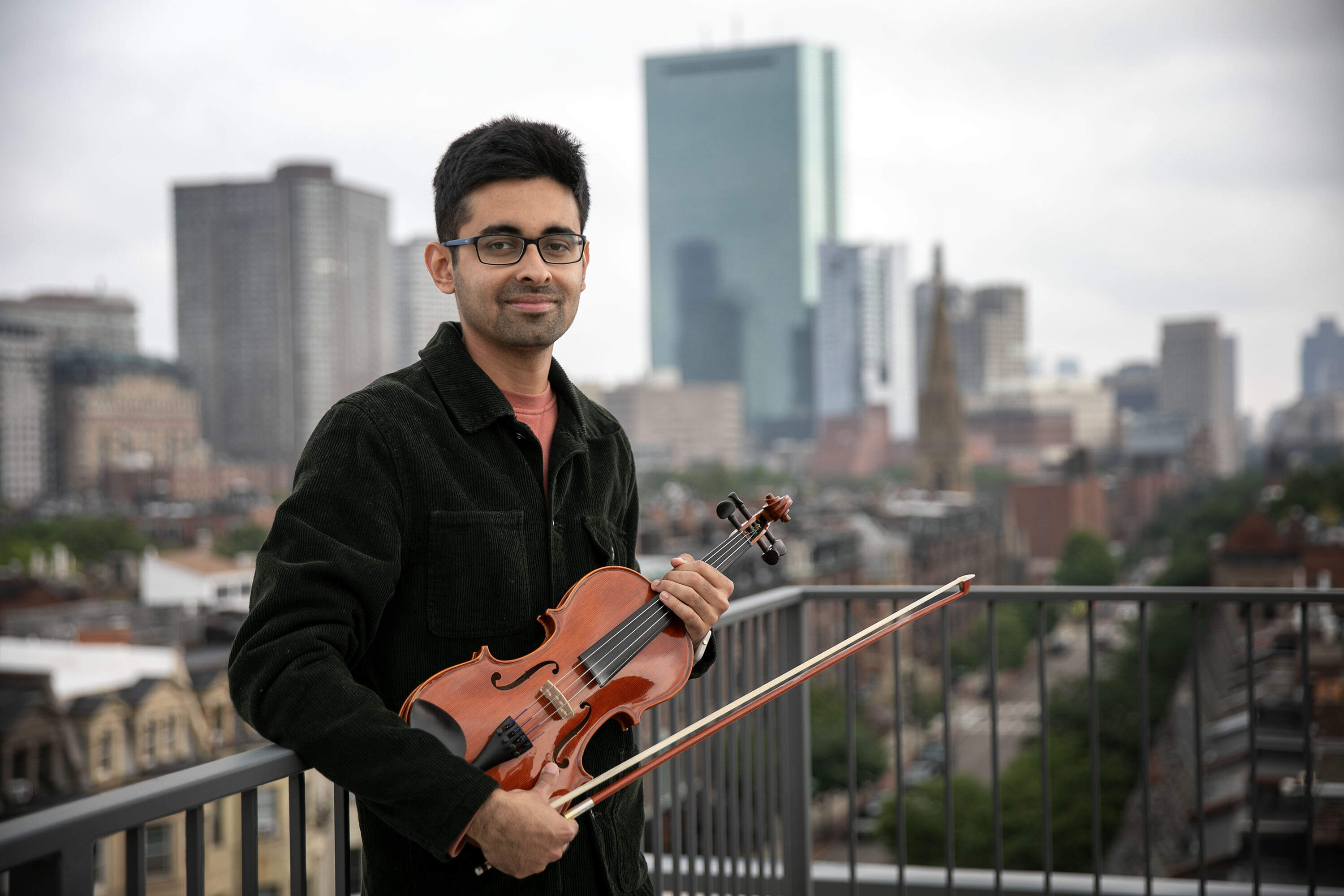
Violinist Pranav Swaroop fuses music from around the globe
In a basement studio at Berklee College of Music in late August, Pranav Swaroop played the violin while listening to a backing track on headphones. The studio, called The Bridge, was impressively quiet, despite the busy streets above. Swaroop adjusted the positioning of his microphone and played again as two of his bandmates watched through a window from behind a massive mixing board in an adjoining control room.
“Super, super,” said bandmate Shivaraj Natraj after a particularly satisfying take.
Swaroop’s decades of training in classical Indian violin help him feel comfortable improvising, even in a studio setting.
“He’s a natural,” Natraj said. “So we don’t exactly think beforehand as to ‘this part comes here, this part comes here.’ As you see, we just go through the song and then he plays whatever he feels like, and those are some of the best fills we get in the band.”
Swaroop’s track would ultimately be layered with vocals, guitar, drums and synthesizers, recorded by his bandmates from different parts of the world. The seven-person global fusion band Project MishraM has members in Boston, San Francisco, London, Rotterdam, Netherlands and Bangalore, India. By the time the components are compiled together, a song will have elements of jazz, progressive metal and electronic dance music, all centered around classical South Indian music.
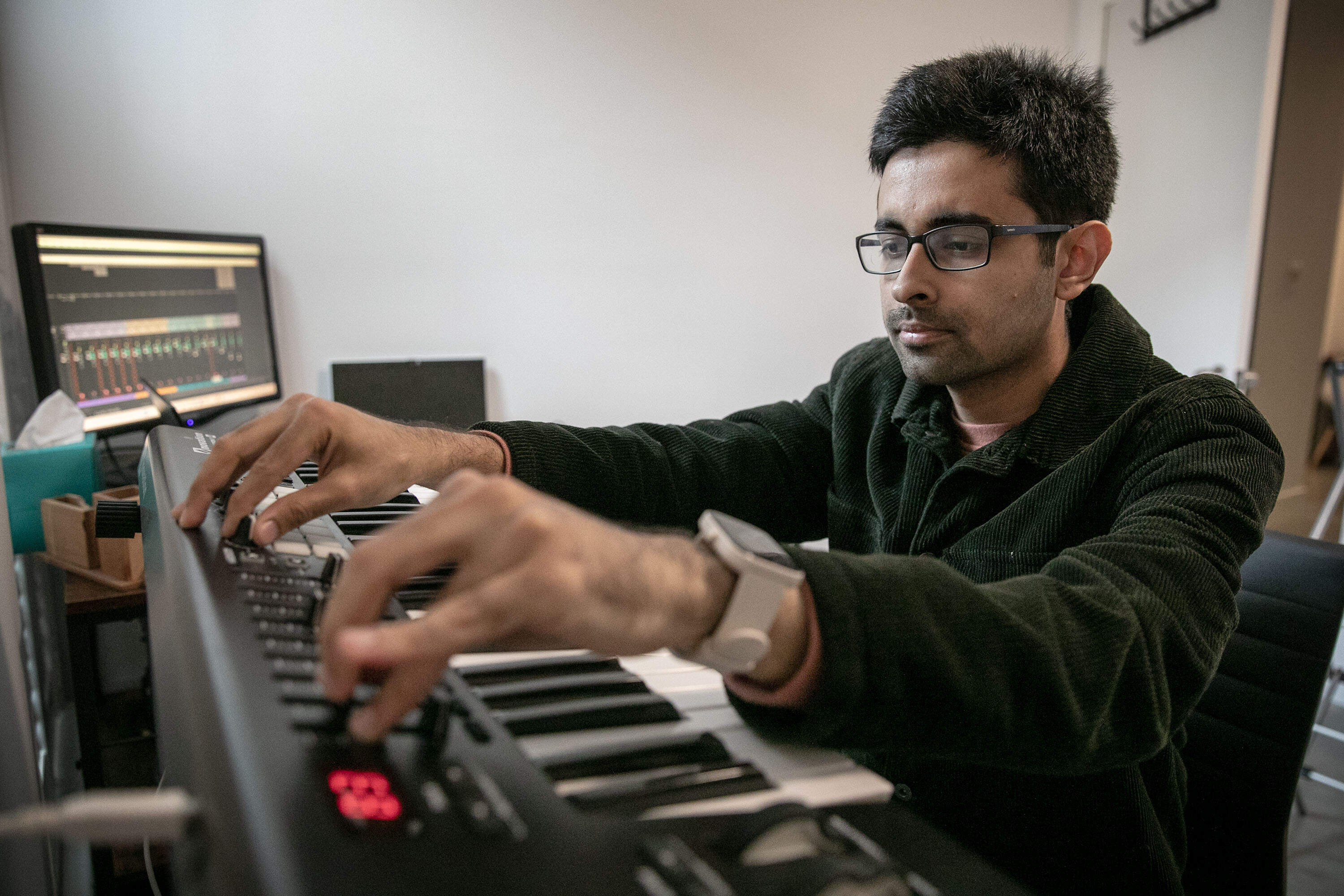
Traditional Carnatic vocals, guitar shredding and swooshing electronic syncopations often share space and build to dizzying, layered crescendos within a Project MishraM song. It’s a musical recipe that incorporates many influences, and it represents the band’s collective musical journey since its origins in 2016.
Swaroop’s own musical journey began several years earlier in Bangalore where he was born and raised. The 27-year-old remembers hearing recordings of classical Carnatic singers, such as Puttur Narasimha Nayak, played on repeat when he was growing up. “There used to be a temple opposite to my house and they would play those songs every morning,” Swaroop said. “So I memorized all of those songs and I would sing along.”
His parents recognized his passion for music and enrolled him in violin lessons while also encouraging him to focus on science in school. It’s a balance that Swaroop has managed to maintain throughout his education and professional life. “Having a background in music has helped me in technology, and having a background in technology has helped me with producing music,” he said.

Swaroop studied mechanical engineering during undergraduate school in Bangalore, and in 2016, he and his friends formed Project MishraM. The band quickly found success in its early years by participating in Indian reality competitions and touring across the country. Popular Indian singer-songwriter Benny Dayal judged Project MishraM in the Colors of Youth competition and accurately predicted that the band would “take Indian music internationally to international festivals and make us really proud.” The band toured the U.K. in 2019, stopping for an interview at the BBC and making its debut at Tech-Fest. The band performed again at the beloved (and now defunct) progressive metal festival in 2022.
In 2018, Swaroop moved to the U.S. for a master’s in music technology at Georgia Tech, then to Boston for a job at the audio and electroacoustic testing company Listen, where he merged his background in science and passion for music. As the bandmates went global, so did their influences.
“When I was in India, you only got exposed to a few types of music styles, so you thought that was the entire universe,” said Swaroop. His musical tastes expanded when he moved to Boston and connected with people at Berklee through Shivaraj, who is a student there. “Then we started thinking about the direction we would like to go with the songwriting process. It opened up my mind and it also opened up my musical perspective.”
This summer, the band prepared for its U.S. festival debut at Louder Than Life, a four-day heavy metal event in Louisville, Kentucky, not the typical venue for a global fusion band. They were selected as part of a partnership between Berklee Popular Music Institute and several festivals around the country. For Natraj, it felt like a dream. “Playing with Slayer, Kahn, Anthrax, Judas Priest — it's like, the names we grew up listening to, so it's surreal. We're still digesting the fact.”

Following the festival performance, Swaroop and his bandmates will use funds from a 2024 Boston Media Arts Empowerment Award to film a music video at The Loop Lab in Cambridge. The band will also be releasing new music in the coming months.
Outside of Project MishraM, Swaroop has played around the world as a solo violinist, at venues such as the Rainforest World Music Festival in Malaysia and the Embassy of India in Iceland, where he taught masterclasses in Carnatic music. More locally, he’s performed on stages at Berklee, the MIT Media Lab and Brighton Music Hall. He also frequently lends his talents to other Indian dance performances and cultural events in and around Boston. In 2023, he began a stint as an advisory board member of the Boston Cultural Council, a role in which he helps review applications for art grants.
“I'm trying to push for resources and opportunities for BIPOC artists in the community and also people who are performing and practicing Indian classical arts,” Swaroop said, noting that many Indian cultural events in Massachusetts take place outside of Boston, in other towns where Indian populations have congregated such as Shrewsbury, Acton, Billerica and Norwood.
Swaroop places value in art’s ability to inspire and lift people’s spirits. With Project MishraM, he aims to put listeners into a different state of mind.
“If people just forget where they are, and they completely have this new sort of experience, and that makes them feel happy,” Swaroop said, “I think that's the ultimate takeaway.”
This segment aired on October 9, 2024.