Support WBUR
Indigenous artist Jeffrey Gibson blurs the space between nightclub and ceremony at MASS MoCA
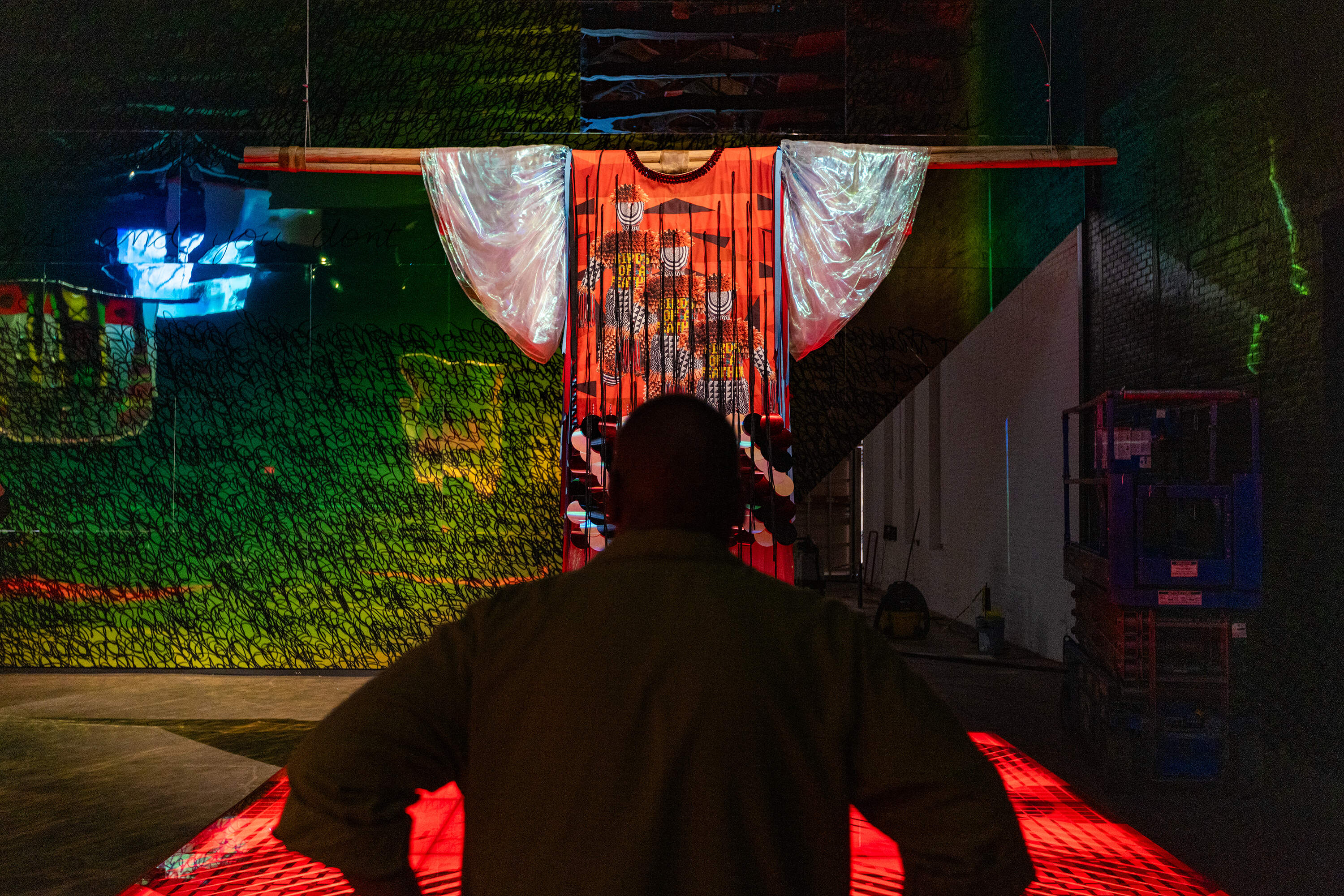
In the heart of MASS MoCA, Jeffrey Gibson has built a portal.
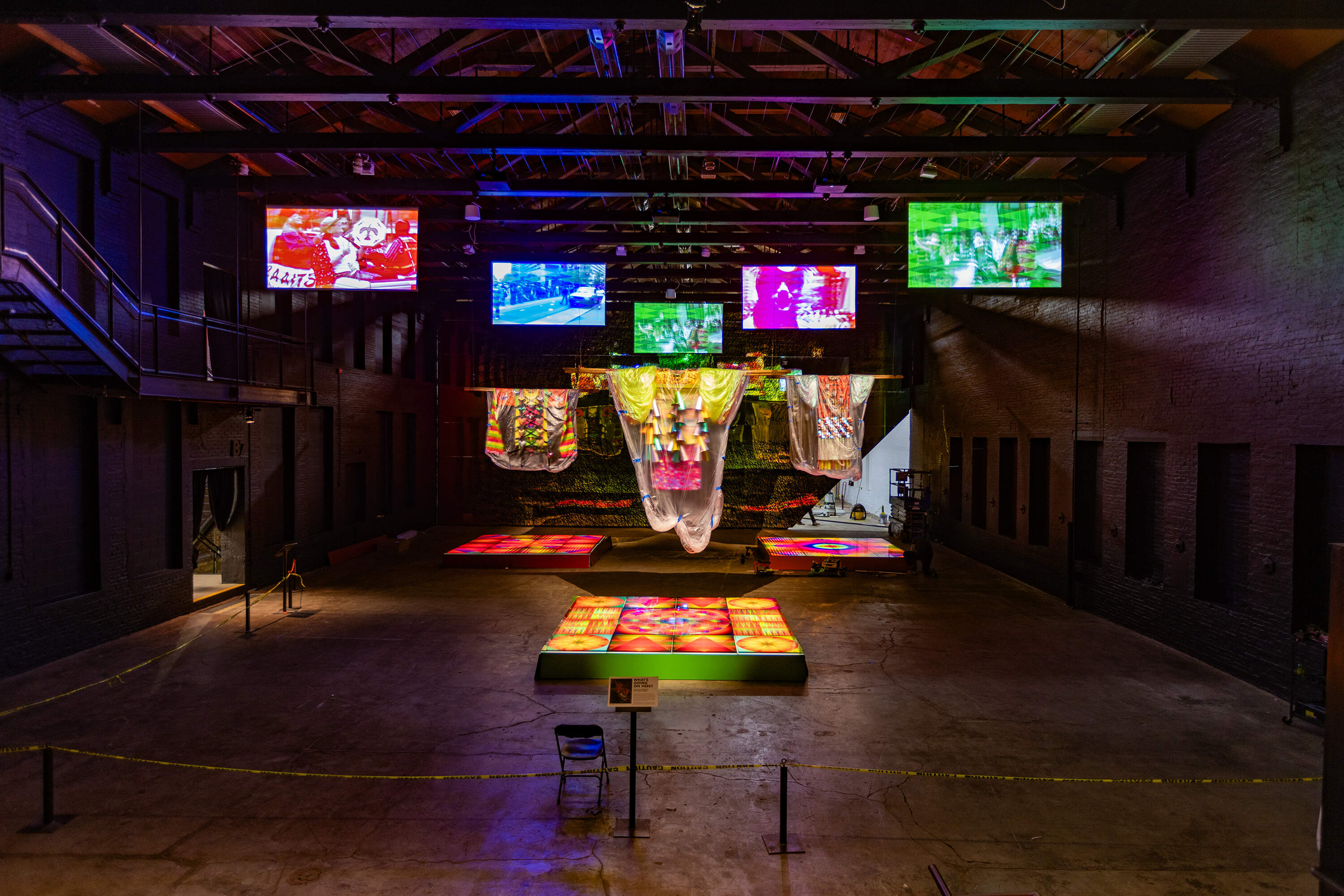
In this space that is part nightclub and part church, a kaleidoscope of experiences fill five screens suspended from the ceiling. The lives of indigenous and queer activists, drag queens, DJs, and artists reflect off a floor to ceiling mirror. The bass music vibrates in your chest.
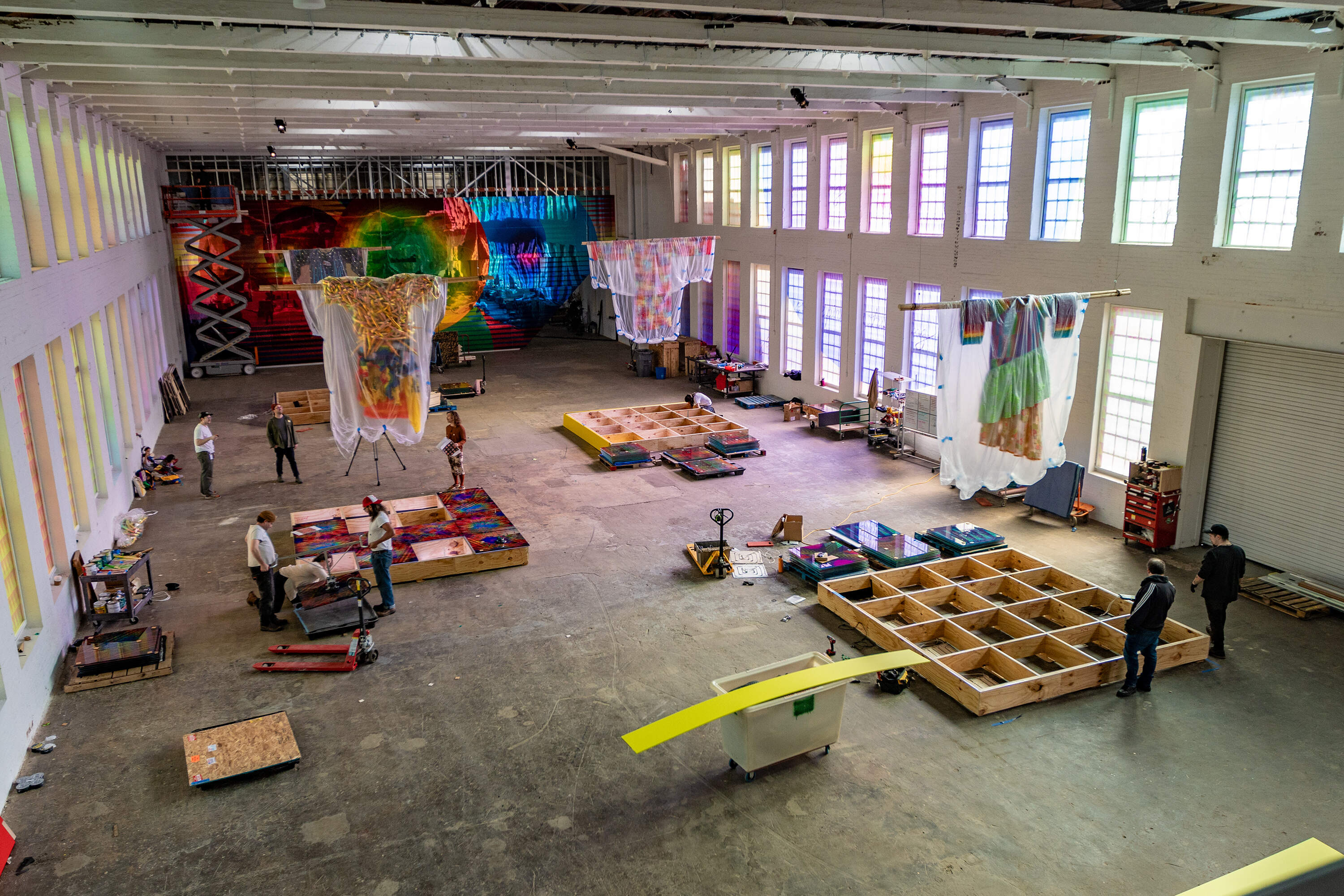
Last week, Gibson stood in the gallery as colorful stages were constructed around him.
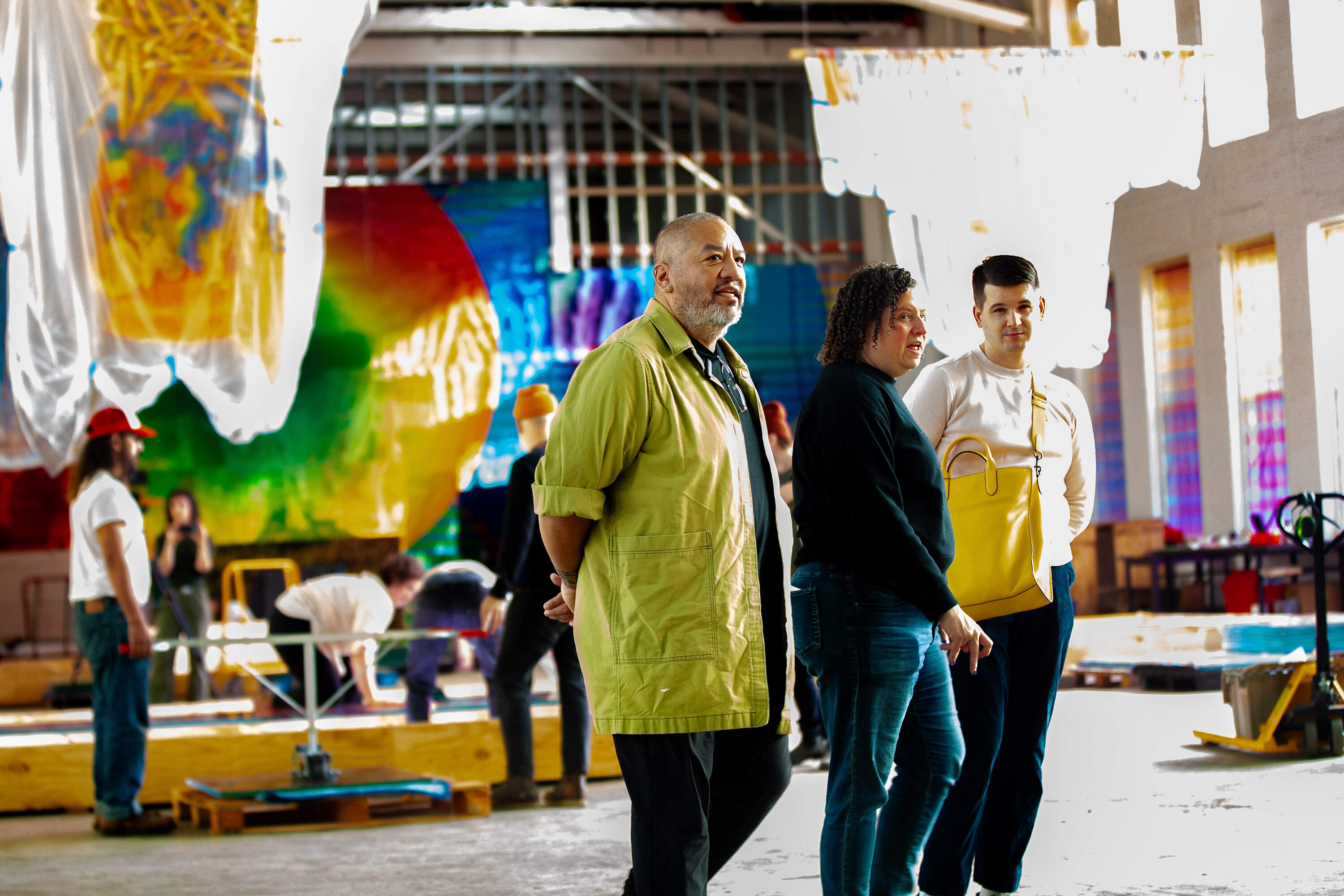
“The thing about the nightclub, which is amazing, is there's no camera pointed at you and the lights are off,” he said. “There's an anonymity that happened in my memory of nightclubs, which was very, very freeing, but also really collected you with what felt like your people.”
In Gibson’s videos, someone is eating strawberries, dancing in a field, putting on drag make-up, shaving. This is the regular, beautiful, day-to-day experience of what it means to be two-spirit.
Gibson explores this concept, present across Indigenous cultures, in which a third gender can be both, and neither male nor female. Just as portals allow passage between dimensions, Gibson sees the two-spirit identity as a portal of its own.
“You enter as one self, you experience another self, oftentimes inside of this space, and you exit a different iteration of yourself,” he said.
The artist, who’s the first ever Native American to represent the U.S. at the Venice Biennale, is a citizen of the Mississippi Band of Choctaw Indians and half Cherokee. Gibson uses videos, technology, and color to explore the intersection of Indigenous and queer identities. In September, he painted a richly colored and symbol-laden mural on the Rose Kennedy Greenway near South Station.
Now he’s created a whole immersive experience. Gibson’s multimodal art celebrates that which is indigenous, that which is queer, that which is beautiful in its infinite and colorful differences. Gibson spent the last month directing the installation of this immersive experience called “POWER FULL BECAUSE WE’RE DIFFERENT.”
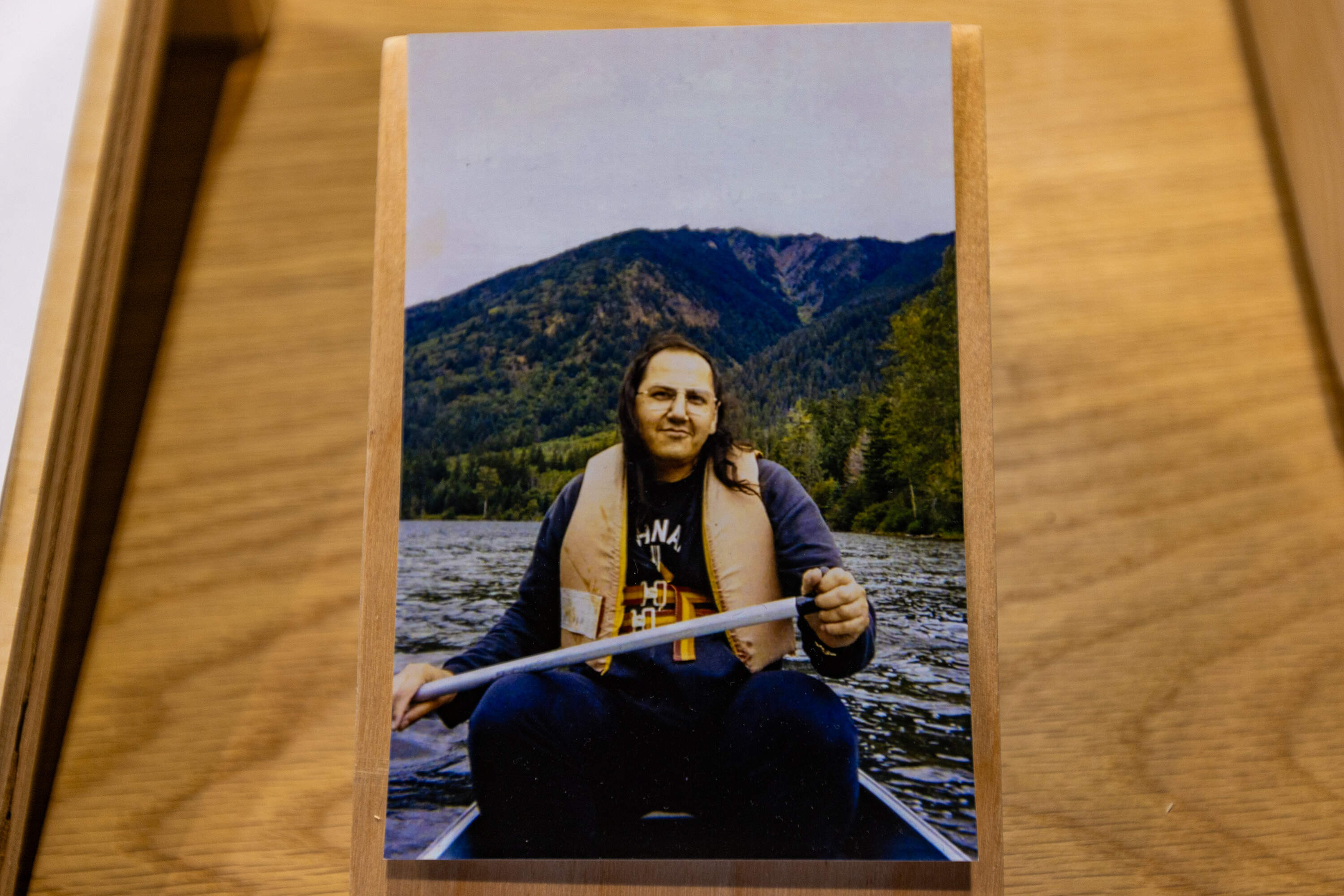
The exhibition draws inspiration from an early ‘90s documentary about two-spirit people and from deep conversations with Albert McLeod, a two-spirit elder from Winnipeg, Canada.
“I think that’s why these artistic exhibits are so important because they create a sacred space where everything can exist in balance and we don’t have to explain,” McLeod said.
McLeod says two-spirit beings have always existed across tribes under different names, some original words lost to history and colonization.
Indigenous two-spirit couple, powwow dancers, and activists Sean Snyder, 36, who is Navajo and Southern Ute, and Adrian Stevens, 29, who is Northern Ute, Shoshone Bannock, and San Carlos Apache, are featured in Gibson’s work.
“It's definitely not biological,” Stevens said. “It's spiritual and it's having that spiritual connectedness to whether it be more masculine or feminine. It's being able to be operative in both spaces.”
Across the exhibition hall, the feeling is immediately lighter. Sixty tall windows are covered with vinyl patterns, which let in natural light and emanate into a rainbow prism like stained glass across the concrete floor. The walls are scrawled with Gibson’s handwritten messages.
“I will continue to change, speak to your ancestors.”
“I am haunted by you, your spirit whispering in my ear.”
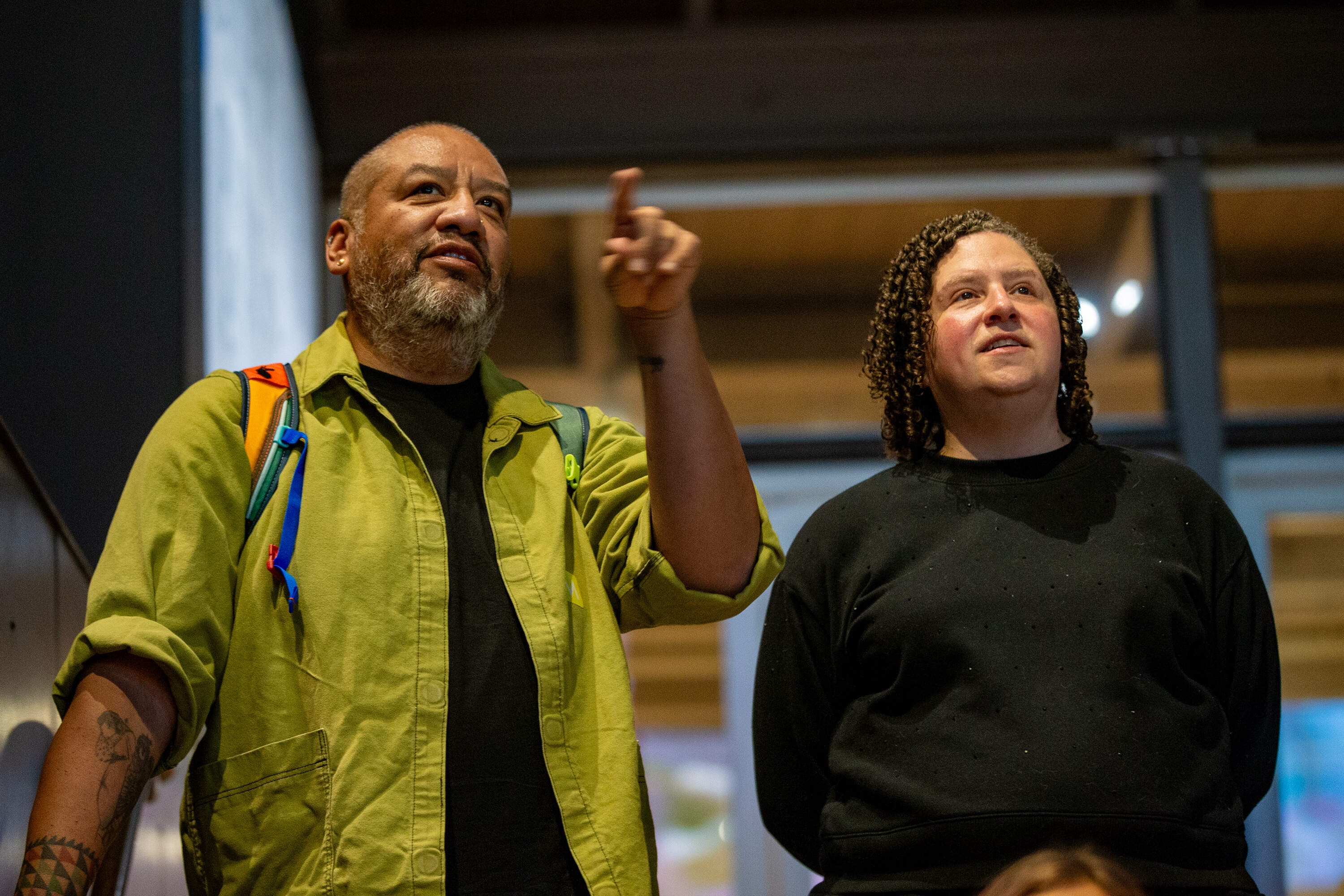
MASS MoCA chief curator Denise Markonish says she and Gibson have been talking about this exhibit for years. In all her time at the museum, she’s never seen an artist divide this gallery — the size of a football field — to create such disparate experiences.
“And just the way it so radically shifted how the space feels, it fills it with this pastel light that feels so soft,” she said. “It's very calming.”
There are consistent markers throughout Gibson’s work. The encompassing of two worlds, club culture and the ceremonial. Use of traditional materials like beading and ribbon and jingles from powwow regalia. The psychedelic color palette with geometric shapes.
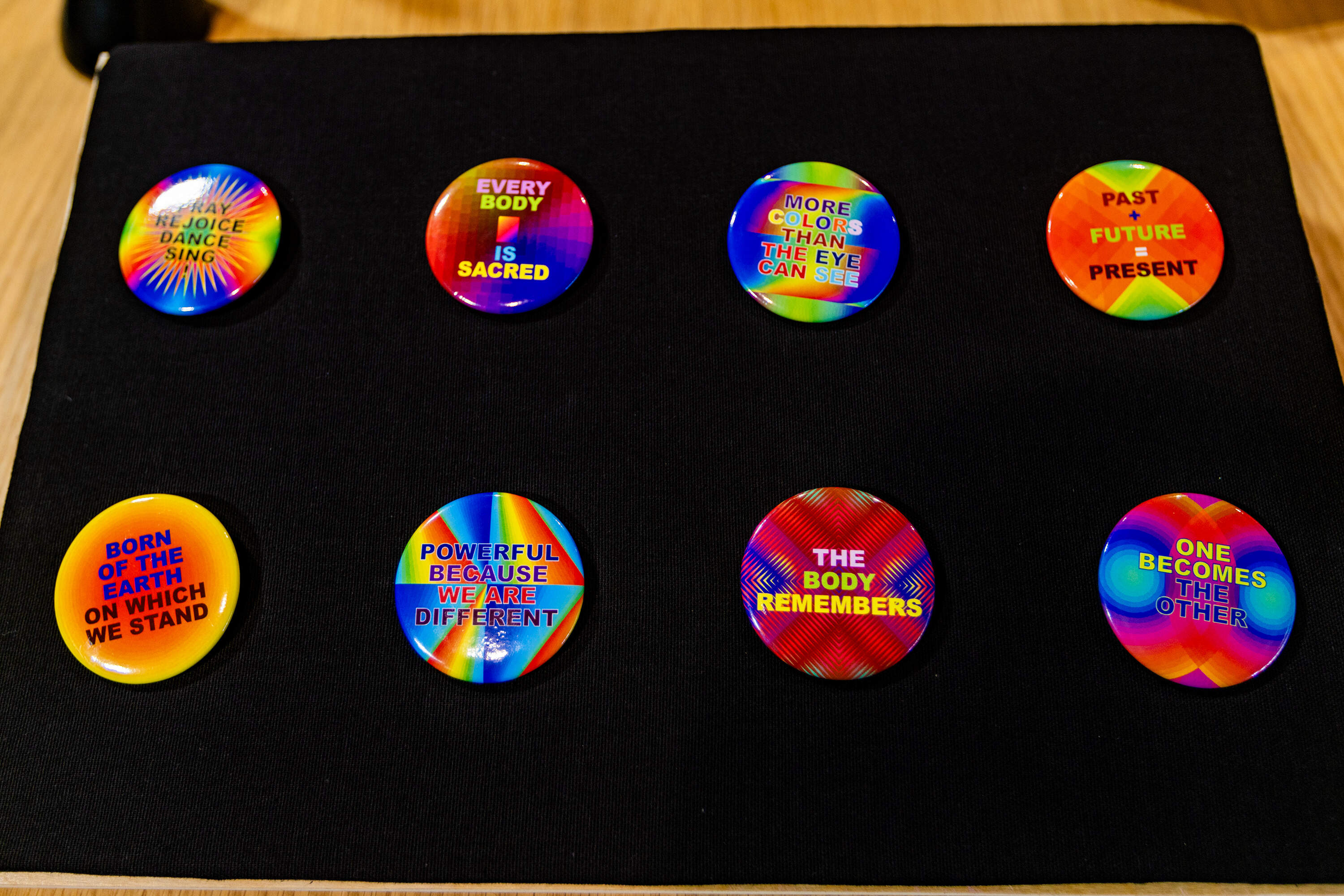
“I have so much experience, so many years of working with color. I know how to make it activate, Gibson said. “I can calm it, I can slow it, I can speed it up, I can make it vibrate. I feel really, it's really like music. It's like I can orchestrate color” .
And he does, in a video at the end of the exhibition where he dons seven glorious glittering garments. Those garments also hang throughout the gallery on tipi poles. The video is an ecstatic vision of Gibson in heavy makeup, playing up the camp and the glory and the cacophonous with a soundscape he composed of dozens of instruments.
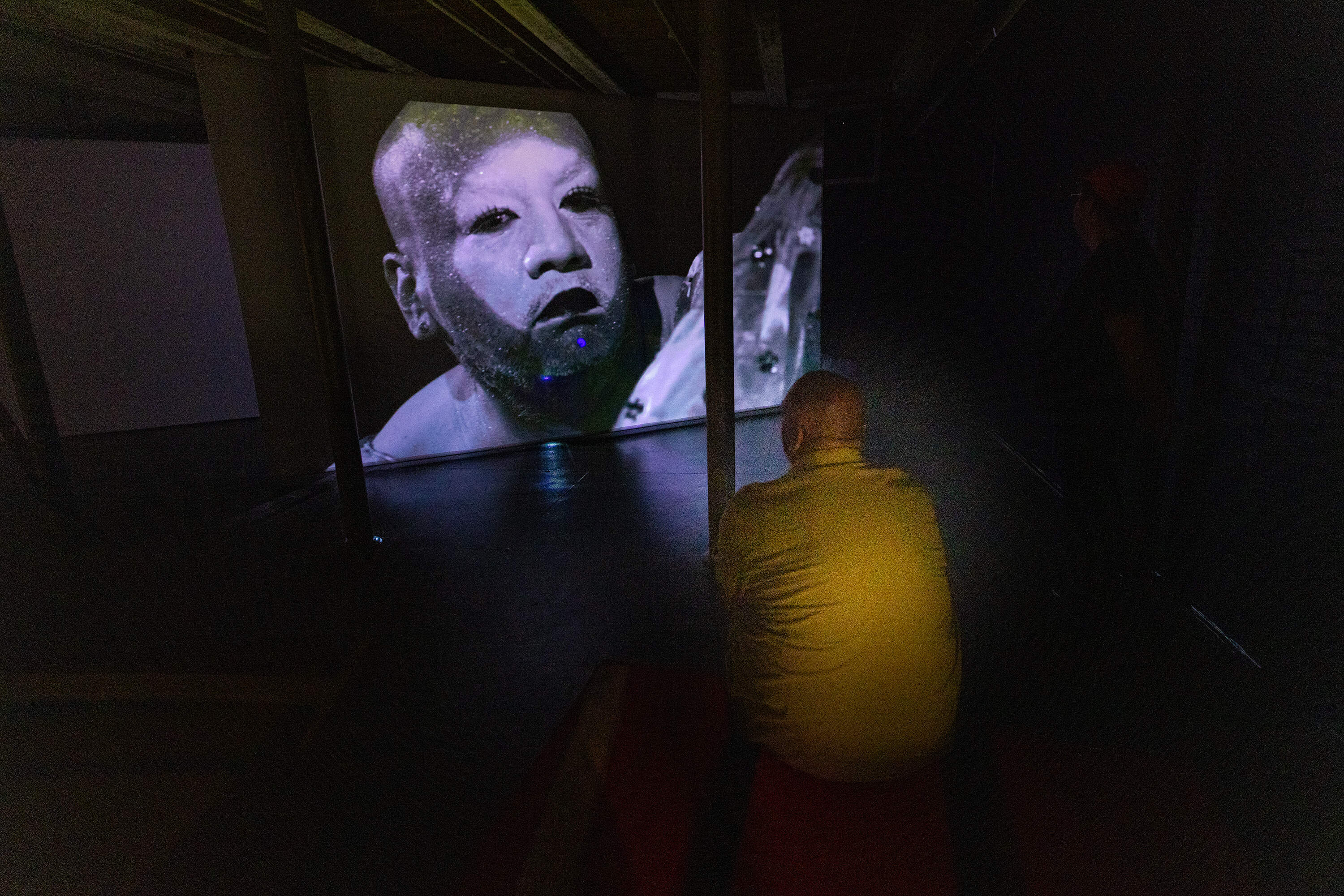
“When I think of it visually, he is often playing with tropes of art history,” Markonish said. “He's looking at modernism and minimalism and kind of hard edge geometric painting, but what he's doing at the same time is he's looking at that through the lens of indigeneity.”
The video pays homage to a performance art icon named Leigh Bowery, from whom Gibson draws influence and sees as a kindred spirit.
In 1988, Bowery spent a week living behind the street-facing windows of the Anthony D’Offay Gallery in London. Bowery faced a one-way mirror, unable to see his audience, but fully aware of their presence. He preened and posed while trying on costumes. It interrogated the idea of what it meant to see yourself while also being seen.
“What he did was drag, but it was twisted drag, and it was culturally informed drag, and it engaged in camp but it also really engaged in what I would say is like political camp,” said. “It had a real point of view, which was oftentimes very punk about disrupting the status quo of the LGBTQ community of the time. It was not meant to make you feel comfortable.”
Gibson’s video has no words, just a euphoric energy emerging from the footage. The way Gibson spins and moves is almost meditative, lost in the color around him. Each garment louder than the last, each channeling the spectacle, while at 52, perfectly comfortable in his own skin.
Jeffrey Gibson’s exhibition "POWER FULL BECAUSE WE’RE DIFFERENT" is on view at MASS MoCA through May 2025.