Support WBUR
Boston's Morning Newsletter
How warmer winter waters are creating new pitfalls for Massachusetts oyster farmers
Editor's Note: This is an excerpt from WBUR's daily morning newsletter, WBUR Today. If you like what you read and want it in your inbox, sign up here.
The search for survivors continues after last night’s horrific collision between a passenger jet and Black Hawk helicopter outside of Washington, D.C. Ronald Reagan Airport remains closed this morning, and over two dozen flights to Boston’s Logan Airport have been canceled. NPR has the latest updates on the crash here.
There’s more below on all the national news from yesterday, including the Trump administration’s partial walk-back of its federal grant freeze and RFK Jr.’s contentious Senate confirmation hearing.
But first, let’s take a break to talk about oysters.
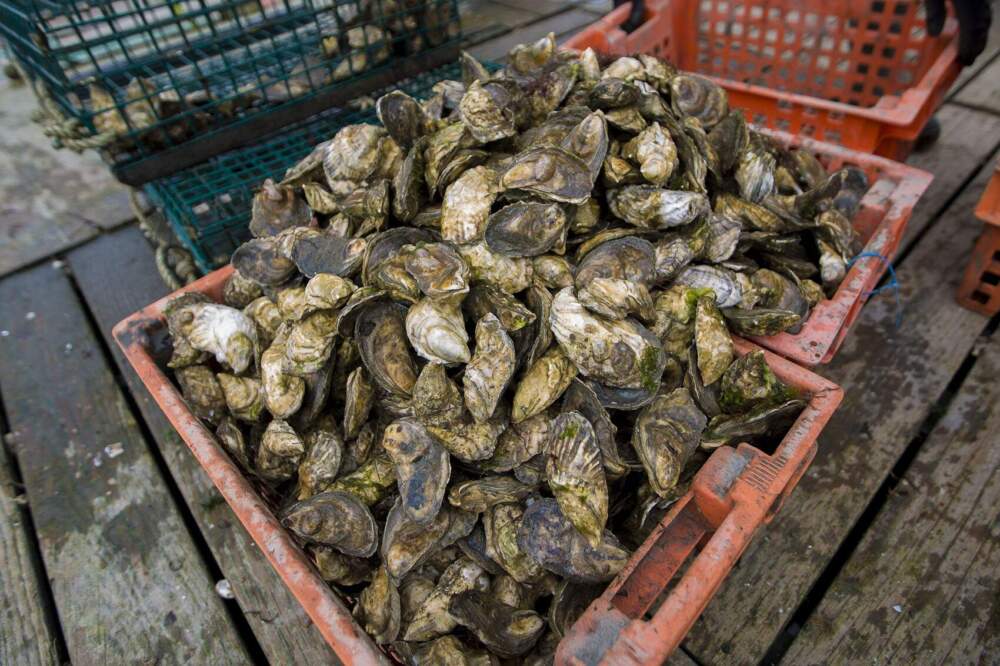
Oyster farming pit-falls: You may want to slurp on oysters in the summer, but it turns out winter is peak season to eat them at their best. As WBUR’s Amanda Beland reports, the saltwater shellfish are at their most plump and sweet in the winter, thanks to a tasty molecule called glycogen. (Oysters build up and rely on glycogen for sustenance in the winter, when they become dormant and stop eating.) Unfortunately, winter is also becoming harder than ever for many oyster farmers, thanks to a myriad of challenges brought by climate change.
- Zoom out: A common practice for local shellfish harvesters is to pit their oysters in the winter to protect them against ice damage. This means taking oysters out of their watery homes once they’re dormant and putting them in offsite storage until the spring. Roughly 60% of oyster farmers in Cape Cod Bay pit their oysters, according to Josh Reitsma, a fisheries expert with the Woods Hole Oceanographic Institution. But warmer winters and fluctuating temperatures have not only made it difficult for them to determine when to pull out and store the oysters, but whether the oysters are able to stay fully dormant during the weeks-long process. (Oysters can die if they’re pitted without being fully dormant.)
- Zoom in: Andrew Cummings, who’s been harvesting oysters in Wellfleet for three decades, says warmer water temperatures over the years have made pitting an uncertain, risky call. During the 2022-2023 winter, Cummings said he hadn’t pitted his crop because it was a warmer winter, so he wasn’t sure they were dormant enough to move. But when a winter storm that would produce ice was coming, Cummings said he “had to gamble” and pit them last-minute. He says he ended up losing roughly 60% of his inventory, costing him well into the six figures. “It was the thing where I’m gonna lose some animals pitting, but if I don’t, I’m probably going to lose everything,” he said. Luckily water temps have stayed cold this season, but Cummings says the overall instability season-to-season remains a stressor: “ You’re literally like, ‘am I going to have my career next year?’”
- Meanwhile: Climate change also means heavier rainfall and more combined sewer overflows in Massachusetts, which can lead to temporary harvesting bans. Last year, the state closed portions of the coastline — from Boston Harbor to Buzzards Bay — roughly three dozen times to shellfish harvesting due to sewage-related reasons (a notable jump from 17 in 2023 and eight in 2022). A new study also found that higher carbon dioxide levels are making oceans more acidic, which may affect the sex of oysters.
Local legal experts are raising concerns about the first law enacted by President Trump in his second term: the Laken Riley Act. The new law, signed by Trump yesterday, expands the scope of those who can be arrested and deported by federal immigration officers.
- Specifically, the law allows ICE to detain and deport people without legal status who are arrested for even minor crimes — and it bypasses the current practice of waiting to see if the person is convicted before beginning the deportation process. Dan McFadden, the managing attorney at the ACLU’s Massachusetts branch, told WBUR’s Deborah Becker that potentially deporting someone “with no due process based solely on unproven accusations” would violate their constitutional rights. He said the organization plans to closely monitor how the law is implemented.
- Go deeper: NPR reports implementation could also be a challenge; ICE has said it would need $26.9 billion to enforce the law.
- Meanwhile on Beacon Hill: With the Trump administration stepping up deportation efforts, some immigrant advocates are again pushing for a statewide law to limit how much local police could assist federal immigration officers. WBUR’s Mira Donaldson and Jesús Marrero Suárez have more on the rally yesterday at the State House.
P.S. — Yesterday marked the beginning of Lunar New Year, but the celebrations aren’t done yet. Chinatown’s streets will come to life on Feb. 9 with drums, cymbals and lion dancers for the Chinese New Year Parade. Before you go, learn about the history and tradition of the lion dance in Boston in this episode of The Common.