Support WBUR
Testing the limits of 'Impossible Music' at Tufts
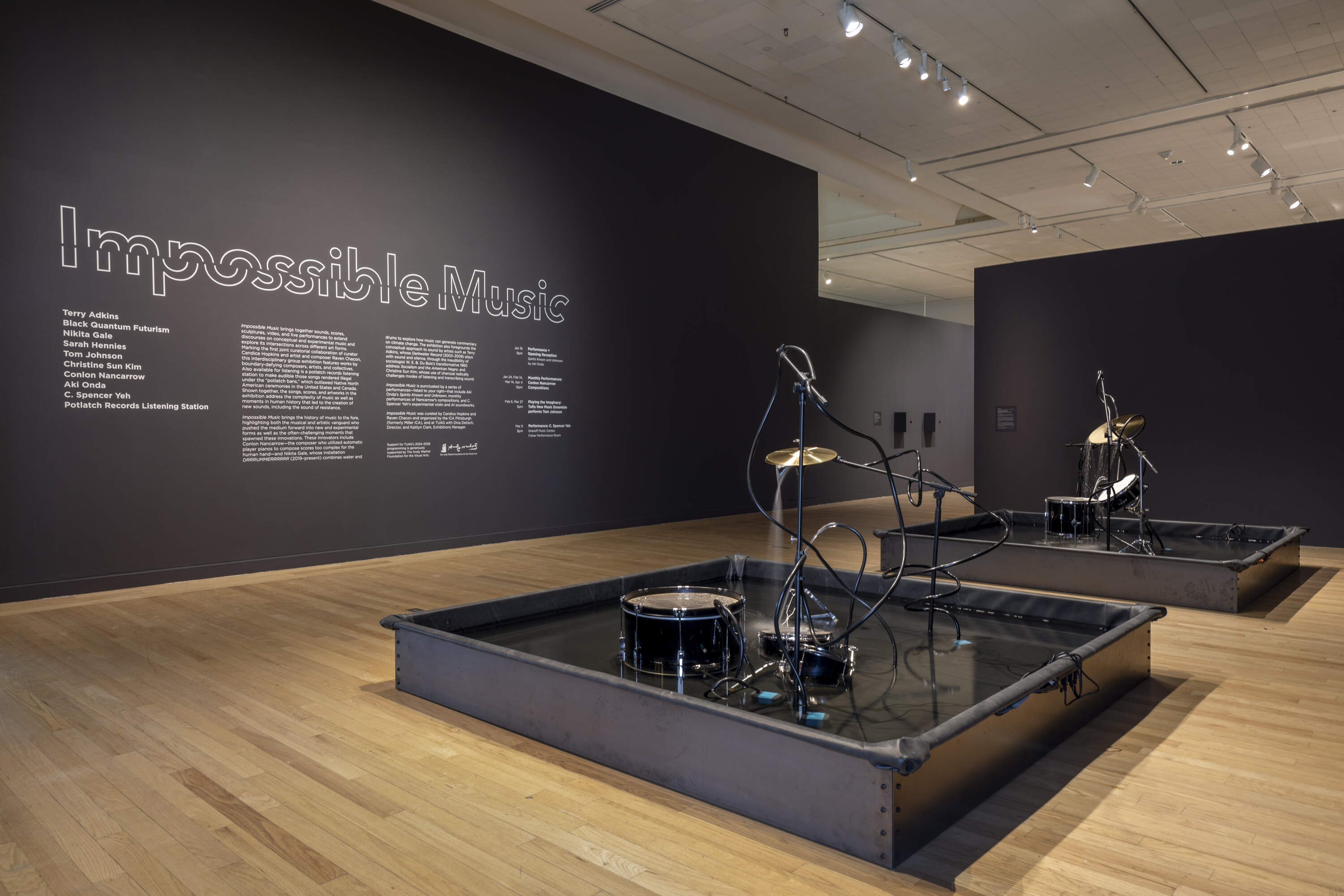
A striking display distinguishes the entrance to Tufts University Art Galleries’ new exhibition “Impossible Music.” The eyes are immediately drawn to a pair of water basins, and standing erect within them are drum sets, complete with brass cymbals. Streams of liquid drip from the instruments, creating a sound of soft trickling, though there are no human beings physically present to produce this subtle music. Instead, artist Nikita Gale, in this work titled “DRRRUMMERRRRRR,” asks viewers to envision a post-apocalyptic world where climate change has led to rising sea levels and eradicated much of life as we know it. Here, nature serves as the musician, while the performer is absent.
In “Impossible Music,” running through April 20 at the Aidekman Arts Center in Medford, spectators are guided into inquiring, “What makes music possible? What makes it impossible?” These questions inspired curators Candice Hopkins and Raven Chacon to create the exhibit exploring what defines and shapes our very concept of music, and what its boundaries are.
“In developing the exhibition, we initially thought about difficult music, virtuosic music, music that is very hard to play,” said Hopkins. “There are some scores that were written to be impossibly fast, that a human being can hardly perform. We thought about ceremonial songs that had been banned from being listened to, and situations where the musician might not even be a living, breathing person. In putting together the show, we wanted to explore what the limits of music are, which we have imposed upon ourselves.”
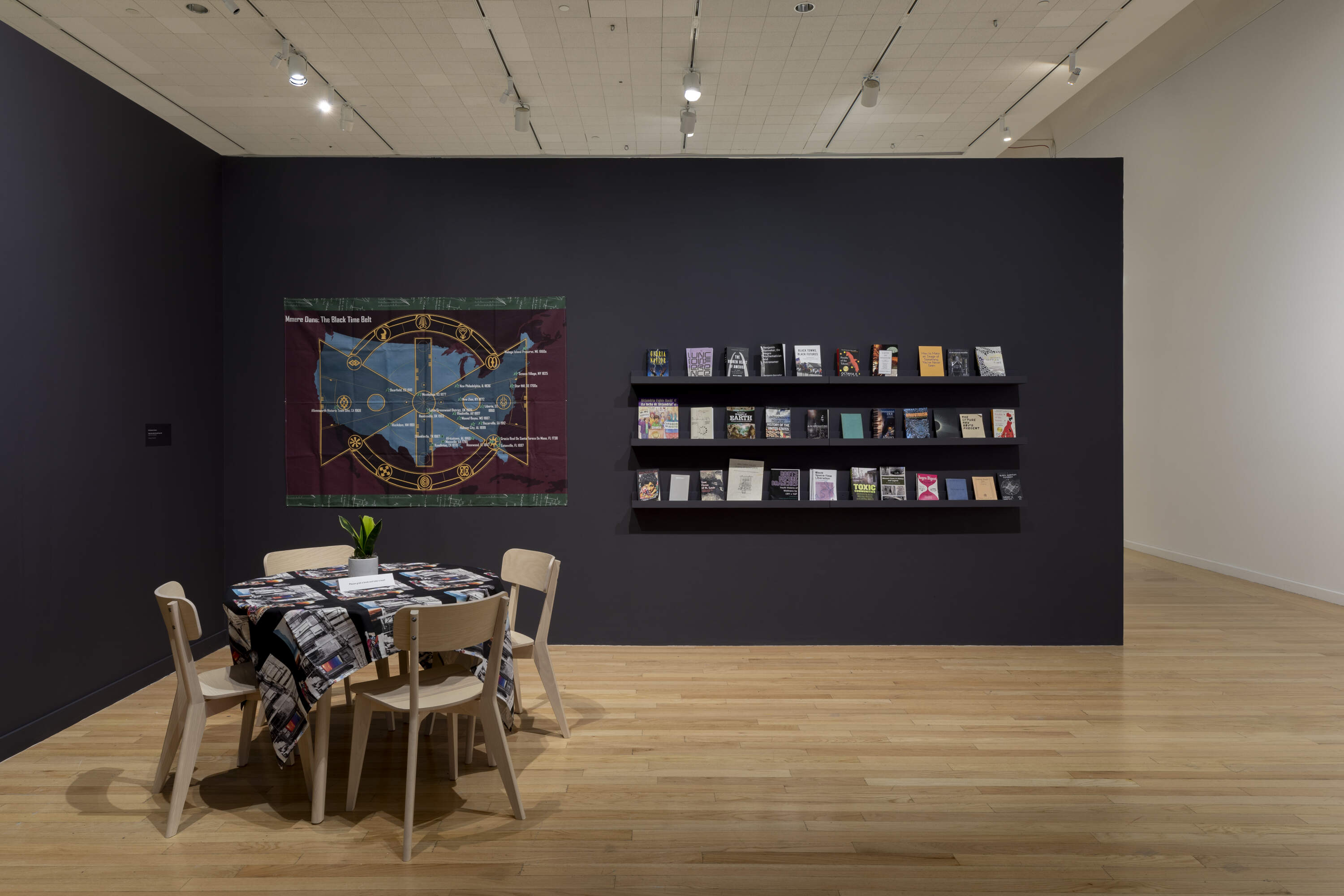
The show features works from the collective Black Quantum Futurism, whose “Mmere Dane: Black Time Belt” serves as a map that shows historic all-Black towns and Freedom Colonies, many of which have disappeared because of displacement and forms of injustice or violence. By representing this network, the artists seek to reimagine a different kind of reality where Black communities might have persisted. Nearby is a set of listening stations where soundscapes have been created to correspond with points on the map.
Around the corner are pieces that engage with the idea of silence. Terry Adkins’ “Darkwater Record” features a porcelain bust of Mao Zedong atop five recorders. These play W.E.B. Du Bois’ speech “Socialism and the American Negro,” a commentary on capitalism, according to text on the wall nearby. Yet, audiences cannot hear his delivery — there are no speakers. Instead, we can only observe the cadence of his voice, related through the movement of needles tracking his speaking patterns. There is still power in the soundlessness of his words. Artist Christine Sun Kim, who is deaf, strives to put the experience of anticipation into charcoal notations of music, in a work called “Six Types of Waiting in Berlin.” Waiting can be a form of silence — a state where there is no activity — and Kim gives meaning to the way that we experience that void.
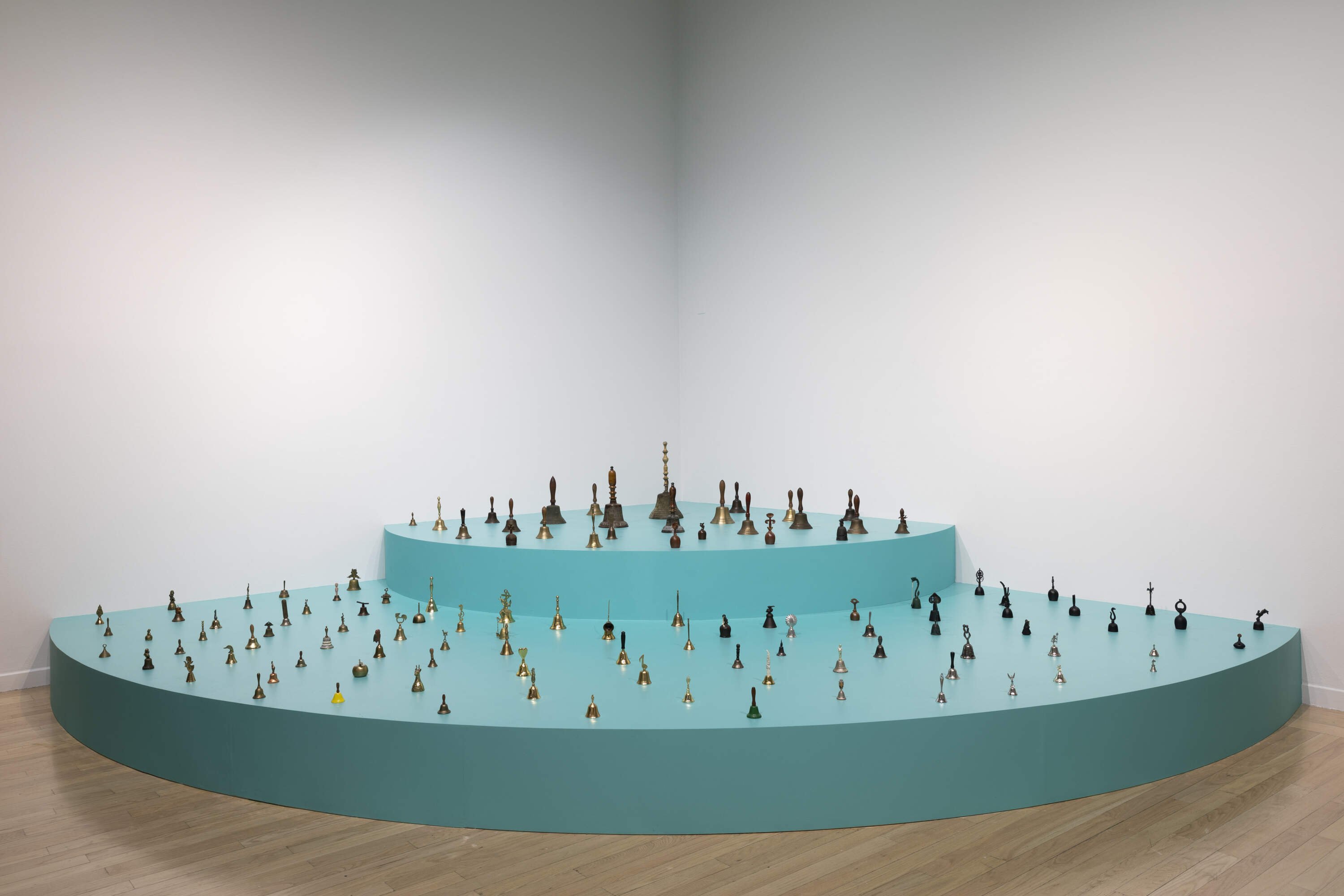
The show evokes a kind of minimalism, with little use of bright color, except for the burst of turquoise in Aki Onda’s “Spirits Known and Unknown.” His installation features an assemblage of brass bells found over the years at flea markets, antique shops and online. Bells are hardly used today, and yet they hold so much weight, he said. Over time, they have been used to call upon spirits, while connecting the owner to former ringers and carrying historical significance — they are almost obsolete in modern life, Hopkins said. To Onda, they can bridge different worlds, linking us to realms that we cannot see.
“I am always interested in the physical presence of artwork. But at the same time, I am also interested in the energy, psyche, and memory of the object,” said Onda. “Those are invisible layers. These are old found bells, used by different individuals in different societies, in the past. So ringing or imagining those bells recalls messages from the past.”
Other works ask us to consider music that is impossible because it has literally been repressed from society. At the Potlatch Records Listening Station, “An Anthology of North American Indian and Eskimo Music” is presented in the form of a record player with two sets of headphones. Visitors can hear four songs recorded by Ida Halpern that were deemed illegal because of the Potlatch Ban in Canada. Potlatch ceremonies, occasions of feasting and gift-giving, traditionally important spiritual traditions in Native cultures, were outlawed from 1885 to 1951, in an effort to assimilate Indigenous people into Christian society.
Stepping into a side room, the video “Contralto” by artist Sarah Hennies screens. In the film, a group of transgender women are singing, performing vocal exercises, and giving testimonies about incongruencies relating to identity. The film explores the fact that when a transgender man takes testosterone, his voice will deepen. Conversely, a transgender woman’s voice will not change or reach a higher pitch when estrogen levels in the body increase.
“I view ‘Contralto’ through the lens of impossibility in that trans women are placed in an impossible position in society. We are under intense societal pressure to look and sound like cis women, but then are called fake women for our attempts to adhere to conventional standards of femininity,” Hennies wrote in an email. “I believe we should instruct trans women to find the voice that is most comfortable for ourselves, which is a complicated and highly personal process that is different for everyone.”
“Impossible Music” captures so many different facets to sound, song and speech that for whatever reason may seem improbable, opening our understanding of what it means to hear. There’s music that articulates things that cannot quite be said. There’s music that achieves feats that seem astounding, that accomplishes miracles. And there’s music that, because of the constraints of our social worlds, simply falters. Yet here, it exists.
"Impossible Music" is on view through April 20 at Tufts University Art Galleries.