Support WBUR
A Boston guitarist's optimistic soundtrack for the internet

If you’ve spent any time scrolling through the infinite algorithmically generated short-form video on social media, you’ve likely come across Evan Lo’s music. Characterized by soaring guitar tones and recursive riffs, his music has become the essential soundtrack for a corner of the internet dubbed “hopecore.”
Appearing suddenly on TikTok in 2023, hopecore videos — highly-stylized and sentimental montages edited together to evoke grand emotions — were everywhere for several months, and almost each one used Lo’s music published under the moniker Flawed Mangoes.
“It’s funny to see them and be like, ‘Oh, that’s my song,” Lo says. It wasn’t his intention to spawn a viral genre of video content when he began posting snippets of song ideas that he recorded in his Cambridge bedroom, where he was living at the time. “But it makes sense,” he observes. “I’m trying to evoke very strong emotions.”
And he has succeeded. Equally bitter and sweet, inspirational and depressing, Lo’s music has proven steadfast in an online world where everything quickly fades into obscurity. Even as the hopecore trend has warped into the post-irony-poisoned “hopelesscore,” Flawed Mangoes remains a household name for the terminally online. His snippets have turned into full songs and viewers have been converted to millions of dedicated listeners.
The popularity led to an appearance on Kai Cenat’s Twitch stream, an uber-successful creator who regularly pulls in over 60,000 concurrent viewers. Lo, understated and quiet, appears mid-stream with his old guitar in hand. “I’m here to play some music,” he says. Cenat and his co-hosts are confused, but as Lo begins playing the chords to “Swimming,” instant recognition Dawn's on their faces. Backed by Lo’s performance, Cenat and guests start sharing the inspirational stories of their rise to fame. Even Lo takes a moment to speak.
“Never doubt your own potential,” he tells the audience, and it’s easy to believe him. Just four months prior, he signed a record deal and left his day job. After a lifetime of dreaming of becoming a musician, he had arrived.
Growing up in an Asian American family in Newton, Lo’s parents forced him into piano lessons. “A very typical Chinese family thing,” he explains. “I definitely didn’t appreciate the music then.”
But in middle school, Lo began to find joy from the likes of Green Day and Red Hot Chili Peppers, which led him to pick up the guitar. Pretty soon, he was playing in bands with high school friends.
When it came time for college, Lo enrolled in an audio engineering program in Rochester, New York. “It was my way of reconciling that I wanted to be close to music, but also get a real job to make my parents happy,” he remembers. Separated from his high school bandmates, Lo turned to solo material, honing a bedroom recording technique that required little more than a computer. Those tracks — vibey electronic music posted under the name Fla.mingo — got some traction, but not enough to drop out, Lo felt.
Out of college, Lo briefly considered striking out to Los Angeles to pursue music. Instead, pragmatism brought him back home for an engineering job at Bose. The return came with some mixed feelings. Lo was heartbroken by the end of a long-term relationship, but at the same time was surrounded by old friends and his family.
Old memories collided with uncertainty about the future, and Lo realized that music had fallen to the wayside as he committed to his engineering career. “It felt like a dream that never happened,” he says. In this emotional milieu, Lo started messing around on his old guitar again, the same one that he and some friends installed a janky killswitch into with a utility knife and some duct tape. A little trigger in the guitar’s body, the killswitch allows Lo to suddenly cut the signal coming from the guitar to the amp. This is what inspired “Killswitch Lullaby” which he first posted in July 2023, one of his first songs to go viral.

Looking back, the old hopecore aesthetics and his emotional state at the time mirror each other. “It was a period of personal change,” he explains. “I was rediscovering stuff about how I wanted to live.”
His childhood friend, Rauf Sunyaev, who also does the artwork for many Flawed Mangoes projects, observes that corner of the internet was also perfectly suited to Lo’s personality. “He has this calming presence,” Sunyaev explains. “It’s cool to see that translated into music.”
These days, with TikTok’s future in the balance, Lo is focused on more conventional musical pursuits. At his new Allston apartment overlooking Commonwealth Avenue, he’s putting the final touches on an as of yet unnamed upcoming full-length album. The recording space — although it’s not technically a bedroom anymore — is bare. A handful of guitars rest on a rack and a few cheap-looking MIDI controllers and synthesizers are scattered about. He feels uncomfortable in a professional studio, he says. “It’s pretty odd and overwhelming.”
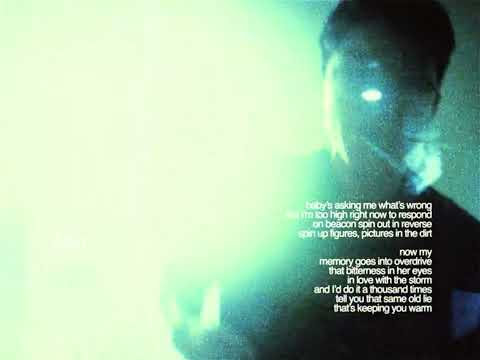
The album will be released in batches every month, part of a strategy to keep the audience engaged and to game the streaming platforms that encourage consistent uploads. The first batch of tracks were released on Jan. 29 and boast a familiar sound with one notable exception: “mk4.” The lead guitar has an almost country twang, something you might hear on a Neil Young record, and it’s grounded by drums played and recorded by his Bose colleague, Jonathan Zonenshine.
Their collaboration began casually before Lo quit the company. He showed Zonenshine some demos that he wanted drums for. “I knew enough about his music to hear that this was a big departure,” says Zonenshine. “It’s a rock song,”
Most notably on “mk4,” Lo is singing. His voice is a surprisingly grungy callback to the pop-punk of his middle school days culminating in a belted line: “Now my memory goes into overdrive.” It’s the perfect encapsulation of Lo’s brand of ultra-nostalgia: reverent of the past, but somehow in motion, both forward and backward.