Support WBUR
What's the next frontier of housing reform in Mass.? A state commission has some ideas
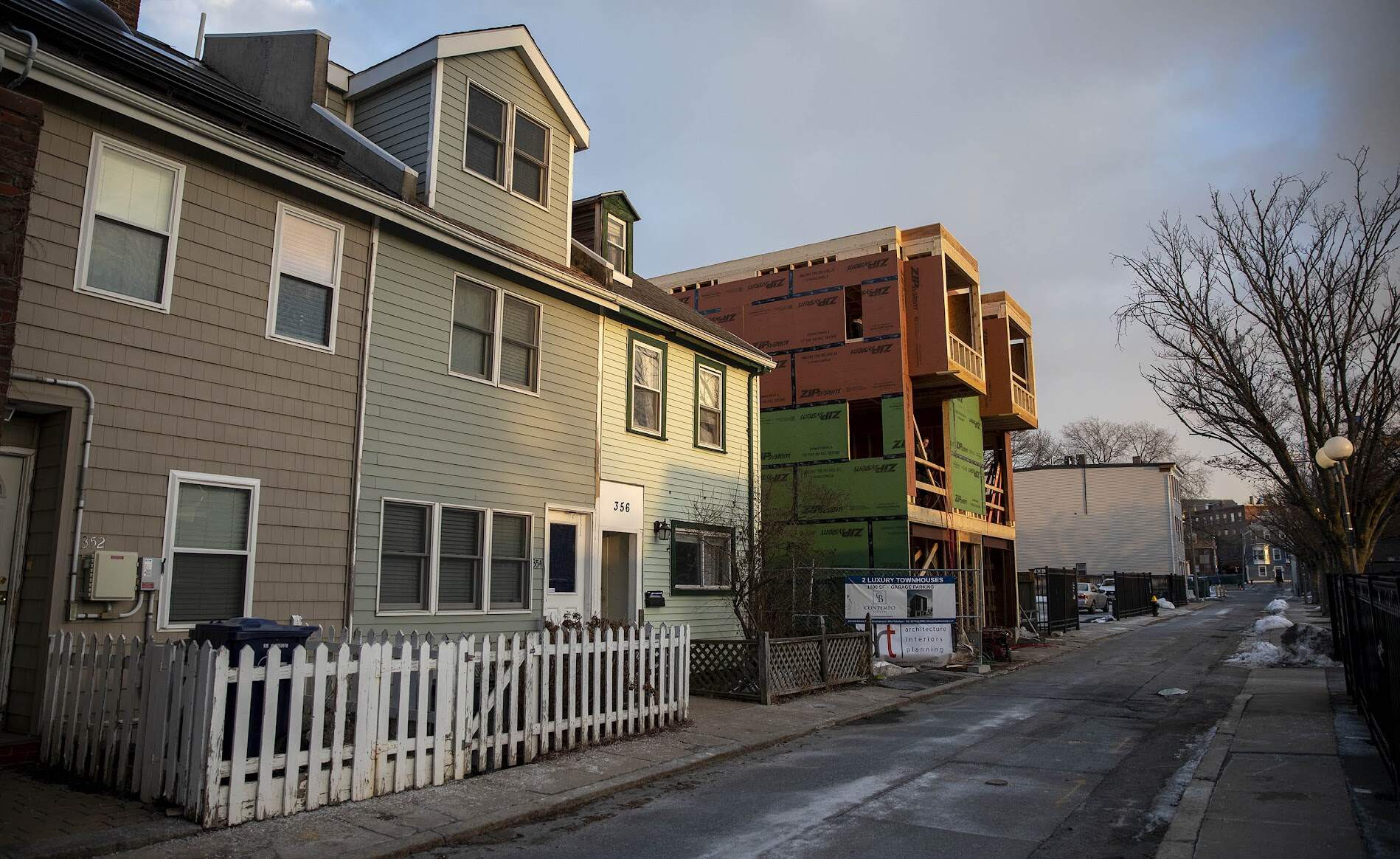
Last year, Massachusetts passed a law that top elected officials characterized as “the largest housing investment” in state history. It authorized billions of dollars in borrowing to spur housing construction, made it easier for property owners across Massachusetts to build additions on their homes and expanded tax credits to incentivize development.
However, Gov. Maura Healey says the state shouldn’t stop there.
After a year of work, a commission created by Healey — officially dubbed the state’s Commission on Unlocking Housing Production — released a 108-page report Friday with more than 50 policy recommendations to increase the housing supply. It follows a recent estimate from Healey’s office that suggests Massachusetts needs 222,000 more units of housing by 2035 in order to address the shortage driving up the market. (That’s a 7% increase from the current number of housing units across the state.)
Massachusetts housing costs have risen to among the highest in the nation — particularly in the Boston area — thanks to several decades of sluggish home construction. According to the commission’s report, buyers now need to earn “at least $215,000 to afford a median-priced home in Eastern Massachusetts.”
The commission noted throwing money at the shortage isn’t enough to solve the problem, and called for several sweeping changes to how housing is regulated by cities and towns.
“Without significant zoning and regulatory reforms that maximize the impact of available state funding, housing production will remain slow, unpredictable, and insufficient to meet resident demand,” the commission wrote.
Here are the highlights from the report:
An end to single-family housing zoning?
Perhaps the most far-reaching proposal: abolish residential zoning rules that only allow single-family homes in certain neighborhoods.
The commission recommended two-family homes, such as duplexes, be allowed by right on all residential lots in Massachusetts. It also called for buildings with up to four units (think three-deckers and fourplexes) to be allowed on any lot hooked up to a municipal water and sewer system.
Several other states — from Oregon to Vermont — have recently banned single-family zoning.
But it would be a change for “most” Massachusetts municipalities, which have at least some single-family zoning. (This means property owners in those areas currently have to get special permission if they want to build a duplex or something bigger.) It would also “dramatically expand the number of buildable units” in the state, the commission wrote.
“Importantly, this recommendation does not mandate multi-family construction but removes unnecessary zoning barriers, ensuring that two-, three- and four-unit dwellings can be built without requiring variances or discretionary review,” the commission wrote.
Ease up on the parking requirements
The commission also called for getting rid of what’s known as “parking minimums.”
Parking minimums are municipal rules for new housing developments that require a certain number of off-street parking spaces. The idea is to ensure new developments can accommodate people with cars — and do not overwhelm local on-street public parking spaces.
However, the commission argues that requiring a minimum number of parking spots takes up valuable space and increases project costs by “upwards of $50,000 per unit” — not to mention the climate change impacts of “subsidizing car ownership at the expense of public transit use.” They also cited research that suggests there’s an over-supply of parking across the Boston area because of these minimum rules.
The commission said private developers should simply be allowed to decide themselves how much parking they want to offer: “Removing minimums will allow the market to right-size parking, ensuring new developments meet actual demand rather than mandated thresholds.”
So far, two Massachusetts cities — Cambridge and Somerville — have fully gotten rid of parking minimums, though others have scaled them back, according to CommonWealth Beacon.
Another minimum to ditch: lot size
The Boston Globe reported in 2023 that more than half of the cities and towns in Eastern Massachusetts have rules requiring certain residential lots for single-family homes be at least one-acre large. Some had a two-acre minimum standard.
But according to the commission, those rules “significantly hinder housing affordability,” and should go away. They also called for getting rid of local rules against lot mergers and splits. The only exception would be on “environmentally sensitive and excluded lands.”
“There is no established health or safety justification for minimum lot sizes; other dimensional controls, such as setbacks, can ensure adequate separation between structures while maintaining public health and safety standards,” the commission wrote.
What else?
The commission’s report included many other recommendations beyond land use reform. It called on the state to do more to incentivize modular, factory-made housing. It suggested a PR campaign to get more people interested in construction careers. And it also called for the state to refine recent environmental and energy regulations that it says have made certain construction projects more expensive and time-consuming.
It also floated an array of ideas to bring down the costs of multi-family housing projects, from a state sales tax credit for construction materials to relaxing the two-staircase requirement for buildings between three and six stories. (That extra staircase is a big cost driver!)
You can read all of the report’s recommendations here.
The big picture
The zoning reform proposals take lessons from the success stories of other booming U.S. metropolises that have faced affordable housing shortages. Most notably, Minneapolis and Austin, Texas have recently eliminated single-family zoning, gotten rid of parking minimums and reduced their minimum lot sizes. Both subsequently saw major bursts in multi-family housing construction. Once dubbed “one of the least affordable cities” in the country, the Texas capitol has seen housing prices fall over the last year, particularly for renters.
Still, whether Massachusetts decides to follow suit will depend on the appetite of state lawmakers. As the commission’s report notes, those three proposed reforms would require a law to be passed by Beacon Hill. And it’s unclear if they even have Healey’s support.
Karissa Hand, a spokesperson for Healey, said the governor appreciates the Unlocking Housing Production Commission’s work and “will be closely reviewing their recommendations.”
“There is definitely still more work to do, and Massachusetts isn’t kicking the can down the road when it comes to increasing housing production and lowering costs,” Hand said.
Healey’s administration has already hit some resistance over zoning reforms — particularly the MBTA Communities Act. A small but vocal group of communities fought against what they see as state encroachment on local control over land use and the character of their communities. Even after the state’s top court upheld the law, some towns are continuing to push back.
The commission says its proposals are “designed to balance local decision making with the imperative to produce more housing.”
“However, if the Commonwealth and its municipalities fail to make sufficient progress in permitting new homes, further state-level intervention will be necessary to ensure Massachusetts does not fall further behind,” the report noted.