Support WBUR
Boston's Morning Newsletter
What to know about Trump's plan to rescind federal funding from NPR and PBS
Editor's Note: This is an excerpt from WBUR's daily morning newsletter, WBUR Today. If you like what you read and want it in your inbox, sign up here.
The Celtics will begin their championship defense against the Orlando Magic in the first round of the NBA playoffs, following the results of last night's play-in game. Game 1 is Sunday at 3:30 p.m. at TD Garden. You can see the full series schedule here.
Now to the news:
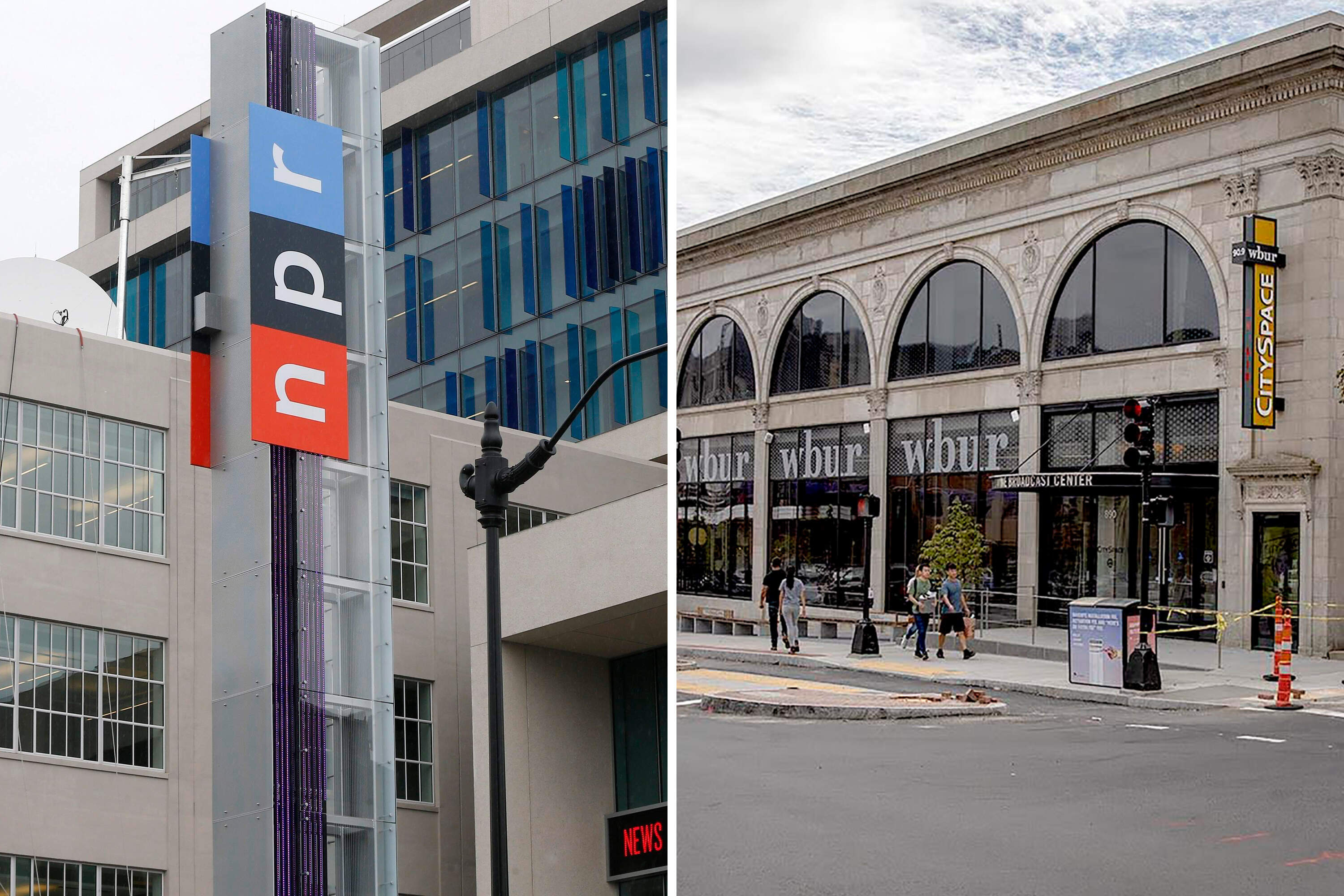
About that draft memo: You may have heard the news that the White House plans to ask Congress to rescind funding for the Corporation for Public Broadcasting later this month, a move that would undercut NPR and PBS stations across the country. As NPR's David Folkenflik reported yesterday, the Trump administration has drafted a memo to Congress outlining the plans. According to a White House official who spoke to NPR on the condition of anonymity, the proposal, if passed, would clawback $1.1 billion from the CPB — or two years worth of funding. (Overall, the CPB's annual funding is less than 0.01% of the federal budget.)
- What does CPB funding mean for WBUR? Our biggest sources of revenue are individual donations and sponsorship (including what we call underwriting on the radio). A little more than 3% of our annual budget comes from the CPB. But that doesn't fully encapsulate the potential impact of CPB cuts. We also rely on several million dollars a year in syndication fees from other public media stations that air our two national shows, Here & Now and On Point. And as Folkenflik notes, smaller stations, which have a heavier reliance on CPB funding, could be "wiped out" by the proposed cuts. (Our friends over at GBH recently created a short video explaining how CPB funding is the "glue" of public media.)
- What's next: The White House plans to send the request to Congress on April 28. That will open a 45-day window in which Congress can vote to rescind the funds or allow the money to be restored. The proposal needs approval from a simple majority in both the House and Senate, in which Republicans hold 53-47 and 220-213 majorities, respectively. While the CPB has enjoyed some bipartisan support in the past, NPR's Scott Neuman reports more Republicans now seem to be standing behind Trump and public media critics.
- Zoom out: A Pew Research poll last month found that 20% of Americans say they regularly get their news from NPR, and 21% say the same of PBS. The poll also found that a plurality of Americans support federal funding for public media.
- Go deeper: Read Folkenflik's full story here for more on how public broadcasting funding works and the motivations behind Trump's proposed cuts.
More funding fallout: A local immigrant support organization says it has lost federal funding for its program helping green card holders apply for American citizenship. The Massachusetts Immigrant and Refugee Advocacy coalition said yesterday its $300,000 grant for the program — which was frozen in February — has officially been cut. Stephanie Rosario Rodriguez, the program director for MIRA, told WBUR's John Bender they were told via email by the Trump administration that the work the grant supported was no longer a priority for the federal government.
- Why it matters: Rodriguez says people often rely on assistance because citizenship applications are complicated. "There's a lot of back and forth, a lot of mailing, and sometimes these questions are asked in legalese," Rodriguez said. "And checking off the wrong box could mean that your application is denied."
- Now what? She says MIRA will continue to work with people already in their program, but is no longer accepting new applicants.
Departures board: Massachusetts economic development secretary Yvonne Hao is stepping down at the end of the month to address "pressing family matters," Gov. Maura Healey's office announced yesterday. The economic development agency's under-secretary, Ashley Stolba, will serve in the interim while the Healey administration searches for someone to permanently fill Hao's role.
- FYI: Hao was the first woman and person of color to serve as Massachusetts' economic development secretary, according to Healey's office.
Heads up: The Boston Common concessions stand has reopened with a new operator: Flour Bakery. The small octagonal building — previously home to the Earl of Sandwich — is the 10th location of Joanne Chang's Boston-based bakery.
- The seasonal stand will be open 7 a.m. to 7 p.m. on weekdays (and 8 a.m. to 6 p.m. on weekends), offering Flour's regular menu items — plus some Common-exclusive specials, like hot dogs, soft serve ice cream and a pastry inspired by the nearby "Embrace" statue. Check their Instagram page for the latest.
P.S.— The full schedule for next month's WBUR Festival is available now! On Friday, see Ina Garten, Roxanne Gay and Kara Swisher. Come back Saturday for Dr. Anthony Fauci and Leslie Odom Jr., who just announced his return to "Hamilton" on Broadway. (And don't forget to hit our street fair and kids stage, too.) Plan your weekend and see when your favorites will be on stage.