Support WBUR
Feds hit Harvard with new demands, from international student records to funding cuts and tax threats
The Trump administration widened its pressure campaign against Harvard University late Wednesday, issuing a new demand that it release disciplinary records of international students or risk losing the ability to enroll them at all.
Meanwhile, news broke Wednesday evening that U.S. Treasury officials have moved to ask the Internal Revenue Service to strip Harvard of its tax-exempt status.
The unprecedented efforts are the latest by White House officials aimed at pressuring the university to bow to orders that challenge Harvard's autonomy around academic and policy decisions. The moves came just two days after Trump's antisemitism task force announced it would freeze more than $2.2 billion in federal grants and contracts sent to the school after Harvard's rejection of its broad demands.
The threats are rattling students, staff and leaders at many colleges and universities in the U.S.
According to a Department of Homeland Security press release, Secretary Kristi Noem sent Harvard administrators a letter demanding the school turn over "detailed records on Harvard’s foreign student visa holders’ illegal and violent activities" by April 30 — or face the "immediate loss" of a certification that lets international students enroll.
Harvard enrolled 6,793 international students this academic year, or about 27% of its total student population, university data shows.
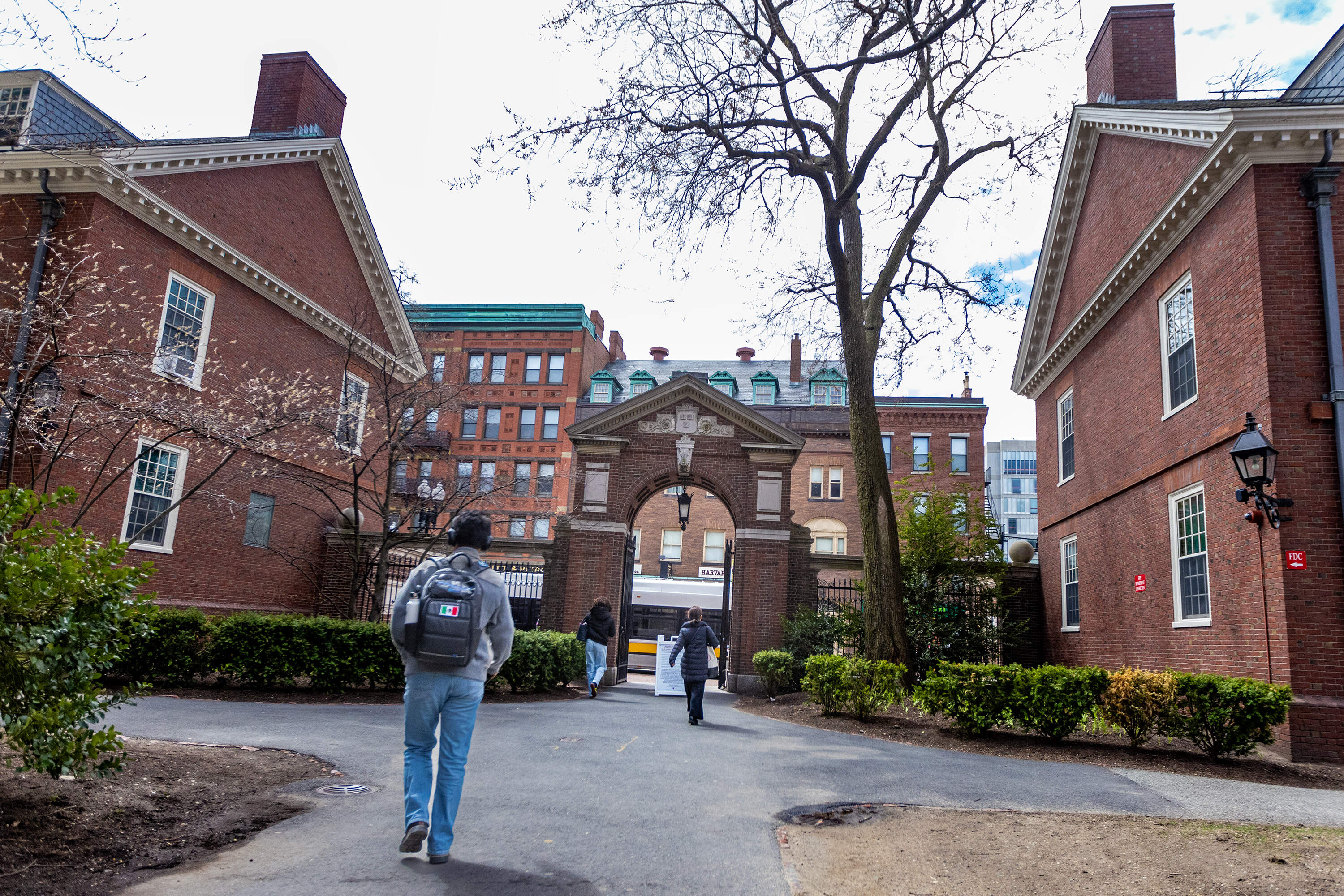
The DHS announcement also said Noem canceled two grants worth more than $2.7 million, "declaring [Harvard] to be unfit to be entrusted with taxpayer dollars."
The agency offered scathing descriptions of the two projects, accusing them of undermining "America's values and security." It described an $800,000 grant for "Implementation Science for Targeted Violence Prevention" as "shockingly skewed" because it "branded conservatives as far-right dissidents." It labeled a $1.9 million "Blue Campaign Program Evaluation and Violence Advisement" grant part of "Harvard’s public health propaganda."
"With a $53.2 billion endowment, Harvard can fund its own chaos — DHS won’t," the department wrote in the release.
Harvard leadership immediately fired back Wednesday night, saying in a statement it was aware of the latest DHS notice, but that it stands by its comments earlier this week that the school "will not surrender its independence or relinquish its constitutional rights."
"We continue to stand by that statement. We will continue to comply with the law and expect the Administration to do the same," Harvard spokeswoman Sarah Kennedy-O’Reilly said in an email.
President Trump suggested the university's tax-exempt status could be in question in a post on social media Tuesday, shortly after Harvard said it would not submit to the antisemitism task force's demands.
Northeastern University professor Julian Fray, an expert in tax law, told WBUR's Morning Edition that stripping an institution of its tax status would be a "pretty strong" and "very unusual" response.
"The Supreme Court has said it should only be done when the activity involved is contrary to fundamental public policy," Fray explained.
Fray pointed to one notable example from 1983. Bob Jones University in South Carolina lost its tax-exempt status, because school leaders refused to stop enforcing a ban on interracial student dating. (The conservative Christian university regained its tax-exempt status in 2017, nearly two decades after it had dropped the discriminatory policy.)
If Harvard's tax-exempt status were revoked, the university could appeal and ask courts to intervene.
"Harvard would have a really good case that they are still within the bounds of public policy," said Fray, "that they are pursuing their charitable purposes" which includes providing education.
She also noted the president lacks the authority to revoke schools' tax designations, and under a law intended to prevent the IRS from "being politically weaponized," presidents are prohibited from even suggesting it. His administration has said the IRS investigations began before Trump's social media post.
Losing tax-exempt status would be felt in multiple ways at Harvard. First, financial donors would no longer qualify for charity tax deductions. The school's endowment would also be taxed at a higher rate, Fray said.
The financial threats are adding to fears of layoffs, program cuts and research grinding to a halt at Harvard.
Research upended
Hours after the federal government announced the funding freeze on Monday, several researchers began receiving stop work orders, including a scientist leading an international effort to curb tuberculosis.
Harvard Medical School Professor David Walt got one, too. He was using federal dollars to find a new diagnostic test for ALS, or Lou Gehrig’s disease. Walt, who is also a member of Harvard's Wyss Institute, said this and similar cuts at many universities will delay breakthrough discoveries.
"Patients will unnecessarily die and unnecessarily suffer, because the future is being pushed out," Walt said.
Dr. Don Ingber, a professor in the medical and engineering schools at Harvard, had 15-20 scientists working on two federal contracts worth just under $20 million. Both are currently frozen. One was recreating the structure of human organs on chips to be used, instead of humans, in drug development. His lab had also developed chips that model injuries from radiation that might occur if the country expands nuclear power.
The Joint Task Force to Combat Antisemitism, which announced the freeze, said in a statement that Harvard's refusal to make changes the task force demanded "reinforces the troubling entitlement mindset that is endemic to our nation's most prestigious universities and colleges - that federal investment does not come with the responsibility to uphold civil rights laws."
Ingber said the U.S. economy will suffer because the freeze at Harvard and federal cuts at universities across the U.S. are pushing scientists to find new careers or work in other countries.
"We had a running engine that everyone in the world looked to us as the leader and emulated us," said Ingber. "China has tried to mimic us, and we just cut the heart out of it, just in the last couple of months."
This article was originally published on April 17, 2025.