Support WBUR
Director David Cronenberg turns personal loss into 'The Shrouds'
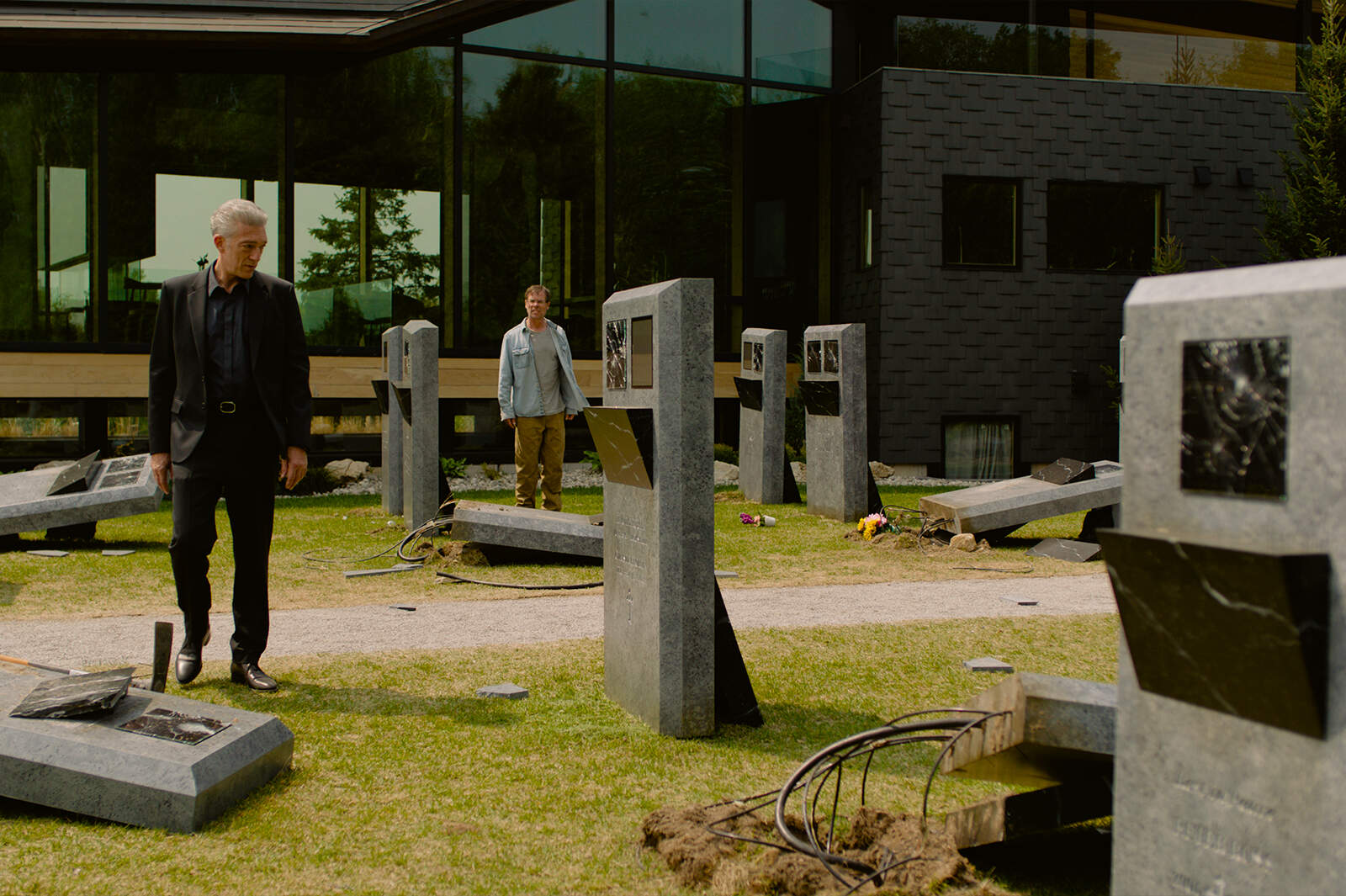
“It’s a rom-com, basically,” says director David Cronenberg of his new film “The Shrouds.” He’s only half-kidding. The movie stars Vincent Cassel as Karsh, an obsessive, inconsolable widower who invented a technology that broadcasts from inside coffins so that grieving loved ones can watch 3D livestreams of their dearly departed’s decomposing corpses on their home screens and mobile devices. It’s called “GraveTech,” and it proves surprisingly popular.
But when his designer cemetery is vandalized, Karsh and his sister-in-law Terry (Diane Kruger, who also plays the dead wife in flashbacks) find themselves swept up in a byzantine international espionage plot. That’s when “The Shrouds” becomes a morbid meditation on our inability to let go, diagnosing a society-wide addiction to conspiracy theories as a desperate way of staving off the emotional effects of loss. In true Cronenberg tradition, the film is icky and unsettling, troublingly erotic and unexpectedly hilarious.
At last fall’s New York Film Festival, I surprised myself by how loudly I was laughing at a story with such grim subject matter. “That screening was great,” says Cronenberg via a Zoom call from a Manhattan hotel room, lamenting the lack of laughs during the movie’s Cannes Film Festival premiere last summer. “Everybody at Cannes was taking it too seriously. Of course, I take it seriously. You know, it is my art. But in it, there are jokes. It is funny. All of my movies are funny. Honestly, I don't know how you survive being a human being without humor and laughter.”
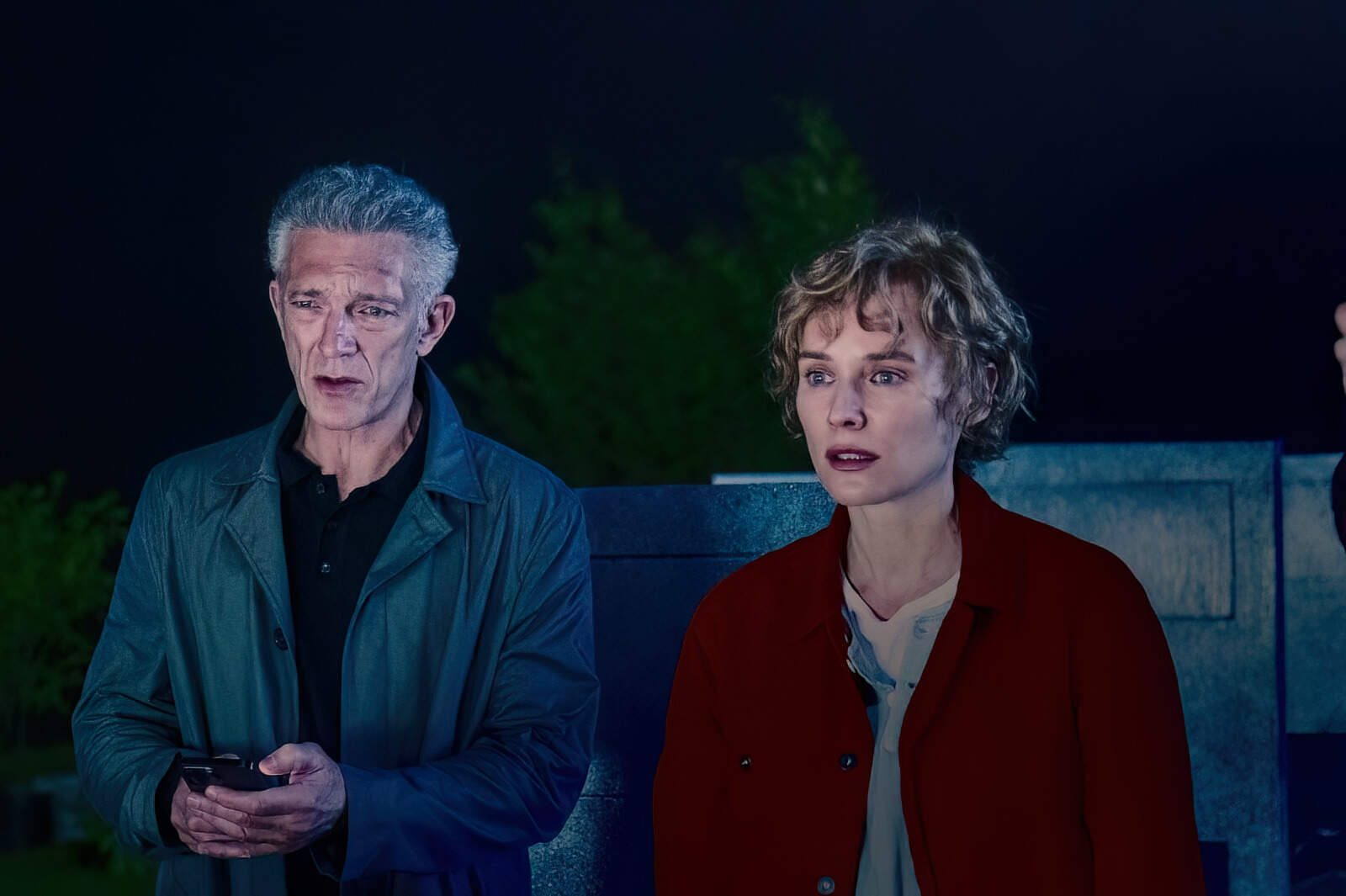
There hasn’t been a lot to laugh about lately. In 2017, Cronenberg’s wife of 38 years, Carolyn Zeifman, died after a long battle with cancer. In 2020, he lost his sister and longtime artistic collaborator Denise Cronenberg, who designed costumes for his films going back to 1983’s “Videodrome.” It’s no coincidence that the two protagonists of “The Shrouds” are a man mourning his wife and a woman mourning her sister. Nor can one miss that Cassel has been styled to look strikingly like the director himself, wearing Cronenberg’s trademark swept-up silver coiffure and sleek suits by one of the film’s backers, Saint Laurent.
“Once the idea is out that it’s autobiographical then it has to be discussed because I have to say: it is, but it isn't,” he explains. “As soon as you start to write the characters, they become fictional. They start to take on a life of their own. They say things you didn’t expect them to say and they start to push you around. At that point, they’re no longer the people from your life and they’re not you. And really, that's what you want.”
Much like the “bug powder” drug in the director’s adaptation of William S. Burroughs’ “Naked Lunch” or the pornographic car accident fetishists in his notoriously NC-17 “Crash,” the paranoid rabbit holes in “The Shrouds” are slightly amplified, science-fictionalized versions of everyday psychological afflictions. Set in the near future, the movie is actually about right now, and the increasingly unhinged conspiracy theories that seem to have embedded themselves in our contemporary discourse.
"The thing about a conspiracy is that it empowers you. It makes you think that you are seeing something that nobody else is seeing."
David Cronenberg
Cronenberg sees them as a coping mechanism and understands the appeal. “The thing about a conspiracy is that it empowers you,” he says. “It makes you think that you are seeing something that nobody else is seeing. You have special insight. And you feel like you have control over things that you don’t really have control over.”
Anyone who spent any time on Facebook during the pandemic already knows that conspiracy theories allow C students to feel smarter than doctors who studied medicine for decades. I always assumed that was the draw, but Cronenberg takes a more compassionate view. Rather than accepting that the cells in your wife’s body can transform into malignant tumors and kill her for no reason, what if there was actually a sinister cabal conducting secret experiments on her instead?
“If there’s a conspiracy then that means your wife died for a reason,” he says. “One of the things about people dying, especially when they die young, is that it seems meaningless. It is an absurdity. I think we have evolved to look for meaning in everything. It’s one of the strengths and weaknesses of our species. And if you can't find meaning, you invent meaning, and that's what a conspiracy theory is.”
Revisiting Cronenberg’s 1986 masterpiece “The Fly” when it screened last Halloween at the Coolidge, I was struck by how one of the saddest, grossest movies ever made by a major studio could almost be a spiritual prequel to “The Shrouds.” Seen now without the AIDS-era subtext, it endures as a film about how in any romance one partner will inevitably outlive the other, and even in the best case scenario, one of you is going to have to watch the person you love most in the world wither and die.
"I think we have evolved to look for meaning in everything. It's one of the strengths and weaknesses of our species."
David Cronenberg
“Yes. That’s exactly right. Unless it’s a car crash in which you both die,” he notes. “You understand why Christopher Hitchens, the sort of philosopher polemicist who was very anti-religion, he said, ‘death causes religion.’ That sums it up in three words, because all religions give you a way to evade the inevitability and the absoluteness of death,” he says. “You know you’ll meet this person in heaven, or you’ll be reincarnated as somebody else. But if you don’t have that, then you have to decide, can you actually take the meaninglessness of death?”
Conspiracy becomes a religion for Karsh and Terry. It’s also an aphrodisiac, with the two literally getting off on coming up with wilder hypotheses to match the plot’s twists and turns. Their retreat from reality is aided and abetted by the film’s omnipresent screens. Nearly every interaction in “The Shrouds” is mediated by some sort of cellphone or FaceTime video, technology becoming another buffer between the characters and the corporeal world. Kruger plays a third role in the film as Hunny, Karsh’s AI virtual assistant who coddles him in the voice of his deceased wife. She talks to him via a Meta avatar on a monitor in his self-driving Tesla, a slyly subversive piece of product placement, as it’s shot like a rolling tomb.
Cronenberg claims a lot of this was unintentional. “I wasn't even really meaning the movie to be a commentary on the way that technology can dehumanize us and separate us from reality. I was just observing what's going on, rather than trying to make a point. But that in itself ends up making a point.” Later in the film, there’s a moment when Karsh could easily get to the bottom of the plot by digging up the evidence. “But we all understand that he's afraid to do that,” the filmmaker acknowledges. “He’s afraid to confront the actual reality of his wife’s body. He would rather do it through a screen.” Besides, behind a screen he can prolong the mystery.
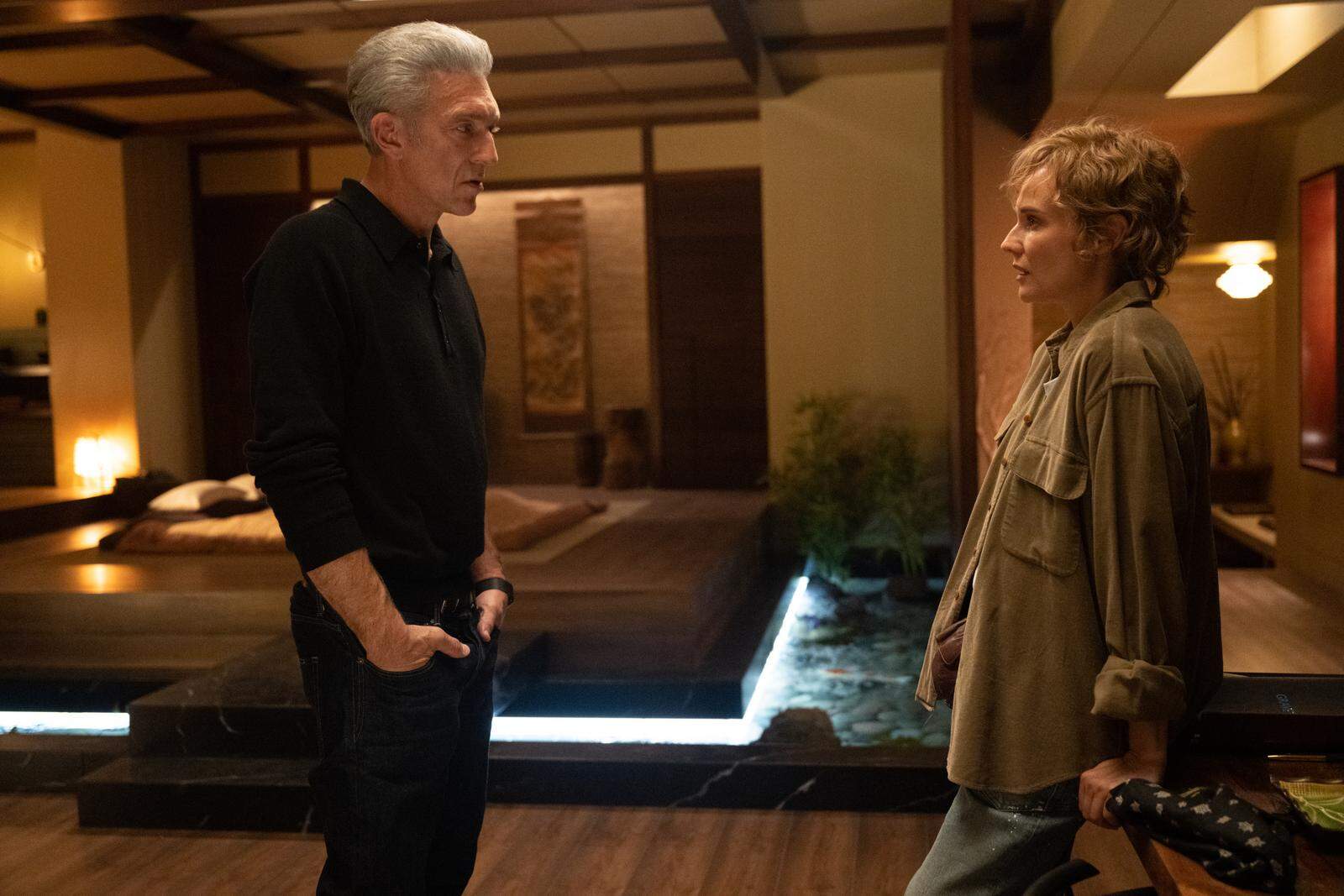
“The Shrouds” was originally developed as a series for Netflix. (According to Cronenberg, the streamer said “thanks, but goodbye” after reading the second episode.) The film ends in the same haunting, open-ended fashion as so many of the director’s pictures, and one could easily imagine Karsh spinning out in infinite variations on these conspiratorial threads for season after season, never finding the same grace that was so hard-won for his creator behind the camera.
“It’s tough to accept your own oblivion. It’s a tough one,” Cronenberg admits. “To feel and accept your own eventual non-existence. How do you do that? It’s difficult to say, what is the meaning of life?”
The 82-year-old filmmaker takes a sip of water and smiles, sounding like someone done looking for explanations beyond, instead committed to the here and now.
“The meaning of life is life itself. It’s living life. To me, that’s all the meaning I need.”
“The Shrouds” is now in theaters.