Support WBUR
Boston's Weekly Health Newsletter
Scientists under siege: What Anthony Fauci said at The WBUR Festival
Editor's Note: An excerpt of this story ran in WBUR's weekly health newsletter, CommonHealth. If you like what you read and want it in your inbox, sign up here.
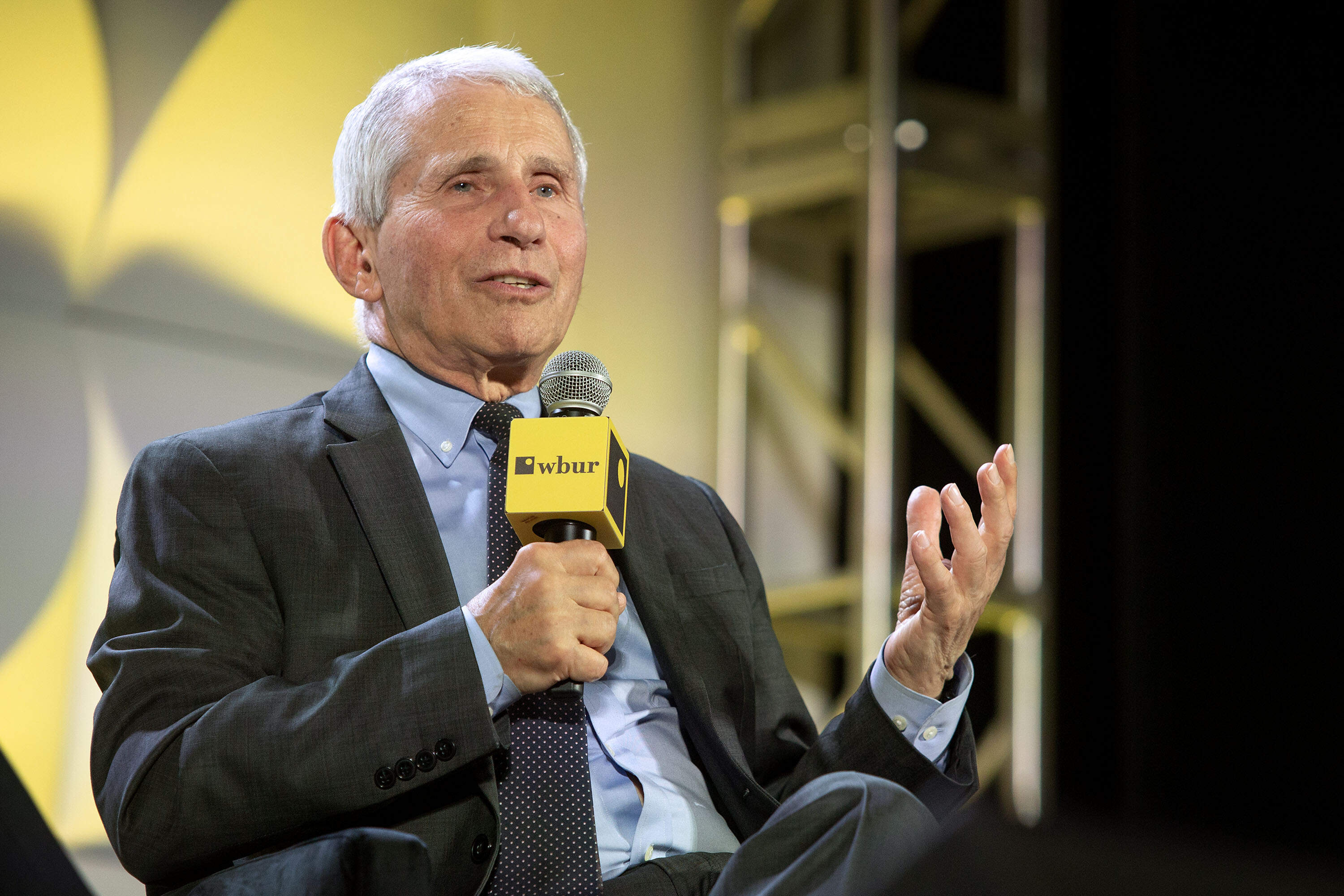
Dr. Anthony Fauci says Americans are witnessing an increased "normalization of untruths" and "severe intimidation" of scientists at government agencies that could undermine the country's leadership in biomedical research.
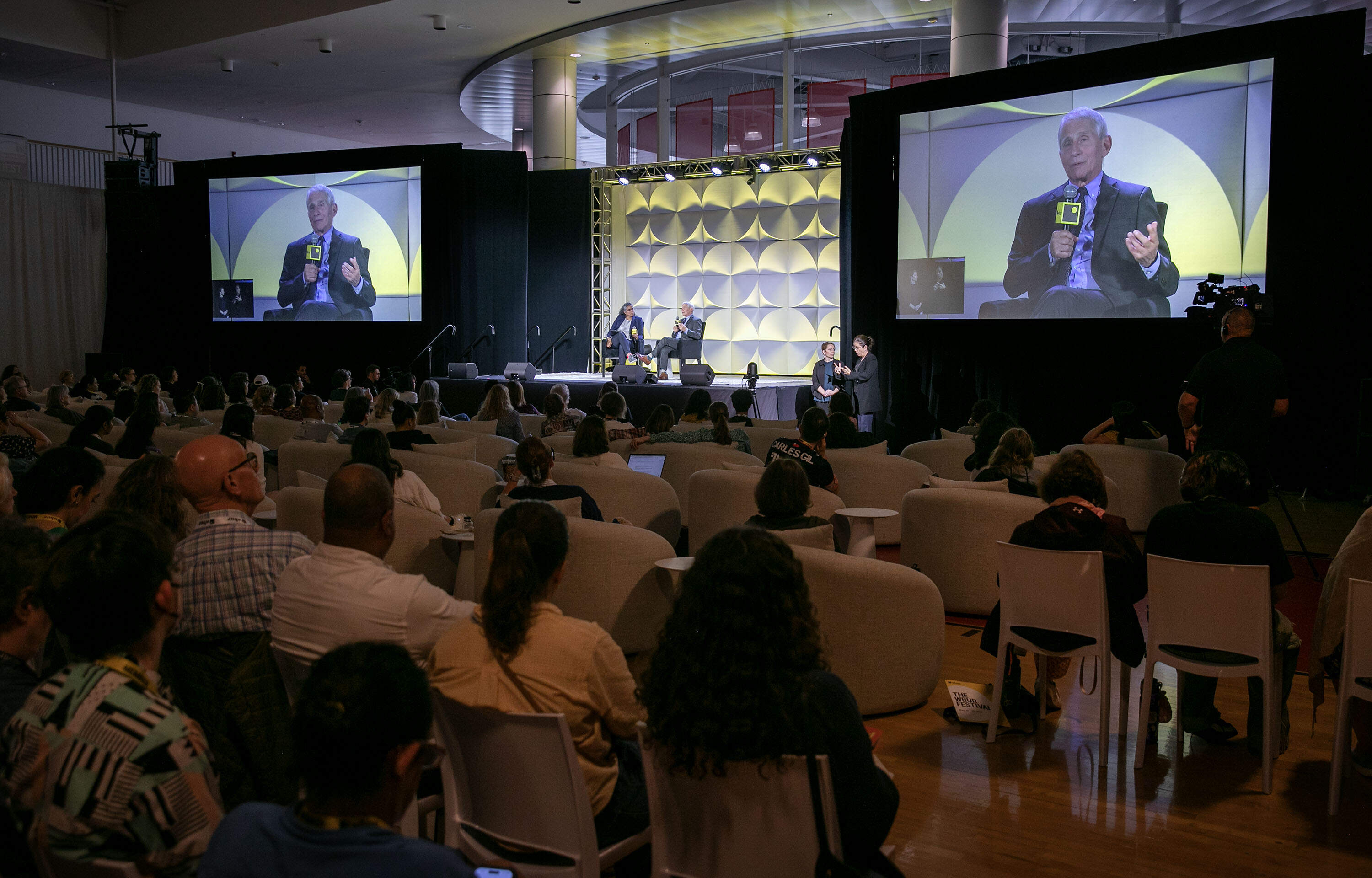
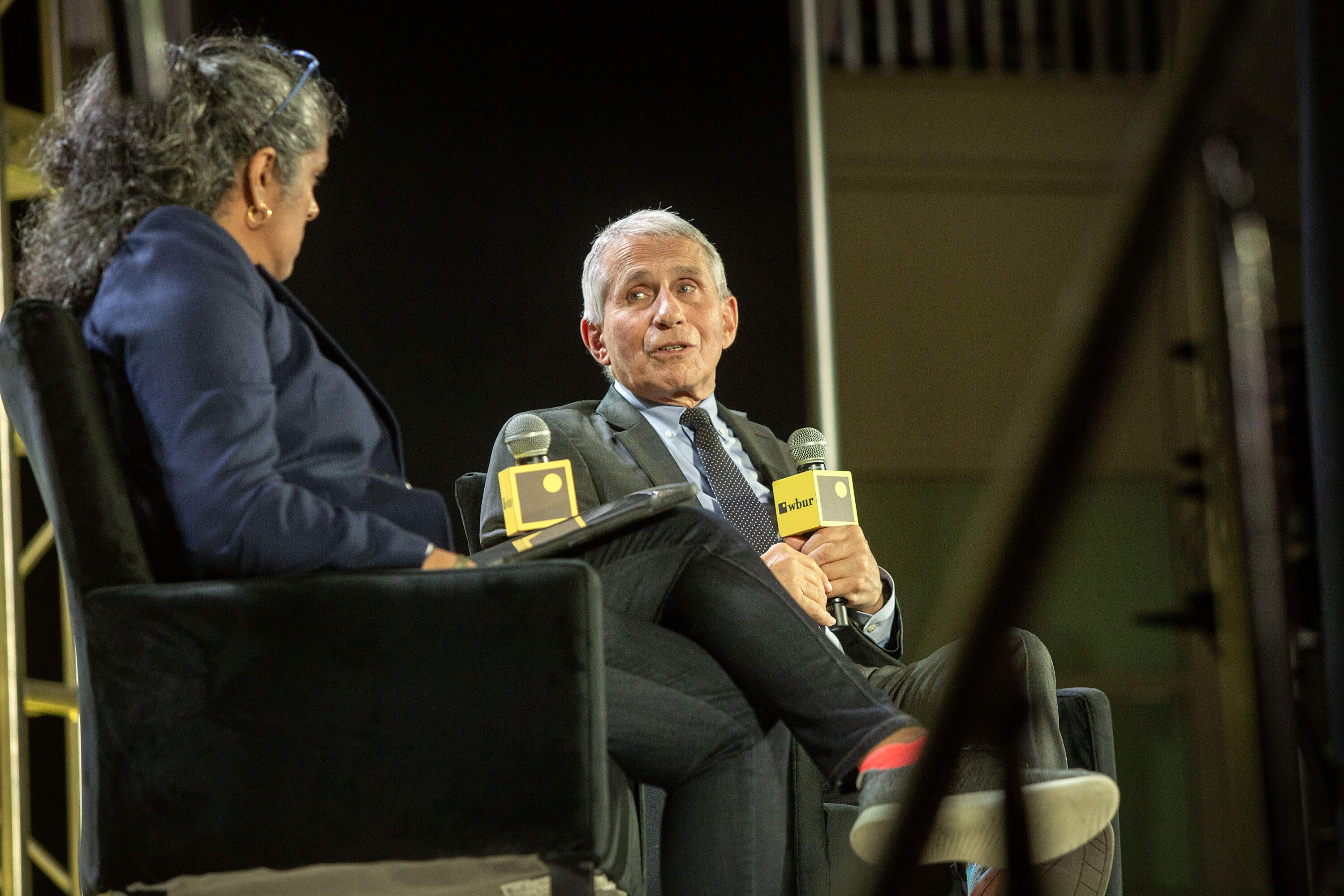
In a conversation Saturday with On Point’s Meghna Chakrabarti at The WBUR Festival, Fauci addressed what he sees as two urgent threats to public health: the growing distrust in scientific institutions and the Trump administration's weakening of public health agencies like the National Institutes of Health and the Centers for Disease Control and Prevention.
Fauci retired in 2022 after playing a top role in the federal response to the COVID-19 pandemic and leading the nation’s infectious disease institute for nearly four decades. During the interview, he also elaborated on the importance of improving science literacy and acknowledged that there are areas where public health leaders "need to do better" to prepare for the next pandemic.
Here are some highlights from the conversation, lightly edited for clarity.
On how he originally got into science as a career:
"The arc of my career in science really did not start off with my being consumed with the love of fundamental science. It really started in my childhood, as well as my training. I went to Jesuit high schools and colleges, and that was mostly a classical upbringing — Greek, Latin, philosophy. When I was exposed to science, it was clear to me that discovery and the fact that science is a mechanism to get to truth and understanding about things that are important. That combination made me want to go into a scientific discipline specifically as a physician and a physician-scientist.
"Science is a mechanism that in my mind is how you gather information, data and evidence ultimately to make the world a better place. If you're a physical scientist, you do things to understand the physical environment and make it a better place to live. If you're in the biological sciences like me, as a physician and a scientist, you get evidence, data and information to make the world a better place by addressing diseases and trying to alleviate suffering and death."
On the spread of misinformation:
"What's happening now, and it's been going on for years, more intensively now so, is that we are now in an environment of what I call the normalization of untruths. Where patently untrue things are said and amplified by social media, such that if you say something over and over again that's untrue, for a substantial portion of people who are not thinking critically. I don't mean that in a pejorative way, but they're busy doing other things. They're not thinking critically about every single bit of information that comes out. They're very much steeped in social media, which is not edited at all, and you wind up having things that are completely untrue being accepted as truth and reality by people.
"What gets confusing is that science is a self-correcting process. If you're dealing with a moving target, you have to look at the data you have at a given moment, and if you need to make a decision, a recommendation or a guideline, you base it on what you know now. If that information changes, then the very nature of what science is compels you to use your information gathering to make a modification. The people who are pushing the untruth in society say, 'Look with science, they told you something in May, and then a year later, they told you something else.' So, it really becomes a discrediting of a process that is essentially a self-correcting one."
On the need for better education about the scientific process:
"Our science education is not up to par with the economic level of our country. When you have other countries, even lower- and middle-income countries, that have a better understanding of science literacy. [Science literacy] is something people get wrong. It doesn’t mean if you don’t understand it, you're illiterate — that's wrong because that becomes pejorative. But we need to be able to get children to develop what we call critical thinking, to analyze things and not accept it purely on its face value. What you see getting spread on social media is the antithesis of critical thinking."
On how the Trump administration has changed the culture at the NIH:
"I came to the NIH as a trainee/fellow after my medical residency in 1968, and I was there ever since. I spent 54 years at the NIH. And the culture of NIH was one of inquiry, analysis, searching for the truth with the bottom line. Since it's the National Institutes of Health, it's an organization in which research is directed at understanding, preventing and treating disease, and in the spirit of the science, it was open, and the ability for the youngest person in my team of fellows or trainees to feel absolutely comfortable with questioning me about a scientific fact. Because if I'm basing what I'm doing on truth and evidence, then anybody could question that in a collegial way to try to get down to what the fundamental facts are. It was sort of a magical type of an intellectual academic atmosphere, where a lot of people were working very hard and in different subspecialties, everybody had the same goal. What can we do to further science to alleviate and prevent disease and premature death? It was just an absolutely wonderful place to work.
"What has happened with NIH now is really unfortunate. As part of the DOGE [Department of Government Efficiency, a White House cost-cutting unit] effect that we all know about with Elon Musk, they have indiscriminately fired a considerable number of people, including some very productive scientists. Even though when you ask them, they say, 'Well, no scientists have been fired.' That's total nonsense. I could name several of them for you right now. Right now, the morale at the NIH is just gloomy. They feel intimidated. They feel threatened that anything they say that might disagree with certain people, they could literally get fired. That, to me, is so antithetical to what the spirit of what NIH was.
"Never, in the half century I was there, was anyone afraid to say something because they thought they might lose their job. That is very severe intimidation."
On whether the United States will still be a good place to do science:
"I hope so. If you look at Harvard University right here in Boston, you know 27% of their student body is foreigners. That is a very rich source of positive input and enrichment of our own society.
"The proposal for the budget is to decrease the NIH budget from $47 billion a year to $27 billion a year. That would be catastrophic for the biomedical research enterprise. It's almost a double whammy against science. If you're a foreign scientist, you might be hesitant to come here because of the threats on them. And if you're an American who might want to go into science, you might say, ‘Is this the career that I really want to take?’ "
On how to rebuild public trust in science in the U.S.:
"I think you have to start off with the fact that especially in the first couple of years of the COVID-19 pandemic, the public health and the scientific community didn't get everything right. I would have been really surprised if we did get everything right, because it was such a perplexing moving target. The one thing I can say about my colleagues and myself is that we tried our best with the information we had. Now, I think we can regain trust by continuing to be humble enough to admit that we didn't do things perfectly, but we are trying to do the best we can, which is difficult to convince people of if they have those preconceived notions.
"The other thing that we can do, which we tried but failed to do, is when you are communicating science to try not to come across as being absolute and saying, 'This is definitely the way it is,' particularly if you know you're dealing with a moving target.
"I remember the first case in Washington, and I had a reporter ask me, 'Should we be telling the American public to do anything different right now?' And my answer was, 'No.' I would think that right now, I wouldn't do anything different, but then say, 'However, this could change.' The scientific and public health community needs to try harder. We need to emphasize that comma, because you have to let your audience know that you're giving them information to the best of your ability based on the data and evidence. And that the information will likely change when you’re dealing with a moving target. We just need to do that better. And we didn't do a very good job of that."
On whether the country is prepared for another pandemic:
"I'll divide the answer into two general buckets: the scientific bucket and the public health bucket.
"I think from the scientific bucket, we get an A-plus. The sequence of the virus was made public on January 10 of 2020. Eleven months later, we had a vaccine that had been tested in tens of thousands of people and was proven to be safe and effective. So that has never been done in the history of public health and science. It usually takes anywhere from five to 10 years. If we hadn't gotten that done, millions of more people throughout the world would have died. From a scientific standpoint, we did well. My concern is, if we diminish the scientific effort and weaken the NIH and the CDC, which is happening, that would make us less prepared, from a scientific standpoint.
"From a public health standpoint, we didn't do too well to begin with, because somehow or other, we had a fragmentation of our public health response. One of the great things about our country is that we have 50 states and additional territories, and because of the diversity, economically, socially, geographically, financially, that we have individualism in this country, which works great. It makes us a great country. However, we didn't do things in a uniformly effective way throughout the country when it came to public health — namely, identification, isolation, contact tracing, physical distancing, wearing a mask, why red states were less vaccinated than blue state, why red states had more hospitalizations and deaths than blue states.
"Those were public health things that we really need to do better. We've got to pull together as a country and remember that the common enemy was the virus, not each other. We were kind of fighting with each other from an ideological standpoint, instead of saying, 'Let's get together the way we would in a real war.' In World War II, we all got together and said, 'We've got to fight the common enemy.' We should have been able to do that with the virus, but it seemed that there was so much divisiveness. We didn't do that very well."
On what his toughest moment was during the pandemic:
"My toughest moment was something that my adversaries think I took pleasure in, and I really didn't, and that was when I was in the White House, in the Coronavirus Task Force, when [President Trump] was saying things that were just not true. When he was saying that the virus would disappear like magic, when I knew epidemiologically that would not happen, when that was clear that it would not happen, he was evoking magical elixirs like hydroxychloroquine or ivermectin to be the answer.
"I didn't proactively do it, but when it got asked by the press, ‘Do you agree with the president?’ I had to say, ‘No, I'm sorry, but I don't.’ I have a great deal of respect for the office of the presidency of the United States, and I had no malicious or any negative feeling towards President Trump when I was in the White House, not at all. The last thing in the world that I wanted to do was undermine the president of the United States. So that was very, very difficult. It cost me dearly because it unleashed a tsunami of negative vitriol against me, which is still present to this day. Four years later, it's still there. It was one of the most difficult things that I had to do, and I'm unfortunately seeing the result of that being prolonged to this day."
On the best moment:
"My group at the NIH was developing the parts of the vaccine. So we were testing the vaccine, and my clinical trial units were involved, and we were hoping that we would get a 50% effective vaccine. If we were really, really lucky, we might squeeze it to 65% to 70%. I remember when I was sitting outside in my back deck eating, as I know many of you did during social distancing when you had guests over. It was November 2020, I was out there with my gloves on, when the weather was 35 degrees. I got a phone call from Albert Bourla, who was the CEO of Pfizer. He called me up, and he said, ‘Tony, are you sitting down?’ And I said, ‘Oh my God, he's going to tell me that the vaccine failed.’ And he said, ‘We got the results of the vaccine just now, and it's 93% effective.’ It was an amazing feeling."
On what gives him hope:
"It's obviously a very tough time now. There's no running away from that. But throughout all the things that we've been through, I have an abiding faith in the goodness of the American people — that the better angels are ultimately going to prevail.
"Even though it seems like we're dealing with a phenomenal amount of polarization, I believe that so many of the people who are on those polar ends are not really bad people, and I think that we can ultimately come together, as a unified country, with a diversity of opinions. We can't say we all have to be homogeneous. That's ridiculous. But you can have a diversity of opinions, without having profound divisiveness. I don't think deep down people really want to be divisive. What gives me hope, maybe somewhat naively, I don't think I'm naive, but I think that we're going to come together as a country much better than we are right now."
Editor's note: The date Fauci learned of Pfizer's vaccine results was misstated during the live event and has since been updated.