Support WBUR
Somerville Theatre celebrates grandeur of cinema with 70mm and Widescreen Festival
In the 1950s, movie theater attendance plummeted as people opted to stay home and watch this newfangled invention called television instead. Widescreen and 70mm film exhibition were invented as a way to lure folks out of their living rooms and back to cinemas by giving them an experience that put their sets to shame. Over 70 years later, the film industry is on the ropes once more, thanks to a couchbound culture addicted to the ease of streaming. So it makes sense that we’re currently in the midst of a 70mm revival, with a new generation of filmmakers eager to explore the advantages of large-format film and recent 70mm releases of hits like “The Brutalist” and “Sinners” becoming some of the hottest tickets in town. Sure, these days you can stay home and stream just about anything at any time. But are you really getting the whole picture?
“Why do people go to the Louvre to see the ‘Mona Lisa’ when you can just pull it up on your phone?” said Ian Judge, the Somerville Theatre’s creative director. “There’s a way things were meant to be seen.” Hence, the theater’s annual 70mm and Widescreen Festival, which runs this Thursday, June 26, through Monday, June 30, for five days of eye-popping, old-fashioned cinema spectacles presented according to their original specifications at the lovingly restored, 111-year-old movie palace.
Watching a 70mm film at the Somerville is the next best thing to going back in time. The curtains on the area’s biggest, most beautiful screen sweep open to reveal images of startling texture and clarity. The auditorium’s 24-speaker surround sound system has been retrofitted to show off the full glory of magnetic sound formats that haven’t been used in decades.
Other theaters in the area sometimes rent equipment from Boston Light & Sound for special 70mm engagements, like the Coolidge recently did for “Sinners” and AMC Boston Common does for Christopher Nolan films, but the Somerville has it all in-house. It took 10 years for Judge and projectionist David Kornfeld to track down all of the old parts and obsolete machinery required to be able to properly play any film from any time throughout Hollywood history. With their NEC 4K digital laser projector humming alongside the tall twin Philips Norelco DP-70 film projectors from the 1960s — a model able to switch between 35mm and 70mm — the booth looks like a cross between a spaceship and a museum.
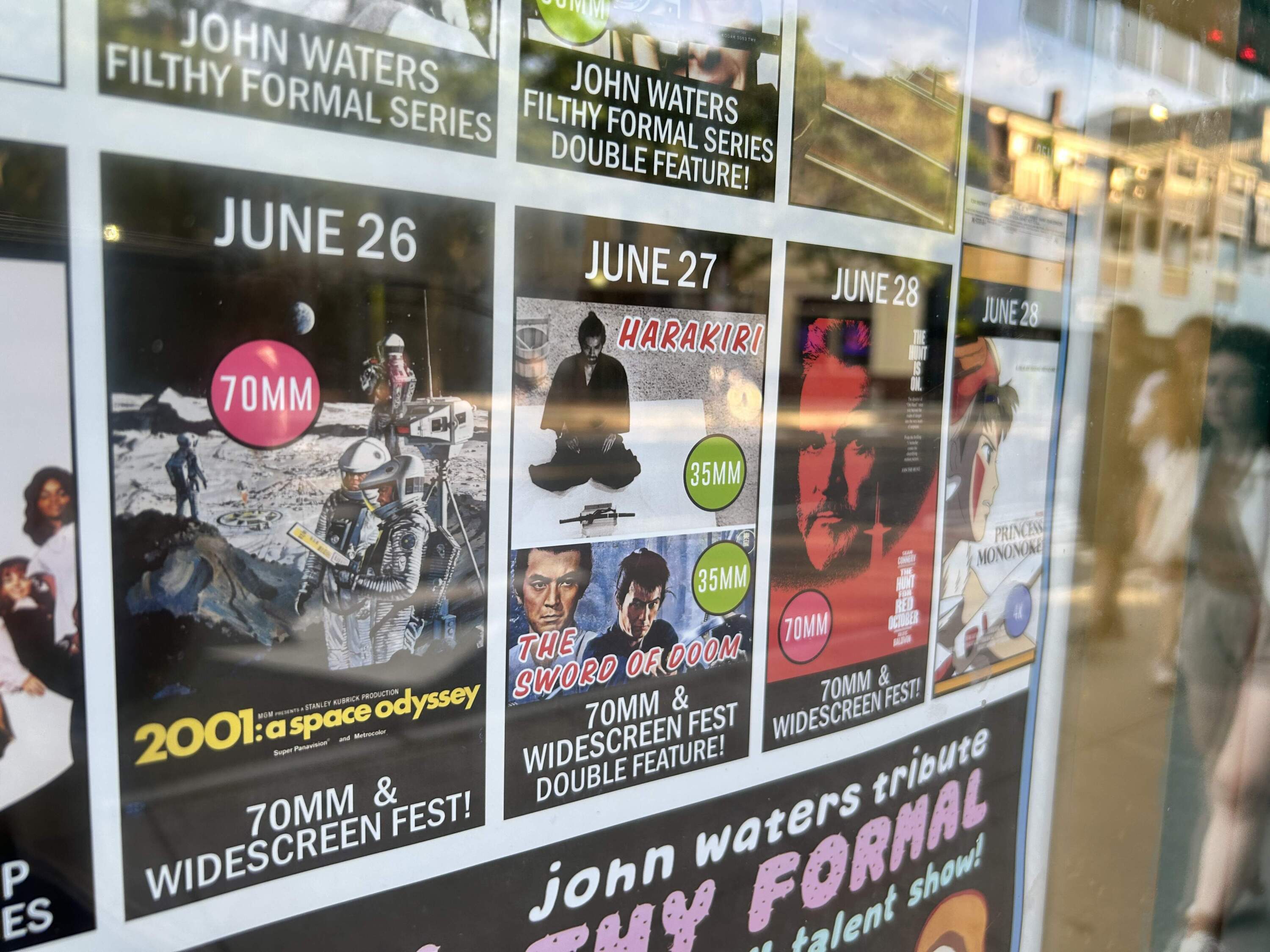
This year’s program begins with Stanley Kubrick’s “2001: A Space Odyssey” (June 26). It’s such a perennial draw at the Somerville that a few years ago the theater purchased its own print of the picture, realizing that would be cheaper than shipping it back and forth to the studio every time they wanted to show it. Kubrick’s towering 1968 masterpiece is one of the best arguments for the superiority of the 70mm format — a heady sound and light spectacular stretching from the dawn of man to Jupiter and beyond the infinite. It’s wild to think that a movie this abstract and narratively experimental was the most popular blockbuster of 1968, but the experience of seeing it on a massive screen with a rapt audience having their minds collectively melted is one of those defining moments in a moviegoers’ life that could never be replicated at home, no matter how nice your new TV is.
About those televisions: There’s no doubt the home entertainment industry has made massive leaps and bounds from the days when I used to watch VHS tapes on my little cathode ray tube TV. The 4,000 pixels of ultra high definition (4K UHD) sets are awfully impressive and the new 4K laser projectors at theaters such as the Brattle and the Somerville are making digital cinema a lot more appealing than it was a few years ago when everything looked murky and dim. But the resolution of a 70mm film is the estimated equivalent of between 13K and 16K pixels – so it’s not like there’s any contest here. I had already watched a digital copy of Quentin Tarantino’s “The Hateful Eight” before I went to check it out in 70mm Ultra Panavision at the Somerville and I remember gasping aloud at how much richer and more detailed the presentation looked.

It's a cumbersome format that’s a lot of extra work. Filmmakers generally stopped shooting on 65mm film stock (the remaining five millimeters of the release prints are taken up by the magnetic soundtrack) somewhere around 1970, with “Airport” and “Patton” being two of the format’s last hurrahs. But movies shot on 35mm were frequently blown up to 70mm throughout the next decade, and especially in the 1980s, when advances in cinema audio design could really be heard on those six-track magnetic soundtracks. This is one of the reasons the Somerville is screening director John McTiernan’s 1988 certified Dad-movie classic “The Hunt for Red October” (June 28). Alas, too late for Father’s Day but worth celebrating all the same.
With the exception of early ‘80s, special effects-laden outliers “Tron” and “Brainstorm,” 1992’s “Far and Away” (June 29) was the first Hollywood film to be photographed on 65mm since 1970. Director Ron Howard’s sweeping historical romance stars Tom Cruise and Nicole Kidman as Irish immigrants taking part in the Oklahoma Land Run of 1893. As an obsessive Cruise-ologist who even introduced a screening of “Risky Business” at the Somerville last summer, I must sheepishly admit that I’ve never seen the picture in its entirety. It seldom plays anywhere and never in its original format. The Somerville is on the short list of theaters allowed to screen what they’ve been told is the only existing 70mm print, so it’s time for me to finally buckle up and face Cruise’s Irish Spring soap commercial accent.
Similarly, “Always” (June 29), Steven Spielberg’s sappy 1989 firefighter romance that featured the final screen performance from Audrey Hepburn, is the last 70mm print of the film in circulation. As is “Red October,” so if you’ve ever been curious about these titles, this is very likely your only opportunity to watch them as they were originally meant to be seen. The rarity of these screenings is why Judge said he has patrons who fly in from all over the country every year to attend the festival. (I can personally attest that when they showed George Lucas’ notorious 1986 megabomb “Howard the Duck” in 2017, I hung around for the first reel just because I wanted to be able to say that I was there the last time “Howard the Duck” ever played in 70mm.)
Striking a new 70mm print can cost the studio anywhere from $25,000 to more than $50,000. Running movies this way is not a cost-effective nor a particularly efficient business. It typically takes Kornfeld two hours to physically inspect the prints frame by frame, after which he runs each reel through to check the magnetic soundtracks. It’s an arduous, time-consuming process, and as far as he is concerned, the only way. A projectionist since 1978, Kornfeld is one of the most knowledgeable and amusingly prickly characters in the Boston film community, sort of like if Yoda was also an insult comic. It’s his reputation for fastidiousness among studio archivists and private film collectors that allows the theater access to seldom-screened prints.
Of more than a hundred 70mm prints Universal shipped to theaters showing “Oppenheimer,” Kornfeld said only a handful returned undamaged. The Somerville’s was one of them. By contrast, when I saw the press screening at the Common, the film jammed and jumped around the gate so often it felt like we were watching the film get fed into a meat grinder. (I would have walked out if I wasn’t on a deadline.) Talk to any projectionist for a little while and they’ll tell you the scuttlebutt about which films got wrecked where.
“There are maybe a dozen theaters in the country doing 70mm regularly and there are a whole lot less of them doing it right,” Judge said. “We’re one of the places doing it right. It’s an opportunity that’s not going to exist forever because these prints aren’t going to be around forever."
Outside of the annual festival, Judge has been trying to run at least one 70mm movie a month as part of the Somerville’s regular programming. Since showing “The Brutalist” at the beginning of this year, he’s screened “Once Upon a Time… in Hollywood,” “The Wild Bunch,” a recently discovered 70mm print of David Lynch’s “Dune” and “Indiana Jones and the Last Crusade,” which Paramount sent along only after discovering that they no longer had any playable 35mm prints. The fact that the studio doesn’t have any more 35mm copies of a freaking Indiana Jones movie should tell you how precarious this whole film exhibition business is.
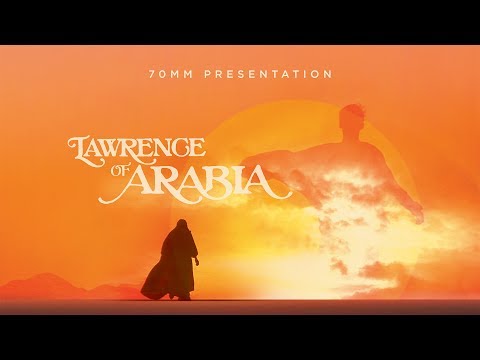
We’ve settled for so many inferior compromises in the name of convenience, growing accustomed to compressed, tinny-sounding music and squinting at sputtering, low-resolution video. The frictionless convenience of streaming has devalued movies into content, background noise sprayed at you by an algorithm. But sometimes doing things the hard way is worth it. It should tell you something that directors like Nolan, Tarantino, Paul Thomas Anderson and Ryan Coogler are shooting on 65mm and pushing so hard to have their movies screened on film in movie theaters. Come see “Lawrence of Arabia” (June 30) as it was originally intended and it’s impossible to not be swept away by the scale and scope of what movies can do.
The 70mm and Widescreen Festival runs from Thursday, June 26, through Monday, June 30.