Support WBUR
Here's why 8 new MBTA subway cars from China are stuck in Philadelphia
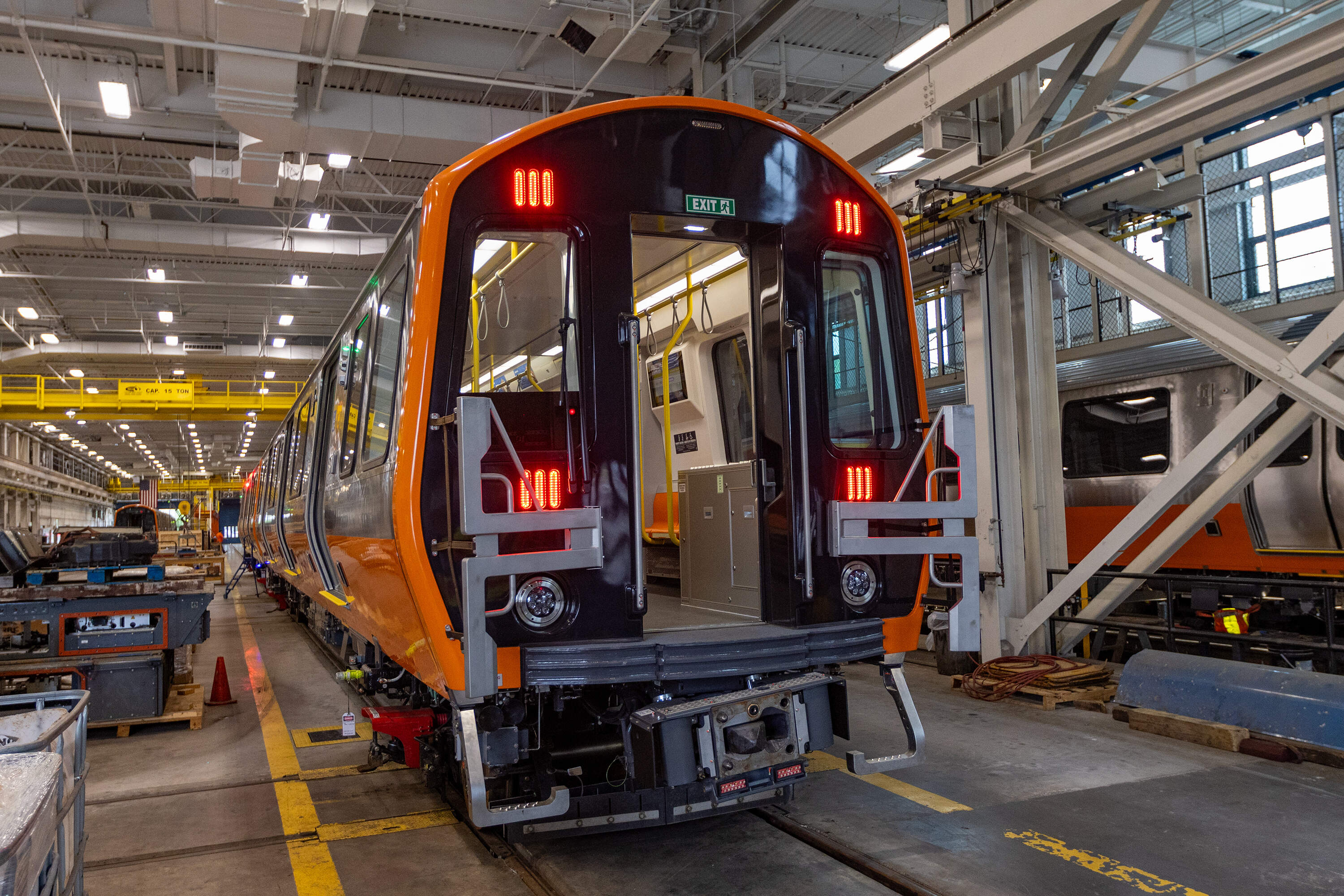
The latest chapter in the MBTA’s decade-old saga to modernize the Red and Orange Line is unfolding hundreds of miles away, at a port in Philadelphia.
For the last month, eight new subway car shells have sat idle at the vast port while federal Customs and Border Protection agents investigate whether forced labor was used to make the vehicles.
The shells are made in China, home of the China Railway Rolling Stock Corporation, the company the T contracted in 2014 to produce 284 new Red and Orange Line cars. The shells are assembled at a facility in Western Massachusetts before they carry passengers.
The shells were flagged by customs agents in May, marking a “first-time detainment” of any CRRC imports since the contract began, according to company spokesperson Lydia Rivera.
The manufacturer's leadership is trying to answer customs agents' questions related to the Uyghur Forced Labor Prevention Act, a 2021 law that aims to prevent items made from the forced labor of the Uyghur population of the Xinjiang Uyghur Autonomous Region of China, from entering the U.S.
Rivera said the company has “maintained rigorous compliance reviews” of all its suppliers and “no entity involved in these shipments is linked to any violation of The Uyghur Forced Labor Prevention Act, or use of forced labor.”
Eng said production at the Springfield facility “continues,” and the detainment has not impacted the delivery schedule of the subway cars. The contract calls for a total of 152 Orange Line cars to be delivered by September and for 252 Red Line cars to be delivered through 2027.
T general manager Phil Eng said there are enough train shells in Springfield “to keep the workforce working through the end of the year.” He also said the T will have a better understanding of any impact to the overall schedule “once this gets all resolved.”
“ We really do believe that CRRC is going to be able to answer these questions, and ensure that we can continue production,” Eng said.
Cornell University professor of global labor and work, Eli Friedman, said the Uyghur Forced Labor Prevention Act requires companies that have goods coming from Xinjiang to prove the items were not made with forced labor. It's a task Friedman said is “famously difficult.”
"It requires a kind of a level of invasion into the supply chain that most brands that are sourcing things from China, like, just can't accomplish,” Friedman said because the process can be labor intensive and time consuming.
Eng said they are holding off on sending more train shell shipments from China to the U.S. for now while CRRC leadership is in the “ midst of finalizing the third round of questions” to CBP.
"Once that is done, we'll have a better understanding of what next steps are to be taken," he said.
Editor's Note: A previous version of this story, citing a company spokesperson, misstated when the subway car shells were flagged by customs. They were flagged in June.