Support WBUR
More than money: What a Harvard deal with Trump could mean for academia
First came the University of Pennsylvania. Then Columbia. Then Brown. The three Ivy League schools agreed to adhere to specific Trump administration policy demands in the last month to restore frozen federal funds. Two of those schools agreed to pay fines as well.
Is Harvard next?
The New York Times reports that Harvard is closing in on a deal with Trump officials to restore more than $2 billion in frozen federal grants and contracts. Meanwhile, a decision from a Boston federal judge on whether to unlock those funds could come down any day.
Many shudder at a potential Harvard deal. If a school with the Harvard's prestige and deep pockets can't withstand ideological demands from the government, what school could? Harvard is the only higher education institution that challenged the administration in court thus far over the loss of funding.
“They have the power and the position and the funding to hold the line and serve as an example to universities,” said Veena Dubal, a professor of law at the University of California at Irvine and the general counsel to the American Association of University Professors — which brought its own lawsuits against the Trump administration, including one challenging threats to Harvard's federal funds.
But given the political climate and risk to the school's financial future, several experts who spoke with WBUR said it may be strategically beneficial for Harvard to strike a deal with the Trump administration.
“We are talking about the biggest crisis that universities are facing in our lifetime,” said Kenneth Wong, a professor of education policy at Brown University.
The Trump administration is "fundamentally dismantling” the partnership between universities and the federal government that has existed for more than half a century, Wong said, adding that reaching an agreement may be a way to find common ground.
“We have to find ways to reestablish this relationship,” he said. "Without that relationship, the mission of the university will be significantly hindered.”
The White House pressured Brown and Columbia into entering agreements using similar tactics it's applied to Harvard. It withdrew hundreds of millions of dollars in federal research funding, accusing the schools of tolerating antisemitism on campus and demanding sweeping changes to policies.
It has also attempted to bar international students from enrolling at Harvard (the subject of another lawsuit) and more recently, threatened its accreditation status.
"We are talking about the biggest crisis that universities are facing in our lifetime."
Kenneth Wong, Brown University
In April, Harvard rebuffed the administration’s demands to change, among other things, its hiring practices and disciplinary policies. The Trump administration froze the university's research funding and Harvard initiated litigation.
But in recent weeks the university reportedly signaled a willingness to pay up to $500 million to settle with the government, according to the New York Times — although University President Alan Garber disputed that figure and denied an agreement is near, according to the Harvard Crimson.
That's far more than the $50 million Brown University will pay, and double the $221 million Columbia agreed to.
A spokesperson for Harvard did not respond to requests for comment about any pending settlement deal.
In its 22-page settlement, Columbia agreed, among other things, to submit detailed applicant data to the Trump administration, including their test scores, grade point averages and race. The university also agreed to prohibit programs that “promote unlawful efforts to achieve race-based outcomes, quotas, diversity targets, or similar efforts," and made several commitments to address accusations of antisemitism on campus.
Columbia had already agreed to some of the reforms in March. U.S. Secretary of Education Linda McMahon described the settlement with the university as a "road map” for other elite schools.
The Trump administration canceled $400 million of Columbia's federal grants and contracts in March, citing antisemitism on the New York campus. Columbia President Claire Shipman has said the financial impact was much greater; the White House had placed on hold "the majority” of the university's $1.3 billion dollars of federal funding. Since a deal was struck, the money has started flowing again, she said in a campus message.
Columbia agreed to pay the federal government $200 million over three years, and an additional $21 million to resolve investigations launched by the U.S. Equal Employment Opportunity Commission.
Brown’s nine-page settlement also committed the university to sending applicant data to the federal government, in addition to adopting the administration’s interpretation of gender and making several commitments to address accusations of antisemitism. Its $50 million payout will not go to federal coffers but to workforce development groups in Rhode Island over the next decade.
The University of Pennsylvania agreed to limit the participation of transgender athletes in sports and adopt a "biology-based definition for the words 'male’ and 'female’ ” that aligns with the Trump administration's interpretation of Title IX. The school paid no fine.
Despite concerns expressed among some First Amendment defenders, Columbia’s president said the school did not surrender its academic freedom with its settlement.
“Columbia’s governance remains in our control,” Shipman wrote in a July 23 message to the campus community. “The federal government will not dictate what we teach, who teaches, or which students we admit.”
A line in the settlement stipulates that the agreement does not give authority for the federal government to dictate faculty hiring and admissions decisions, "or the content of academic speech.”
But UC Irvine's Dubal said the concessions made by Columbia — which include turning over faculty hiring data to an outside monitor for auditing — could have an indirect role in the school leadership's choices moving forward.
“Those demands create kind of an incentive for the university to avoid hiring faculty who would draw the ire of the administration,” she said.
This kind of oversight could subject universities to “government intrusion,” she added, with a goal of pressuring them to “bend” to the Trump administration’s demands.
Jon Fansmith, senior vice president for government relations at the American Council on Education, said there has been a great deal of pushback at the idea Harvard would even entertain a settlement with the Trump administration. But Garber, Harvard's president, also has to answer to the people at the university whose studies and livelihood are on the line.
" The financial harm of withholding the funding is what is compelling them to negotiate in the first place,” he said. “I think Harvard has some red lines that they've been pretty clear about and they wouldn't reach a settlement that violated that."
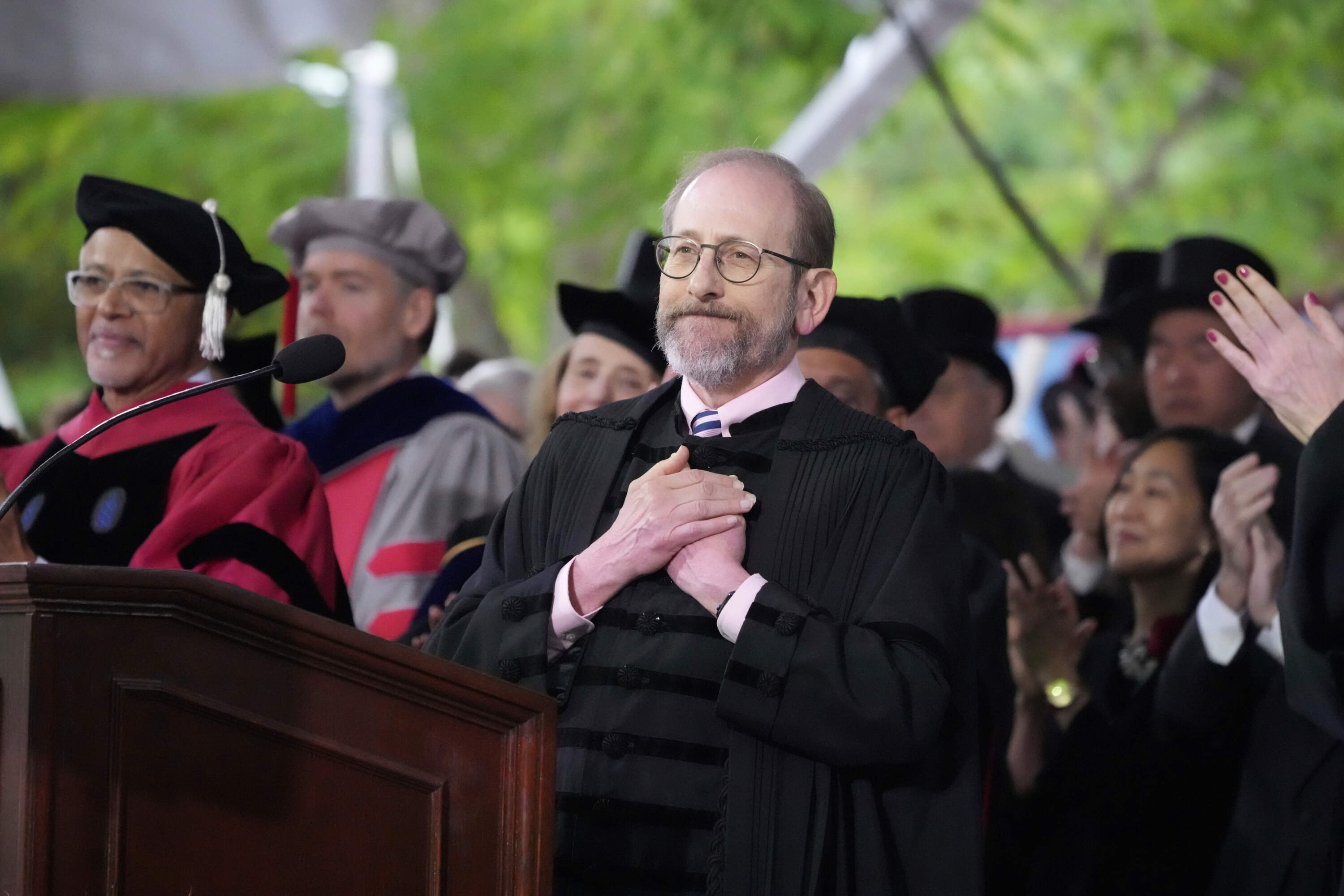
Those include attempts to dictate what the university teaches, and who they admit and hire, as emphasized in Garber's April 14 message to the campus community.
Pressure is mounting in some corners for Harvard to stand its ground against striking a deal that curtails its autonomy. A Harvard alumni group issued an open letter that urged the university not to “give in,” arguing that the Columbia and Brown settlements “represent a dangerous capitulation” that threatens American higher education.
Fourteen members of Congress, all Harvard alumni, recently threatened to launch an investigation if Harvard settled with the Trump administration, saying a deal would have “lasting implications” that reached far beyond Cambridge and would risk “setting a precedent that could severely undermine the independence not only of Harvard but of educational institutions nationwide.”
One major difference between the Brown and Columbia agreements lies in how they will be enforced. Columbia will have a third-party monitor, while Brown will work directly with the federal government to ensure compliance.
Brown's Wong said the kind of enforcement — whether internal to the university or external — might be where Harvard and the Trump administration are hitting a wall.
“One of the most challenging areas is the issue of monitoring Harvard's activities going forward,” he said. “And I think that might be the sticking point in the settlement negotiation.”
Wong anticipates that Harvard will need to pay a larger fine than any university thus far, but said what’s more important is where the money goes.
The Brown settlement introduced the possibility that a university payout could be funneled locally to benefit community colleges or vocational programs in Rhode Island.
Wong said he hopes that whatever comes out of a Harvard settlement would lead to something similar.
“I think that would be hugely beneficial to the workers of the region,” he said. “I think that's aligned with what President Trump has been talking about as well.”