Support WBUR
Spalding Gray's 'Swimming to Cambodia' is back at the Brattle 40 years later
The bathrooms at the Brattle Theatre are wallpapered with old calendars, programs and advertisements for events from throughout the cinema’s storied history. In the men’s room — or more accurately, the “sitting and standing” room, as opposed to “sitting only” next door — above the urinal is a flyer welcoming monologist Spalding Gray for a series of live performances. After first appearing at the Brattle in 1984 as part of a benefit for the late, lamented Boston Film and Video Foundation, Gray returned for a five-week residency in October and November of 1985, during which he performed his masterpiece “Swimming to Cambodia” for the first time in New England. On the ad for the event adorning the Brattle’s bathroom wall, a patron scrawled the initials “JMC” and “I was there.” Lucky JMC.
Forty years later, “Swimming to Cambodia” is coming back to the Brattle. Long out of print on DVD and unavailable to stream, director Jonathan Demme’s 1987 film of Gray’s monologue has been remastered from the original camera negative for a characteristically excellent new Blu-ray from Vinegar Syndrome’s Cinématographe label, packed with special features and expert appreciations from critics Scout Tafoya, Keith Uhlich and Demme biographer David M. Stewart. Local film professor Stewart, whose “There’s No Going Back: The Life and Work of Jonathan Demme” hit bookstores last month, will be conducting a discussion with Cinématographe curator Justin LaLiberty following the Brattle’s premiere of the 2K remaster on Saturday, Aug. 16.
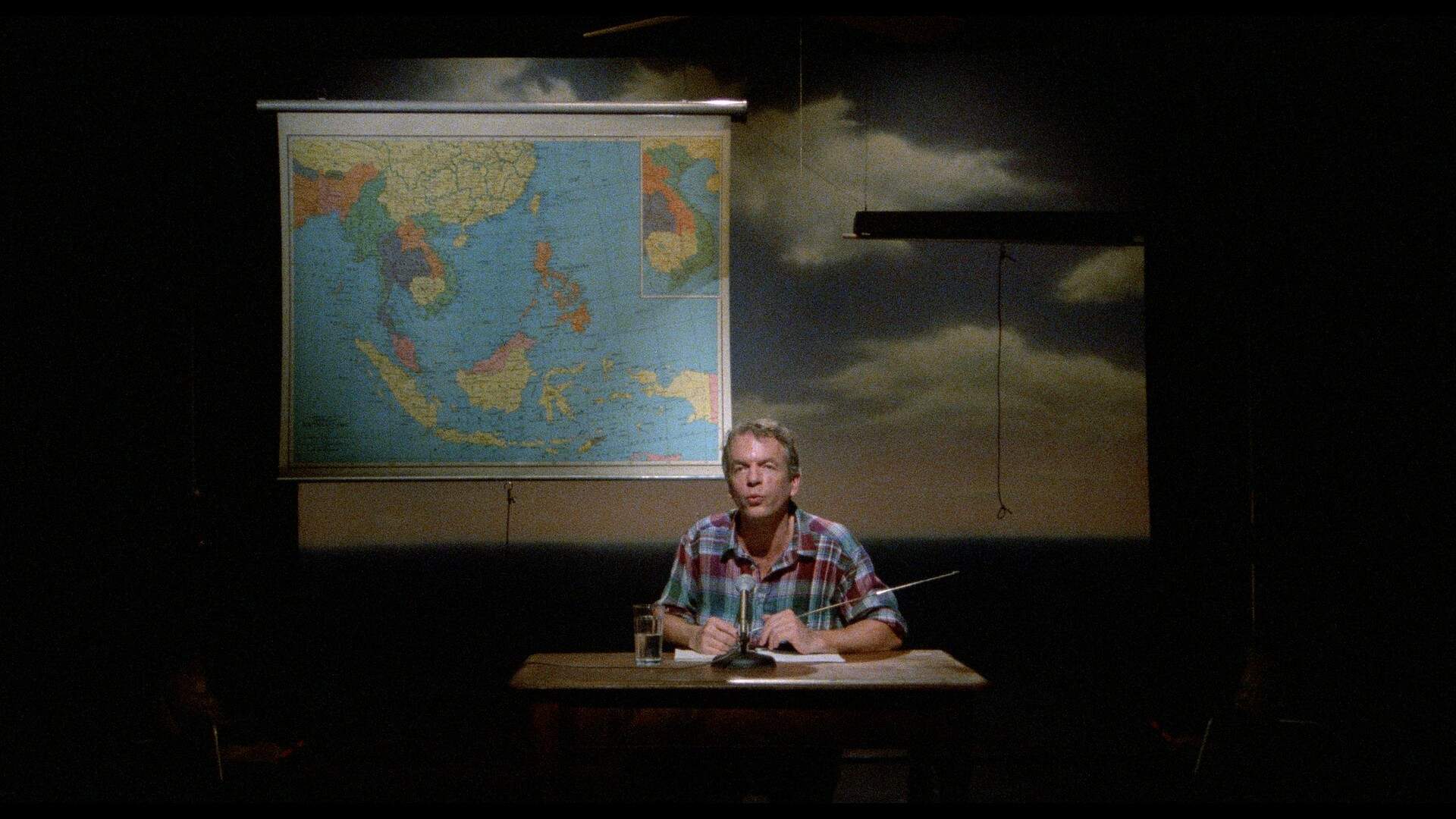
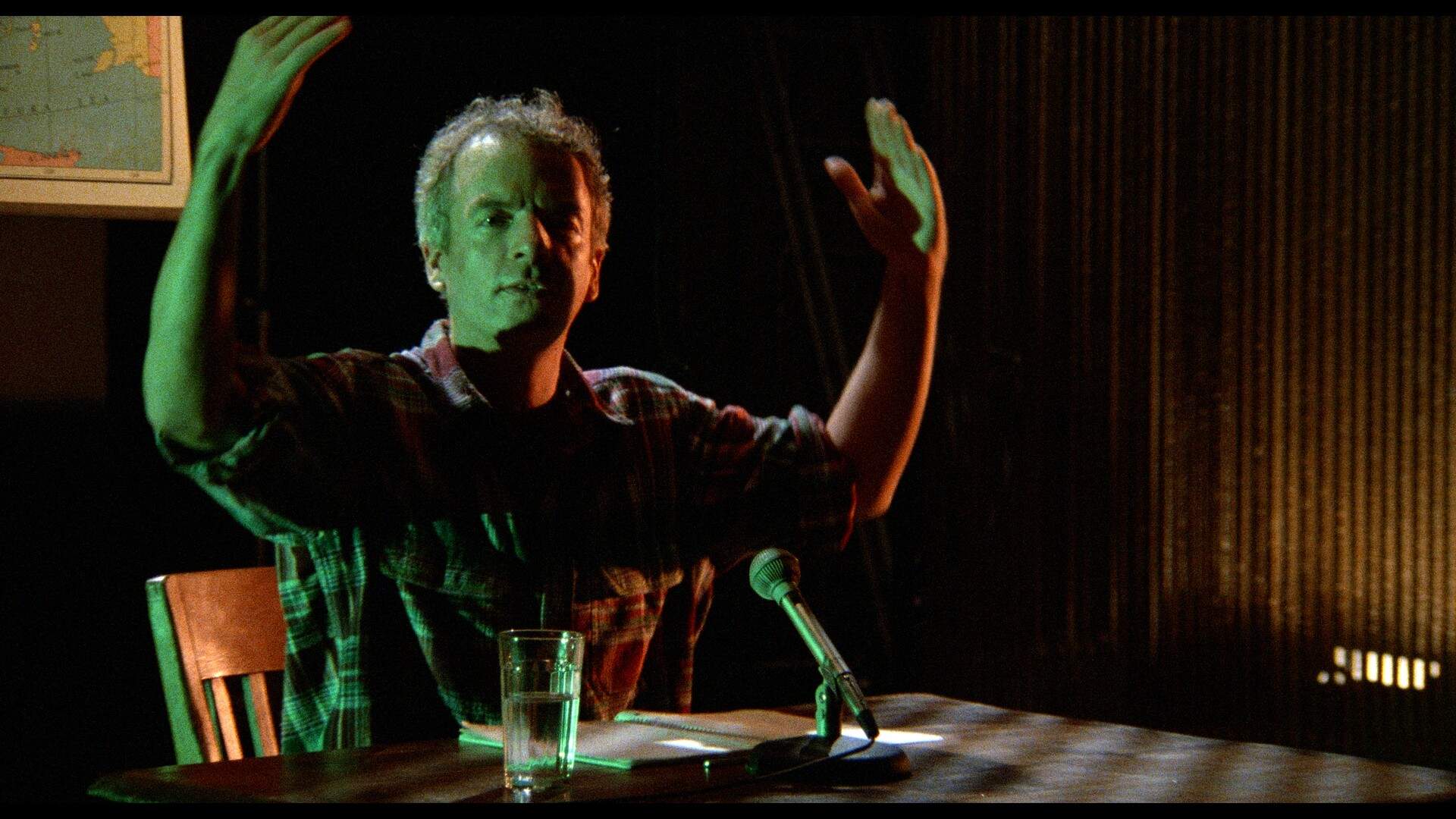
I first saw Demme’s film of “Swimming to Cambodia” sometime in the early 1990s, thanks to a late night PBS broadcast. Watching it on the little black-and-white TV in my childhood bedroom after my parents thought I had gone to sleep, I found myself riveted and up buzzing half the night after it was over. This was unexpected, as I’d initially tuned in because it sounded like something that would be pleasant to doze off to. The whole movie is a man sitting at a small wooden table with a spiral notebook and a glass of water, talking fast and telling stories about his experiences as a bit player in Roland Joffe’s 1984 film “The Killing Fields.”
But there’s no nodding off once Spalding Gray starts speaking. Riffing with a feverish intensity, interrupting himself with wry, conversational asides and precisely timed manic outbursts, Gray’s incantatory repetitions of key phrases and callbacks are almost musical in their syncopations. His descriptions are so vivid, you might later find yourself remembering things he recounts in the film as if you saw them with your own eyes. It’s the “My Dinner with Andre” theater of the mind effect, or that old Alistair Cooke line about preferring radio over television because the pictures are better.
Gray comes off as an endearing basket case, so neurotic he frequently whips himself into a tizzy and, at one point in the movie, can’t allow himself to leave his SoHo loft apartment without turning the radio off on a positive word. (As an NPR listener, he jokes that sometimes he’d be waiting for one all morning.) He was a veteran of the downtown New York experimental theatre scene and one of the co-founders of The Wooster Group alongside Willem Dafoe. Gray made a name for himself in the early 1980s with acutely detailed, amusingly self-deprecating one-man shows like “Terrors of Pleasure,” about the traumas of renovating a vacation house, and “Sex and Death to the Age 14,” which is about exactly what it says it is.
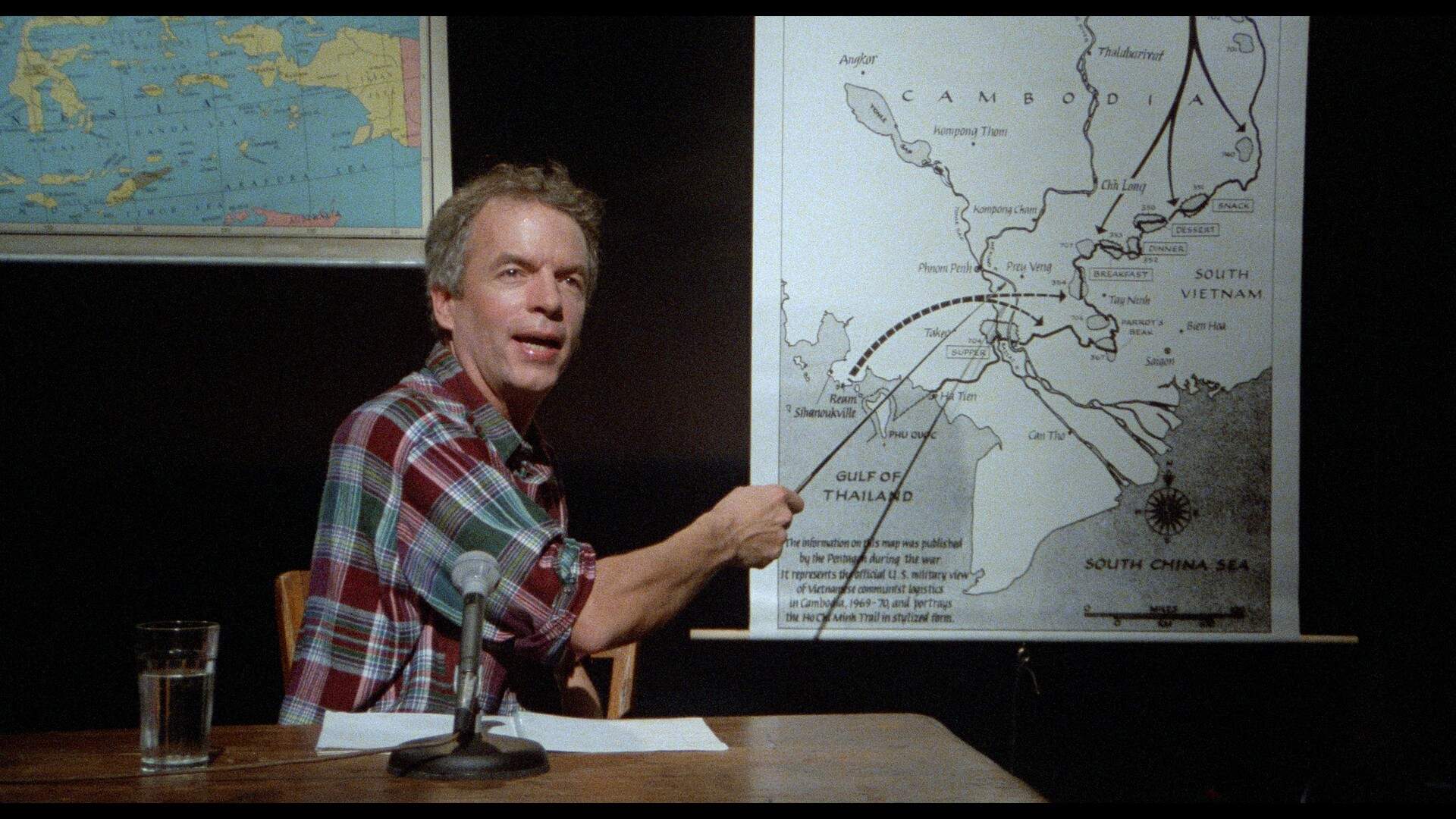
Turning navel gazing into performance art, Gray obsessively recounted the minutiae of his life as a way of imposing order on an existence he found overwhelmingly chaotic. Telling stories is how we explain our lives to ourselves, but “Swimming to Cambodia” is about what happens when a seasoned storyteller comes up against the unexplainable. “The Killing Fields” chronicles the harrowing true story of New York Times reporters Sydney Schanberg and Dith Pran, who investigated the U.S. illegal bombings of Cambodia during the Vietnam War, after which the country fell to the Khmer Rouge militia and a genocide that killed more than two million people in some of the most savage and barbaric ways imaginable. As Gray despairs in his monologue, “Who needs metaphors and poetry for hell? This is here. It happened.”
“Swimming to Cambodia” traces the actor’s awakening amid the surreal absurdity of a big-budget movie shoot, full of goofy party stories and sidelines to Bangkok brothels. It’s a solipsist’s journey to understanding the unfathomable. So much of Gray’s comedy comes from fancying himself a freewheeling philosopher-poet, while his attempts at being a libertine are inevitably sabotaged by his neurotic hangups and WASP-y New England repression. (The Barrington, Rhode Island native’s Brahmin accent is so thick it took me years to realize his frequent references to a Los Angeles arts venue called the "Machtay Perform” were actually the Mark Taper Forum.) His is the plight of a day player realizing how small his part is in the larger story, an actor unable to remember his lines in the shadow of a tragedy beyond words.
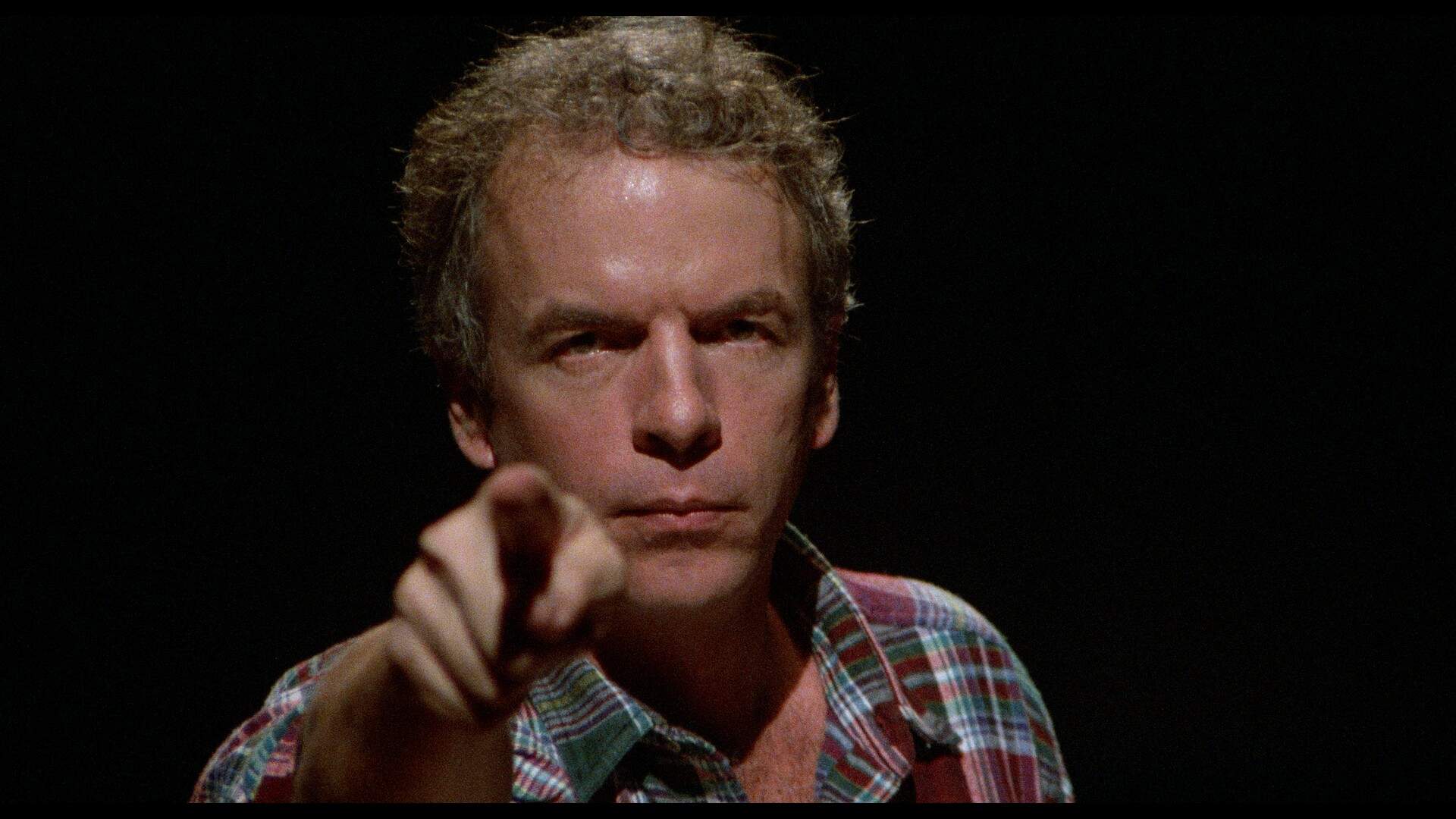
Paring the four-hour, two-evening, one-man show down to a brisk 87 minutes, Demme shoots Gray the same way he filmed the Talking Heads in “Stop Making Sense.” He keeps the cameras confined to the stage and riding the rhythms of the performance, punctuated by dramatic though not overbearing lighting flourishes from the legendary cinematographer John Bailey, while Laurie Anderson’s music bleats and burbles in time with Gray’s patter. Most importantly, Demme leaves out the crowd shots other concert films rely upon to tell us how to react. By excluding the audience, “Swimming to Cambodia” doesn’t feel like merely a record of a theatrical performance. It stays in the present tense — something happening in front of us right now, instead of something other people saw back then. It’s notable how in his later Hollywood films like “The Silence of the Lambs” and “Philadelphia,” Demme’s signature shot became characters looking and speaking directly into the camera lens. Here’s an entire movie of Spalding Gray doing just that.
I was lucky enough to see Gray perform four times, and once embarrassed myself by annoying him on the street for an autograph when I was stumbling home from a Greenwich Village bar and he was trying to catch a cab after the premiere of a Wim Wenders movie at Webster Hall. A considerably prouder occasion was the day I completed the last of my college classes and treated myself to a ticket to see Gray rehearsing that night at New York’s fabled P.S. 122, an abandoned public school building turned performance space where he’d sometimes test out new material in front of a crowd. The monologue “Morning, Noon and Night” would turn out to be his last, a heartfelt account of the late-life domestic bliss Gray discovered after having children and moving to the Sag Harbor suburbs in his mid-50s. He even stepped out from behind that trademark wooden table and danced a little bit at the end.
The last time I saw him was during a return to Cambridge in January 2002, performing not at the Brattle this time, but at Harvard’s Sanders Theatre. He had taken “Swimming to Cambodia” back out on the road as a response to 9/11, tweaking a few lines here and there to try and meet a horrible historical moment none of us had quite figured out how to process yet during that numbed, grief-stricken winter. Gray seemed miserable. He was walking with crutches and visibly in pain throughout the show. Celebrating his 60th birthday in Ireland the previous summer, a gruesome car accident had fractured his skull and hip, leaving him with a torn sciatic nerve and titanium plates in his head. His friend Oliver Sacks would later write devastatingly about the brain damage and depression the performer suffered as a result of his injuries. After several suicide attempts, Spalding Gray went missing in January 2004. His body was found two months later in the East River.
I couldn’t bring myself to revisit his work for years after that. It was too sad. His sometime collaborator Steven Soderbergh’s 2010 “And Everything is Going Fine” is a brilliantly edited collage film distilling countless hours of Gray’s monologues and television interviews into a stream-of-consciousness semi-autobiography. It’s a worthy tribute in which the subject gets to do all the talking, because nobody talked better than Spalding Gray. In recent years, I’ve started watching my old “Swimming to Cambodia” disc again. Whenever current events get too insane and overwhelming, I take solace in the film and Gray’s quixotic search for beauty and the sublime in a world where unspeakable horrors and atrocities happen every day. As you might imagine, it’s been in pretty heavy rotation lately.
“Swimming to Cambodia” screens at the Brattle Theatre on Sunday, Aug. 16, and is available on Blu-ray from Cinématographe.